


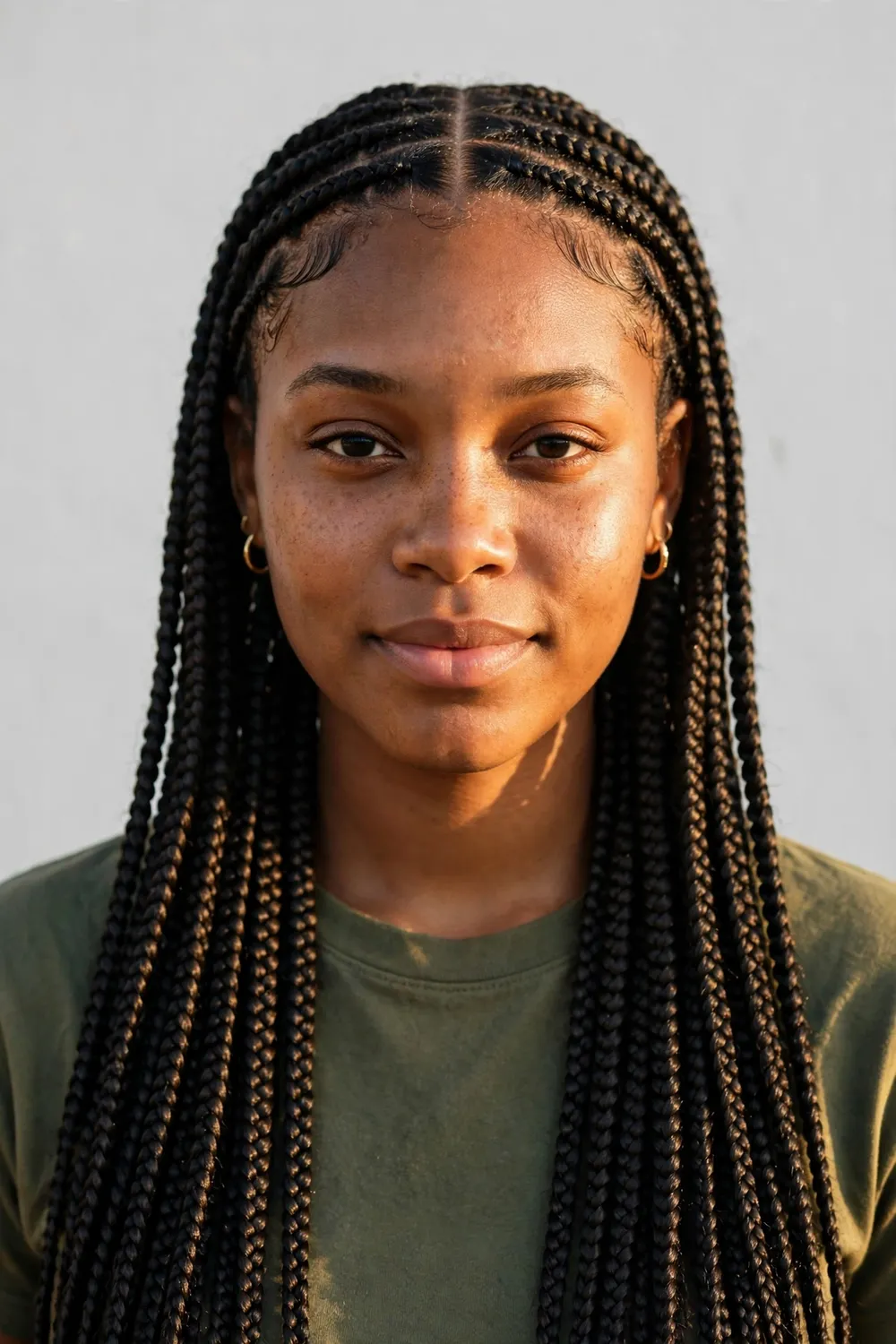
Box braids are the protective style that does the most with the least fuss — neat square sections, three-strand plaits, and weeks of wear with almost no daily styling. If you want one answer before you scroll: Classic Medium Box Braids for the safest all-rounder, Knotless Medium Braids for gentler roots and a flatter fall, and a Chin-Length Braided Bob if you want the whole look in a short, light package.
What Are Box Braids?
Box braids get their name from the square-shaped sections the hair is parted into before each three-strand plait is braided down its length, usually with extensions added for length and fullness — though your own hair can be braided alone if it’s long enough. The style goes back centuries in African braiding traditions, and it has stayed popular because it genuinely protects the ends of your hair while letting you skip the daily heat and styling. The key point, and one worth repeating: box braids are protective only when they aren’t installed too tight. Pain, bumps or pulling at the hairline is a sign to loosen up, not something to “get used to”. Read the short history and the technique behind them on Wikipedia’s box braids page if you want the background, and if you’re still weighing up the wider world of plaits, our braided hairstyles guide covers the styles that sit alongside box braids.
How to Pick Your Box Braids
Three choices decide how your braids will look and feel: the size of each part, the length, and how they’re finished at the root. Small parts give you movement and styling options but take hours longer and weigh more; jumbo parts go in fast and feel light but offer fewer ways to wear them up. Length is the same trade-off — waist-length braids photograph beautifully and pull on the scalp more, while a bob or collarbone length is the easiest to live with day to day. Fine hair suits medium parts with knotless roots best, because the weight is spread out and there is no hard knot sitting on the scalp; thick hair can carry almost any size, though very small braids on very thick hair get heavy fast.
| Size | Length | Who it suits best |
|---|---|---|
| Small | Shoulder to waist | Thick hair, or anyone who wants lots of styling options |
| Medium | Collarbone to mid-back | Almost everyone — the safest first choice, including fine hair |
| Jumbo | Shoulder to waist | Anyone short on time who wants a bold, statement look |
| Bob / short | Chin to collarbone | Fine hair, first-timers, hot weather, low-maintenance wearers |
What to tell your braider: say the part size (“medium, about the width of my little finger”), the exact length (“ending at my collarbone”), whether you want knotless or knotted roots, and how much tension you can take — “no pain at the hairline, please” is a perfectly good instruction. Bring a photo, mention your hair type and any past scalp sensitivity, and agree the price before they start. A good braider will also ask about colour and whether you want beads or cuffs, so decide that before you sit down rather than mid-install.
The 46 Best Box Braids Hairstyles
1. Classic Medium Box Braids

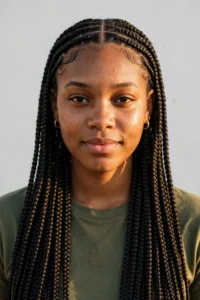
This is the version everyone pictures when they hear “box braids”: neat square parts, medium sections, braids falling to the collarbone or just past it, with clean blunt ends. It suits nearly every face shape and hair type, which is exactly why braiders recommend it to first-timers — nothing about it is a gamble. Ask for medium parts, roughly finger-width, with a centre or side part to suit your face, and braids ending at the collarbone for the lightest wear. A little edge control finishes the hairline. Tie them back at night in a satin scarf, oil the scalp twice a week, and wash with diluted shampoo when itchy. Expect four to six weeks of wear before new growth starts to look messy.
2. Knotless Medium Braids
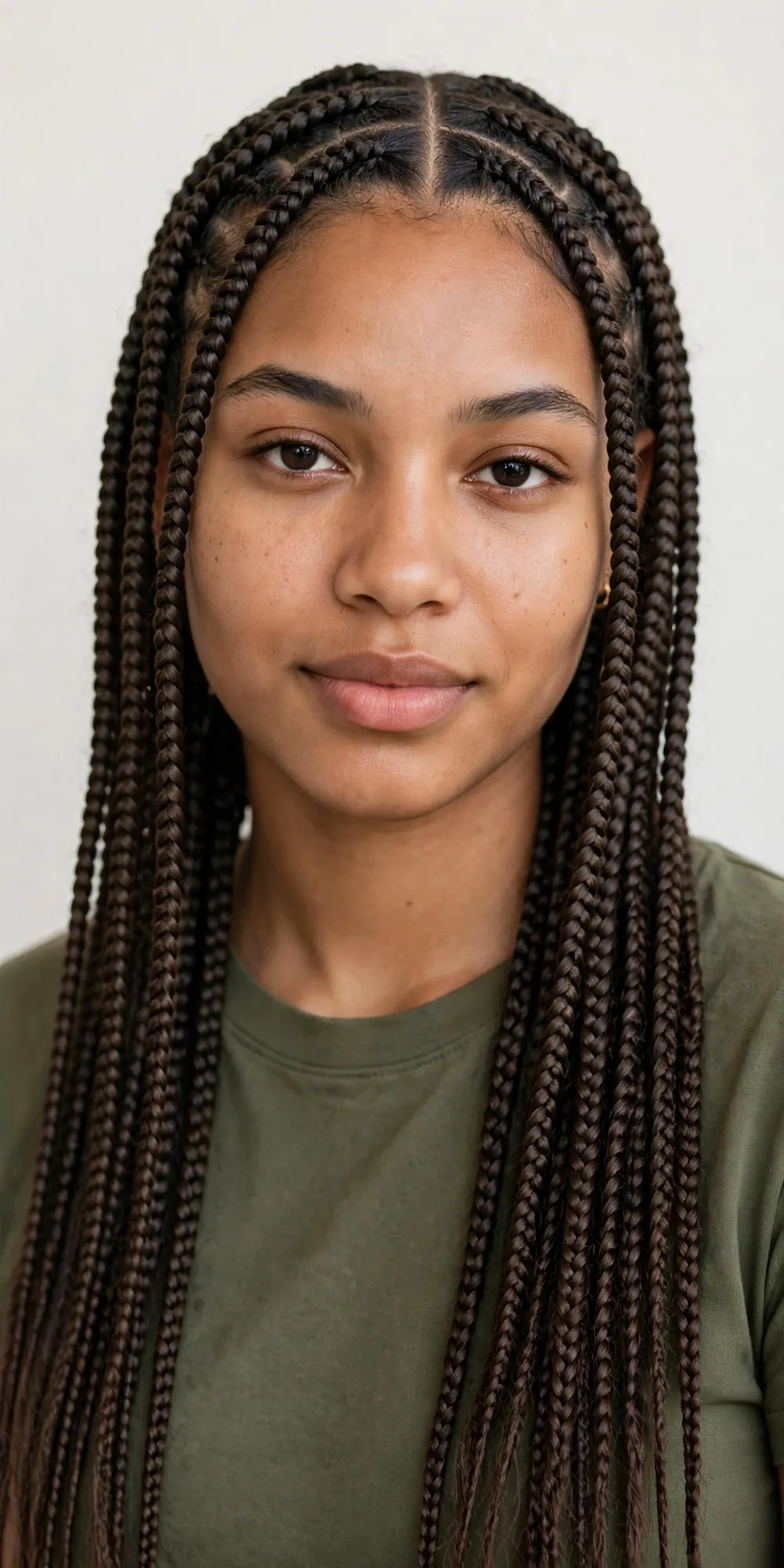
Knotless braids start with your own hair and feed the extensions in gradually, so there’s no knot sitting at the root — and that’s the whole point. The result lies flatter and pulls far less, which makes it the better pick if you’ve ever had a sore scalp after braiding. It suits fine hair especially well, and it works for anyone who wants to pull their braids up without the roots looking bulky. Ask your braider for a knotless feed-in with medium parts and a length that sits around the shoulder blades. Keep a scalp oil handy, since knotless roots show dryness fast. A satin bonnet at night, a wash every ten days or so, and you’ll get a clean five to six weeks out of them.
3. Collarbone-Length Braids

Braids that stop right at the collarbone hit a sweet spot most people don’t think about until they’ve worn waist-length ones: they’re long enough to tie up, short enough to forget about. The weight is noticeably less than longer styles, so your neck and scalp get a break, and they dry faster after washing. They suit anyone with fine hair or a smaller frame, and they’re a smart first set if you’re nervous about how braids will feel. Tell your braider medium parts and a firm “cut them off at the collarbone” — braiders default to longer unless you say otherwise. Upkeep is minimal: scarf at night, oil the scalp twice a week, and a gentle wash when needed. You’ll get a tidy four to five weeks before regrowth shows.
4. Chin-Length Braided Bob
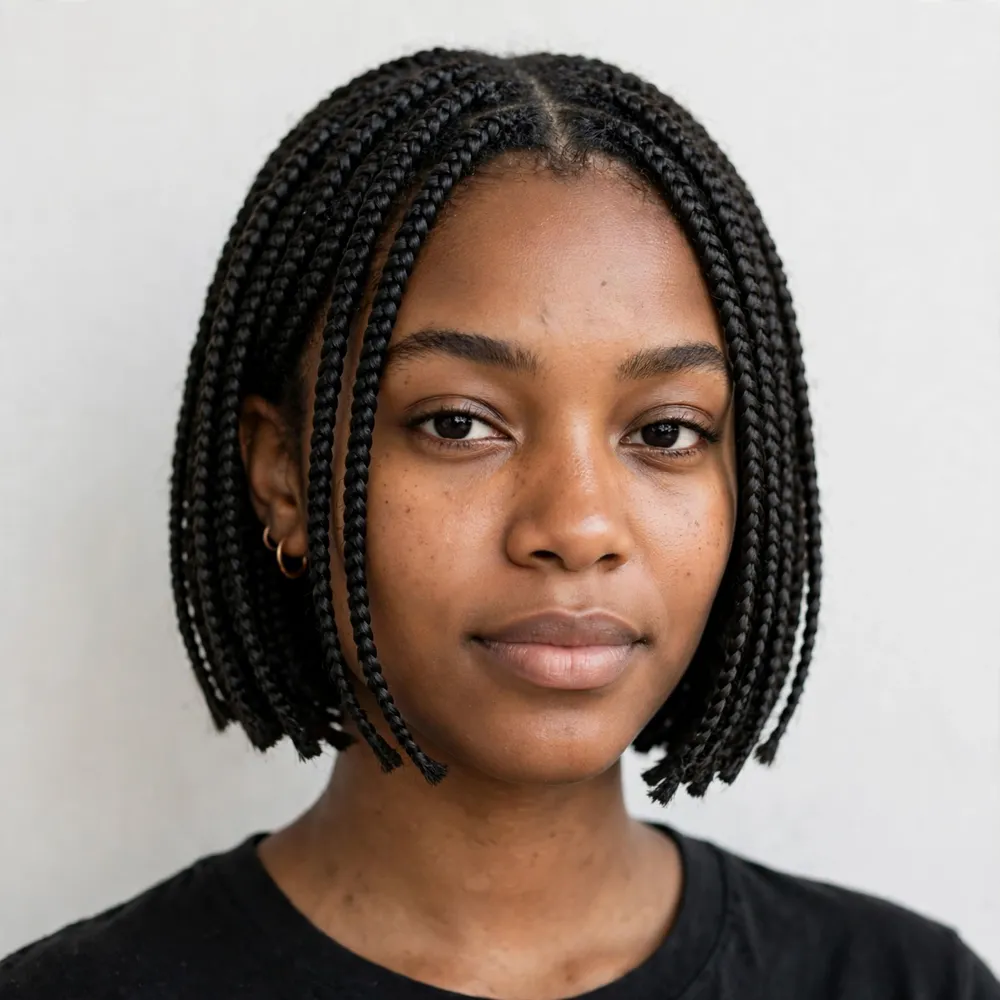
A braided bob takes everything good about box braids and shrinks it into the lightest, coolest package — compact sections, blunt ends that skim the jaw, and almost no weight to speak of. It flatters round and oval faces in particular, because the sharp ends frame the jawline, and it’s a lifesaver in hot weather or at the gym. If you’ve never had braids before, this is the lowest-commitment way to try them. Ask for medium-small parts, a clean blunt cut at chin length, and a centre or side part depending on which side you like your hair to fall. The trade-off is that short braids show new growth sooner, so expect about three to four weeks of really crisp wear — still plenty for a style this easy.
5. Shoulder-Length Layered Braids

Layers change the whole feel of box braids. The front pieces are cut shorter so they fall around the face while the rest sits at the shoulders, giving you movement blunt-cut braids don’t have. It’s a good middle ground between a bob and waist-length. The style suits most face shapes, and the face-framing layers are especially kind to square or longer faces, softening the angles. Ask your braider for medium parts with the front layers starting at cheekbone level and the back finishing at the shoulders. A little oil on the scalp stops the parts looking dry. Nightly, a satin scarf keeps the layers from frizzing; wash every week or so with diluted shampoo and you’ll get five solid weeks.
6. Triangle-Part Braids

Triangle parts are the modern twist on the classic square grid — the sections are parted into neat triangles instead of boxes, and the pattern shows through the braids. It suits anyone who wants their braids to look a bit more considered, and it works best with medium braids, where the pattern is visible without the parts getting lost. Ask your braider specifically for triangle parting and medium sections, and mention whether you want the pattern visible all over or just at the front, since a full-head triangle grid takes longer. Maintenance is the same as standard box braids — scarf at night, oil the scalp — but the pattern does blur as new growth comes in, so the sharpest look lasts about three weeks before it softens.
7. Diamond-Part Braids

Diamond parting turns the usual grid on its side, so the sections form neat diamonds across the scalp — a small change that looks more intricate, especially in a low ponytail. It suits people who like detail and don’t mind paying for the extra parting time, and it photographs well from behind. Tell your braider you want a diamond grid with medium parts, and decide the length in advance — shoulder to mid-back keeps the pattern visible without the weight pulling it out of shape. Keep heavy gel off the parts or it can flake and spoil the clean lines. Like triangle parts, the diamond grid softens as hair grows out, so enjoy the crispest version in the first three weeks, then wear it loose.
8. Side-Part Braids

A side part is the easiest way to make box braids feel softer without changing anything else. Shifting the part off-centre lets the braids fall asymmetrically, which adds a bit of volume on one side and frames the face more gently than a dead-centre part. It suits almost everyone, and it’s particularly good if your face is very symmetrical and you want a little asymmetry to work with. Ask your braider for a soft off-centre part — not a hard deep line, just a natural shift — with medium sections and your usual length. Care is standard: satin scarf at night, scalp oil twice a week, diluted shampoo when it needs a wash. The part will stay neat for the full four to six weeks.
9. Deep Side-Swept Braids
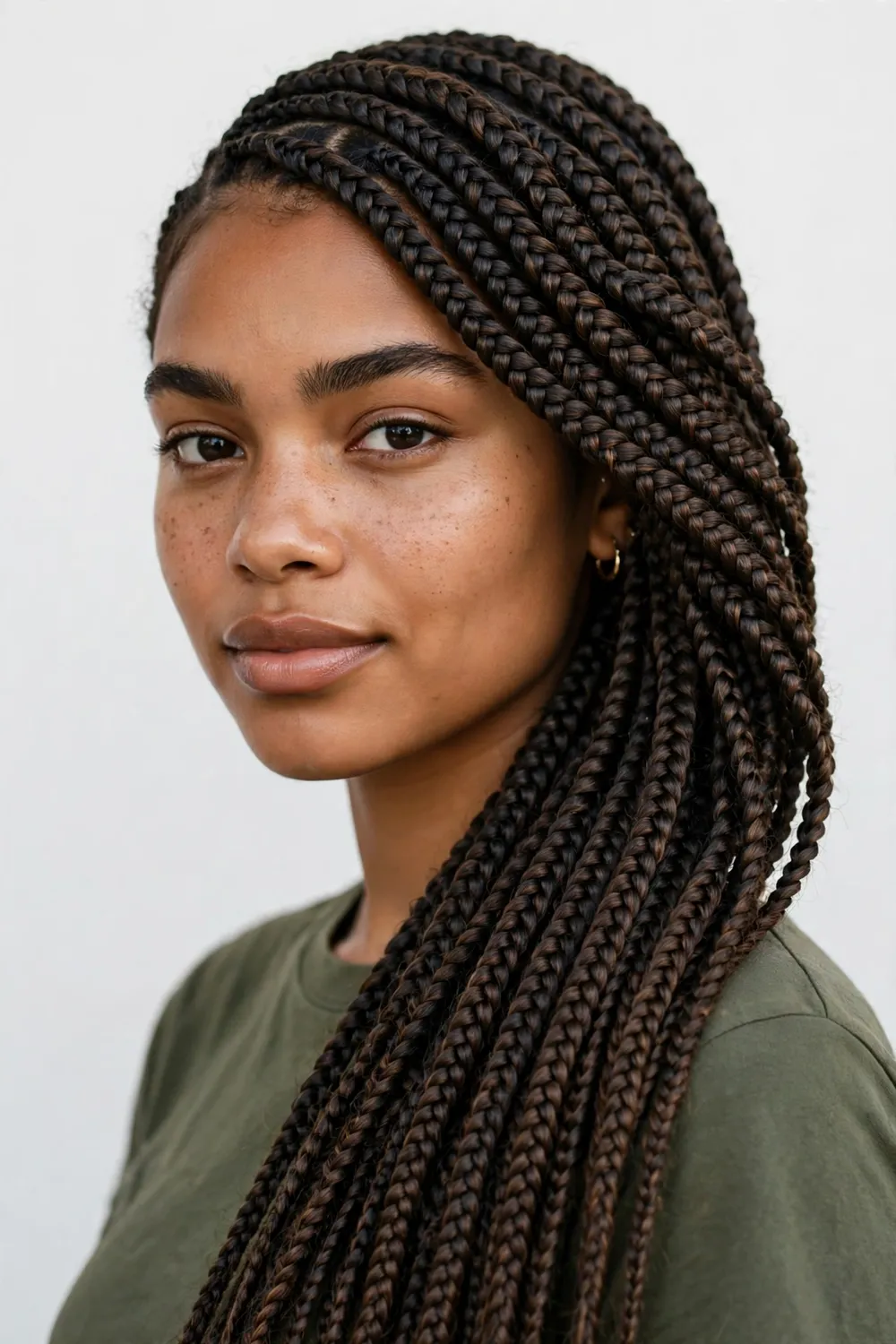
This is the dramatic version of the side part: a deep line swept low over one side, with most of the braids falling over a single shoulder. It suits special occasions and photos, and anyone who likes their hair to make a statement. Longer braids show the sweep best, so go mid-back with medium parts. Ask your braider for a deep side part and braids long enough to drape over one shoulder, keeping the roots on the heavy side comfortable. A spritz of shine spray finishes it; avoid heavy gel at the part or it will flake. Sleep with the braids in a loose satin scarf so the sweep doesn’t get flattened, and expect four to five weeks of wear.
10. Center-Part Braids
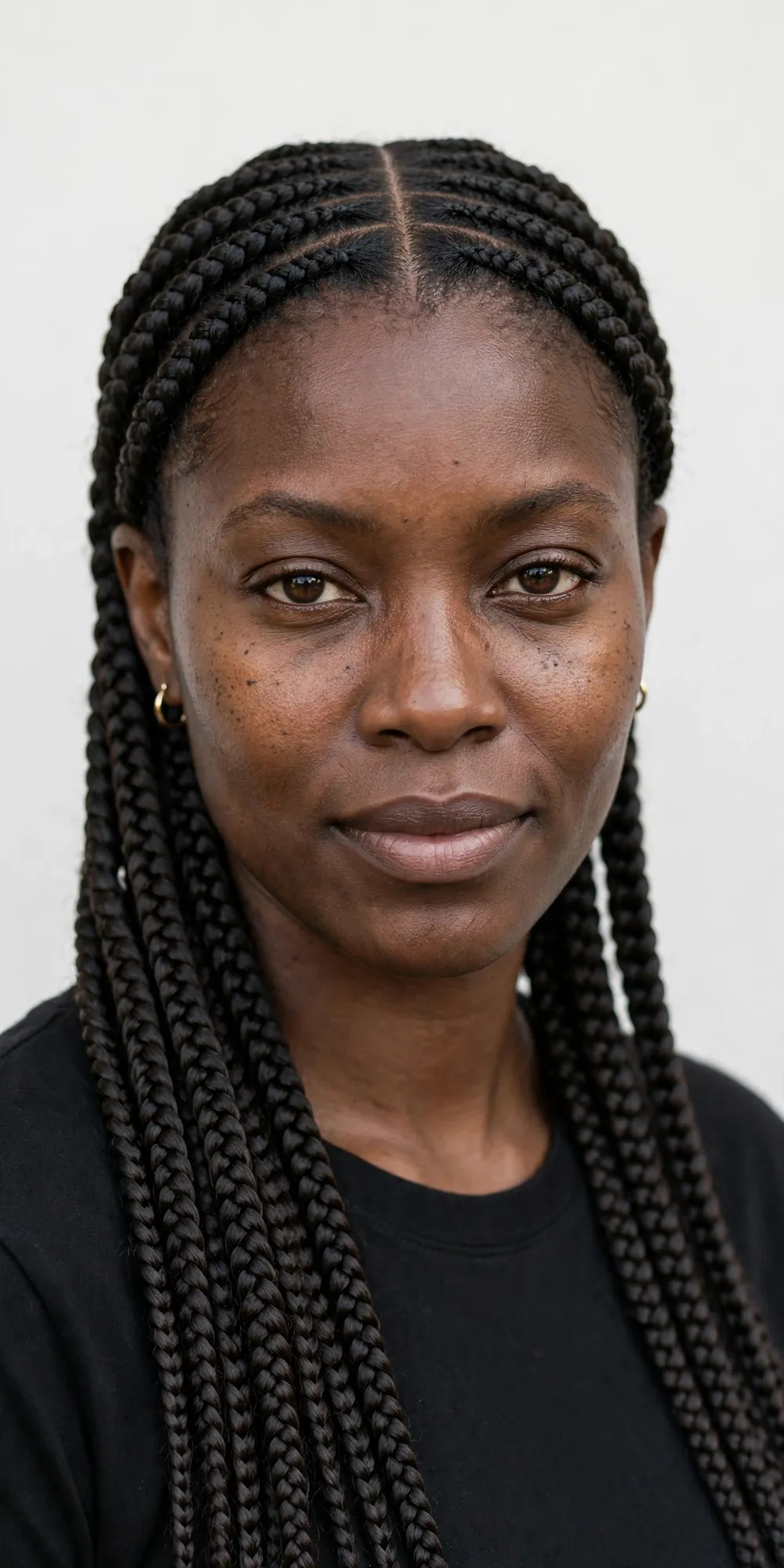
A clean centre part is the most balanced way to wear box braids — symmetrical, tidy, and flattering on oval and heart-shaped faces in particular. There’s nothing fussy about it, which is precisely the appeal: it looks polished with zero extra effort, and it works with any length from a bob to waist-length. Ask your braider for a straight, clean centre part with medium sections, and decide whether you want the braids left loose or pulled back, since the part stays visible either way. A little edge control sharpens the hairline without looking overdone. Satin bonnet at night, scalp oil, a gentle wash weekly — and a centre part hides new growth well, so you’ll get a full five to six weeks.
11. Crisscross-Part Braids

Crisscross parting adds a small woven detail right at the crown, where two sets of parts cross over each other before the braids fall away — a subtle piece of work that rewards a closer look. It suits anyone who likes their braids to have a talking point without going full statement. Tell your braider you want a crisscross detail at the crown with medium parts elsewhere, and be clear that you want it neat rather than tight — the crossed sections can pull if they’re overdone. The crisscross detail is the first thing to blur as hair grows, so the sharp version lasts about two to three weeks, though the braids themselves will carry on looking good for the usual four to six.
12. Zigzag-Part Braids

Zigzag parts are the playful option: the sections zig and zag across the scalp, giving the install personality from the start. It suits anyone who wants their braids to look fun rather than formal, and works best pulled back, where the pattern shows. Ask your braider for clean zigzag parting with medium braids, and keep the length around shoulder to mid-back so the pattern doesn’t get buried under too much hair. A light gel on the parts helps the zigzags hold their shape for the first week or two. The pattern softens with new growth like all parting details, so enjoy it sharp for the first few weeks. Otherwise, care is standard — scarf at night, oil the scalp — and you’ll get four to five weeks of wear.
13. Fulani-Inspired Braids
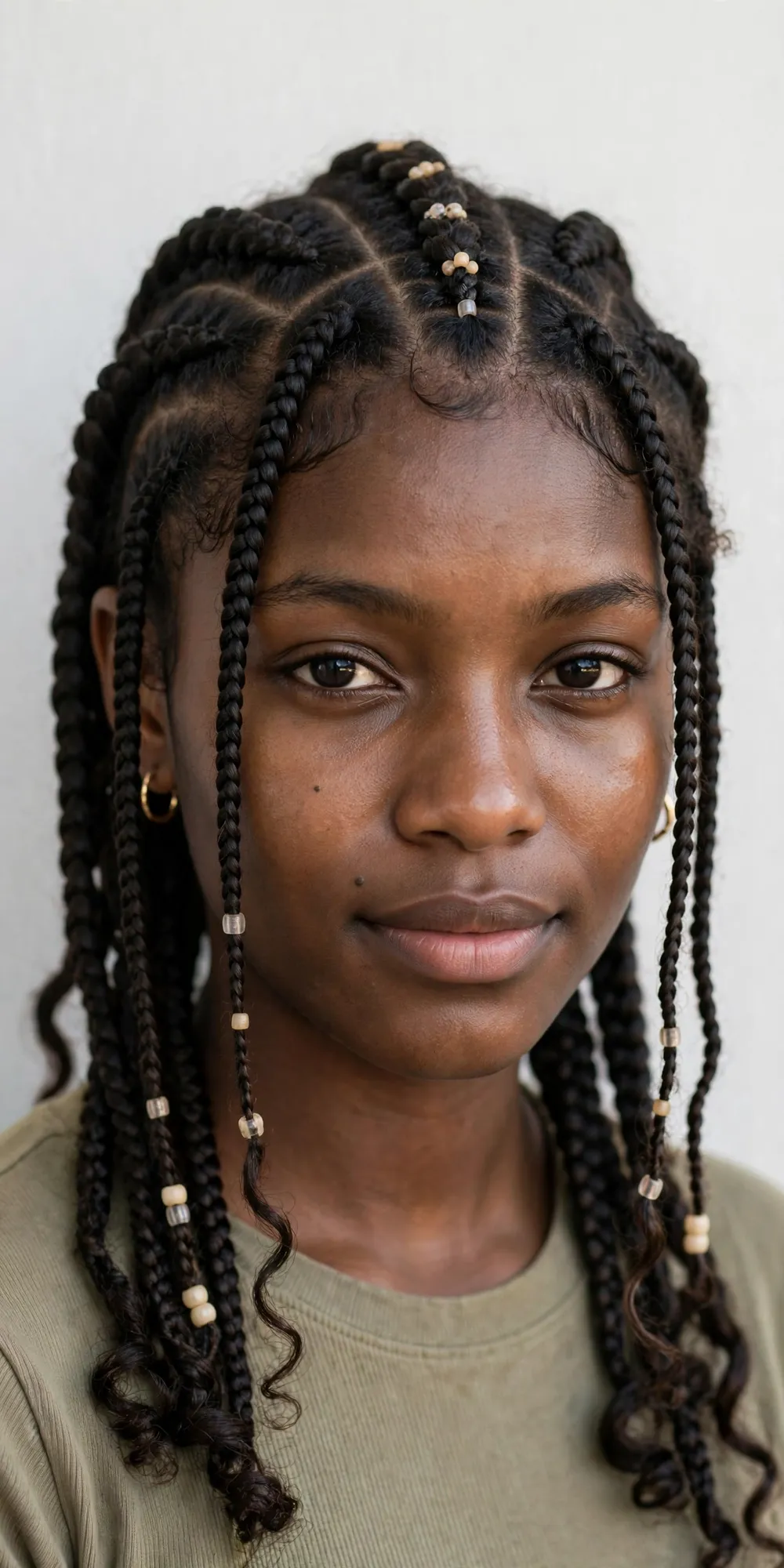
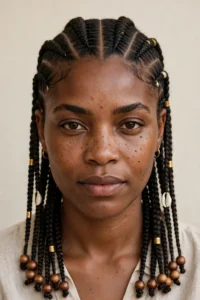
This style borrows the signature of Fulani braiding — a centre braid running front to back, with face-framing pieces and a few light beads — folded into a box-braid install. It feels more decorated than a plain set of braids, and suits anyone who loves the Fulani look but wants the fuller coverage of box braids. Ask for a centre braid with box braids on either side, a few beads on the front pieces, and medium parts so the beads don’t weigh the braids down. Keep the beads light — heavy ones pull and can break the hair. For the full traditional version, see our Fulani braids post. Check the beads every few days so none slip off, and you’ll get four to five weeks of wear.
14. Half-Up, Half-Down Braids

Half-up, half-down is less a braid style and more a way of wearing one — the top section pulled into a loose knot while the rest falls free — but it changes the look completely. It suits almost any box-braid install, and it’s the easiest way to keep braids out of your face without committing to a full updo. Mid-back braids give the knot the most presence. Don’t pull the top half too tight: gather it loosely, secure it with a snag-free band, and let a few pieces fall around the face. A little mousse on the loose braids keeps them from frizzing, and edge control tidies the hairline. At night, take the knot out and sleep in a satin scarf so the top section doesn’t kink.
15. Low Braided Ponytail

A low ponytail at the nape is the quiet workhorse of box-braid styling: it keeps every braid off your neck, takes about thirty seconds, and looks neat enough for work. It suits every length from shoulder down, and it’s especially kind to fine hair, since the weight hangs straight down instead of pulling from a high point. Gather the braids loosely at the nape and secure them with a snag-free band — never a thin elastic, which catches and snaps braids — and wrap one braid around the base to finish it. A spritz of shine spray keeps the ponytail looking fresh. Sleep with the ponytail taken out and the braids in a satin scarf, or the band will leave a dent; the braids themselves last four to six weeks.
16. High Braided Ponytail
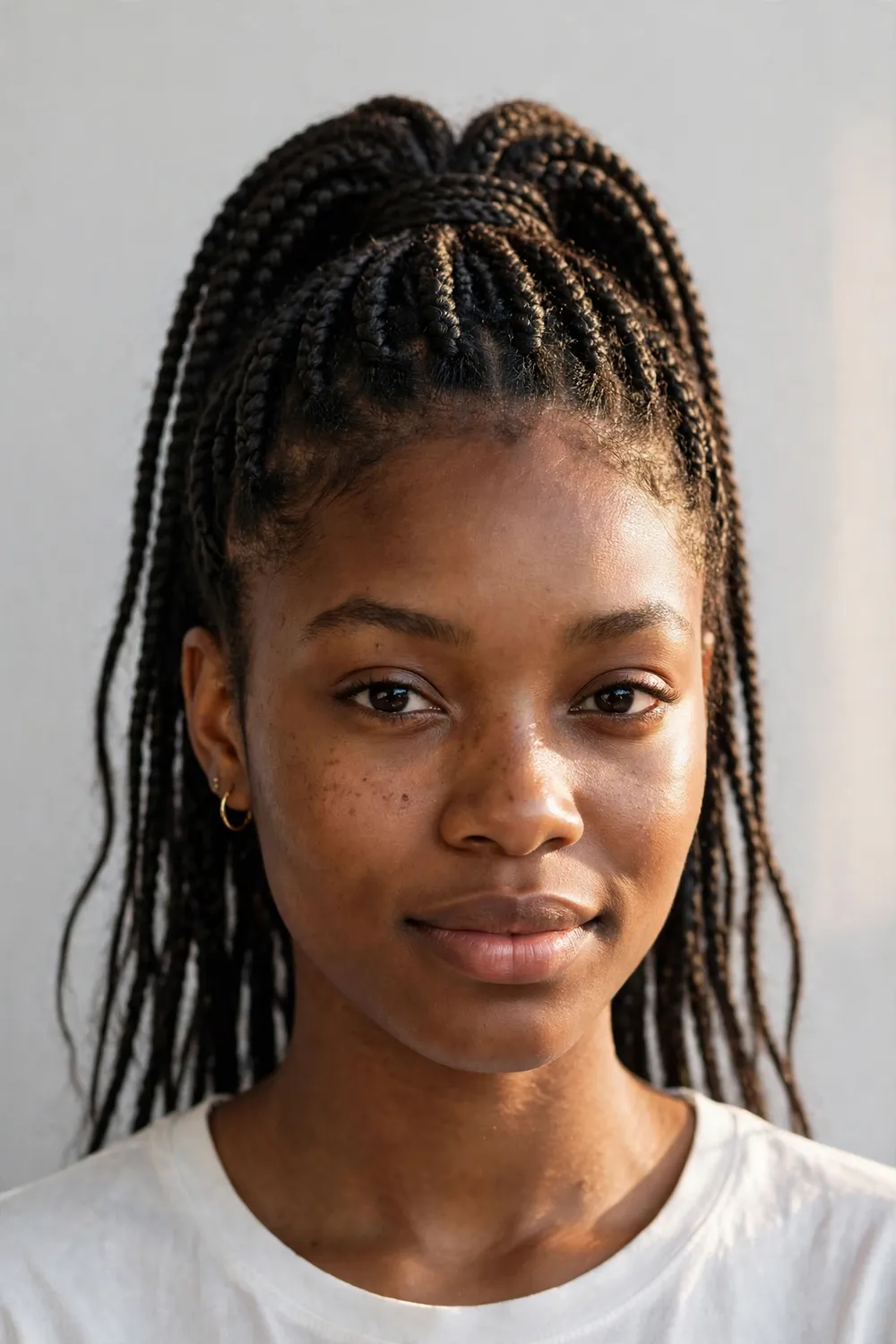
A high ponytail lifts the whole style, giving you an airy crown and a long, swinging fall of braids that keeps hair completely off the neck. It suits oval and heart-shaped faces well, and it’s a favourite for the gym or a night out — though it pulls more than a low ponytail, so skip it if your scalp is sensitive or your braids are very long. Gather the braids high on the crown, but keep it soft rather than scraped back, and secure with a snag-free band; wrapping a braid around the base hides the band. Don’t sleep in a high ponytail — take it down, use a satin scarf, and alternate with the braids worn down to rest your scalp. Expect four to six weeks of wear.
17. Low Braided Bun
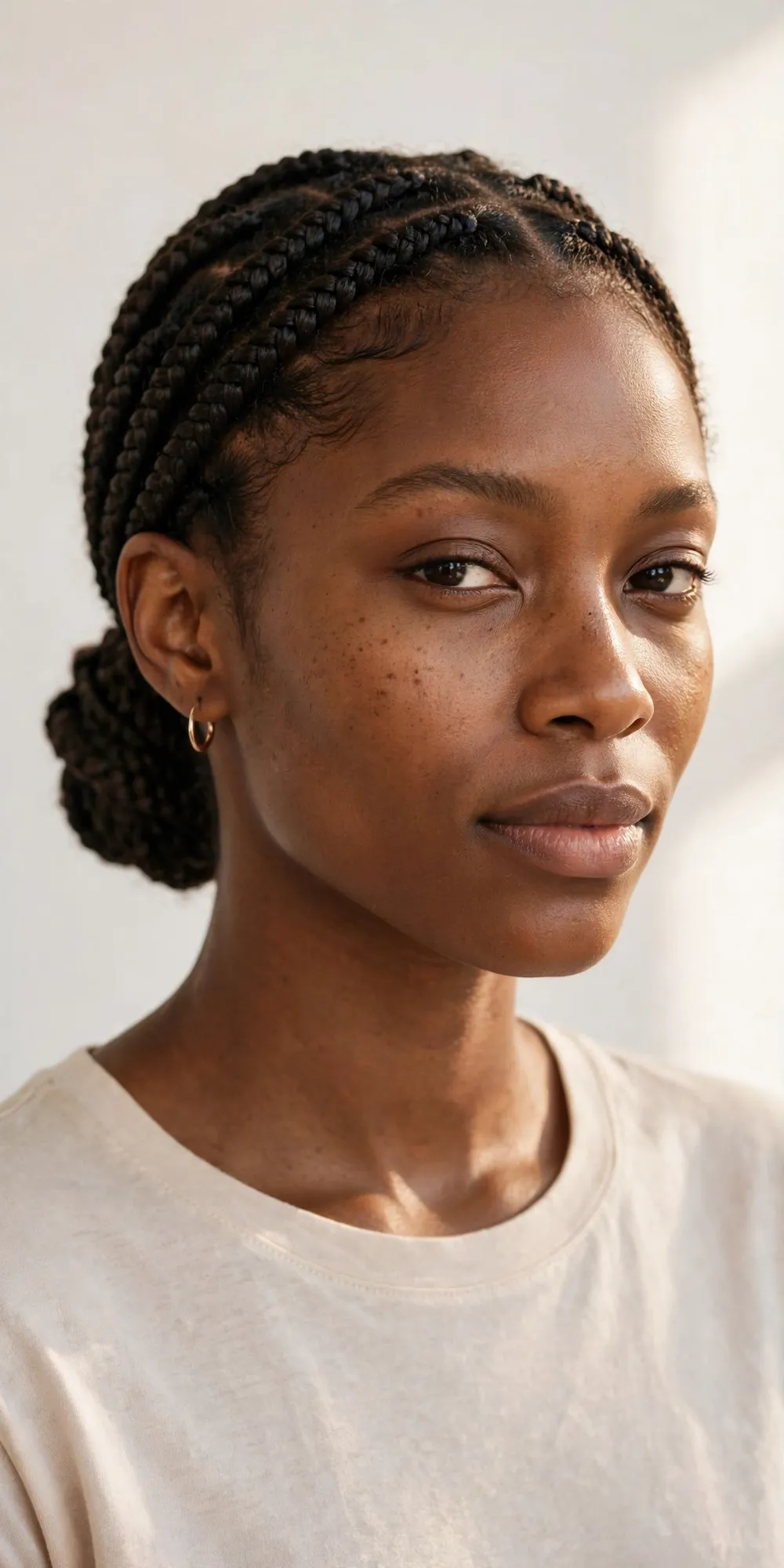
A low bun at the nape is the most understated way to wear box braids up — suitable for anything from the office to a wedding. It suits every face shape, and it’s particularly good for fine hair, since the weight sits low instead of pulling at the hairline. Coil the braids gently into a bun at the nape and pin them in place, tucking the ends in, rather than twisting hard — a tight twist is what makes a bun ache by midday. Mousse before you coil them keeps the bun smooth, and edge control finishes the hairline. At night, take the bun down and sleep in a satin scarf so the braids don’t kink. The underlying braids will give you four to six weeks of wear.
18. Space Buns with Braids

Two small buns at the crown turn box braids into something playful — a festival or weekend look that suits younger wearers and anyone who doesn’t take their hair too seriously. It works best with medium or longer braids, since you need enough length to coil each bun, and it flatters round and oval faces. Split the braids into two even sections, coil each one loosely into a bun, and pin them in place — keep them soft, or they’ll pull at the parting. A little mousse keeps the buns neat and the loose braids underneath smooth. Take the buns out before bed and sleep in a satin scarf, or you’ll wake up with dents. The braids themselves last the usual four to six weeks.
19. Side Bun Box Braids

A low side bun is the softer cousin of the centred bun — braids swept to one side and coiled low, with a few face pieces left out, so the whole thing looks relaxed rather than severe. It suits occasions where you want an updo without looking overdone, and flatters most face shapes, especially rounder ones. Gather the braids loosely to one side, coil them gently, and pin them in place, leaving two thin pieces out at the front. A touch of mousse keeps the bun smooth, and edge control tidies the hairline. Don’t pull it tight — the uneven weight is what makes it ache. Take it down at night and sleep in a satin scarf. The underlying braids will last four to six weeks.
20. Boho Braids

Boho braids weave loose curls between the plaits, so instead of a neat, uniform set you get something softer and fuller. It suits anyone who finds standard box braids too severe, and the curls add volume that flatters fine hair. Ask for medium box braids with curly pieces left out or woven through, and be clear how much curl you want — a few strands reads subtle, a lot reads full boho. The curls need a little more care: a light leave-in or curl cream keeps them defined, and never brush them dry or they’ll frizz. Sleep in a satin bonnet to protect the curls overnight. For the full style, see our boho braids post. Expect four to five weeks of wear, with the curls softening over time.
21. Curled-End Braids

Curled ends give box braids a bouncy finish — the braid body stays neat, then the last few inches curl into soft, springy ends that move when you do. It’s a middle ground if you like the tidiness of box braids but want something softer than blunt ends, and it suits most face shapes. Ask your braider to curl the ends with flexi-rods or a hot-water set, and say how tight you want the curl — loose waves read relaxed, tighter curls more polished. Mousse on the ends helps the curls hold. The curls will relax over the first week or two, especially if you wash the braids, so don’t expect them to stay as tight as day one. The braids last four to six weeks.
22. Beaded Braids
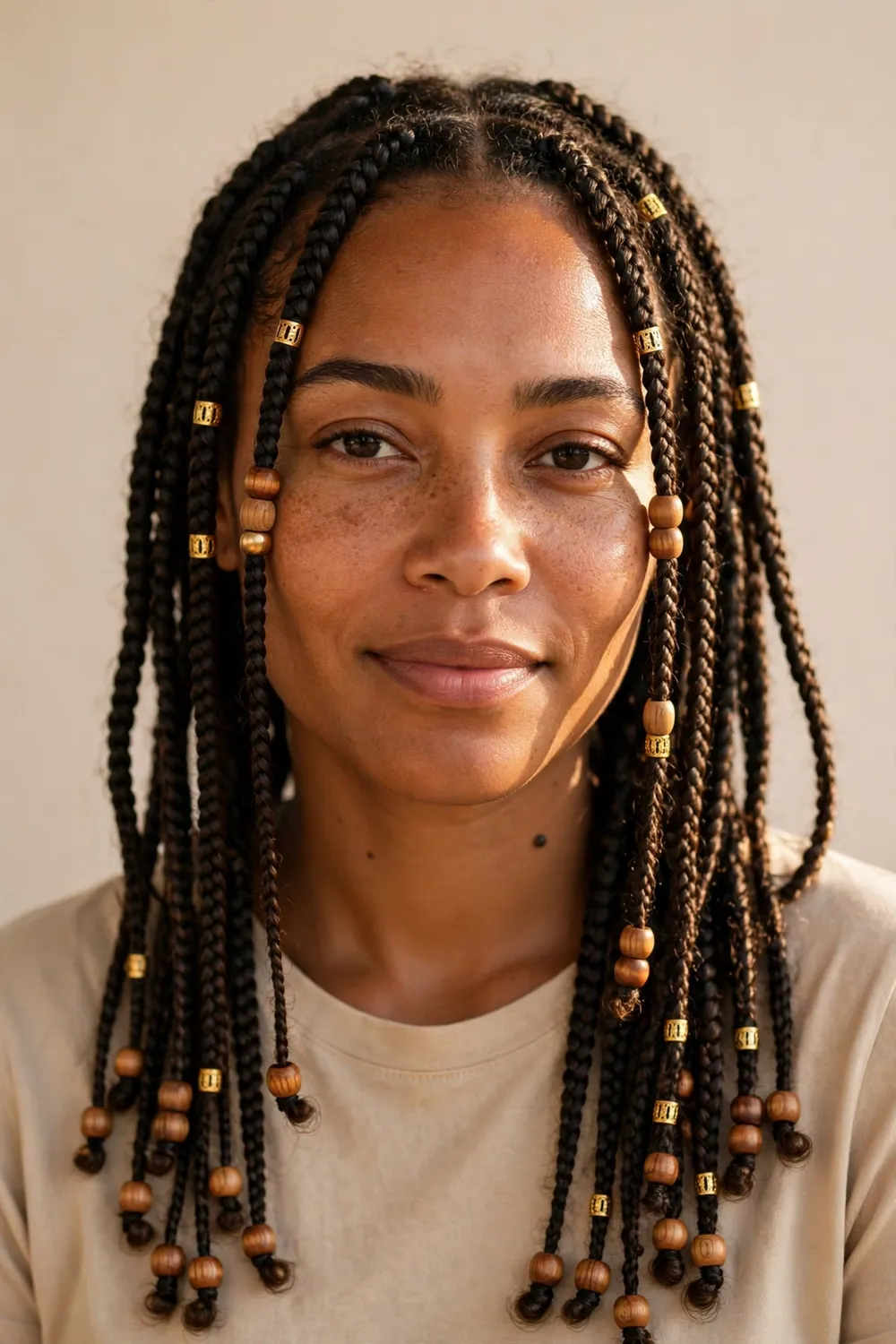
Beads are the simplest way to dress up box braids: a few wooden, metal or colourful beads threaded onto the ends and front pieces, adding movement and personality. They suit anyone, and they’re a great option for kids’ braids too, though the beads should always be light — heavy beads pull and can snap the hair. Ask your braider to add beads to a few braids at the ends and a couple of face-framing pieces, and agree the colours in advance. A small rubber band or a knot holds each bead in place; check them every few days, since beads do slip off. A little mousse keeps the rest tidy. The braids will last four to six weeks, and the beads can be moved or removed any time.
23. Gold-Cuffed Braids

Gold cuffs are the grown-up version of beads — small metal rings slipped around a few braids near the face and the ends, catching the light. They suit anyone who wants their braids to feel polished without going colourful, and they stand out best on darker braid colours. Ask your braider for a handful of light cuffs near the face and at the ends of a few braids, rather than all over — a few well-placed cuffs look elegant, a head full of them looks cluttered. Keep the cuffs light, since they can slide down the braid over time. A spritz of shine spray makes the gold pop. The cuffs are easy to remove and reuse, and the braids will last four to six weeks.
24. Ribbon-Wrapped Braids
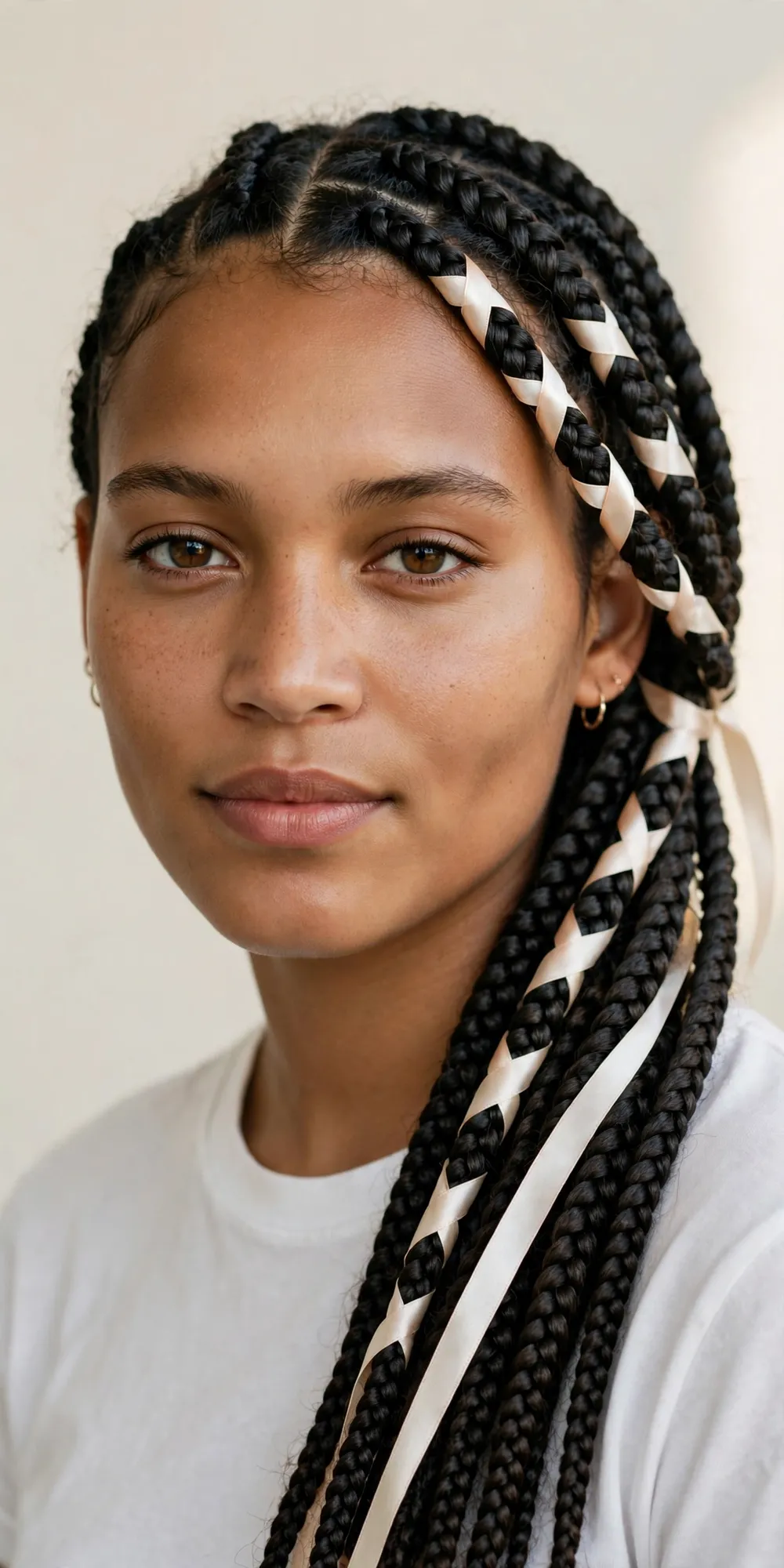
A thin satin ribbon spirals around a handful of braids — usually the ones framing the face and a few at the back — and suddenly a set of plain box braids looks finished, like someone thought about it. It suits anyone who wants a softer, slightly romantic edge without committing to colour or accessories that jingle. Ask your braider for medium braids in a size that sits comfortably, then have her wrap the ribbon loosely from just below the root to the last third of the braid, tying it off with a small knot rather than a tight bow. Grosgrain holds better than silk on braided hair, and a single colour that picks up something in your outfit works better than a busy print. Keep the ribbon on for a few days, take it off at night if it slips, and refresh it whenever it starts to fray at the ends.
25. Scarf-Tied Braids

Here the scarf is the hairstyle’s second lead. A colourful silk or satin scarf ties at the crown — or wraps around a high ponytail — and the braids fall beneath it, so you get colour and pattern without a single drop of dye. It flatters everyone, but it is a gift for long hair days when the braids are a week old and the roots need camouflaging. Ask your braider for medium-to-long braids with a clean parting, because a scarf draws the eye to the hairline. Tie the scarf over the hairline, not across the forehead, and let the tails hang loose at the back. A light mousse on the braids keeps flyaways from poking out from under the fabric. At night, swap the decorative scarf for a plain satin bonnet, and wash the scarf regularly so it does not transfer dye onto the braids.
26. Burgundy Braids

Burgundy is the colour that converts people who thought they would never dye their braids. Rich, warm, and far more forgiving than red, it deepens in low light and catches fire in sunlight — and it flatters warm and deep skin tones especially well. Ask for pre-coloured burgundy braiding hair, usually labelled #99J, rather than dyeing your own hair underneath, and have the braider mix in a few strands of a darker shade at the roots so the grow-out looks intentional. A lightweight oil sheen keeps the colour glossy without weighing the braids down. Patch-test any coloured extension hair first if your scalp is sensitive — the brief for this post insists on that, and it matters here more than anywhere. Colour lasts the full 4–6 weeks, but expect some fading if you swim often.
27. Honey-Blonde Ombré Braids

Dark roots melting into warm honey-blonde ends gives you the blonde look without the blonde upkeep, because the roots are your own colour — or close to it. It suits oval and heart-shaped faces particularly well, since the lighter ends pull the eye downward and soften a strong jaw. Ask your braider for ombré braiding hair that starts dark brown and ends in honey blonde, and request the transition to start around cheekbone level rather than at the scalp, which looks more natural. Knotless roots work beautifully here because they let the dark section lie flat. A colour-safe leave-in spray keeps the blonde from going brassy, and a purple-toning shampoo used once a fortnight on the ends only is enough. Expect the ends to dry out faster than the rest, so a little extra oil on the last few inches helps.
28. Chestnut Brown Braids

If black braids feel a touch severe on you, chestnut brown is the quiet upgrade. Warm, glossy, and close to natural tones, it softens the face and makes the parting look less stark — the kind of change people notice without being able to name it. It suits every skin tone, but it is especially kind on fair and medium complexions where jet black can wash you out. Ask your braider for chestnut or #4 braiding hair, medium parts, and a length that hits the collarbone or shoulders if you want it to feel everyday. The finish should be smooth rather than matte: a light sheen spray after install is all it needs. Maintenance is the standard box-braid routine — diluted shampoo, scalp oil, bonnet at night — and because the colour is close to your own, grow-out stays invisible for weeks.
29. Face-Framing Layered Braids

Shorter layered pieces cut — or rather, braided shorter — around the cheeks do for box braids what curtain bangs do for loose hair: they break up the rectangle of a full set and make the whole style feel intentional. Round and square faces benefit most, because the layers create vertical lines that slim the face. Ask your braider to keep the braids at the front two or three inches shorter than the rest, with the shortest pieces starting at cheekbone level and the layers stepping down gradually. This is not a style to DIY at home; the layering has to be planned at the parting stage, not chopped afterwards. A light mousse keeps the shorter pieces from sticking out at odd angles, and a satin scarf at night stops them frizzing faster than the longer braids.
30. Tapered Nape-Length Braids

The shortest set in this whole list, and one of the most practical. Nape-length braids end just at the back of the neck, with a soft taper so nothing sticks out at the hairline. It is a brilliant pick for hot weather, for the gym, or for anyone trying box braids for the first time and not ready to commit to a full head of long hair. Ask your braider for small-to-medium parts and braids that finish at the nape, with the ends sealed by dipping in hot water so they sit flat. Because there is less hair, the install is quicker — often under three hours — and the style weighs almost nothing. The trade-off is styling range: you can still tie them back with a scarf, but a high ponytail is out. Wash as normal with diluted shampoo, and they will last the usual four to six weeks.
31. Bubble Ponytail Braids

Gather the braids into a ponytail, then section the tail with small elastic bands every couple of inches, puffing each section out into a bubble. The effect is playful and a little bit dramatic — a festival look that still works for a night out. It suits long and medium braids best, because you need enough length for at least three bubbles. Ask your braider for medium braids with a clean centre or side part, and gather them high or mid-height with a snag-free band. Wrap a spare braid around the base to hide the elastic. Use small, soft elastics rather than tight rubber bands, and take them out gently to avoid snagging the braids. It is a one-day style rather than a leave-it-in look, so take the bubbles out at night, and never sleep with the elastics in — they can kink and weaken the braids.
32. Halo Crown Braids

A single braid wraps around the head like a crown, framing the face from every angle, while the rest of the braids fall loose behind. It is one of the most elegant things you can do with a set of box braids, and it suits weddings, formal occasions, or any day you want to feel a bit dressed up. Ask your braider for a few longer braids at the front that can be wrapped and pinned around the crown — or, if your set is already installed, take one braid from behind each ear and cross them over the top, pinning with bobby pins that match your hair colour. A light edge-control gel keeps the hairline tidy under the crown. Because the crown braid is pinned, not plaited in, you can take it down at night and redo it in two minutes the next morning.
33. Mixed-Length Braids
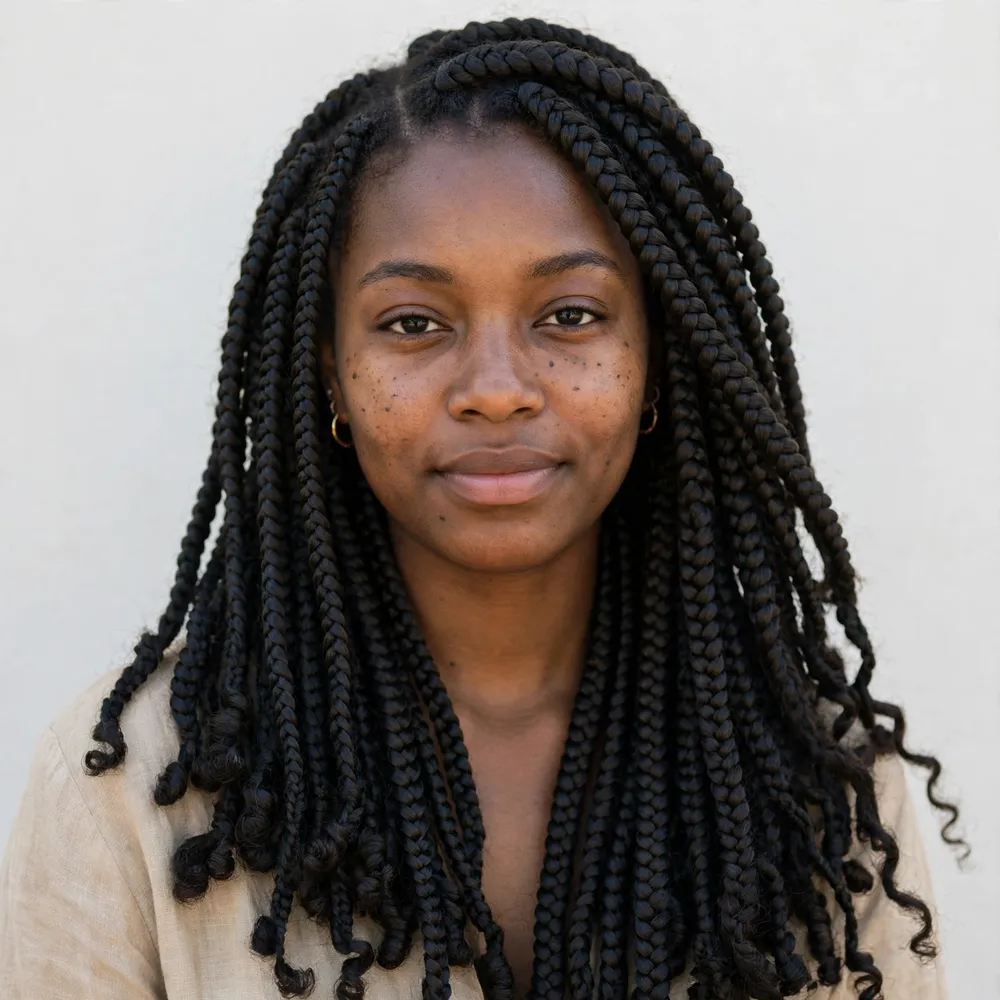
Instead of every braid ending at the same line, the lengths stagger — some at the shoulders, some at the chest, some longer — and the silhouette ends up fuller and more natural, almost like layered loose hair. It suits thick hair and anyone whose braids can look a bit flat when they all finish at one length. Ask your braider to plan the stagger at the start: the front pieces slightly shorter, the back pieces longest, with the middle lengths filling in between, so the variation looks deliberate rather than accidental. A light mousse on the ends keeps the staggered tips from frizzing at different rates. Maintenance is the same as any medium set, though you may find the shorter pieces need a touch more oil at the ends. It also grows out gracefully, since the lengths were never uniform to begin with.
34. Soft Jumbo Bob Braids
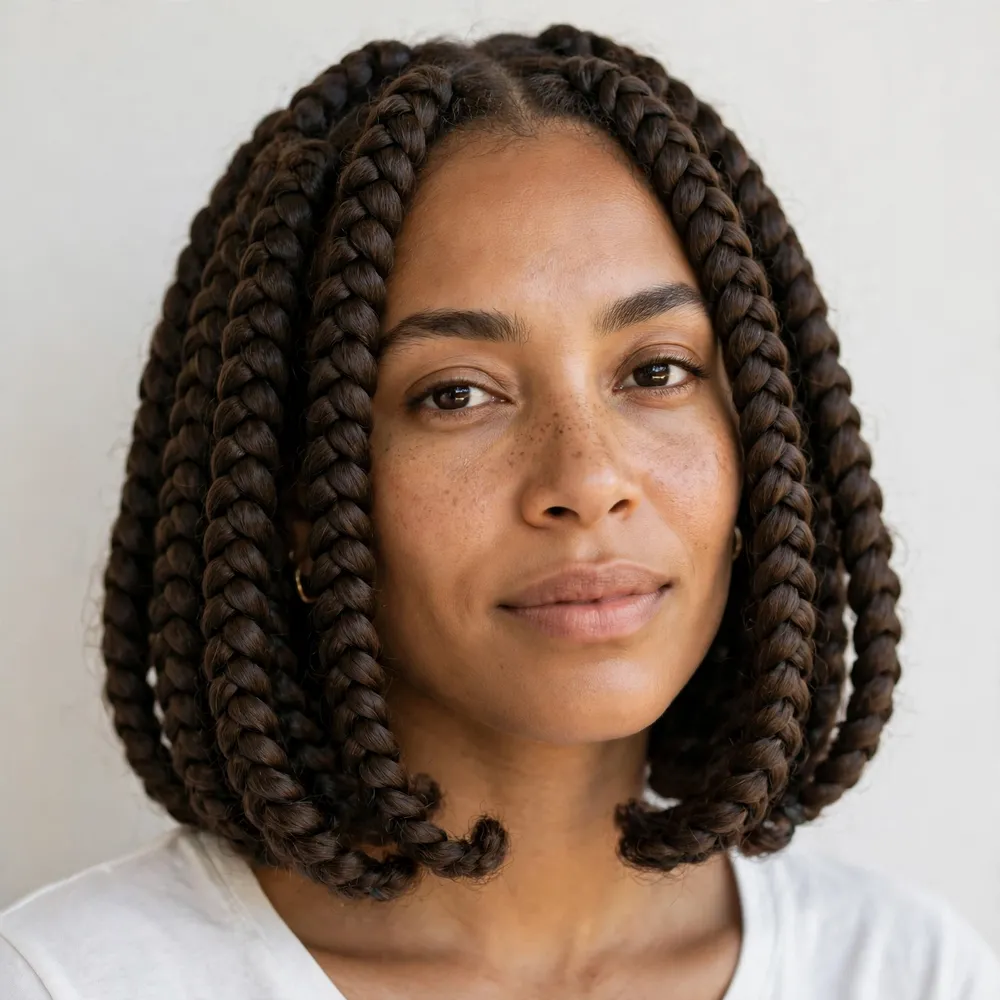
Big sections, short length — the jumbo bob takes the statement size of jumbo braids and keeps it wearable by ending at the chin or collarbone. It suits anyone who loves the look of large braids but does not want the weight of a long jumbo install, and it frames the face beautifully on round and oval shapes. Ask your braider for large parts — about an inch square — and braids that finish blunt at the jaw or collarbone, with the ends dipped in hot water so they sit straight. Because the sections are big, the install is fast, often under three hours. The honest catch: jumbo parts put more tension on each root, so the braider must keep the roots loose — braids are protective only if they are not too tight, and a heavy, tight jumbo install is one of the quickest routes to traction alopecia. Wear for four weeks at most, not six.
35. Slim Waist-Length Braids

Slim sections carried all the way to the waist — this is the showstopper of the list, and the one that demands the most patience. It suits people with strong, healthy hair and a braider they trust, because waist-length braids are heavy and the install can take eight hours or more. Ask for small-to-medium parts with knotless roots to spread the weight, and insist the braider feed in the extension hair gradually so no single braid carries too much bulk. A lightweight leave-in spray is better than heavy oils here, since product travels down long braids and builds up. Sleep with them in a loose braid or a satin bonnet, and never wear them in a tight high ponytail — the weight pulling on the roots is what causes breakage. Four weeks is a sensible limit for this length, and a professional takedown is worth the money.
36. Small Box Braids

Pencil-size braids, dozens of them, and the payoff is a fuller, more flexible head of hair that moves almost like loose hair. Small braids suit fine hair especially well — the even weight distribution means no single root carries much load, and the extra braids fill out a style that can look thin with bigger parts. That said, the install is long: expect six to eight hours in the chair, and book a braider who is comfortable with small sections, because sloppy parting shows at this size. Ask for even parts, knotless roots if your hairline is sensitive, and braids that end at the shoulders or beyond. A light mousse keeps the small braids from frizzing into each other, and a satin bonnet at night is non-negotiable — small braids tangle faster than big ones. They last the full six weeks if you keep up with wash day.
37. Jumbo Box Braids

Big, bold sections and the fastest install of any box braid size — jumbo braids can be done in two to three hours, which is why they are the first set many people ever try. They suit thick hair and anyone who wants a statement look without a whole day in the chair. Ask your braider for large square parts, roughly an inch across, and be specific about the length: shoulder-length jumbo feels light and modern, while waist-length jumbo gets heavy fast. The weight warning matters here more than anywhere in this list. Jumbo parts concentrate tension on fewer roots, so if the roots feel tight or sore, say so immediately — braids are protective only when they are not too tight, and a tight jumbo install can cause traction alopecia around the hairline. Keep them in for four weeks, wash with diluted shampoo, and enjoy the quickest protective style there is.
38. Goddess Box Braids

Goddess braids are box braids with loose curly strands left out and woven through the plaits, so the finished style has the structure of braids and the softness of curls at the same time. If you love the look of our Boho Braids post, this is the box-braid cousin — same free-spirited feel, more defined parting. It suits wavy and curly hair beautifully, and anyone who finds plain box braids a little too neat. Ask your braider to leave a few strands of curly extension hair out of each braid, concentrating the curls at the ends and around the face. A curl-defining cream on the loose strands keeps them from frizzing into a halo. The loose curls need a little more attention than the braids themselves — finger-detangle them gently when damp, and refresh them with water and leave-in between washes. Expect the curls to loosen over the weeks, which is part of the charm.
39. Box Braids with Bangs

A straight braided fringe across the forehead turns a familiar set of box braids into something that looks freshly designed. It suits oval and long faces best, since the fringe shortens the forehead, and it is a good choice if you want a change without touching the length at the back. Ask your braider to braid the front section shorter — the fringe braids should end around eyebrow level — while the rest of the set continues to your chosen length. The fringe needs to sit flat, so a little edge-control gel and a silk scarf pressed over the hairline for ten minutes after install helps it settle. Maintenance is simple, but keep the fringe braids clean: they sit against the forehead, so they pick up oil and makeup faster than the rest. Wash day with diluted shampoo, applied carefully along the hairline, keeps them fresh.
40. Box Braids with Shaved Sides

Shaved sides with braids on top is the edgiest style on this list — a sharp contrast between the clean, close-cut sides and the texture of the braids. It suits confident dressers and anyone with strong bone structure, and it is a genuine time-saver, since there is simply less hair to braid. Ask your barber for a fade or a clean shave on the sides first, then have the braider work the top section into medium box braids, usually worn swept to one side or pulled back. The shaved sides need upkeep — a tidy-up every week or two keeps the line sharp — while the braids themselves follow the usual routine. One practical note: sunscreen on the shaved area matters if you spend time outdoors, and the contrast means regrowth shows quickly, so this is a style for people happy with regular barber visits.
41. Box Braids for Kids
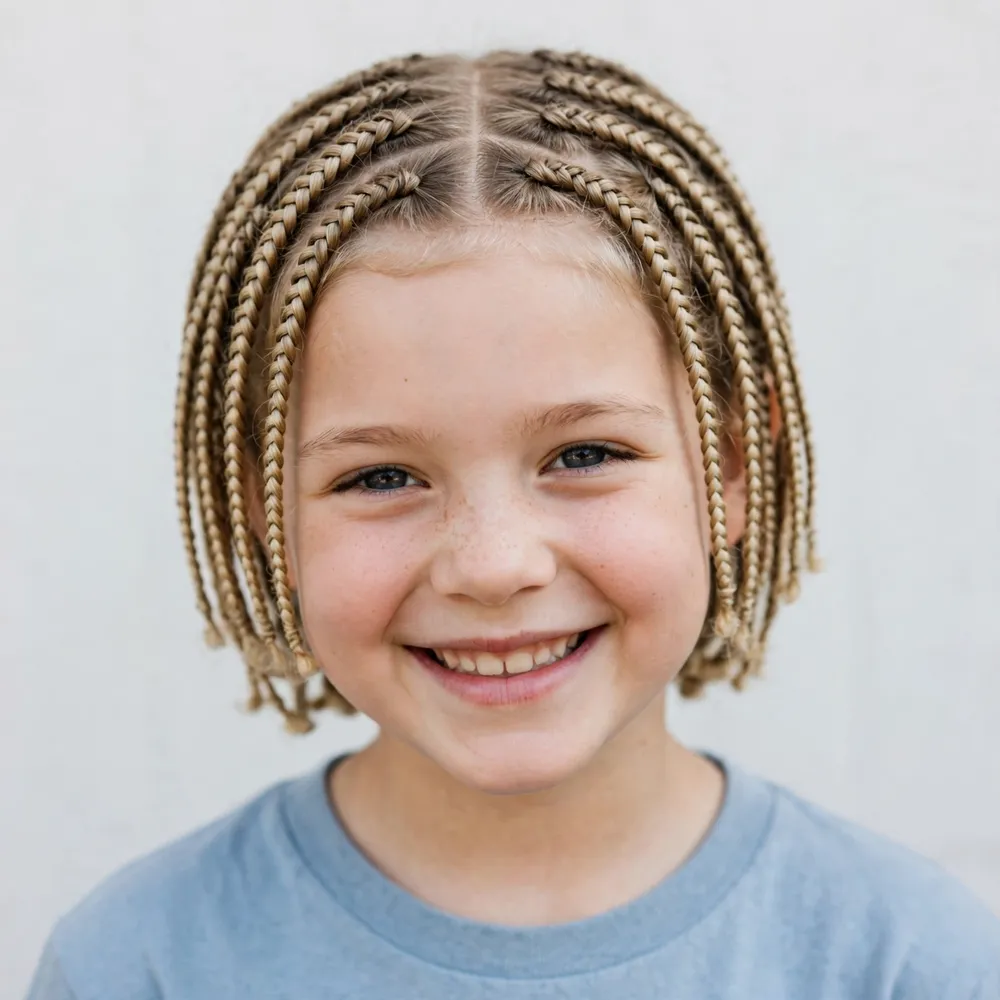
For children, box braids should be short, light, and over quickly — the whole point is a style that survives school, swimming, and the playground without daily battles. Ask the braider for small-to-medium parts, braids that end at the shoulders at most, and knotless roots, because a child’s hairline is delicate and a tight install can cause real damage. The session should take two to three hours at most, and a good kids’ braider will work in breaks. A few colourful beads at the ends make it fun without adding weight. Wash with a gentle diluted shampoo once a week, keep a satin bonnet or pillowcase for nights, and take the braids out after three to four weeks — never leave them in for six, however good they still look. If your child complains of pain or bumps at the roots, the braids are too tight and should be loosened or removed.
42. High Braided Top Knot
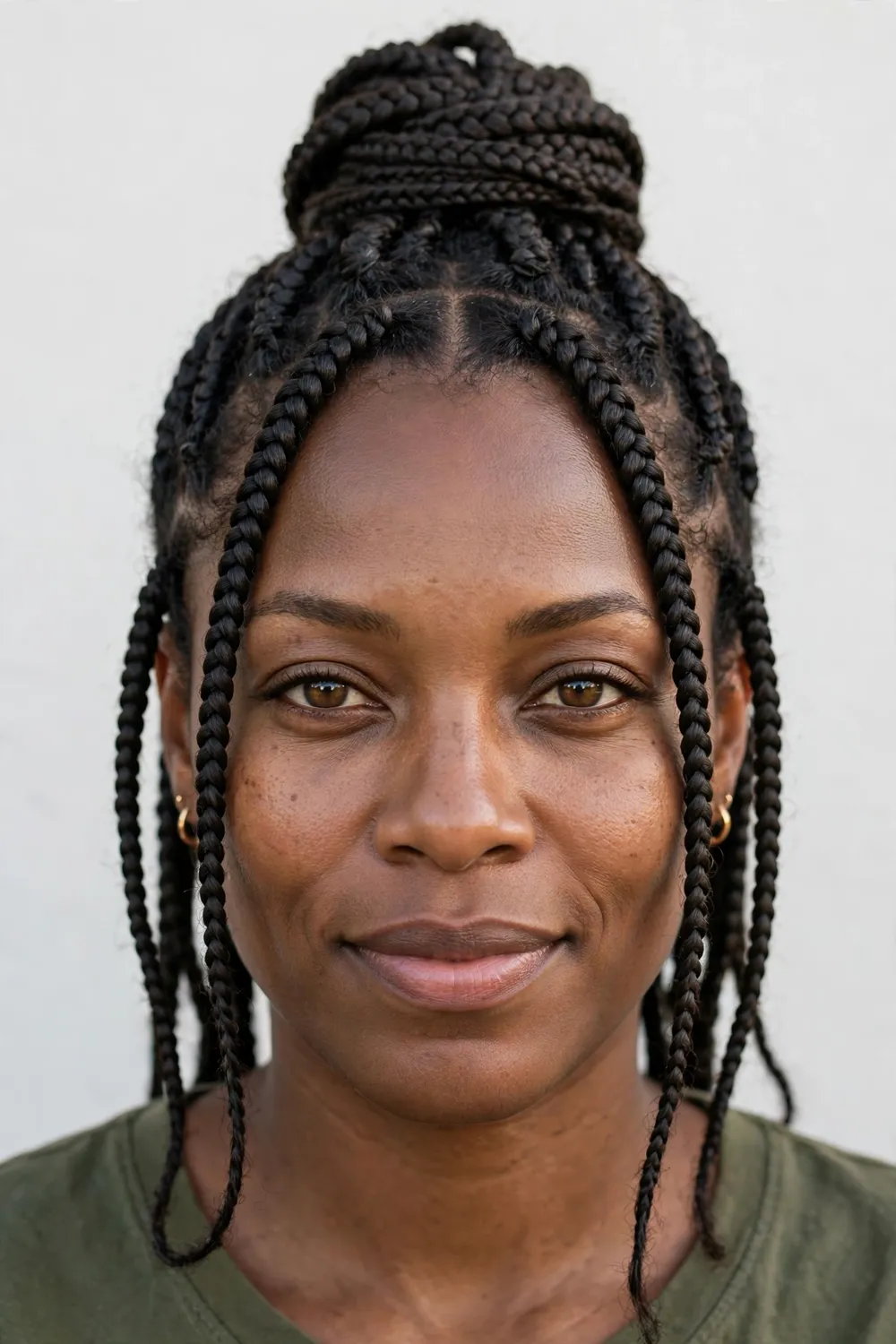
Gather every braid up into a knot at the crown and you get the cleanest, most put-together version of box braids — a style that works for the office, the gym, and a night out with equal ease. It suits long and medium braids best, and it flatters strong jawlines and high cheekbones. Ask your braider for medium braids with a neat parting, then gather them high with a snag-free band and wrap a spare braid around the base to hide it. The key is not to pull too tightly: a top knot that tugs at the hairline all day is a fast track to sore roots and, over time, traction alopecia, so keep it secure but comfortable. A light mousse smooths flyaways around the edges. At night, take the knot down completely and sleep with the braids loose under a bonnet — never sleep in a tight top knot.
43. Heart-Part Box Braids
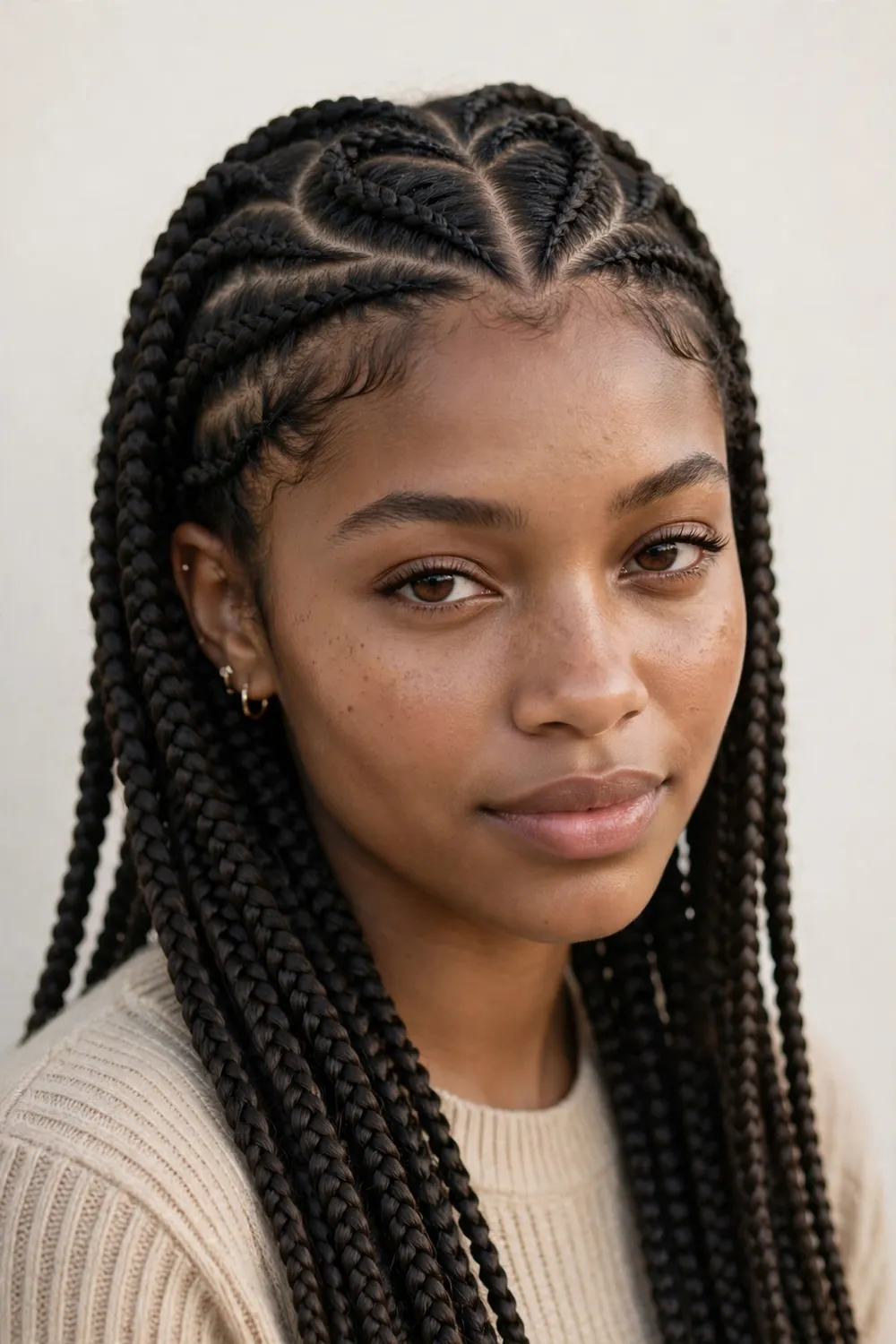
A heart-shaped parting at the crown is the kind of detail that makes people ask who did your hair. It is romantic without being fussy, and it works best on medium braids where the parting is large enough to read clearly. Ask your braider for a heart-shaped part at the crown — this takes a steady hand and a rat-tail comb, so choose a braider who has done shaped parts before — with the rest of the head in a standard square grid. The heart shows best when the braids are worn down or in a low ponytail, so it is not a style to hide under a scarf. A light oil sheen makes the parting pop in photos. Maintenance is the usual routine, though the shaped parting can blur faster than straight lines, so a silk scarf at night helps it hold its shape for the first couple of weeks.
44. Blonde Box Braids
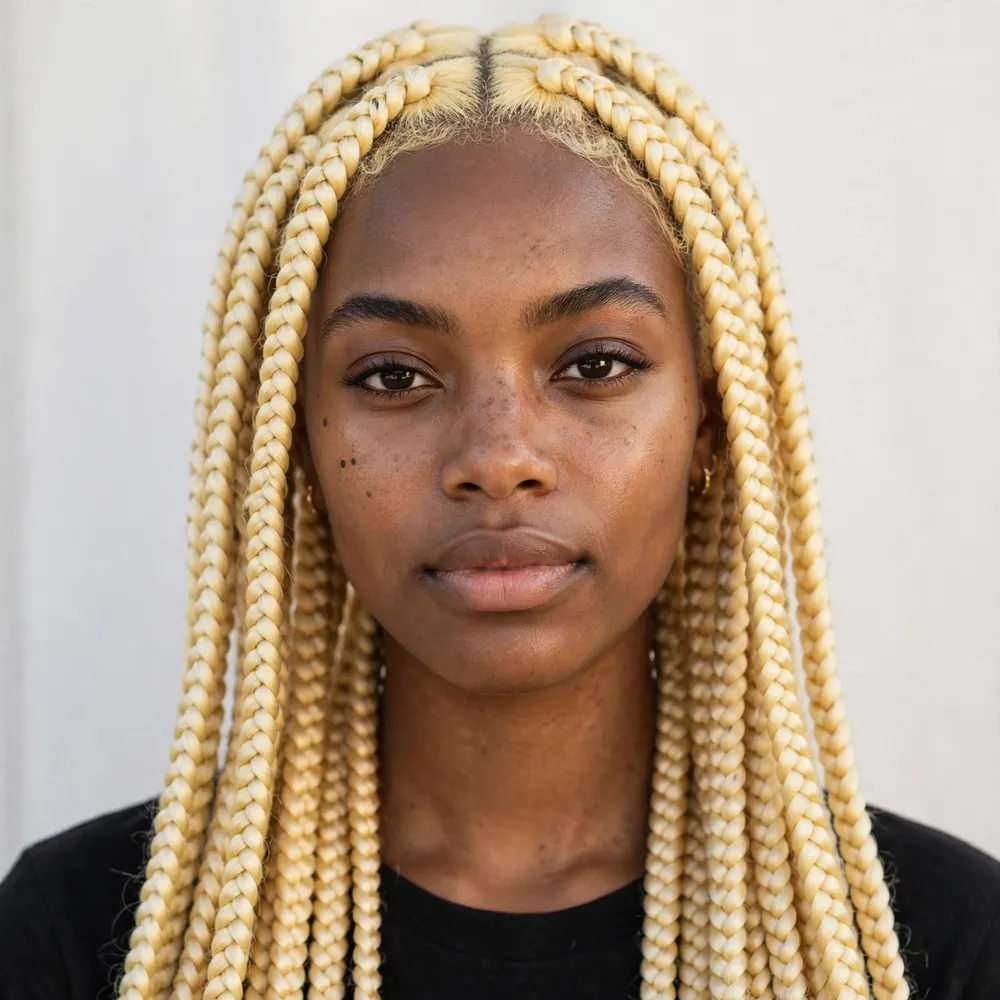
Full blonde braids are bold, bright, and impossible to ignore — the kind of style that changes how every outfit looks. They suit warm skin tones with golden blonde, and cooler platinum shades flatter fair complexions, so the exact shade matters more here than with any other colour on this list. Ask for pre-coloured blonde braiding hair rather than bleaching your own hair, and have the braider use knotless roots so the scalp does not show dark regrowth lines too early. A purple-toning shampoo once a fortnight keeps the blonde from turning brassy, and a colour-safe leave-in protects the ends. Patch-test the extension hair first if your scalp is sensitive. Blonde shows new growth and frizz sooner than darker shades, so expect to refresh the edges more often, and plan on four to five weeks of wear.
45. Pastel Box Braids
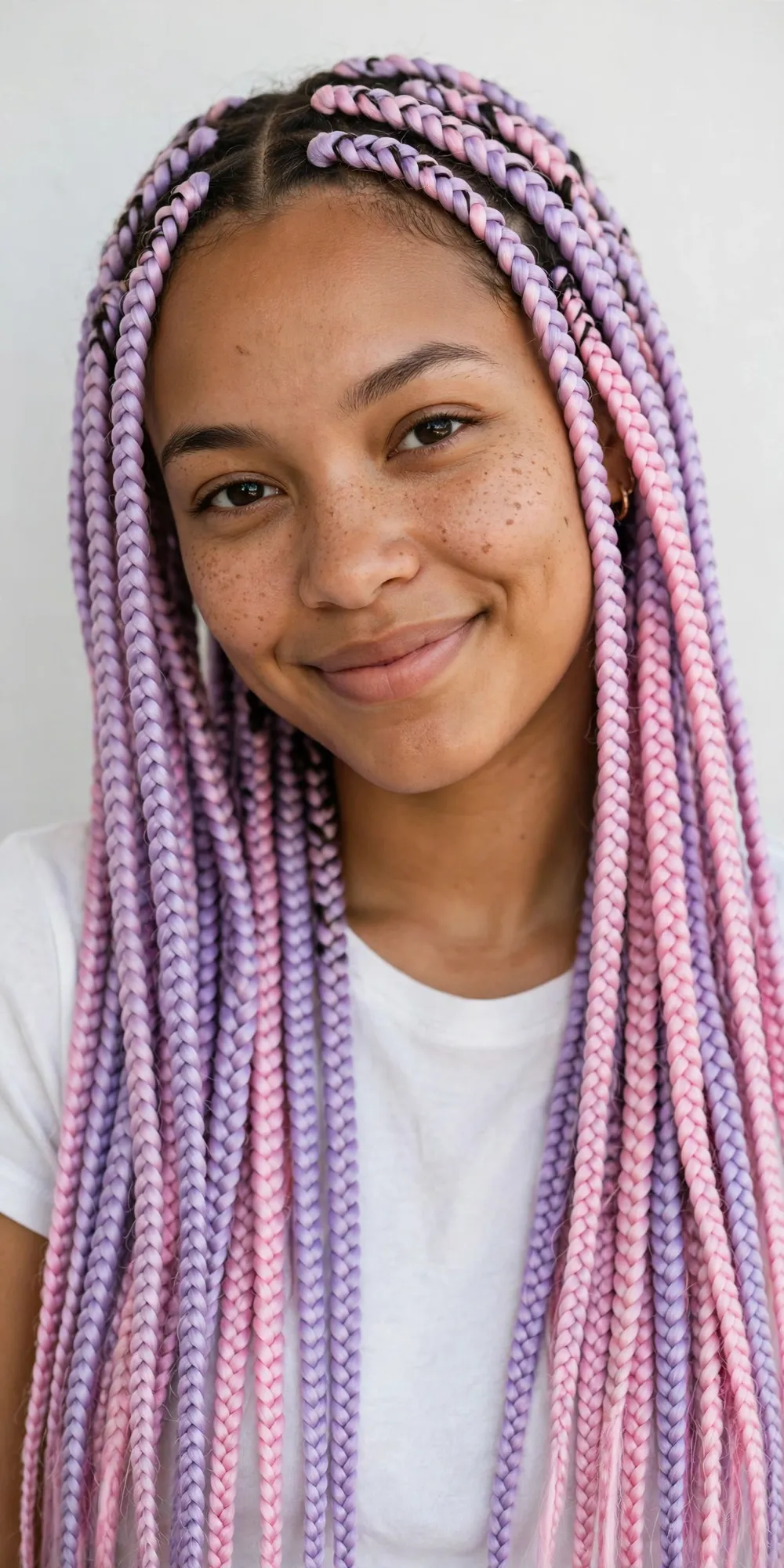
Soft lavender, baby pink, and powder blue woven through box braids — pastel is the playful end of the colour spectrum, and it works best as an accent rather than a full head, unless you are fully committed to the look. It suits fair and medium skin tones especially well, and it photographs beautifully in natural light. Ask your braider for pastel braiding hair mixed with a base of black or dark brown, so the colour reads as highlights rather than a solid block. A leave-in spray keeps the pastel shades from drying out, and colour-safe shampoo is worth using if you wash often. Patch-test before install, since pastel extension hair is sometimes coated more heavily than natural shades. The colour fades gradually over four to five weeks, and the pastel strands tend to frizz a little faster, so a satin bonnet at night is essential.
46. Cornrow-Top Box Braids
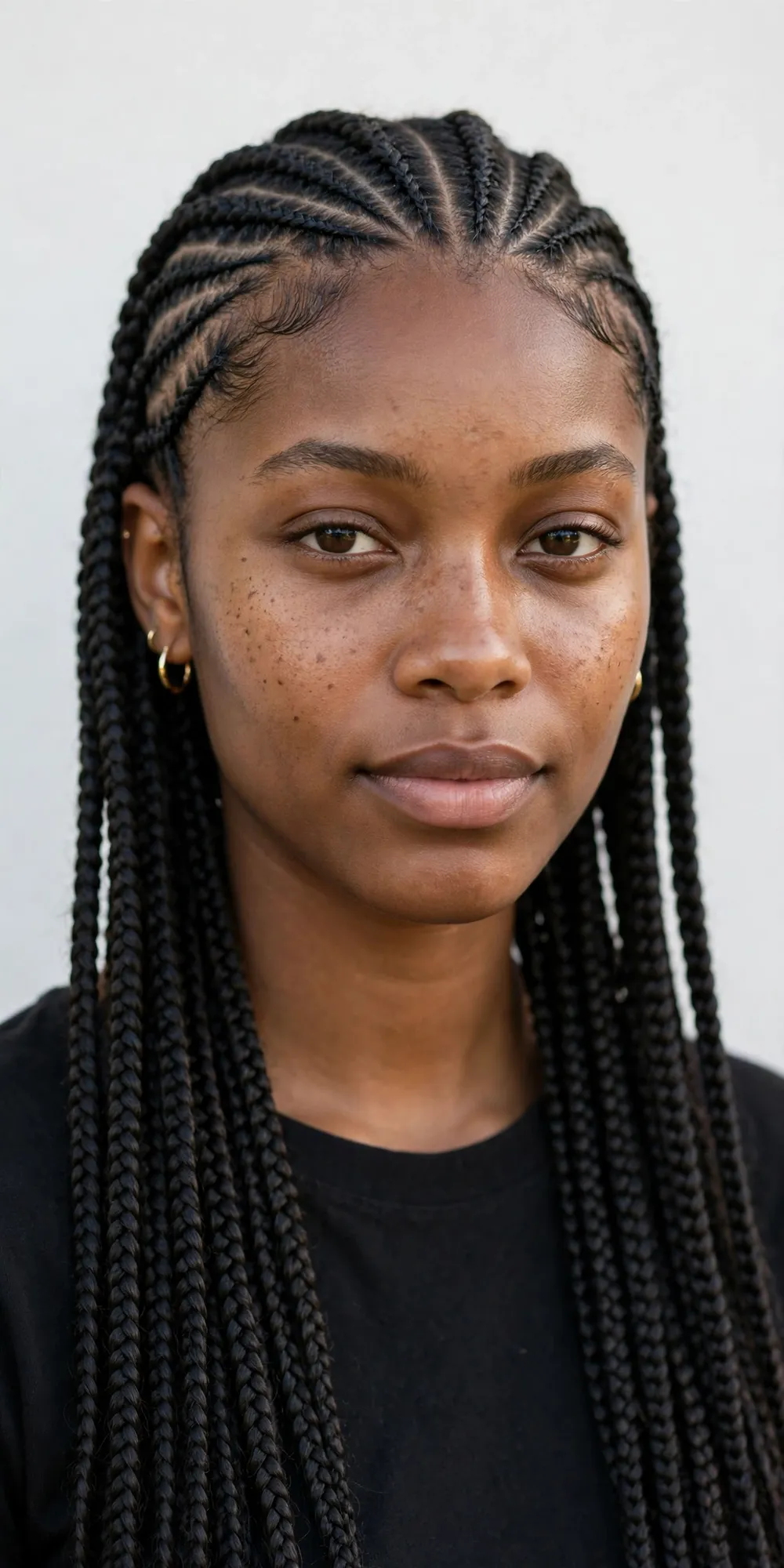
Cornrows at the front feeding into box braids at the back gives you two styles in one — the sleek, close-to-the-scalp look of cornrows where it frames the face, and the freedom of box braids everywhere else. If you like this hybrid, our Cornrow Hairstyles post has more variations on the cornrow half. It suits oval and heart-shaped faces, and anyone who wants their edges laid flat without gel. Ask your braider for three to six cornrows across the front, feeding into medium box braids from the crown back, with the transition hidden under the first row of braids. The cornrow section needs a little extra scalp oil, since it sits tight against the head, and it will loosen faster than the box braids — expect to redo the front after three weeks even if the back lasts six. A silk scarf at night keeps the cornrows smooth.
How to Care for Box Braids
Box braids only protect your hair if you look after them — and if they were not installed too tight in the first place. The routine is simple, but it has to happen every week.
Washing. Mix your regular shampoo with water in an applicator bottle — roughly one part shampoo to three parts water — and squeeze it along the partings, not all over the braids. Massage your scalp gently with your fingertips, never your nails, then rinse thoroughly and let the water run down the braids. Follow with a light leave-in conditioner on the lengths only. Wash once a week, or every ten days at most; skipping wash day lets sweat and product build up at the roots, and that itch is not a sign the style is working.
Scalp care. A few drops of lightweight oil — jojoba, grapeseed, or a scalp oil you already trust — massaged along the partings two or three times a week keeps the scalp comfortable and stops the dryness that makes people scratch. Do not drown the roots in oil; a little goes a long way, and excess oil is what causes buildup.
Nights. A satin bonnet or a silk scarf is non-negotiable. Cotton pillowcases pull moisture out of the braids and rough up the ends, while satin lets them slide. If a bonnet feels too tight, a satin pillowcase is the next best thing.
How long to keep them in. Four to six weeks is the honest limit for most sets. Longer braids and jumbo sizes should come out closer to four weeks, because the weight keeps pulling on the roots. When the new growth at the partings reaches about an inch, it is time.
Takedown. Never rip braids out. Cut the extension hair a few inches above where your own hair ends, unravel gently, and detangle each section with your fingers before you touch a comb. Then wash, deep-condition, and give your hair at least a week of rest before the next install.
How Much Do Box Braids Cost?
Prices vary by city, braider, and length, but these are the typical salon ranges in 2026. Knotless installs usually cost a little more because they take longer, and waist-length or small braids sit at the top of each range.
| Size / Length | Typical salon price |
|---|---|
| Small braids, shoulder length | $180–$280 |
| Small braids, waist length | $250–$400 |
| Medium braids, shoulder length | $120–$200 |
| Medium braids, waist length | $180–$300 |
| Jumbo braids, shoulder length | $80–$150 |
| Jumbo braids, waist length | $120–$220 |
| Knotless medium braids | $150–$250 |
| Kids’ box braids | $60–$120 |
Home braiders and braiding students often charge less, and some salons include the extension hair in the price while others charge for it separately — always ask before you book, so the quote you get is the price you pay.
5 Mistakes to Avoid with Box Braids
1. Braids that are too tight at the roots. This is the big one. If your scalp hurts, if you see small bumps along the hairline, or if you cannot raise your eyebrows comfortably, the install is too tight. Speak up in the chair — a good braider will loosen the roots on the spot. Tight braids are not protective; they are the main cause of traction alopecia, and once hairline hair is lost, it does not always grow back.
2. An install that is too long or too heavy. Waist-length jumbo braids look incredible and feel like wearing a weighted blanket on your head. The weight pulls on the roots all day, every day, and the damage shows up weeks later as breakage at the hairline. Match the length and size to what your hair can actually carry.
3. Skipping wash day. Braids are not a reason to stop washing your hair. Sweat, oil, and product build up at the roots, the scalp gets irritated, and the itch that follows makes people scratch — which loosens the braids and damages the roots. Wash once a week with diluted shampoo in an applicator bottle.
4. Heavy products and buildup. Thick butters, heavy gels, and layering product on product do not moisturise braids — they sit on top of them, attract dust, and turn the roots grey and flaky. Use lightweight oils and leave-ins, and use less than you think you need.
5. Leaving them in too long. Braids that looked perfect at week three can be a matted mess by week ten. Past six weeks, new growth tangles with the extension hair, takedown becomes painful, and breakage follows. Four to six weeks, then take them out, rest your hair, and start fresh.
FAQs
How long do box braids last?
Four to six weeks is the honest answer for most people. Small and medium braids in good condition can reach the full six weeks, while jumbo and waist-length sets are better taken out around four weeks because of the weight on the roots. The real sign is the new growth: once the partings have about an inch of regrowth, the braids start to tangle with your own hair and takedown gets harder. Washing weekly, oiling the scalp, and sleeping in a satin bonnet will get you to the longer end of that range.
Are box braids good for fine hair?
Yes — with the right size. Small and medium box braids suit fine hair well, because the weight is spread evenly and no single root carries much load. Knotless braids are the safest choice for fine hair, since there is no bulky knot pulling at the root. What fine hair does not handle well is jumbo or very long braids, which concentrate too much weight on too few roots, or an install that is pulled tight. Tell your braider your hair is fine, ask for knotless roots, and keep the length at shoulder or mid-back at most. For more ideas that work on fine hair, see our Braided Hairstyles guide.
How much do box braids cost?
A salon install typically costs between $80 and $400, depending on size, length, and where you live. Jumbo shoulder-length braids are the cheapest at around $80–$150, medium braids run $120–$300, and small or waist-length sets sit at the top of the range at $250–$400. Knotless installs usually cost a little more than classic box braids because they take longer. Some salons include the extension hair in the price and others charge for it separately, so ask for the full quote — including hair — before you book. Home braiders are often cheaper, but check their work and reviews first.
Do box braids damage your hair?
Box braids do not damage your hair on their own — in fact, they are one of the classic protective styles, and Wikipedia’s overview of box braids traces that protective history back centuries. The damage comes from how they are installed and worn: braids pulled too tight at the roots can cause traction alopecia, very long or heavy installs strain the hairline, and leaving braids in for months lets new growth mat and break. If the roots are comfortable, the weight is reasonable, and you take them out after four to six weeks with a gentle takedown, box braids protect your hair rather than harm it. If it hurts, it is too tight — say so in the chair.
How do you wash box braids?
Dilute your shampoo with water in an applicator bottle — about one part shampoo to three parts water — and squeeze it along the partings. Massage your scalp gently with your fingertips, then rinse thoroughly and let the water run down the braids. Follow with a light leave-in conditioner on the lengths only, and let the braids air-dry or sit under a hooded dryer on low. Wash once a week. Do not use undiluted shampoo poured over the top of your head: it is hard to rinse out of braids, and the residue is what causes buildup and itching.
Knotless vs regular box braids — which is better?
Neither is better for everyone — it depends on your hair and your hairline. Knotless braids start with your own hair and feed the extension in gradually, so there is no knot at the root, less tension, and a flatter, more natural look. They are the better choice for fine hair, sensitive scalps, and anyone with a fragile hairline, and they hurt less on day one. Regular box braids have a knot at the root that grips the extension hair firmly, which makes them slightly more secure and often a little cheaper and faster to install. If your hair is thick and your scalp is not sensitive, classic box braids are perfectly fine. If in doubt, go knotless.
How long does it take to install box braids?
It depends on the size and length. Jumbo braids are the quickest at two to three hours. Medium braids usually take four to six hours. Small braids take six to eight hours, and slim waist-length sets can take eight hours or more. Knotless installs add about an hour to each of those times because the feed-in technique is slower. Book the whole day, bring snacks and something to watch, and do not plan anything important for the evening — and if a braider promises a full head of small waist-length braids in two hours, find another braider.
Final Word
Box braids have lasted this long for a reason: they protect your hair, they look good from every angle, and with 46 styles to choose from, there is a version for every face, every budget, and every mood. Pick the size your hair can carry, insist on roots that do not hurt, and take them out on time — the style does the rest. If you want more ideas in the same spirit, our Natural Hairstyles for Black Women guide and the rest of the blog are full of protective styles worth trying.