


A textured haircut is a cut where the barber removes weight and cuts the ends at different lengths, so the hair sits with natural separation, movement and volume instead of lying flat in one solid block. Our top 3 picks: (1) Textured Quiff — best all-rounder, (2) Short Brush Up with High Fade — cleanest everyday version, (3) Messy Curly Hair with Taper Fade — best for curls.
What Is a Textured Haircut?
Texture is what stops a haircut looking like a helmet. Instead of cutting every strand to the same length, the barber uses point cutting — snipping into the ends at an angle — along with layering and thinning shears to take out bulk where it’s heavy and leave shorter pieces that push against each other. That contrast is what creates the piecey, lived-in finish: hair that moves when you do, catches the light in different places, and holds a style without a mountain of product.
It works because most hair isn’t naturally uniform. Straight hair gains volume and grip it didn’t have before, wavy hair gets its bends encouraged rather than weighed down, and curly hair gets shape instead of a triangle. Thick hair feels lighter; fine hair looks fuller because the shorter layers prop up the longer ones. The same idea sits behind [layered haircuts for men](/layered-haircuts-for-men/), just pushed further into the ends. If your hair has ever looked flat, heavy or shapeless a week after a cut, texture is usually the missing piece.
46 Best Textured Haircuts for Men
1. Textured Comb Over Taper
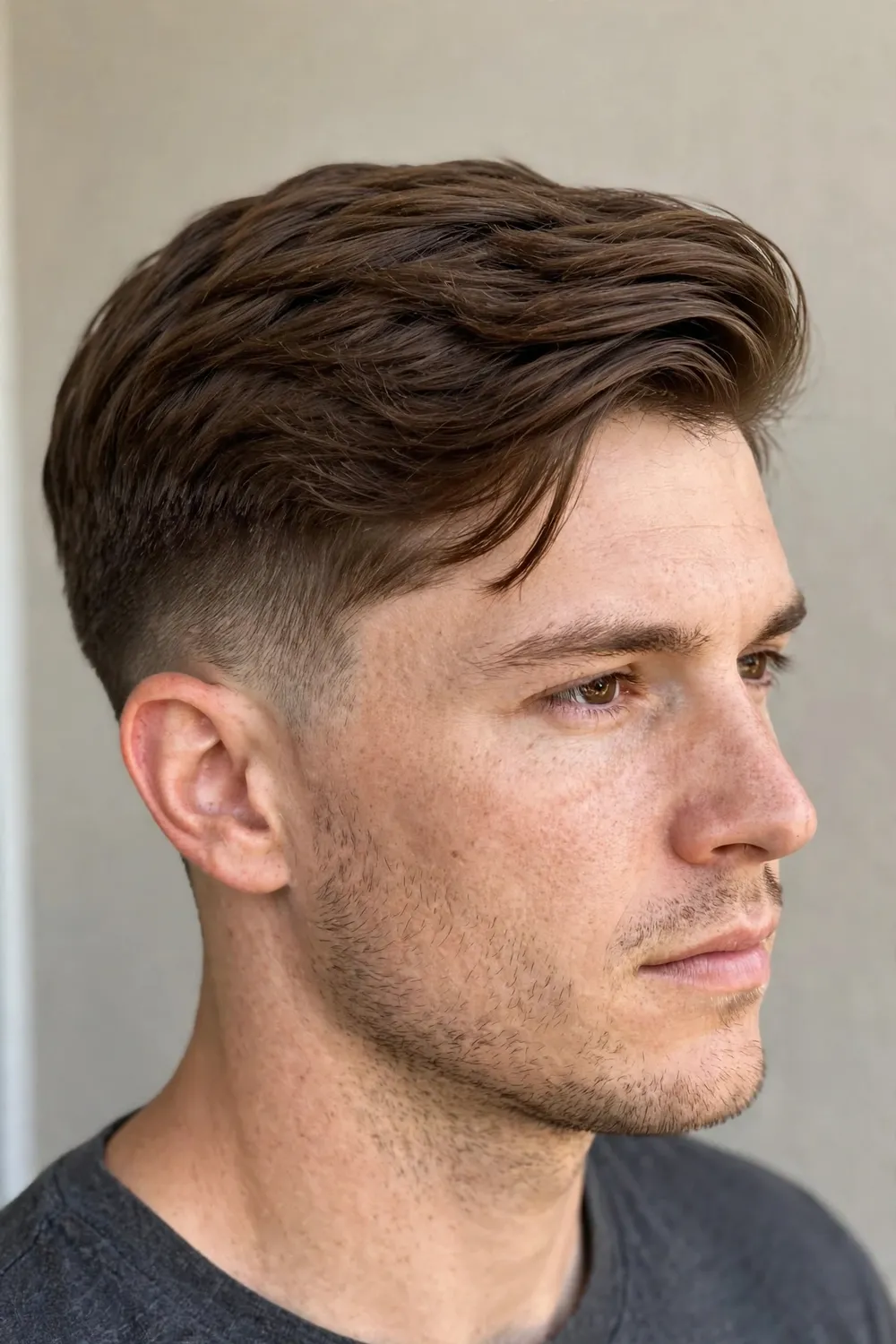
The comb over gets a modern rewrite here: the top stays long enough to sweep to one side, but the ends are point-cut so it breaks up instead of sitting like a sheet. A taper keeps the sides neat without the hard line of a skin fade. It suits straight to slightly wavy hair best, and works particularly well on oval and rectangular faces because the side sweep adds width where it counts. Ask your barber for a classic comb over with a low taper and “texture through the top — choppy ends, not thinned out flat.” A pea-sized amount of matte clay, swept across with your fingers, gives the finish. Plan on a trim every 3–4 weeks to keep the taper crisp.
2. Short Brush Up with High Fade
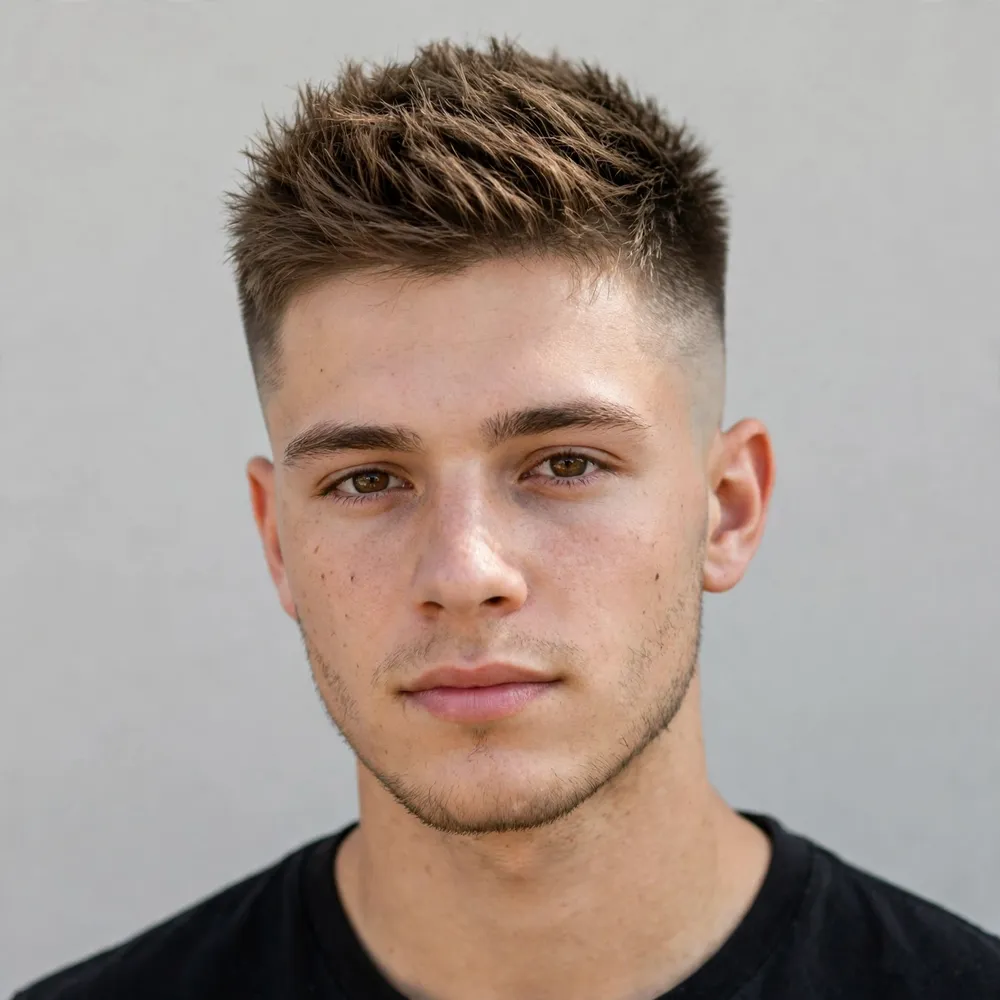
This is the cut that looks sharp at 7am with almost no effort. The top is left just long enough to push up and forward — around 2 inches — while a high fade takes the sides right up to the temples. Texture through the crown stops the brushed-up front from looking like a solid wall. Best on straight or slightly wavy hair with medium thickness, and flattering on round faces because the height on top lengthens the silhouette. Tell your barber: “short brush up, high fade, choppy texture on top so it doesn’t look flat.” Style with a small amount of matte paste, working it in while the hair is slightly damp, then push it up with your fingers. Two minutes, no comb. Keep the fade tight with a cleanup every 2–3 weeks.
3. Messy Curly Hair with Taper Fade
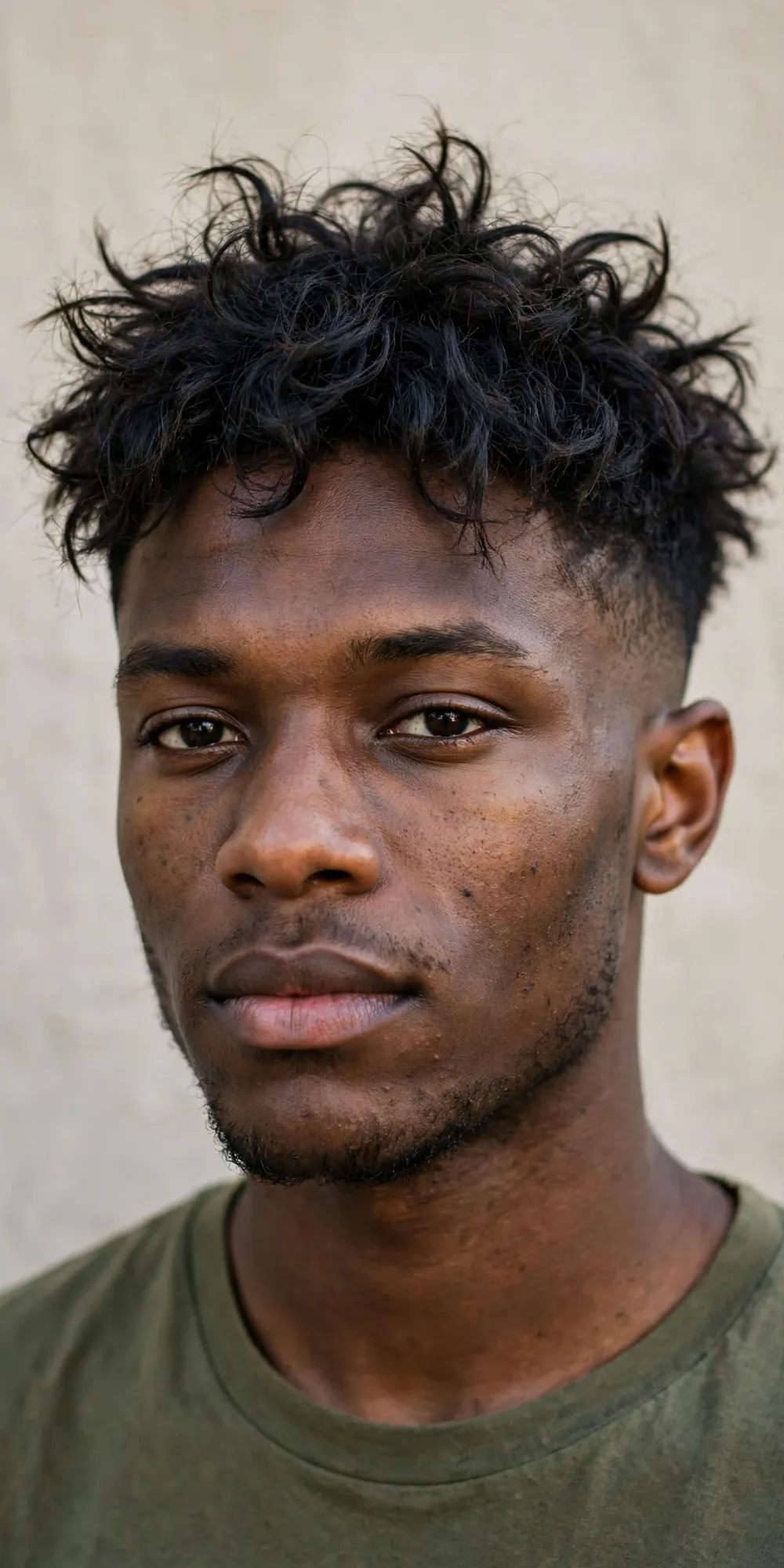
Natural curls do the heavy lifting here — the cut just gives them a shape to fall into. The top stays around 3–4 inches so the curls can form properly, layered so the weight doesn’t drag them down. A taper fade on the sides and back keeps the silhouette clean without fighting the curls up top. It suits anyone with naturally curly or coily hair, especially if your curls are tight enough to hold their own shape. Ask for “taper fade on the sides, keep the length on top, layer it so the curls sit lighter.” A curl cream scrunched in while damp is all the product you need — skip the comb entirely. Trim every 4–5 weeks; curly hair hides growth well, so you can stretch it.
4. Textured Mohawk
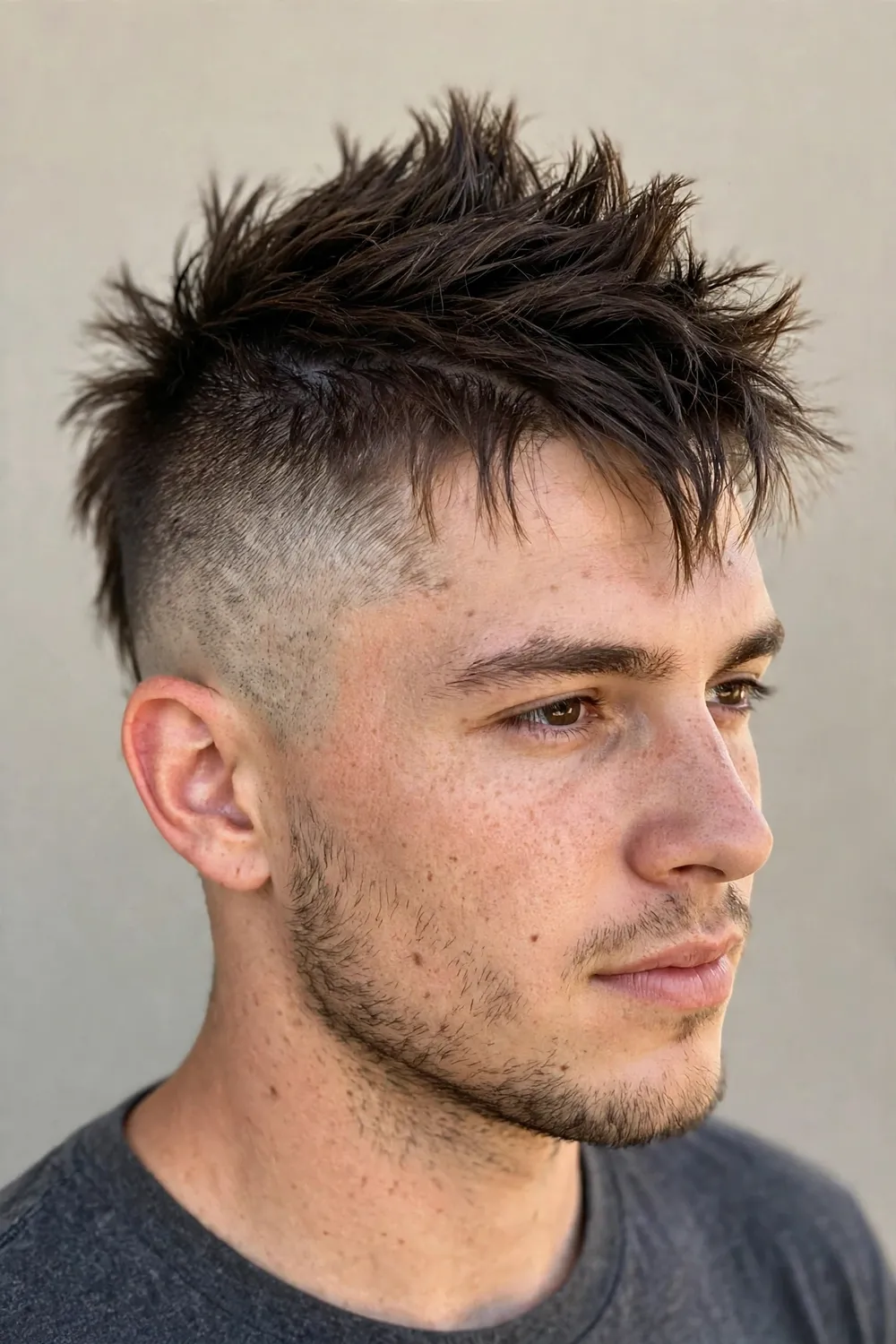
Forget the spiked punk version — this mohawk is softer, wider and far more wearable. The centre strip is left long with choppy texture so it can be styled up, forward or slightly messy, while the sides are faded short rather than shaved bare. It works best on thick, straight or wavy hair that can hold height, and suits oval and square faces, where the lift balances the jawline. Ask your barber for “a wide mohawk, textured on top, faded sides — not shaved, just short.” Blow-dry the strip upward for a full look, or rake matte clay through it and push it up for a messier day. The fade needs attention every 2–3 weeks, but the top is happy to grow out a little between cuts.
5. Long Middle Part
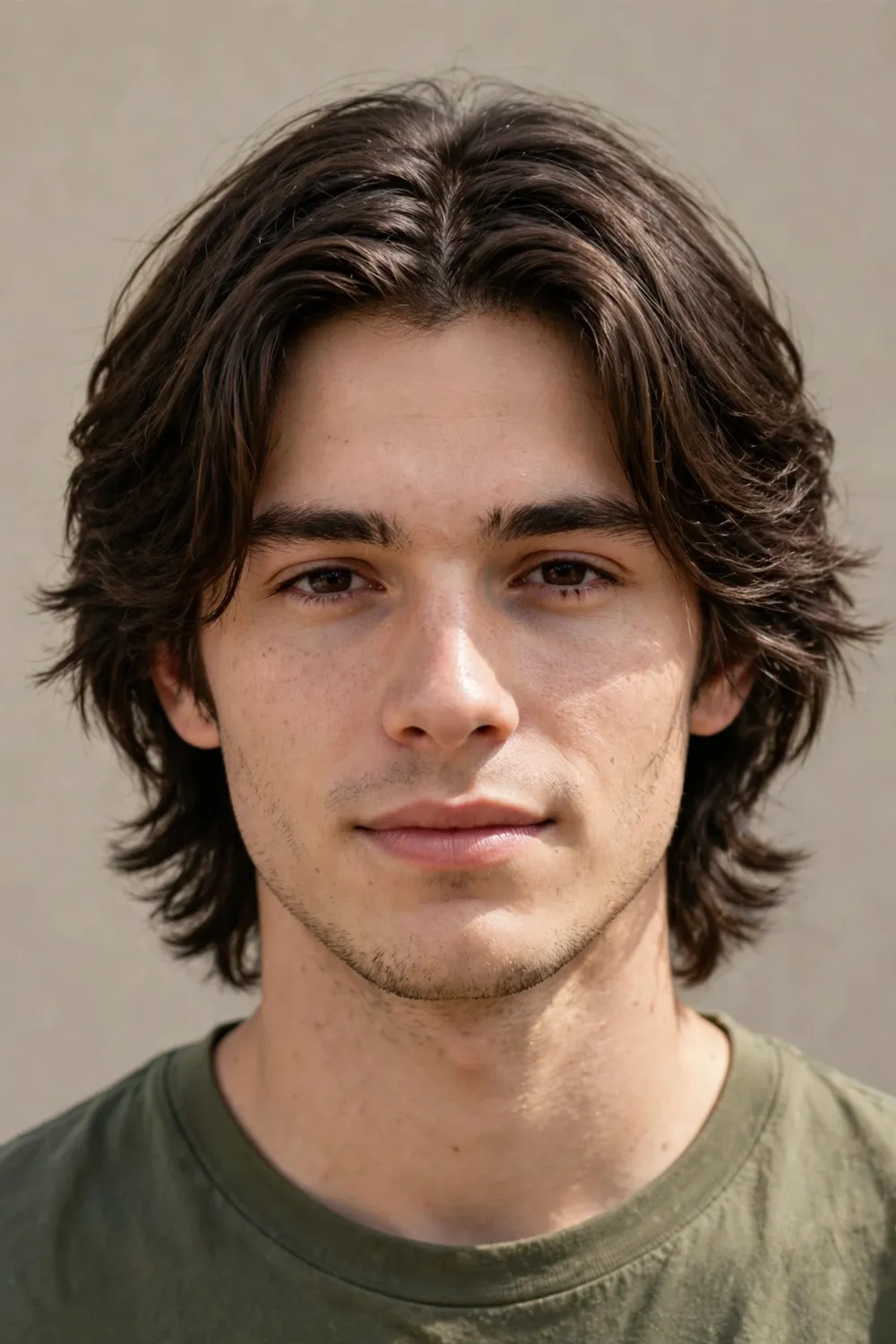
The middle part is back, and texture is what keeps it from looking like a 90s boy-band throwback. Hair falls to around ear or jaw length, parted dead centre, with layers cut through so each side has movement instead of hanging like curtains. It suits wavy and straight hair with medium thickness; the longer layers frame the face nicely on oval, heart and square shapes. Ask your stylist for “middle part, long layers, point-cut ends for movement — I want it to fall naturally, not sit flat.” Sea-salt spray on damp hair, scrunched in and left to air-dry, gives it that effortless finish. Growth is the friend here — trims every 6–8 weeks just to keep the ends healthy and the shape balanced.
6. Flowing Wolf Cut
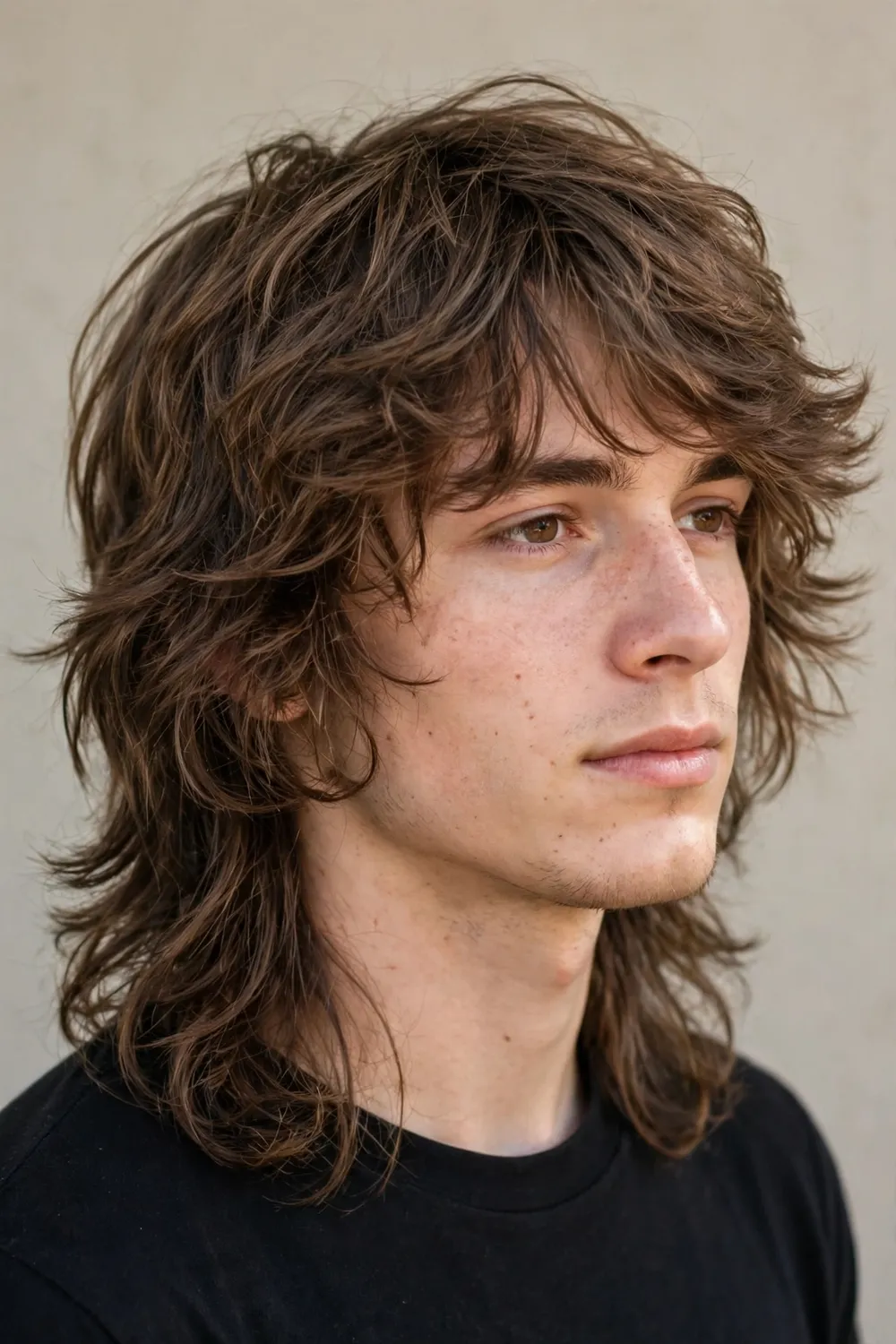
The wolf cut is basically a shag with ambitions: short, choppy layers on top that melt into longer length at the back, all of it textured so the waves have somewhere to go. It needs natural wave or curl to really work; wavy hair is where it shines. Oval, heart and diamond faces suit it best, since the volume on top and length at the back balance each other out. Tell your stylist “wolf cut, heavy texture on top, keep the length at the back — I want it shaggy, not neat.” A light texturising spray and a scrunch is usually enough; a diffuser speeds things up on damp hair. Book a trim every 6 weeks to stop the layers growing into each other.
7. Textured Shaggy Hair

The shag is the easiest cool cut there is, because it looks better slightly undone. Layers of different lengths are cut through the whole head, the ends are point-cut, and the result is a tousled, lived-in shape that doesn’t need much convincing. It suits wavy and straight hair with medium density, and it flatters longer faces by adding width around the cheeks and jaw. Ask for “a shag, lots of layers, choppy ends — messy is the point.” Style by working a small amount of matte paste through towel-dried hair and letting it fall where it wants; a comb would ruin it. It’s one of the lowest-maintenance cuts here — a trim every 6–8 weeks keeps the shape, and growing it out just makes it shaggier.
8. Textured Undercut with Volume

The undercut’s sharp contrast — short sides, long top — gets softened by texture on top, so the length has movement instead of looking like a slab. The top is usually 4–5 inches, point-cut and layered, styled up or swept back for volume. Thick, straight or wavy hair handles it best; the weight of the top needs enough density to hold its shape. It suits square and oval faces, where the height balances strong features. Ask your barber for “undercut, disconnected, texture through the top so it has volume — not slicked flat.” Blow-dry the top upward with a vent brush, then finish with matte clay for hold without shine. The undercut needs a tidy-up every 2–3 weeks, though the top can grow out freely.
9. Textured Quiff
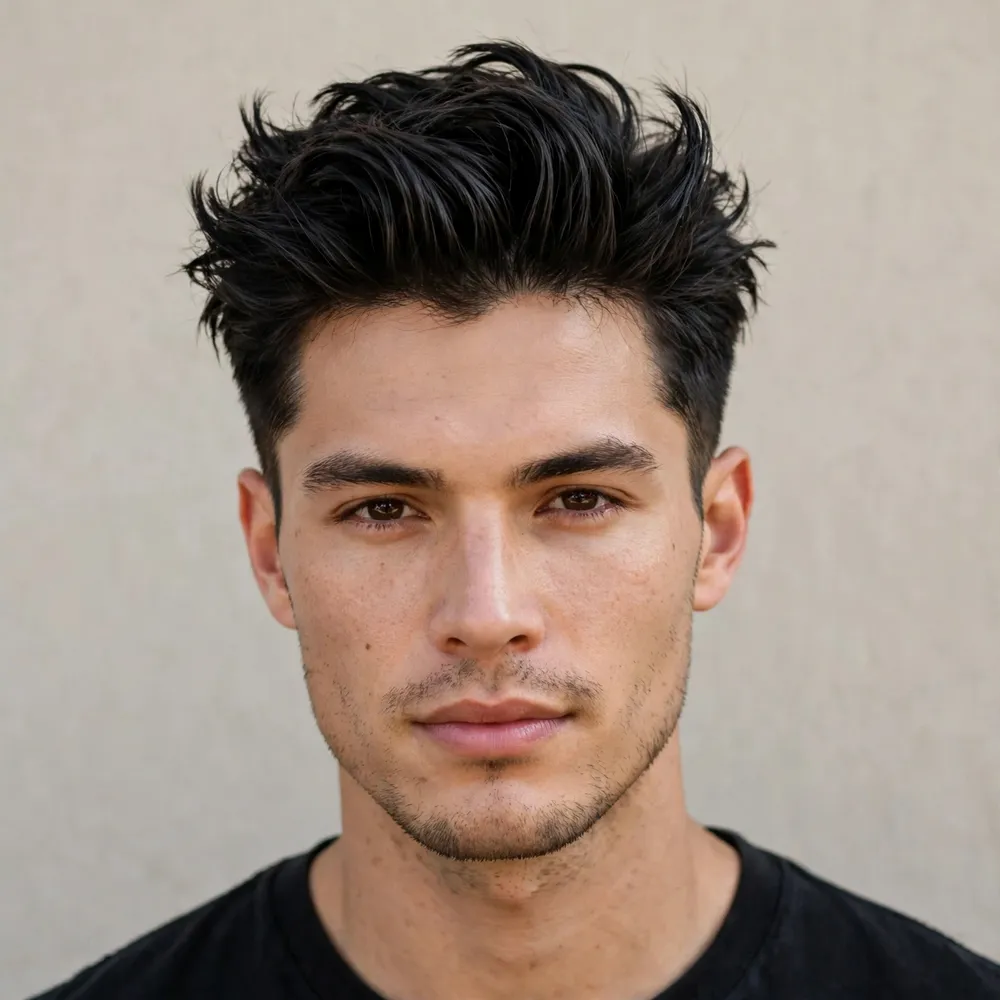
The quiff is the original volume cut, and texture is what makes it look modern rather than retro. The front is left long — 3–4 inches — layered and point-cut so it sweeps up and back in pieces instead of one solid wave, while the sides stay short. It suits almost every hair type, but straight and wavy hair hold the shape most easily, and it flatters round faces especially well by adding height. Ask your barber for “textured quiff, short back and sides, keep the front long with choppy layers.” Blow-dry the front upward and back with a round brush, then lock it in with matte clay. It takes five minutes once you know the motion, and a trim every 3–4 weeks keeps the front from getting floppy.
10. Short Messy Waves

If your hair has a natural wave and you’ve been fighting it flat, stop — this cut works with it. The top stays short, around 2 inches, with texture cut in so the waves break up into pieces instead of clumping. The sides are kept short but not skin-tight, so the whole thing reads relaxed. It suits wavy hair best, obviously, but slightly curly hair works too, and it flatters most face shapes because there’s no strong geometry to clash with. Tell your barber “short on top, keep my natural wave, texture it so it looks messy on purpose.” Sea-salt spray on damp hair, scrunched and air-dried, is the whole styling routine. Trim every 4 weeks — short waves lose their shape fast once they grow past the ears.
11. Textured Faux Hawk with Low Burst Fade
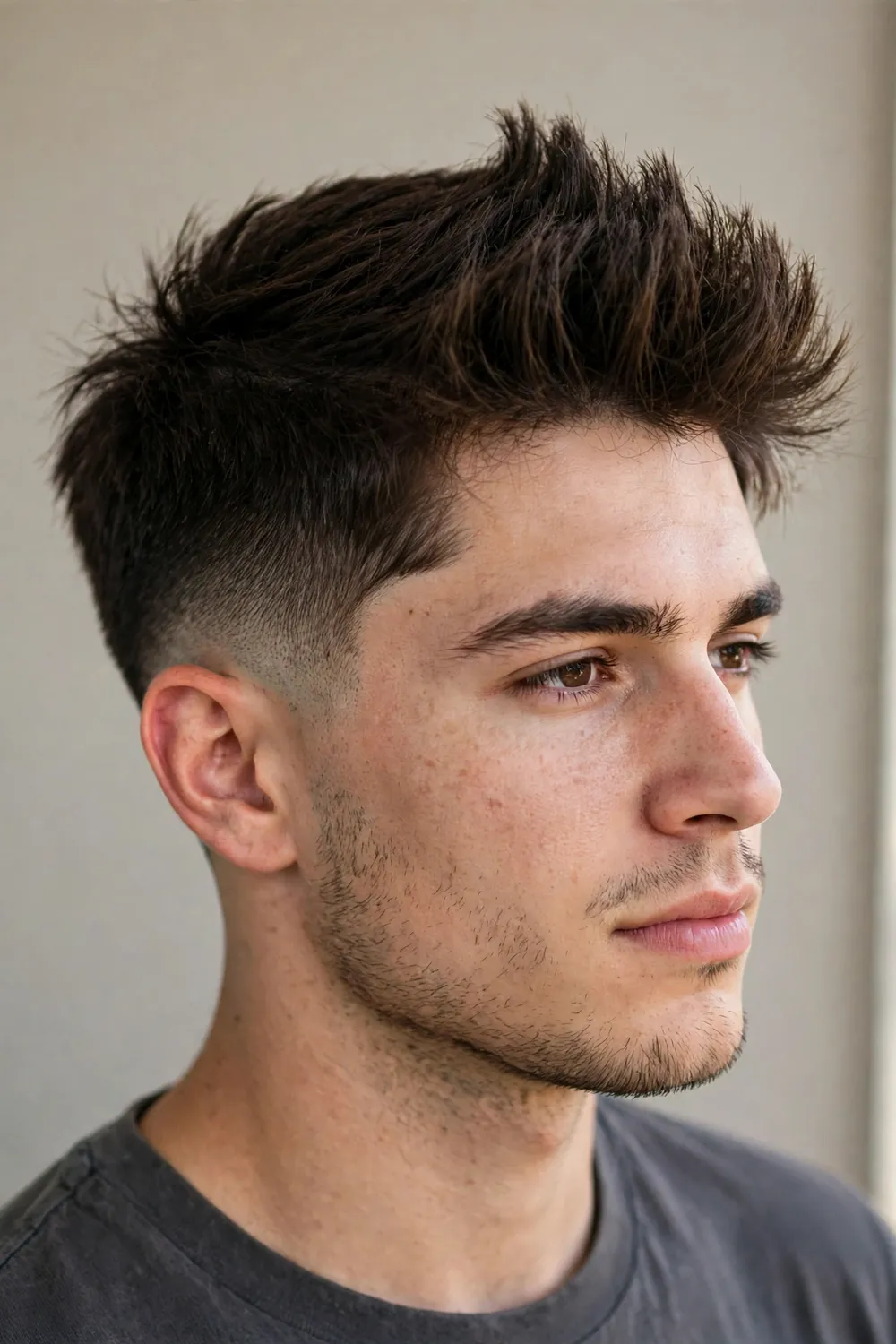
The faux hawk keeps the mohawk’s attitude and drops the commitment. The centre is left long and textured so it can be pushed up into a ridge, while a low burst fade curves around the ears and keeps the sides clean without going too high. It works best on thick, straight or wavy hair that can stand up without much help, and it suits oval and heart faces. Ask your barber for “faux hawk, low burst fade, texture on top so it doesn’t look stiff.” A strong-hold matte clay, worked through damp hair and pushed upward from the sides, does the job — no hairspray needed for a casual finish. Keep the burst fade fresh with a cleanup every 2–3 weeks; the top is flexible about timing.
12. Textured Side Part Fade
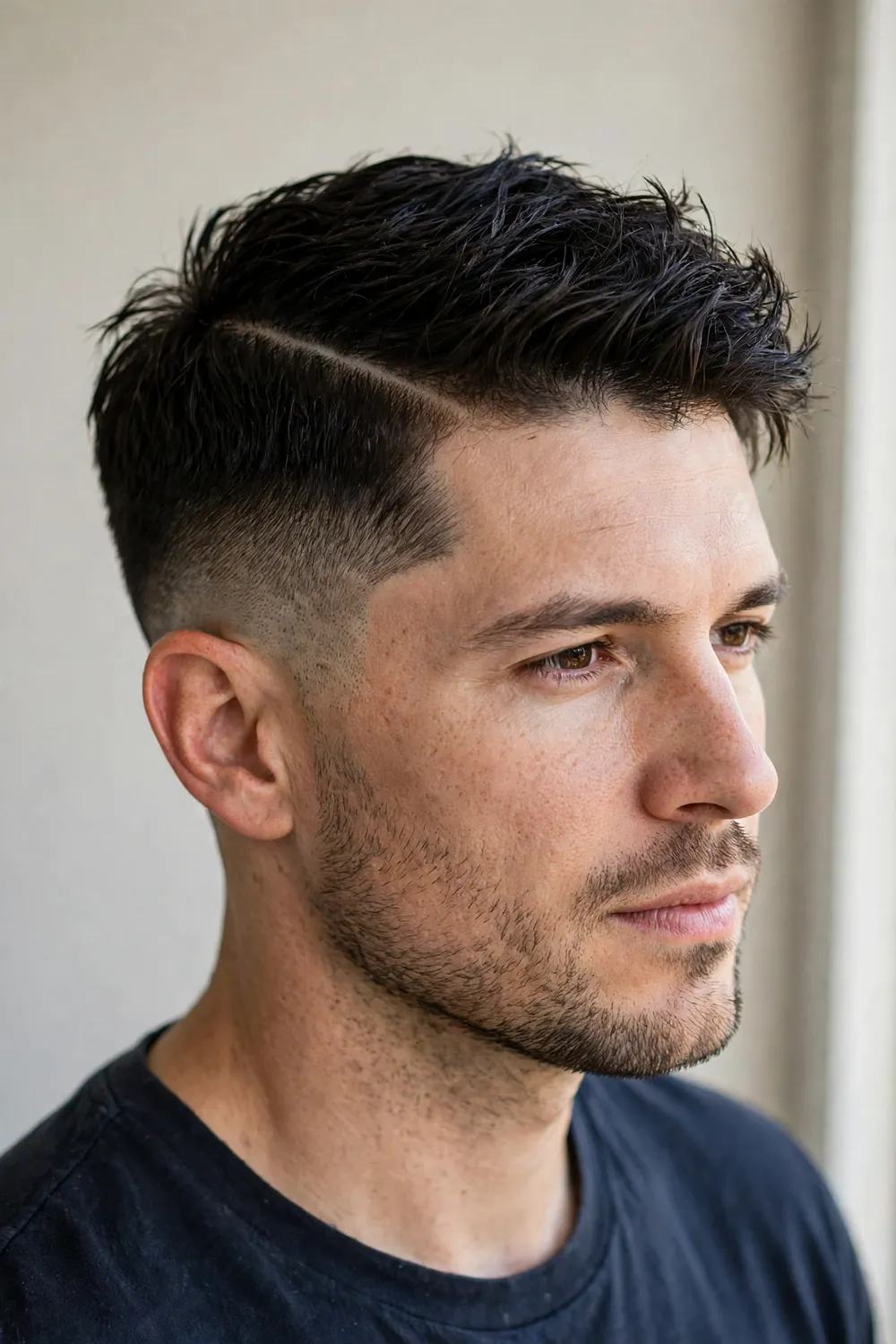
The side part is the office-friendly classic, and texture stops it looking like something from a school photo. The top is parted to one side, point-cut so it has separation and movement, and the sides are faded to a clean finish. It suits straight hair best, and it works on almost every face shape — the part can be placed to flatter whichever side you prefer. Ask for “side part with a mid fade, texture through the top so it isn’t flat.” A small amount of pomade or matte clay, combed into place and then ruffled slightly with your fingers, gives a polished-but-not-stiff result. This is a low-effort daily cut: five minutes in the morning, and a trim every 3–4 weeks to keep the fade and part line sharp.
13. Heavy Textured Fringe
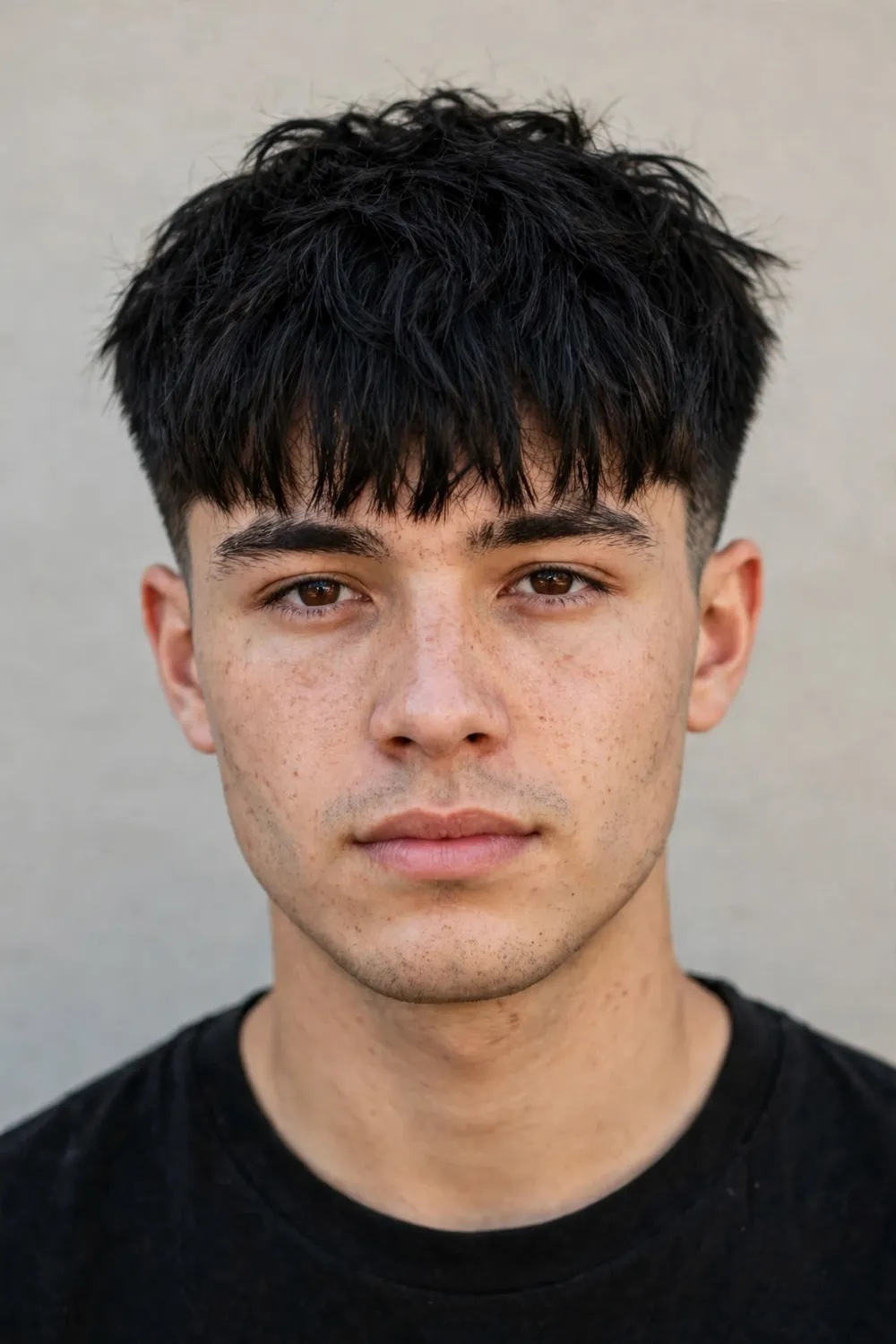
A heavy fringe sounds like a lot of hair on the forehead — and it is, deliberately. The front is left thick and long, layered and point-cut so it falls in pieces rather than a straight curtain, while the sides stay short to keep the weight balanced. It suits thick, straight or wavy hair, and it’s a smart pick for a high forehead or a long face, since the fringe shortens the forehead visually. Tell your barber “heavy fringe, lots of texture, keep the sides short.” Style it forward with a little matte paste, separating the pieces with your fingers — the messier the better. The fringe needs a trim every 3 weeks or it starts creeping into your eyes; everything else can wait a little longer.
14. Crew Cut with Fringe
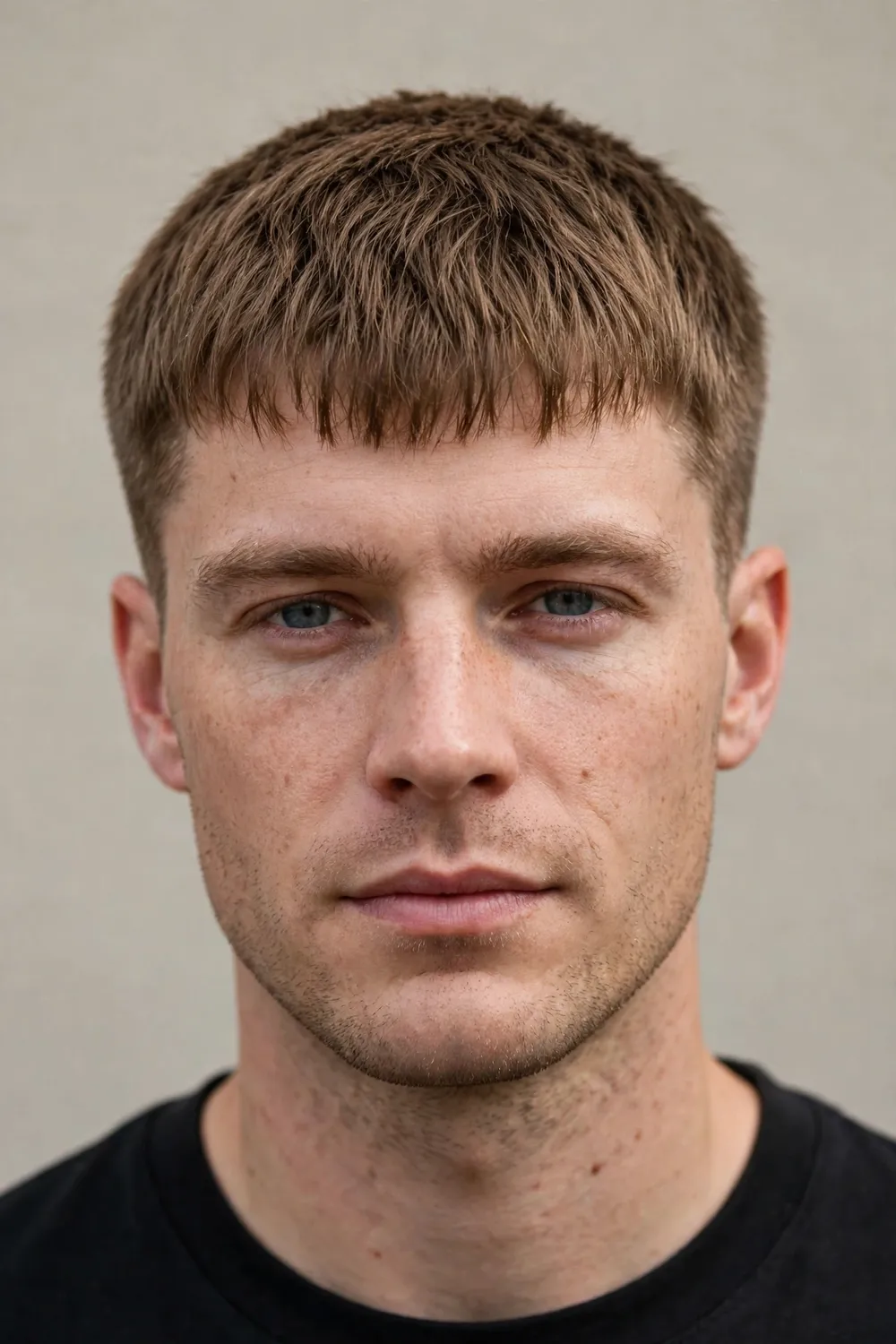
The crew cut is famously low-effort, and adding a textured fringe gives it a personality the standard version lacks. The top stays short — about an inch — with the front left slightly longer and point-cut so it breaks up across the forehead. The sides are tapered short. It suits straight and wavy hair, and it’s a strong choice for square and oval faces, or anyone who wants a neat cut that still looks intentional. Ask for “crew cut, tapered sides, leave a bit of textured fringe at the front.” Honestly, most days need nothing more than towel-drying and a dab of matte paste if you want definition. A trim every 3 weeks keeps it sharp; it’s one of the easiest cuts to maintain on this whole list.
15. Textured Mod Cut
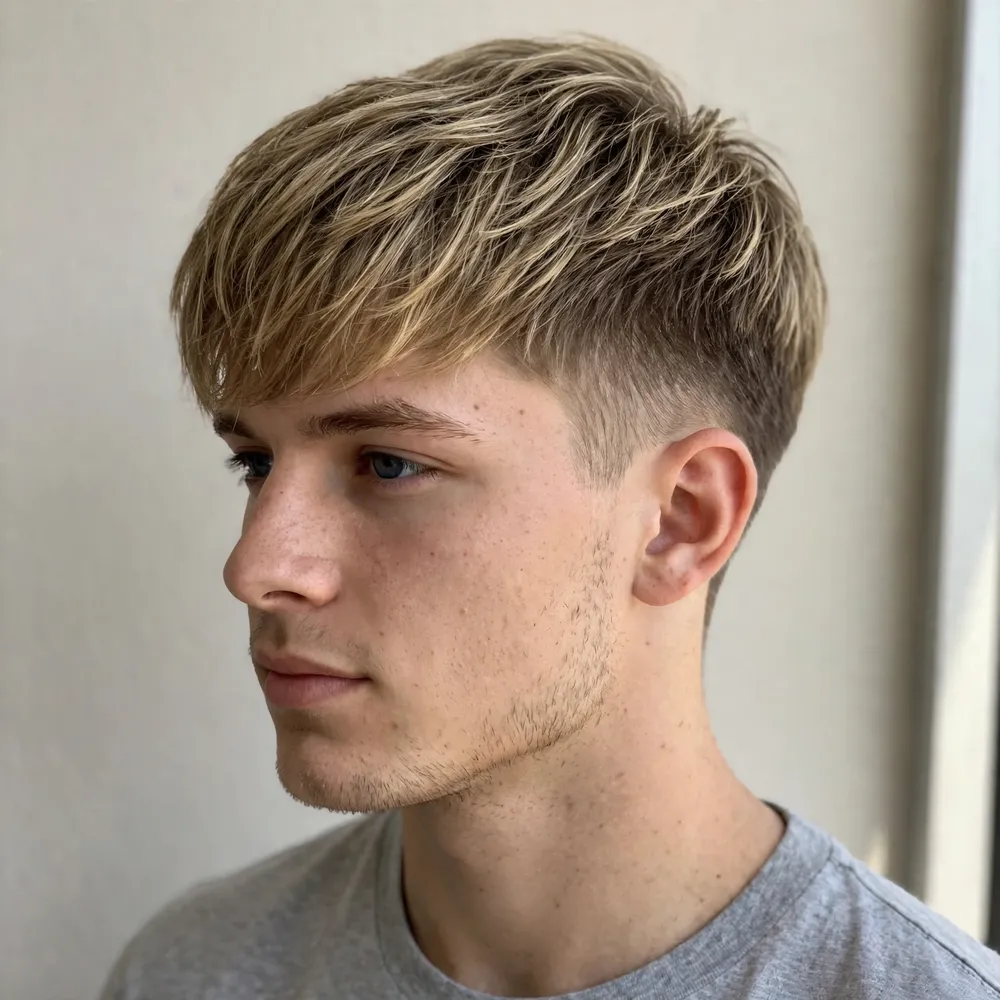
The mod cut borrows its shape from the 60s — a rounded silhouette with a fringe that sits just above the brows — but the texture keeps it from looking like a costume. The top is layered and point-cut so it has movement, the sides stay short, and the fringe is the focal point. It suits straight hair with medium thickness best, and it flatters oval and heart faces, where the rounded shape softens the features. Ask your stylist for “mod cut, textured top, fringe above the eyebrows — I want the shape but not the helmet look.” A little matte paste through the fringe, pushed forward, finishes it. The fringe needs a trim every 3 weeks to stay above the eyes.
16. Disconnected Textured Fringe
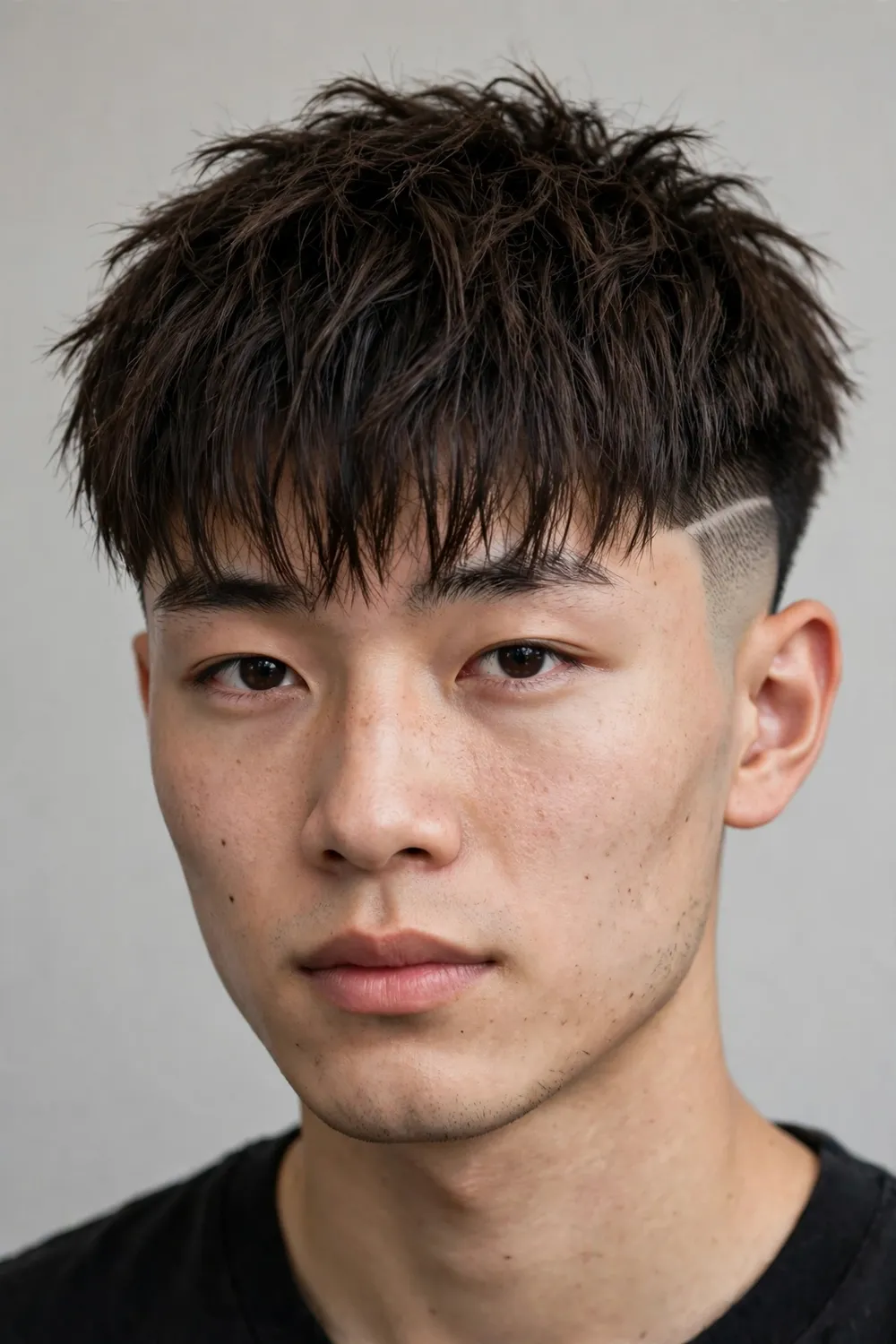
This one’s all about contrast: the sides are cut short and tight, then there’s a clear, visible step up to a long, textured fringe that falls over the forehead. No blending, no taper — the disconnect is the point. It suits thick, straight hair that can hold the weight of the fringe, and it works well on oval and square faces, where the strong line adds definition. Tell your barber “disconnected cut, short sides, long textured fringe — keep the step obvious.” Style the fringe forward with matte clay, separating it into pieces with your fingers so it doesn’t sit as one block. The disconnect needs a cleanup every 2–3 weeks or it starts to blur, and the fringe will need the odd trim to stay out of your eyes.
17. Thick Brush Up

If you’ve got thick hair, this cut finally puts it to work instead of fighting it. The top is left longer — 3–4 inches — and brushed straight up, textured so the volume breaks into pieces instead of sitting like a block. The sides are tapered to keep the bulk under control. It’s made for thick, straight or wavy hair; fine hair will struggle to hold the height. Oval, square and round faces all suit it, since the lift on top balances most shapes. Ask your barber for “brush up, keep the length on top, texture it so it’s not heavy — tapered sides.” Blow-dry upward with a vent brush and finish with a strong-hold matte clay. Trim every 3–4 weeks; thick hair grows fast and the shape goes quickly once it does.
18. Textured French Crop
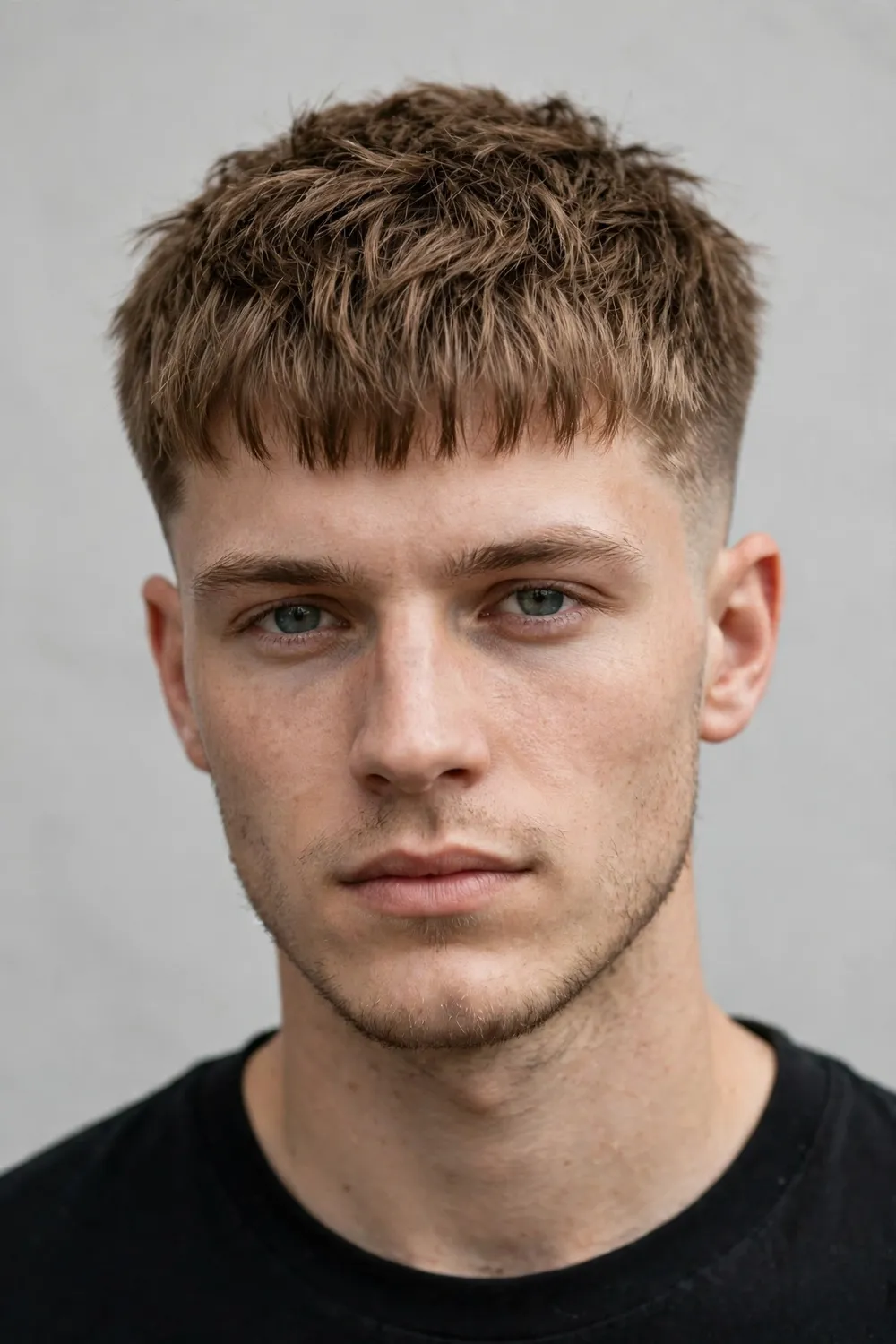
The French crop is short, neat and almost impossible to get wrong. The top is cut short with a small fringe, point-cut for texture so it doesn’t look blunt, and the sides are faded. It suits straight and wavy hair, and it’s particularly good for a receding hairline — the short fringe draws attention forward and there’s nothing to hide. Oval, square and round faces all work. Ask for “French crop, short textured top, small fringe, faded sides.” Styling is optional: a tiny amount of matte paste pushed forward is plenty, and plenty of guys wear it with nothing at all. A trim every 3 weeks keeps the fade and fringe tidy, but it’s a forgiving cut if you stretch it a week.
19. Messy Textured Medium Hair
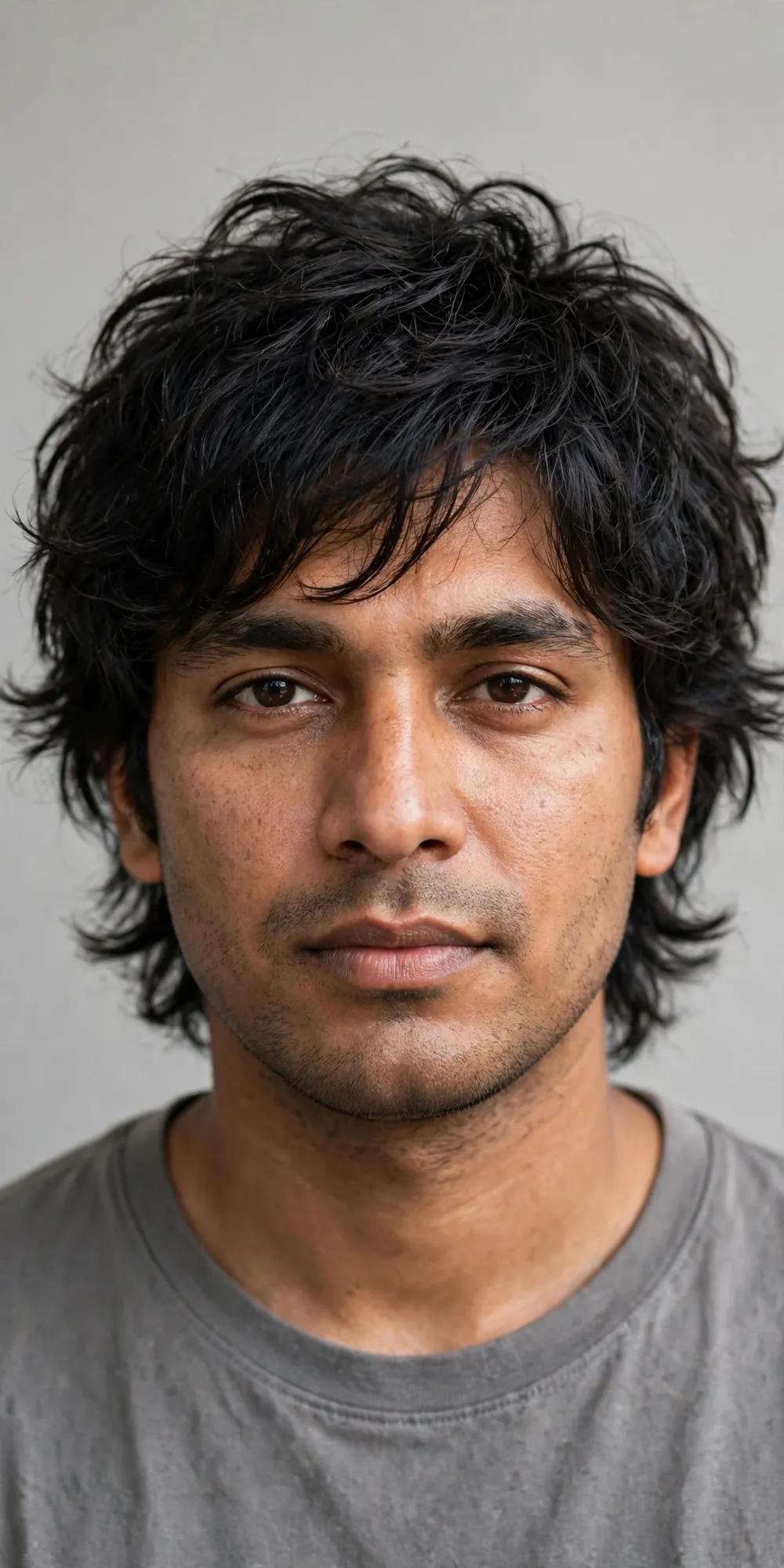
Medium length is the sweet spot for texture — long enough to move, short enough to manage. This cut keeps the hair around 4–5 inches on top, layered throughout so it falls in loose, messy pieces, with the sides kept just short enough to frame it. It suits wavy hair best, but straight hair with a bit of styling help gets there too, and it flatters oval and heart faces. Tell your stylist “medium length, lots of layers, messy textured finish — I want it to look effortless.” Sea-salt spray on damp hair, scrunched and left to air-dry, is the whole routine; a diffuser helps on humid days. Trims every 6–8 weeks keep the layers distinct without losing the length.
20. Textured Curtains
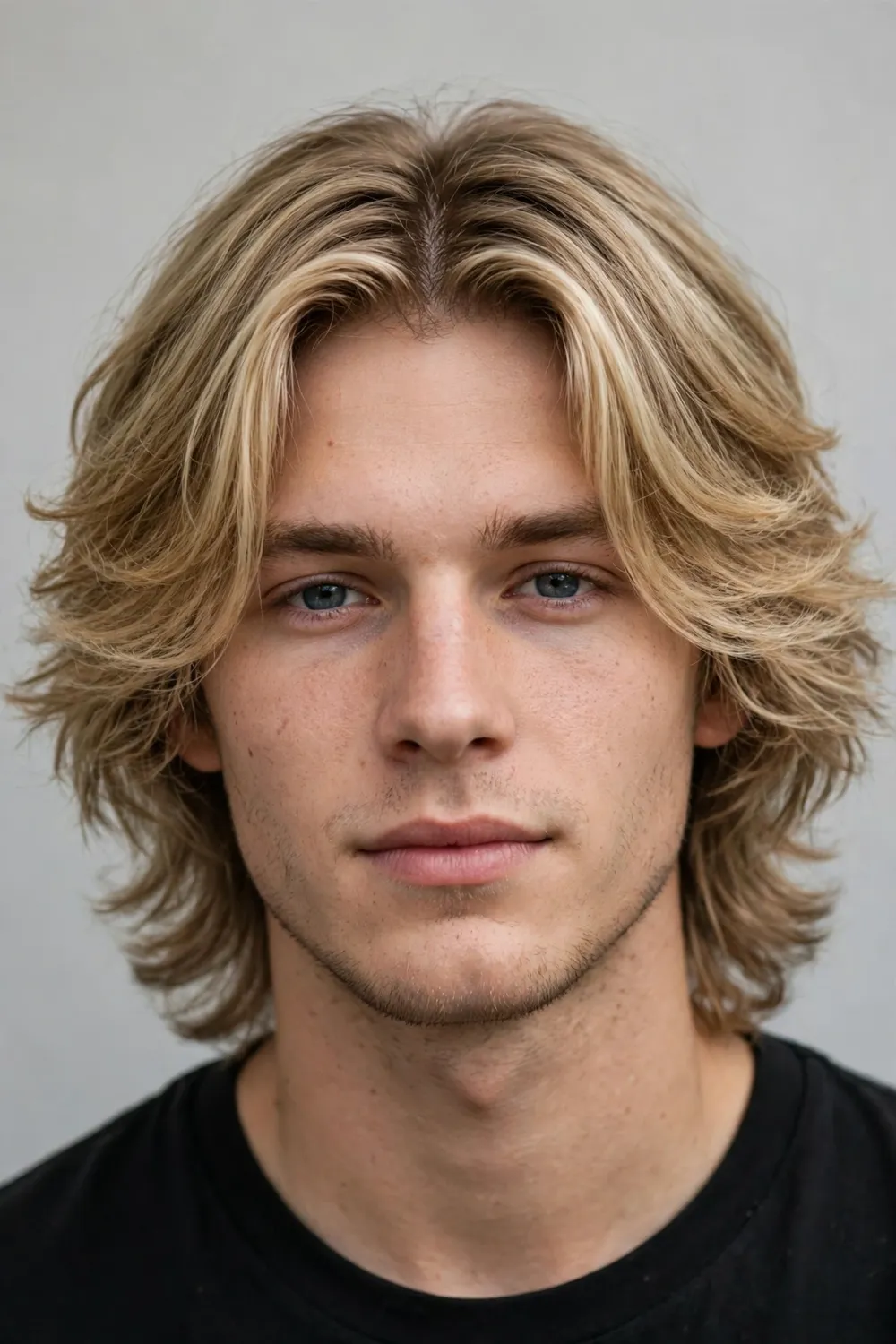
Curtains are back in a big way, and texture is what separates the modern version from the 90s original. The hair is parted in the centre and falls to either side of the face, with layers cut in so each side has movement and the ends aren’t blunt. It suits straight and wavy hair with medium thickness, and it flatters oval, heart and square faces — the face-framing layers soften strong jawlines nicely. Ask your stylist for “curtains, centre part, long layers, textured ends — I want it to fall naturally on both sides.” A little sea-salt spray and a rough blow-dry with your fingers gives it shape; the rest is just letting it do its thing. A trim every 6–8 weeks keeps the layers from growing into one length.
21. Classic Crew Cut with Taper Fade
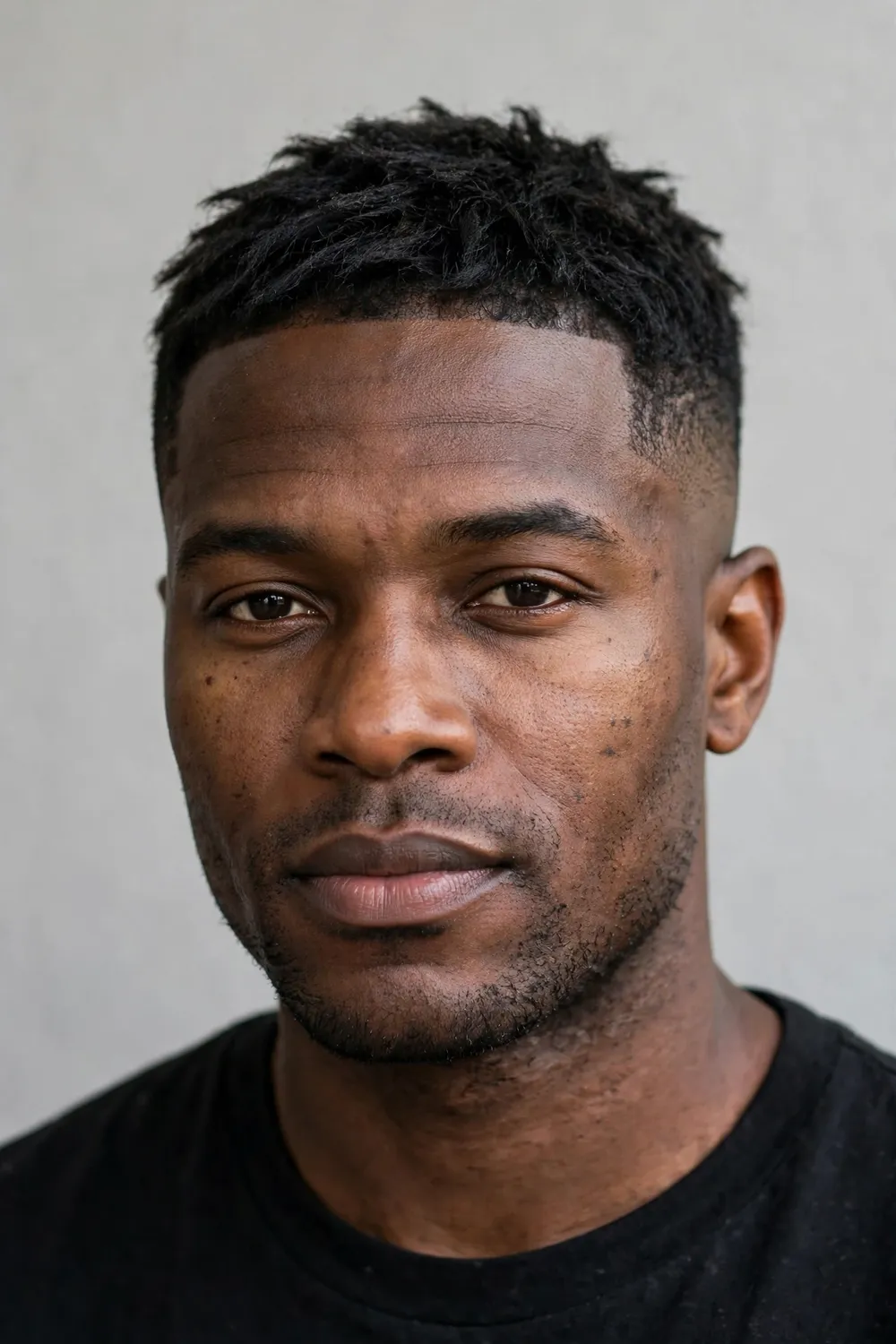
The classic crew cut has survived every trend for a reason: it’s clean, short and it suits nearly everyone. This version adds a taper fade on the sides and texture through the short top, so instead of a flat buzz-like finish you get subtle movement and a softer outline. It suits straight and slightly wavy hair, and it’s one of the most versatile cuts for face shape — square, oval, round, it works. Ask your barber for “crew cut, taper fade on the sides, a bit of texture on top so it’s not flat.” Most days need nothing but a towel-dry; a dab of matte paste adds definition if you want it. Keep it sharp with a trim every 3 weeks, though the taper is what really shows growth first.
22. Mullet Fade
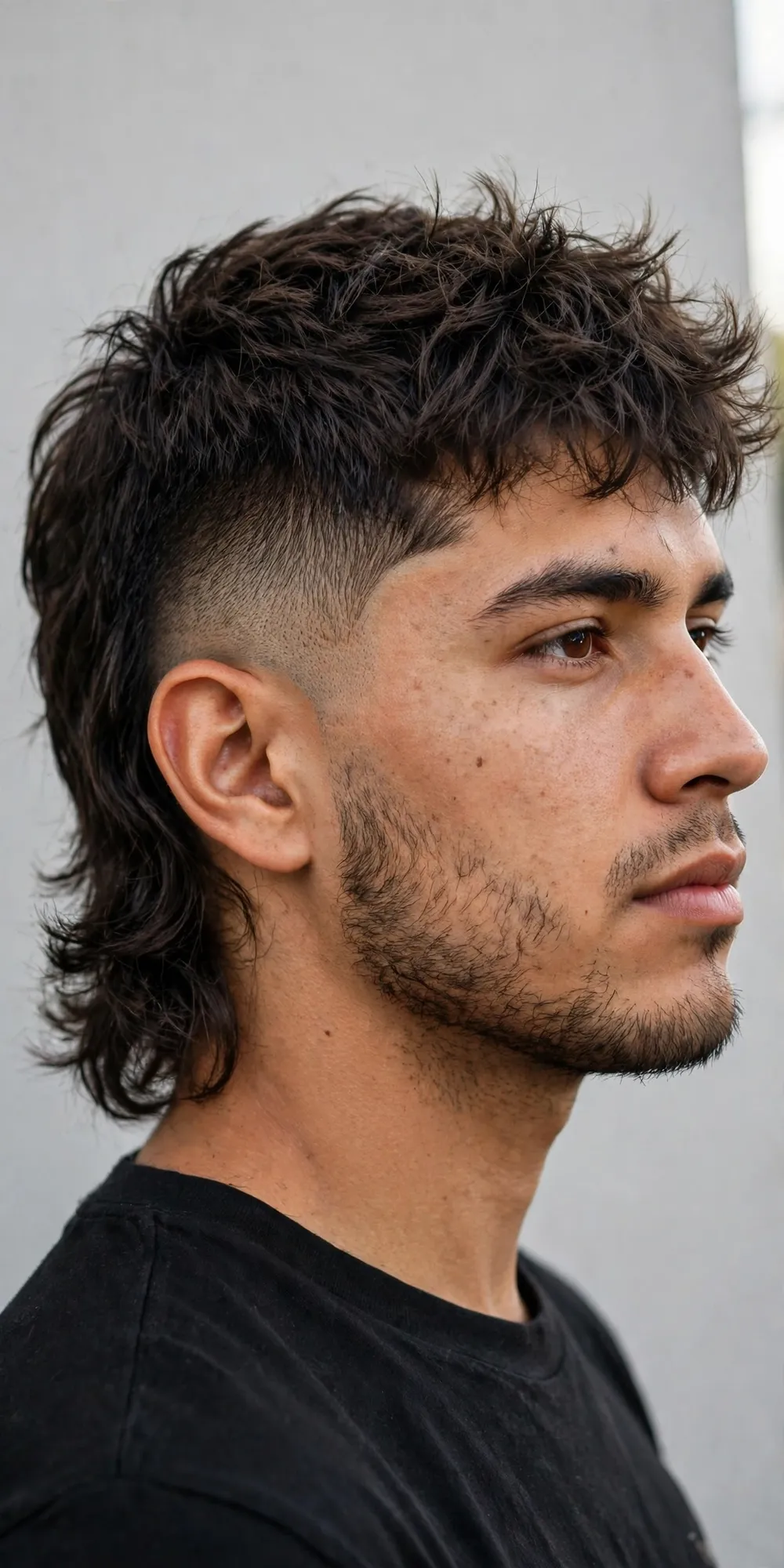
The modern mullet is nothing like the one your uncle had — the sides are faded, the top is short and textured, and the length at the back is the statement. It works best on wavy or straight hair with enough thickness to give the back some presence, and it suits oval and heart faces, where the length at the back balances the features. Ask your barber for “mullet with a fade, textured top, keep the length at the back — short on the sides, not shaved.” A little matte paste through the top and a scrunch at the back is all it needs. The fade needs a cleanup every 2–3 weeks, but the back grows out gracefully — that’s the whole point of the cut.
23. Side Swept Hair with Short Sides
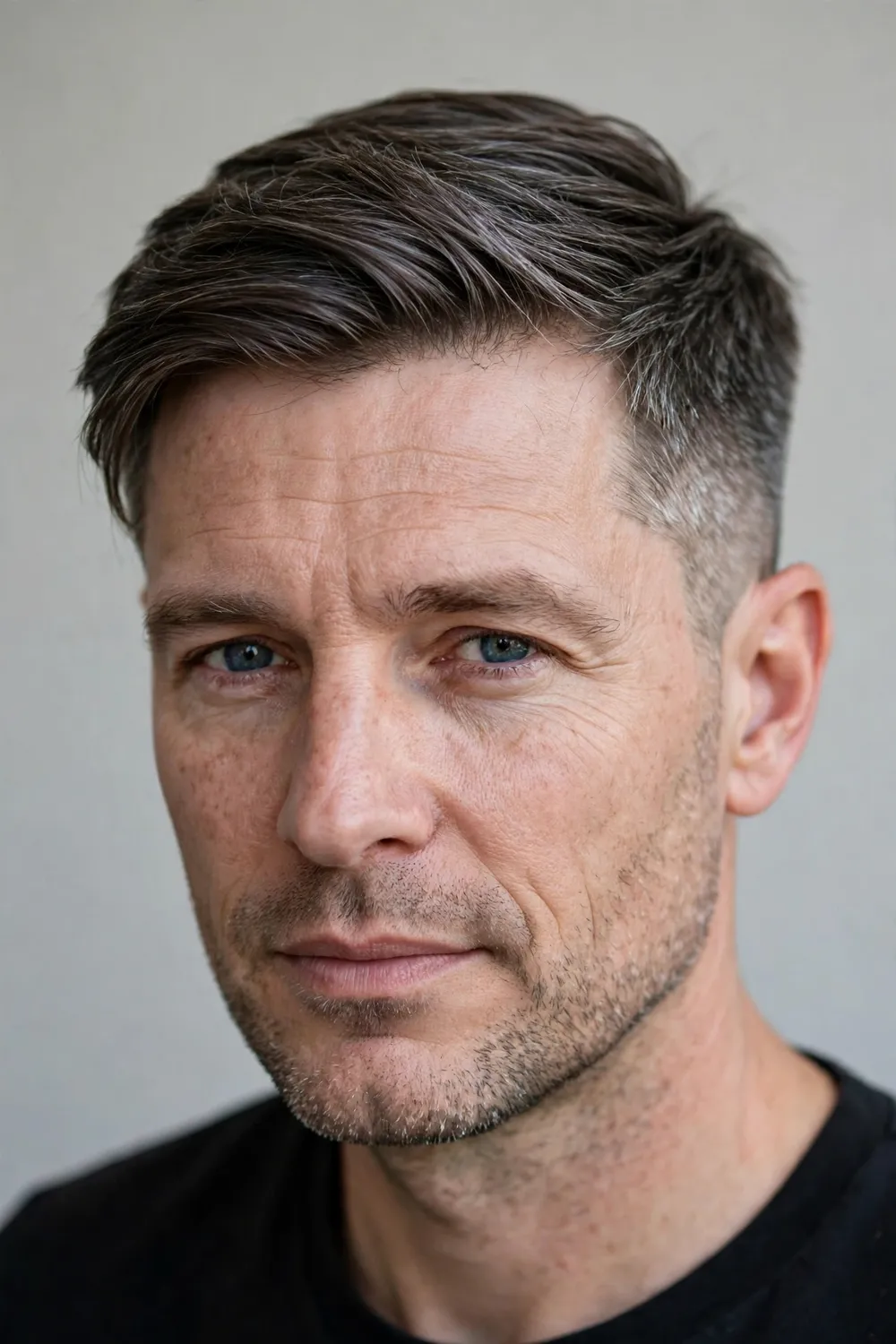
The side sweep is the relaxed cousin of the side part: the top is left long enough to fall across to one side, textured so it breaks into pieces, while the sides are kept short and neat. There’s no hard part line, so it reads softer and more casual. It suits straight and wavy hair with medium thickness, and it flatters most face shapes — the diagonal line adds width to narrow faces. Tell your barber “side swept, longer on top with texture, short sides — no hard part.” Style it by pushing damp hair to one side with your fingers and a little matte clay, letting a few pieces fall forward naturally. A trim every 3–4 weeks keeps the sides tidy and the sweep from getting too heavy.
24. Textured Brush Back
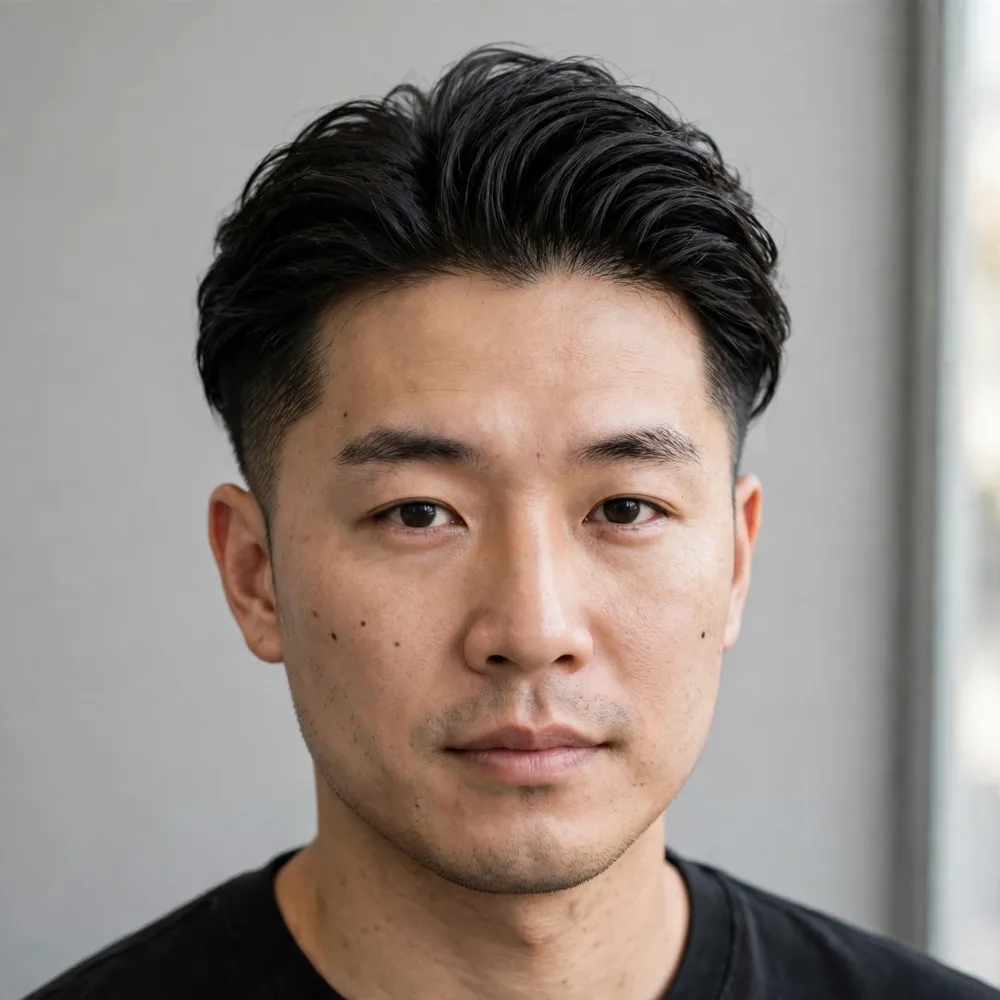
The brush back takes the classic swept-back shape and loosens it up with point-cut layers, so it looks groomed without looking shellacked. Instead of one solid sheet of hair, you get pieces that move and separate naturally. It works best on straight to slightly wavy hair with medium thickness, and it suits oval, square and oblong faces — the height on top lengthens rounder faces too. Tell your barber you want the top left 3 to 4 inches, point-cut through the ends, with the back and sides tapered rather than faded to nothing. Style it with a small scoop of matte clay, blow-dried backwards with your fingers. Maintenance is easy: a trim every 4 to 5 weeks keeps the shape, though a quick blow-dry most mornings stops it falling flat.
25. Modern Pompadour Fade
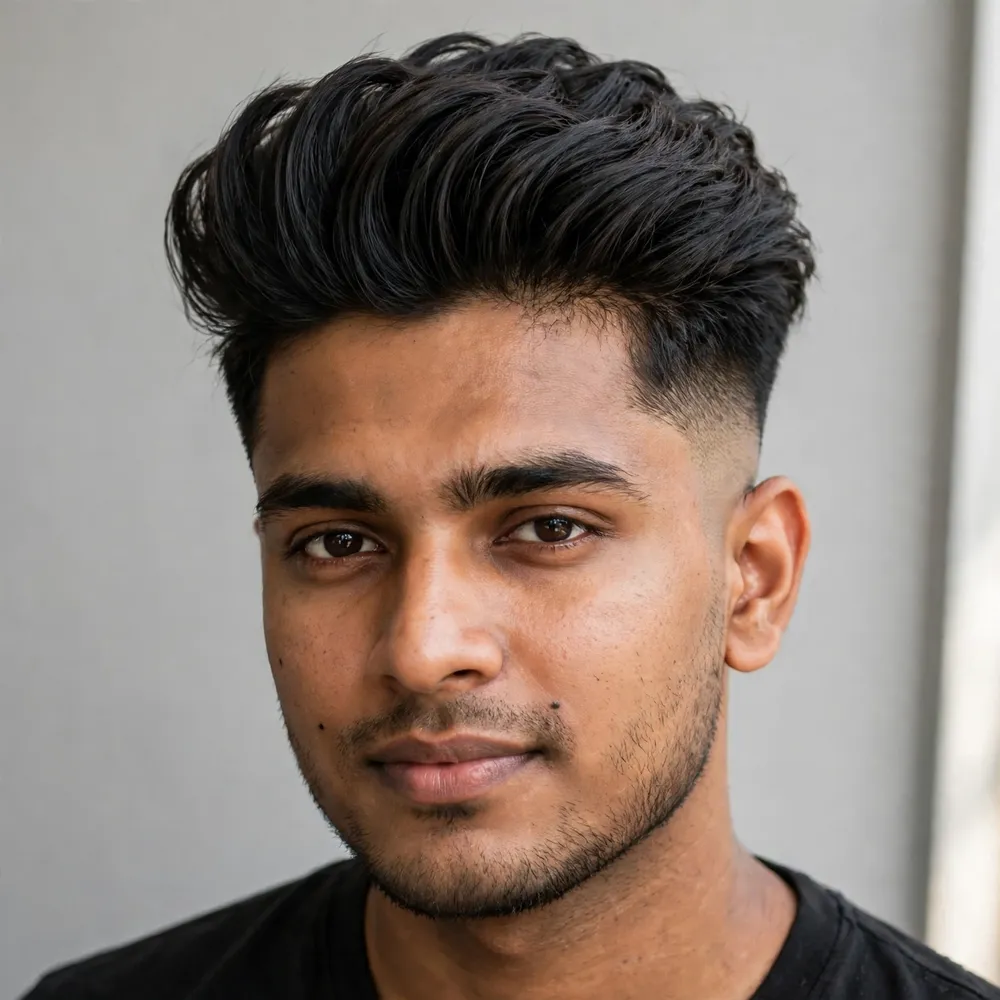
This is the pompadour with the stiffness removed. The top keeps its signature height and backward sweep, but choppy texture through the ends stops it looking like a helmet, while a fade on the sides gives it a modern edge. Thick, straight or wavy hair holds the shape best; guys with fine hair can still pull it off with volumising powder underneath. It flatters oval and square faces, and the height works well for rounder faces too. Ask your barber for 4 to 5 inches on top, heavily point-cut, with a mid or high fade on the sides. Blow-dry upward with a round brush, then work in matte pomade. It needs 5 to 10 minutes of styling daily, and a cut every 3 to 4 weeks keeps the fade sharp.
26. Textured Short Hairstyle with Mid Fade

Short, sharp and almost zero-effort — this cut pairs a choppy textured top with a mid fade that sits neatly between subtle and skin-tight. The texture stops a short crop looking flat and one-dimensional, which is exactly why it’s become such a reliable everyday choice. It suits pretty much every hair type, including fine hair, because the short length and texture create the illusion of thickness. Oval, square and round faces all work. Tell your barber you want about 1.5 to 2 inches on top, point-cut throughout, with a mid fade blended up the sides. Rub a pea-sized amount of matte clay through damp hair and push it roughly into place. Trims every 3 weeks keep the fade crisp, and styling takes under a minute.
27. Faux Hawk

The faux hawk keeps the mohawk’s attitude and drops the commitment. A strip of longer hair runs down the centre, pushed upward and slightly forward, while the sides are clipped short or faded so the contrast does the talking. Texture through the centre strip is what makes it look modern rather than 2000s throwback — choppy ends instead of glued-together spikes. It works on straight, wavy and thick hair, and suits oval, square and heart-shaped faces. Ask your barber for 2 to 3 inches through the centre, point-cut, with a low to mid fade on the sides. Style with a strong-hold matte clay, pushing the centre up with your fingers. Daily styling takes a couple of minutes, and you’ll want a trim every 3 to 4 weeks.
28. Long Loose Curls
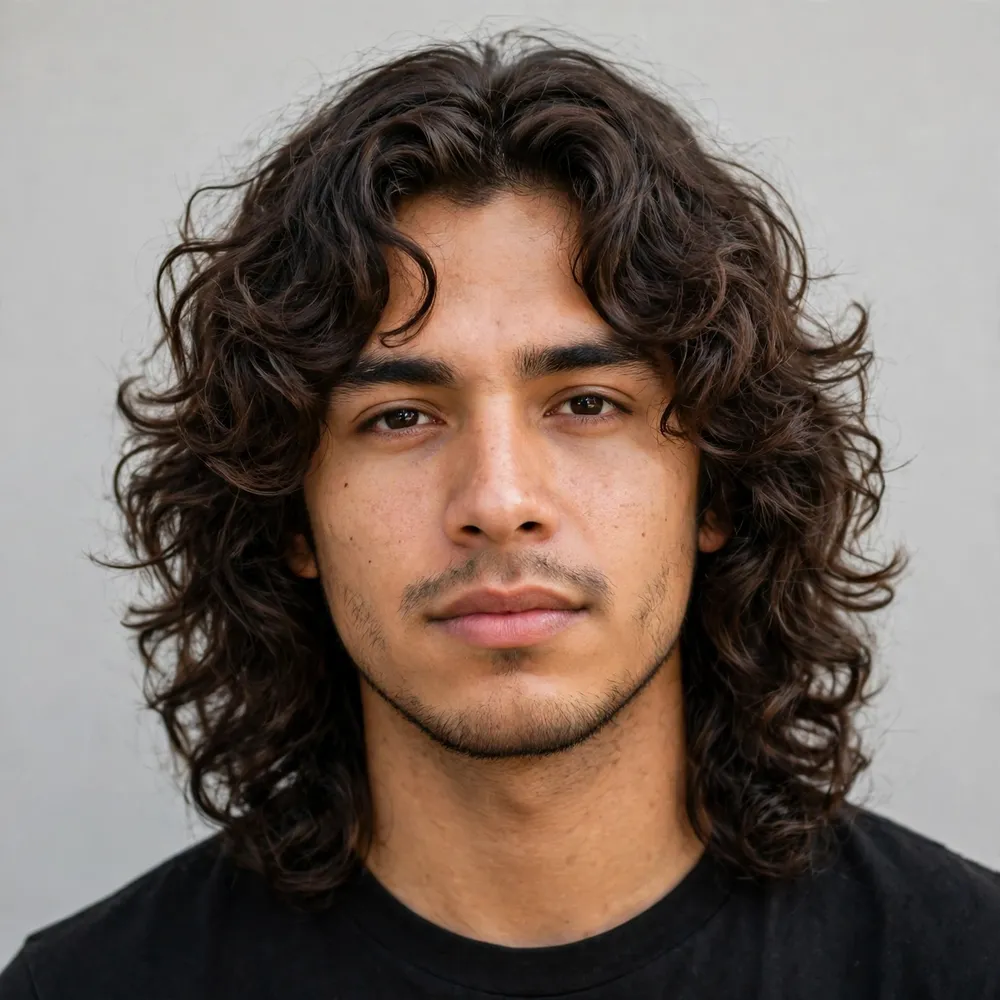
Long loose curls are all about letting your natural curl pattern do the work. Layers cut through the length remove bulk and let each curl form properly, so you get movement, bounce and a shape that frames your face. This one is obviously for naturally curly or wavy hair, and it suits oval, oblong and square faces — the volume at the sides balances longer face shapes nicely. Ask your stylist for long layers cut dry, curl by curl, with the length kept at least past the ears. Scrunch in a curl cream on damp hair and let it air-dry. Maintenance is honest work: trims every 8 to 10 weeks, and you’ll need a proper curl routine, but the payoff is a genuinely effortless-looking head of hair.
29. Short Brush Forward with High Skin Fade
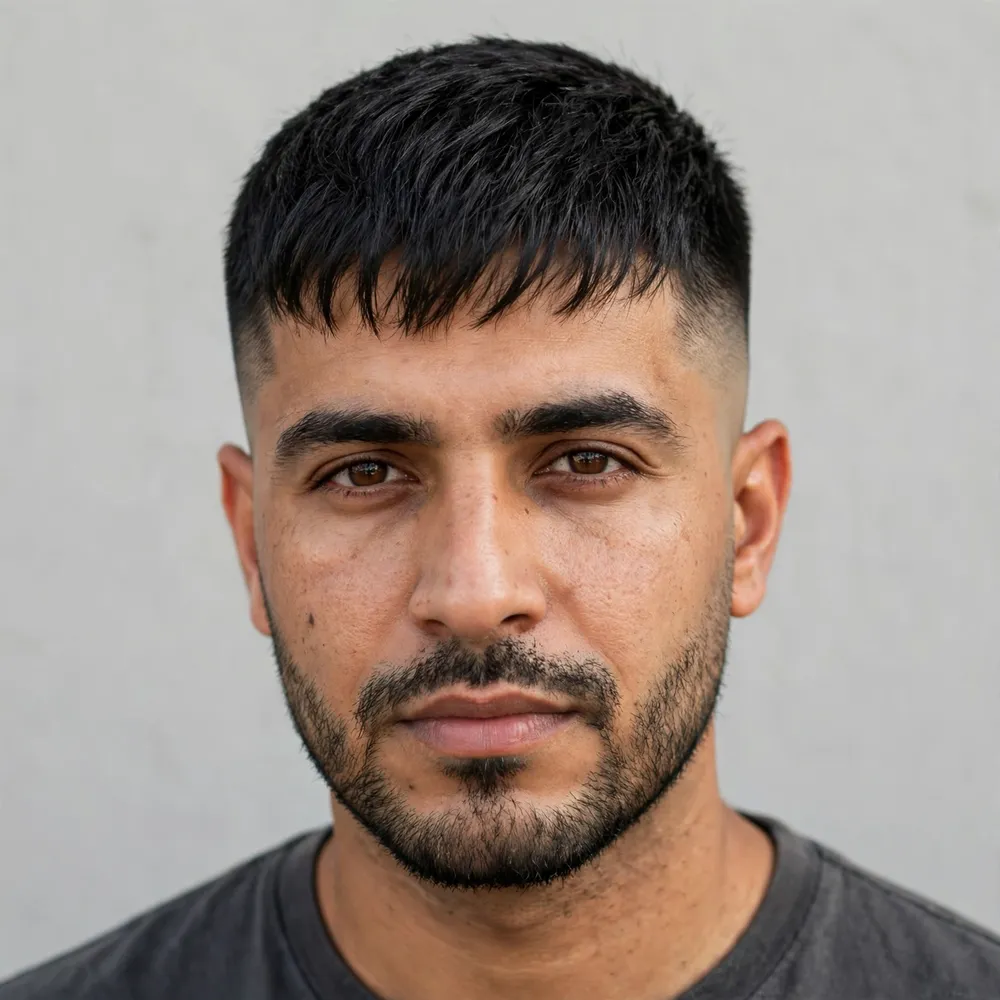
Everything about this cut is designed to look sharp with almost no styling. The top is kept short and brushed forward, with choppy texture breaking up the fringe line, while a high skin fade gives the sides a clean, skin-tight finish that makes the whole thing pop. It suits straight and slightly wavy hair best, and it’s a strong pick for guys with a strong hairline or a forehead they’d rather not show off. Oval and square faces look great with it. Tell your barber you want 1 to 2 inches on top, point-cut and brushed forward, with a high skin fade. A dab of matte paste is all you need, if anything. The skin fade needs a touch-up every 2 to 3 weeks, but styling takes 30 seconds.
30. Messy Spiky Hair and Fringe with Low Drop Fade
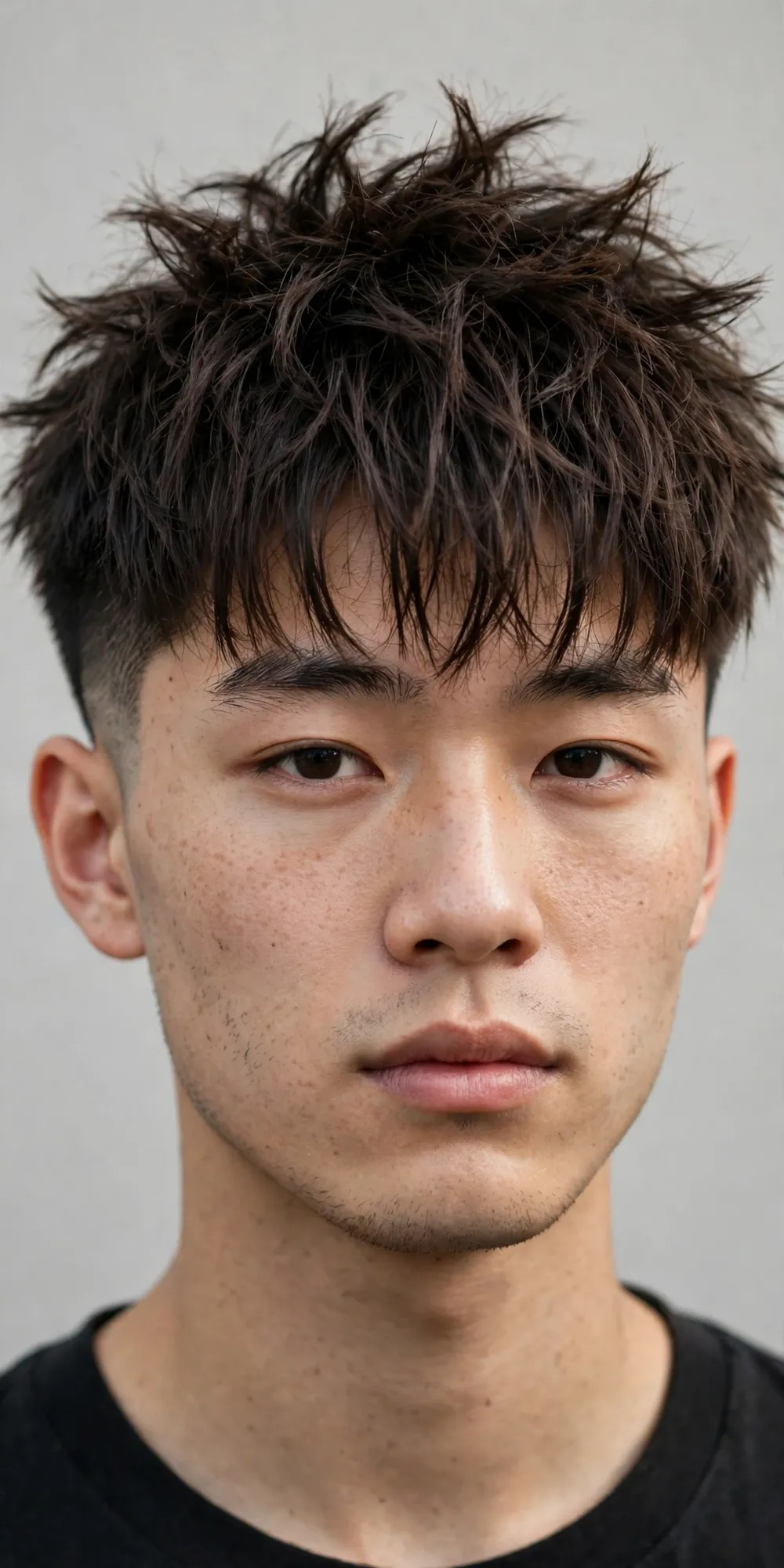
This cut piles three ideas into one look: a spiky textured top, a fringe that falls forward, and a low drop fade that curves down behind the ear. The result is youthful and a bit rebellious without going full punk. It suits straight to wavy hair with medium thickness, and it works well on oval, square and heart-shaped faces — the fringe softens a wider forehead. Ask your barber for 2 to 3 inches on top, point-cut into spikes, with a low drop fade on the sides and back. Work a strong matte clay through towel-dried hair, pulling pieces upward and forward with your fingertips. Expect to spend a few minutes styling each morning, and book a trim every 3 to 4 weeks to keep the fade’s curve clean.
31. Textured Crop with Skin Fade
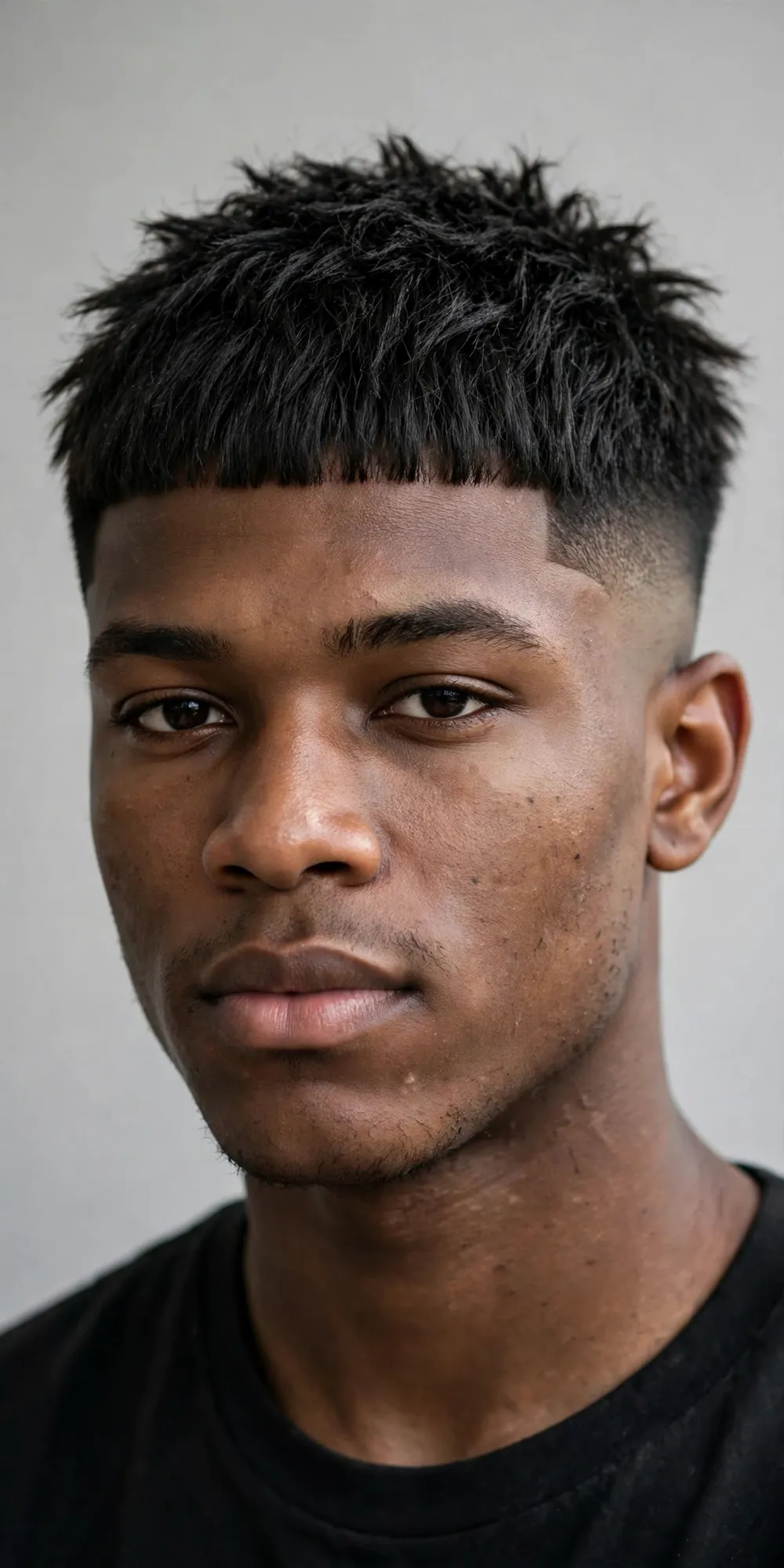
The textured crop with a skin fade is the cut you get when you want maximum contrast with minimum fuss. A short, choppy top of under 2 inches sits against sides faded to the skin, so the texture stands out even more. It suits straight and wavy hair, and it’s especially good for fine hair, because short choppy pieces look thicker than a flat crop ever will. Oval, square and round faces all suit it. Tell your barber you want a short crop, heavily point-cut on top, with a skin fade that starts low or mid. Style it with a little matte clay, pushed forward or to the side. The catch is the skin fade — it grows out fast, so plan a trim every 2 to 3 weeks.
32. Textured Ivy League
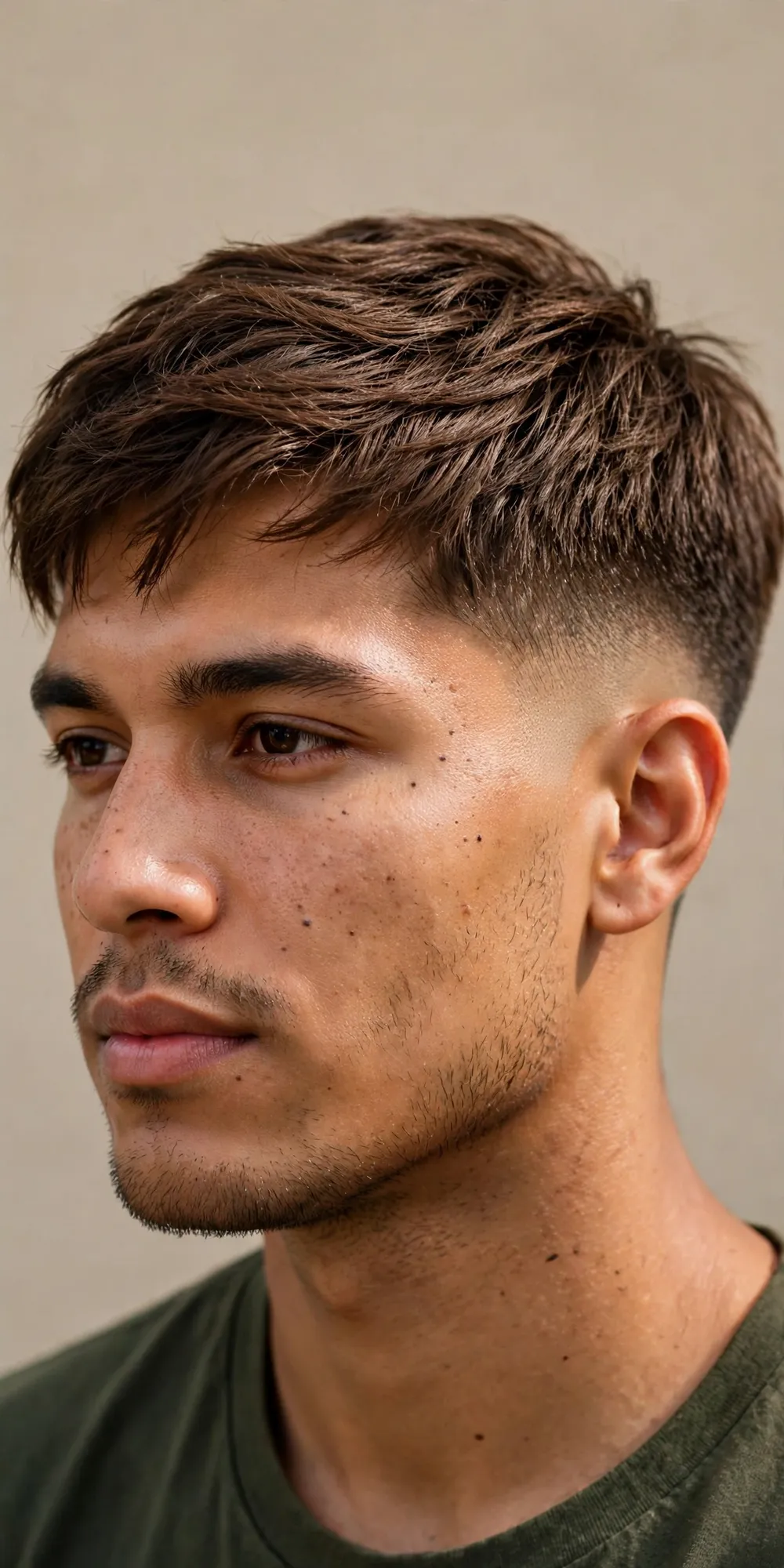
Think of this as the Ivy League for guys who don’t want to look board-meeting ready. The classic shape is still there — short sides, a neat side part, a top you can sweep over — but choppy texture replaces the old polished finish, so it looks lived-in rather than lacquered. It works best on straight to wavy hair with medium thickness, and it suits oval, square and rectangular faces, especially guys who want something office-appropriate. Ask your barber for around 2 inches on top, point-cut for movement, with tapered sides and a soft side part. A small amount of light-hold cream gives it a natural finish. Maintenance is forgiving: a trim every 4 to 5 weeks, and it still looks decent on days you skip styling.
33. Textured Caesar Cut
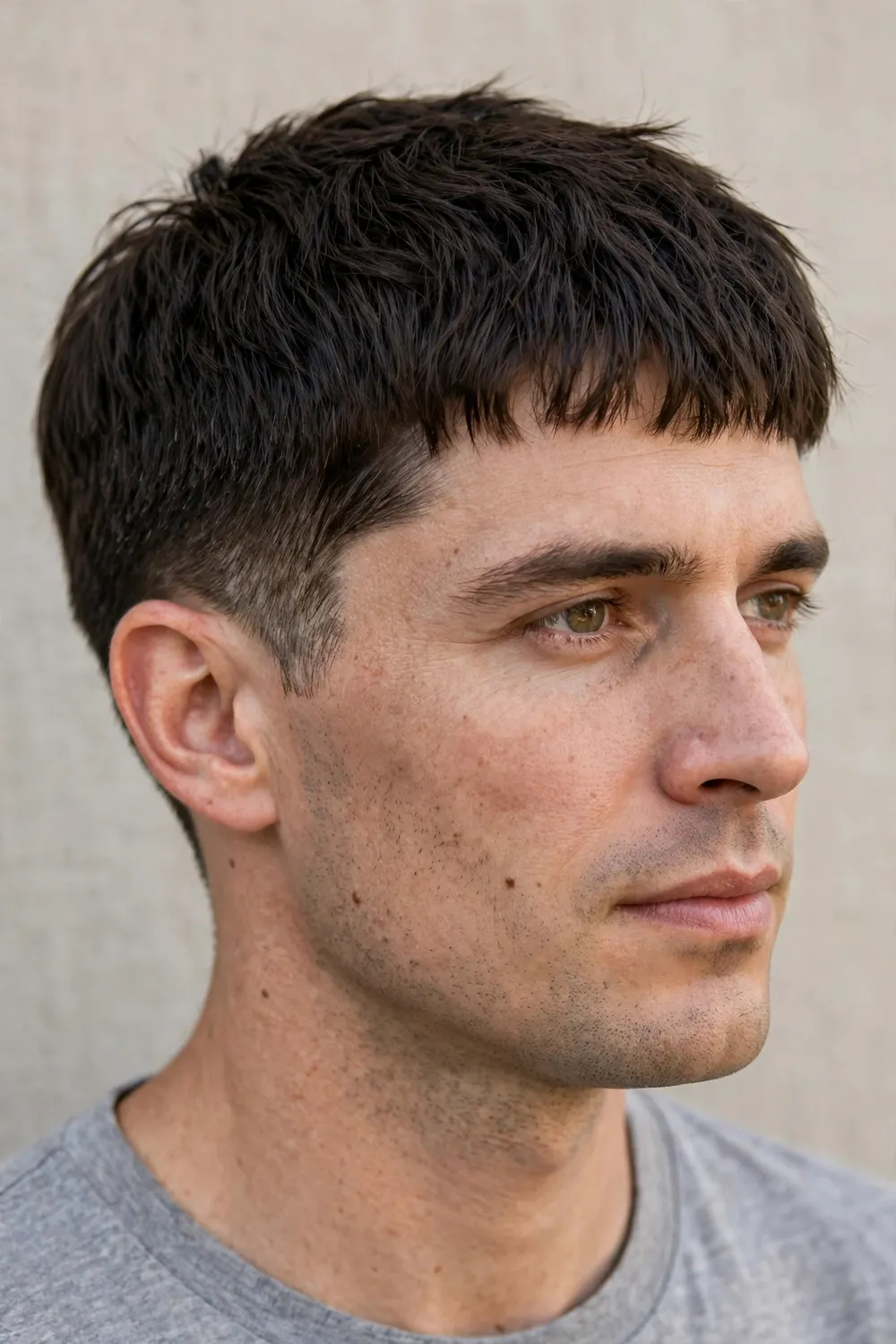
The Caesar has been around since Rome, but the textured version is what keeps it relevant. A short, straight fringe sits across the forehead, and instead of the old flat, uniform top, point cutting adds separation and movement through the whole crown. It’s a smart choice for straight hair, and it works brilliantly for a receding hairline — the forward fringe covers the hairline while the texture distracts from any thinning. Oval, square and round faces suit it. Tell your barber you want the top kept at 1 to 2 inches, textured throughout, with a short blunt fringe and tapered or faded sides. Style with a fingertip of matte paste, pushed forward. Trims every 3 to 4 weeks keep the fringe line honest.
34. Textured Buzz Cut
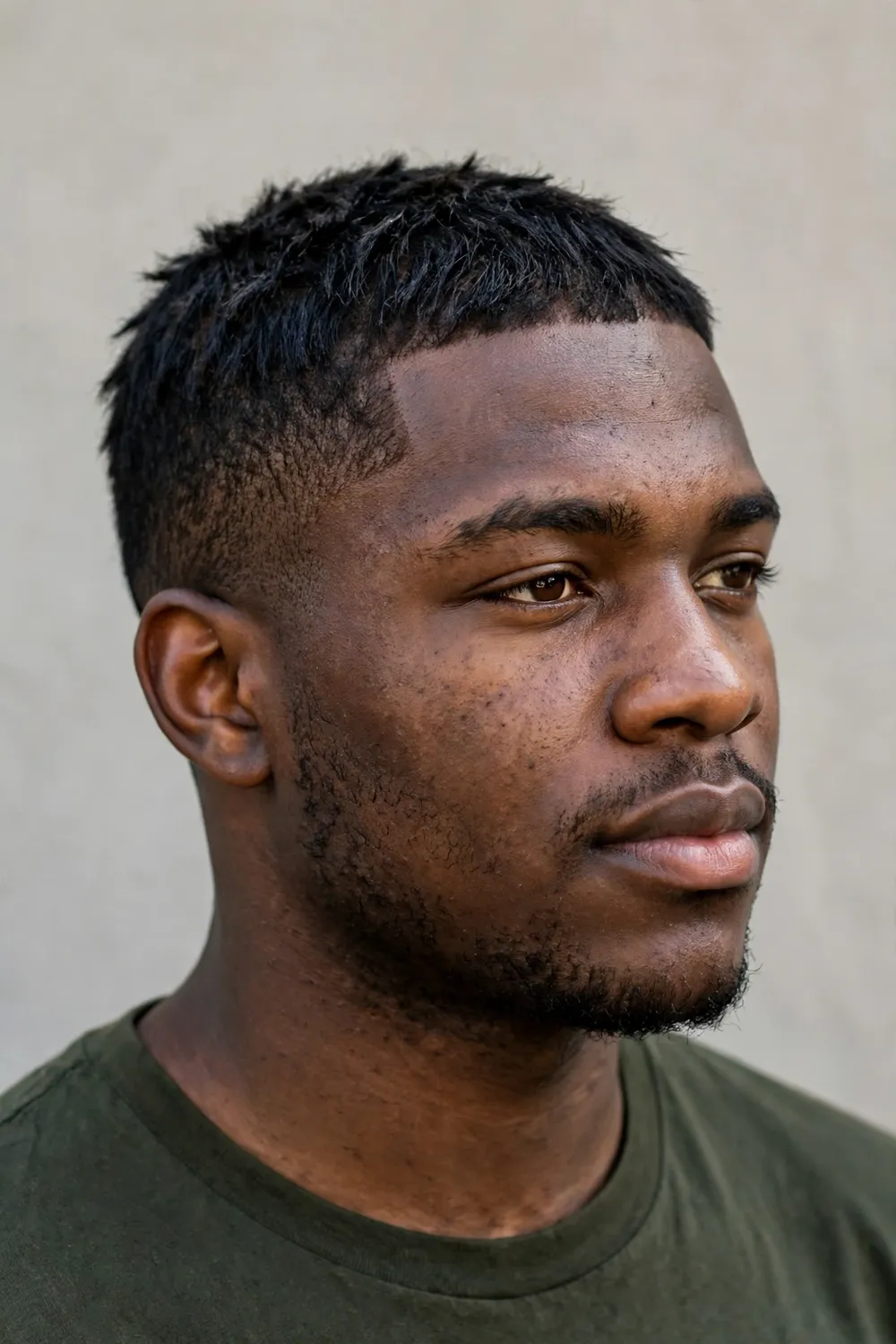
A buzz cut with texture sounds like a contradiction, but it works. Instead of one uniform clipper length, your barber varies the guard slightly and finishes the top with thinning shears, so the very short hair has subtle variation instead of looking like a flat carpet. It’s ideal for thick hair that would otherwise look too dense at buzz length, and it suits oval and square faces best, since the shape of your head does the heavy lifting. Ask for a number 2 or 3 on top, slightly shorter on the sides, finished with texturising shears. Styling is non-existent, though a little matte paste can add definition. You’ll want a buzz every 2 to 3 weeks to keep it tight, but that’s a five-minute job at home with clippers.
35. Textured Edgar Cut

The Edgar is not a subtle haircut — a straight blunt fringe, a textured top, and a sharp fade make it one of the boldest styles on this list. Texture on top stops the fringe looking like a Lego hairpiece; choppy layers break up the hard line and add movement. It suits straight, thick hair best, and works on oval, square and heart-shaped faces — if you like a strong, defined look. Ask your barber for a straight fringe cut blunt across the forehead, texture through the top, and a mid or high fade with a sharp lineup. Style it forward with a light matte product — no volume needed. The fringe and lineup need a trim every 2 to 3 weeks, so be honest about whether you’ll keep up.
36. Textured Blowout

The blowout is pure volume. Hair is blow-dried upward and outward with a round brush, the ends left textured, so you get height and movement instead of a flat wall of hair. It looks best on thick, straight to wavy hair that can hold volume — fine hair will need a volumising mousse to get the same lift. Oval and oblong faces suit it well, and the height flatters rounder ones. Tell your barber you want 3 to 5 inches on top, layered and point-cut, with tapered sides that stay neat underneath the volume. At home, blow-dry with a round brush and finish with a light matte cream. It takes 10 minutes to style, and needs a cut every 4 to 5 weeks to stop the weight pulling it down.
37. Textured Afro with Taper
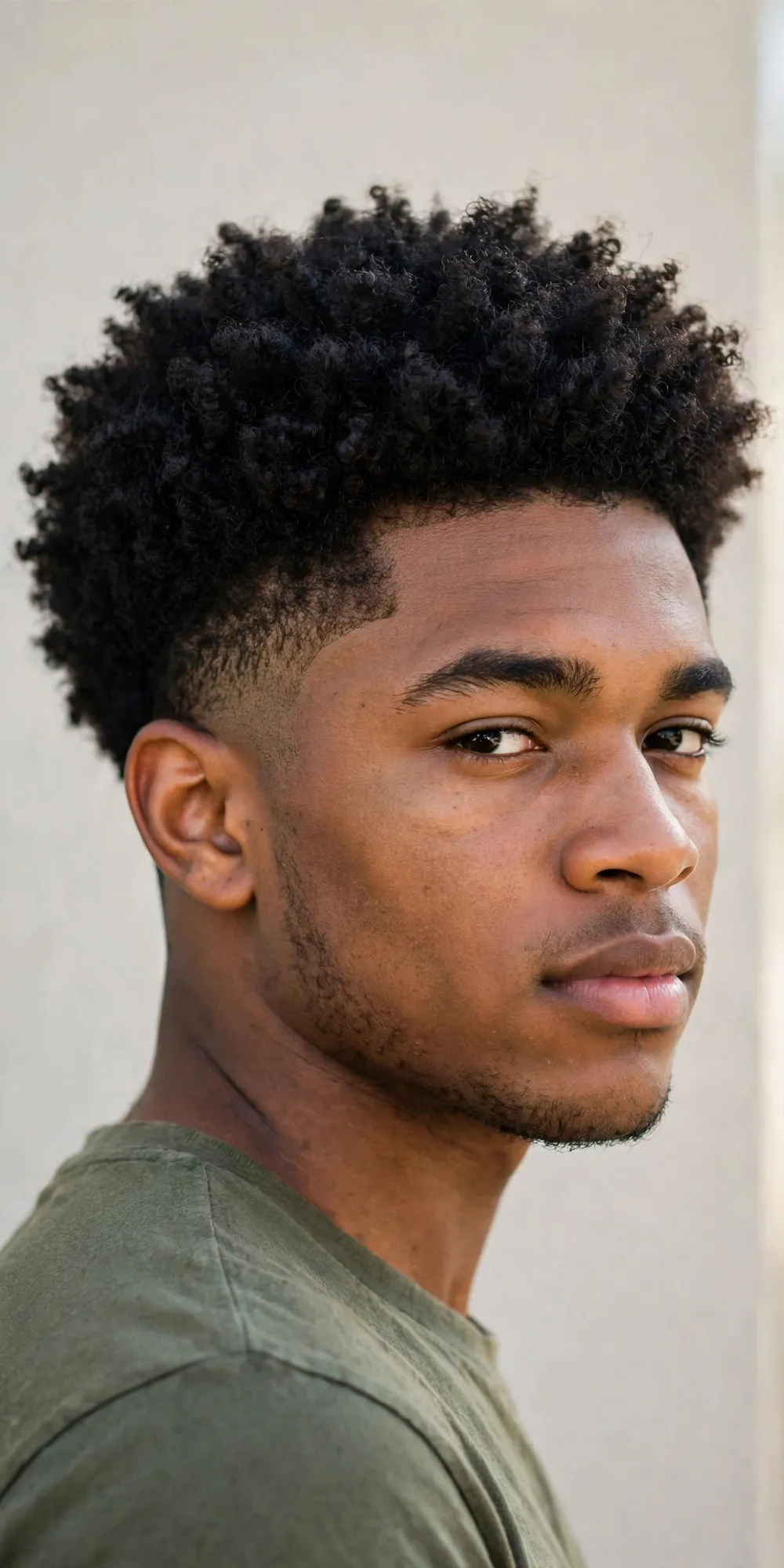
A textured afro with a taper is about shape control. The top keeps its full, rounded afro silhouette, but your barber shapes it so the curls have definition rather than frizz, while a taper on the sides and back keeps the outline clean. It’s for tightly curled and coily hair, and the rounded shape suits oval, square and oblong faces — it adds width where longer faces need it. Ask your barber for an afro shape with texture picked through the curls and a low taper on the sides, no hard lines. A curl cream or light oil keeps it defined; a pick lifts the shape back up between washes. Trims every 4 to 6 weeks keep the silhouette tidy, and a silk pillowcase genuinely helps it last longer.
38. Textured Two Block Haircut

The two block is a K-style favourite for a reason: the top stays long and textured while the sides and back are clipped short, with a clear disconnect between the two sections. That contrast makes the textured top look fuller, and gives you two looks depending on whether you wear it down or pushed back. It suits straight to wavy hair with medium to thick density, and oval, square and heart-shaped faces. Ask your barber for 3 to 4 inches of textured length on top, point-cut, with the sides clipped short underneath and a visible disconnect. Style with matte clay for a messy finish, or a light cream when you want it neater. The disconnect grows out awkwardly, so expect a trim every 3 to 4 weeks.
39. Textured Wavy Fringe

If your hair has a natural wave, this cut works with it instead of fighting it. A fringe falls over the forehead in soft, wavy pieces, and textured layers let each wave form naturally instead of being forced straight. It’s made for wavy hair — straight hair needs sea-salt spray to fake the movement — and it suits oval, square and heart-shaped faces, especially guys wanting to soften a strong forehead. Ask your stylist for a fringe cut into the waves, layered and point-cut, with the sides tapered to keep the focus up front. Scrunch in sea-salt spray on damp hair and let it dry naturally. Maintenance is light: a trim every 5 to 6 weeks, and day-two hair often looks better than day-one hair with this one.
40. Textured Slick Back with Fade
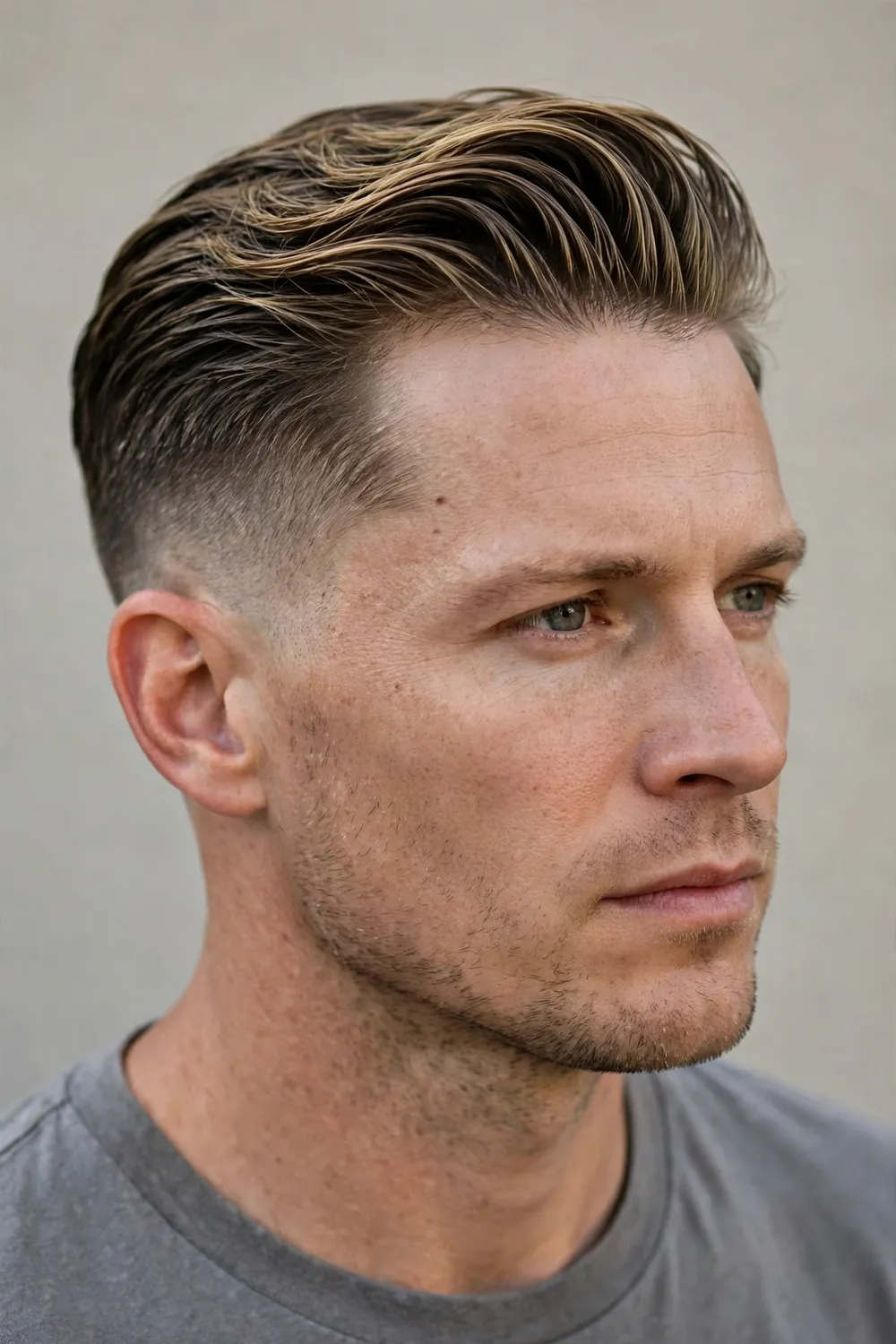
The slick back has a reputation for looking severe; texture changes that completely. Instead of hair plastered flat, point-cut layers let pieces separate as you push them back, so you get the swept-back shape with movement and attitude. It suits straight to wavy hair with medium to thick density, and it flatters oval, square and oblong faces — the backward sweep opens up the face nicely. Tell your barber you want 3 to 4 inches on top, point-cut through the ends, with a mid or high fade on the sides. Blow-dry it backwards with a little matte clay for a modern finish, or pomade if you want shine. The fade needs a trim every 3 to 4 weeks, and a few minutes with a dryer most mornings.
41. Textured Curly Top with High Fade
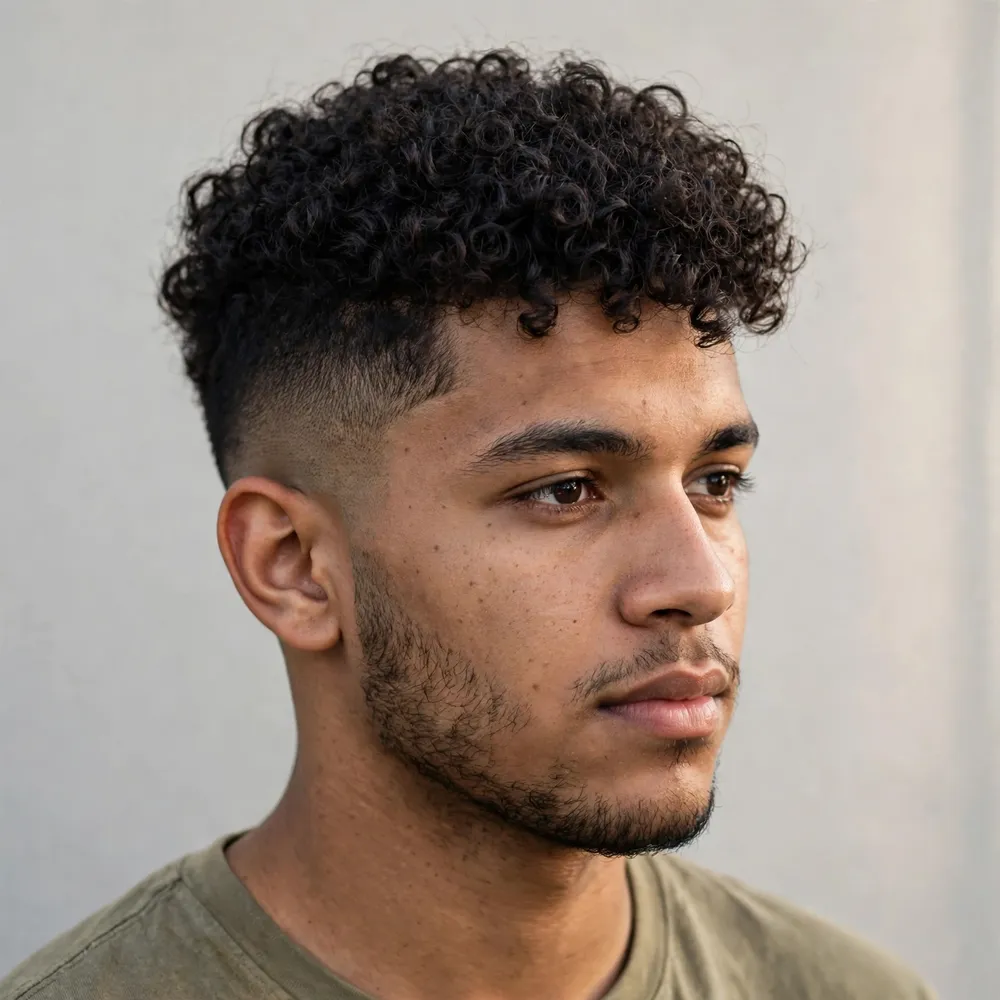
This cut is built around one idea: let the curls be the star. Tight curls stay long on top, shaped with texture so each curl has room to form, while a high fade strips the sides down to almost nothing for maximum contrast. It suits naturally curly and coily hair, and the height on top flatters round and square faces particularly well. Ask your barber for the curls left at least 2 to 3 inches, cut curl by curl for shape, with a high fade on the sides and back. Scrunch in curl cream on damp hair and let it air-dry — don’t touch it while it dries. The fade needs a trim every 3 weeks, but the curls themselves are forgiving between cuts.
42. Textured Burst Fade Crop
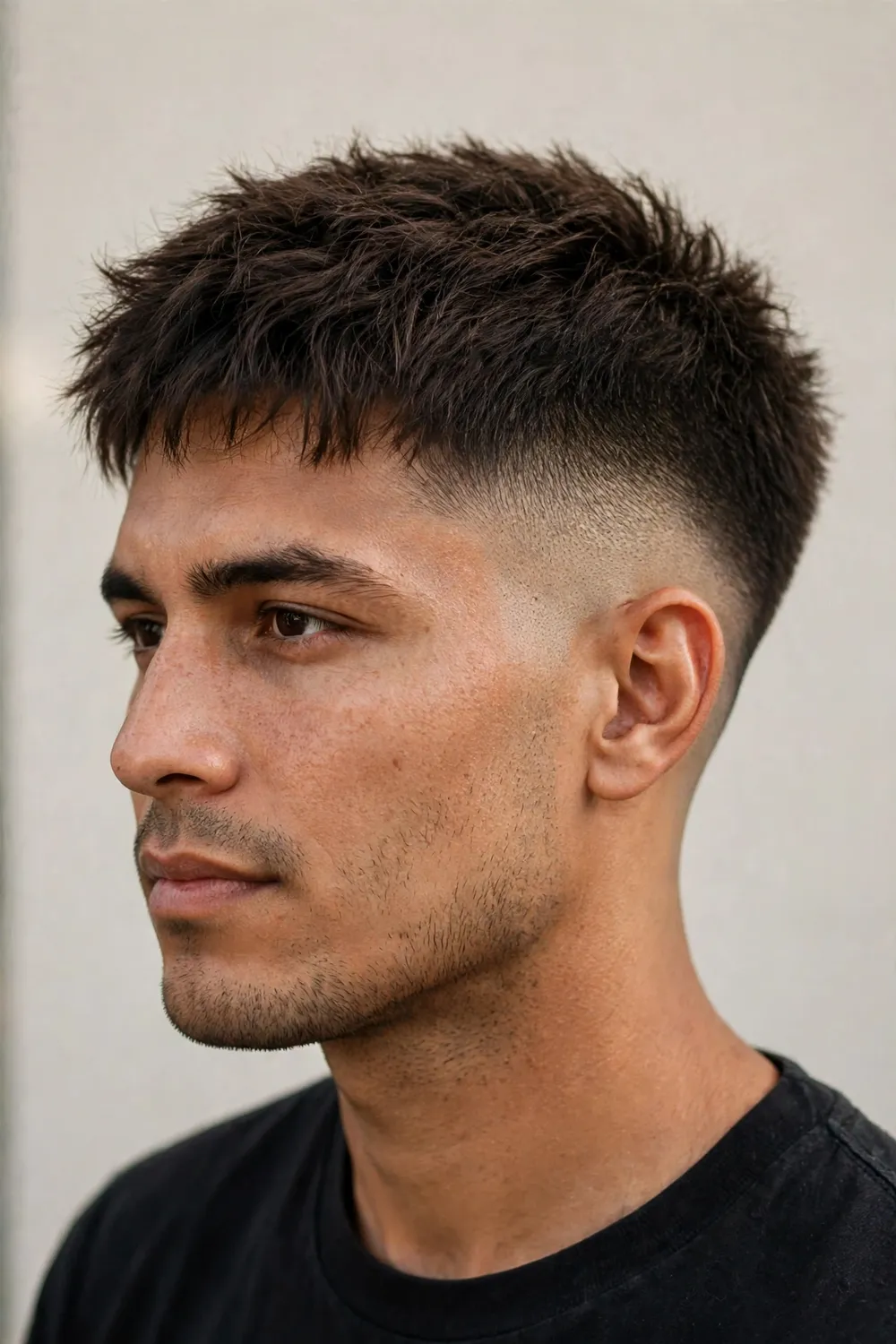
The burst fade is the detail that makes this crop stand out. The fade curves around the ear in a semicircle, leaving length at the neck, while the top is cut short and choppy for a rough, lived-in texture. It’s a great pick for straight and wavy hair, suiting oval, square and round faces — the curved fade adds shape a straight fade doesn’t. Tell your barber you want a short choppy crop, point-cut on top, with a burst fade arcing around the ears. A little matte clay pushed forward with your fingers is all the styling it needs. The burst fade is fiddly to grow out, so book a trim every 3 weeks, and make sure your barber can cut a proper burst — not every barber can.
43. Long Textured Layers with Undercut

Long hair with an undercut sounds extreme, but in practice it’s a clever bit of engineering. The top stays long — past the ears, often to the jawline — and is cut with long layers for movement, while the undercut underneath removes bulk and weight so the long hair sits flatter and dries faster. It suits straight to wavy hair with medium thickness, and oval, oblong and square faces. Ask your stylist for long layers through the top with a disconnected undercut on the sides and back — hidden when the hair is down, revealed when you tie it up. A light cream or sea-salt spray keeps it looking intentional rather than neglected. Trims every 8 to 10 weeks, but be warned: growing the undercut out is an awkward phase.
44. Textured Top Knot with Fade

The top knot only works when the top is textured — otherwise you get a tight little bun on a flat head. Here, the long top is layered and point-cut so the knot has volume and the loose pieces look deliberate, while a fade keeps the sides sharp. You need at least 6 inches on top, and it suits straight to wavy hair with medium to thick density. Oval, square and oblong faces work best. Tell your barber you want the top left long and textured, with a mid or high fade. Gather the top into a knot at the crown and secure it loosely — too tight and it looks severe. Trims every 4 to 5 weeks keep the fade clean, though the knot is forgiving between cuts.
45. Textured Flow with Taper

The flow is that effortless, just-got-back-from-the-beach length — hair that moves when you do. Textured layers through medium-length hair give it that movement, while a clean taper on the sides and back stops it looking shaggy or unfinished. It suits wavy hair best, though straight hair with a bit of sea-salt spray gets close. Oval, oblong and square faces all work, and the length is flattering on guys with strong jawlines. Ask your stylist for medium length with long textured layers, tapered sides, and the back left long enough to flick out slightly. Let it air-dry with a little sea-salt spray and leave it alone. Trims every 6 to 8 weeks keep the shape; this is one of the lowest-effort long styles you can choose.
46. Textured Taper with Choppy Top

Last on the list, and arguably the most versatile. A classic taper — gradually shorter as it goes down, with no harsh fade line — pairs with a choppy, heavily point-cut top that looks neat from the side and relaxed from the front. It works on straight, wavy and curly hair, and suits every face shape, which is why barbers reach for it. Tell your barber you want a classic taper on the sides and back, with the top at 2 to 3 inches, cut choppy throughout. A little matte clay adds texture, or wear it natural — it holds up either way. Maintenance is easy: a trim every 4 to 5 weeks, and it grows out gracefully, unlike a skin fade, so a missed appointment isn’t a disaster.
How to Ask Your Barber for a Textured Haircut
The single most useful thing you can say is “point cutting” — that tells your barber you want the ends cut at an angle to create separation, not cut straight across. Follow it with “choppy layers on top” and mention how much texture you want: light texture for a subtle finish, heavy texture if you want visible separation and movement. Be specific about length too — you need at least 2 inches on top for texture to show at all, and most of the cuts in this list work best at 2 to 4 inches.
Bring photos. Two or three pictures of the exact cut from different angles beat ten minutes of describing it, and they also show your barber the finish you want — matte and messy, or neat and controlled. Point at the photo and say which part you like: the fringe, the fade, the way the top sits. Also mention what you don’t want. If you hate the feeling of product in your hair, say so, because that changes how much texture your barber should cut in. And if you’re unsure which length suits your face, ask — a good barber will tell you honestly. For shorter textured options, our guide to [short haircuts for men](/short-haircuts-for-men/) is a useful place to compare lengths before your appointment.
How to Style a Textured Haircut at Home
Textured hair is designed to be styled with your hands, not a comb. A comb pulls the pieces together and flattens the separation your barber just cut in, so keep it in the drawer. Here’s the routine that works for almost every cut on this list:
- Towel-dry until damp, not wet. Rubbing too hard creates frizz, so press and squeeze instead.
- Work product through damp hair. A pea-sized amount of matte clay for short cuts, or a few sprays of sea-salt spray for medium length. Rub it between your palms first so it spreads evenly.
- Push the hair roughly into place with your fingers. Don’t aim for perfection — pinch small sections apart to create the separation.
- Blow-dry on low heat if you want volume. Point the dryer upward and scrunch with your fingers as you go. Skip this step if you’re happy with a flatter finish.
- Leave it alone. The biggest styling mistake with texture is over-touching it. Once it’s set, stop fiddling — the slightly messy look is the point.
The whole routine takes two to five minutes once you’ve done it a few times. If your hair is on the longer side, our guide to [medium length hairstyles for men](/medium-length-hairstyles-for-men/) has more styling detail for that length.
5 Mistakes to Avoid With Textured Haircuts
- Using too much product. A heavy handful of clay or pomade glues the texture together and makes your hair look greasy. Start with less than you think you need — you can always add more.
- Combing it flat. A comb defeats the entire purpose of a textured cut. Use your fingers, always. If you must use a tool, a wide-tooth comb is the only acceptable option.
- Getting the texture cut too short. Texture needs length to show. If the top is under 2 inches, point cutting barely registers and you’ll just have a short crop. Grow it out first if you’re starting from a buzz.
- Skipping trims for too long. Textured cuts grow out into shapelessness faster than blunt cuts do, because the layers lose their structure. A trim every 3 to 5 weeks keeps the shape — 6 weeks is the absolute limit for most of these styles.
- Choosing a texture level that doesn’t match your routine. A heavily textured, messy style looks great but needs daily styling. If you realistically won’t spend more than 30 seconds on your hair, pick a lighter texture or a shorter cut and be honest with yourself about it.
Frequently Asked Questions
What is a textured haircut for men?
A textured haircut is a cut where the barber uses point cutting, layering or thinning shears to remove weight and create separation in the hair, instead of cutting it all to one blunt length. The result is hair with visible pieces, movement and volume — it looks natural and lived-in rather than flat and uniform. It works on straight, wavy and curly hair.
Does a textured haircut work on straight hair?
Yes — in fact, straight hair benefits from texture more than any other type, because straight hair is the most likely to look flat and lifeless. Point cutting and choppy layers give straight hair movement and the illusion of thickness. You’ll need a matte clay or sea-salt spray to make the texture visible, but the cut itself does most of the work.
How long does my hair need to be for a textured haircut?
At least 2 inches on top. Below that length there’s simply not enough hair for the texture to show. Most of the styles in this guide work best with 2 to 4 inches on top, though longer options like the textured flow or long layers need 4 inches or more. If your hair is currently very short, give it 6 to 8 weeks of growth before booking the cut.
How do I style a textured haircut?
Towel-dry your hair until damp, work a small amount of matte clay or sea-salt spray through it with your fingers, then push it roughly into shape — don’t comb it. Blow-drying on low heat with your fingers adds volume if you want it. The whole routine takes two to five minutes, and the key rule is to use your hands, not a comb, so the texture stays separated.
Are textured haircuts good for thin hair?
They’re one of the best options for thin hair. Short choppy layers create the illusion of thickness because the pieces overlap and catch the light, while a blunt cut on thin hair just lies flat and shows the scalp. Keep the length short to medium, ask for light to medium texture rather than heavy thinning, and use a volumising powder or matte clay for extra lift.
How often should I trim a textured haircut?
Every 3 to 5 weeks for most styles, depending on the cut. Styles with a skin fade or burst fade need a trim every 2 to 3 weeks to stay sharp, while longer textured styles can stretch to 6 or 8 weeks. Textured cuts lose their shape faster than blunt cuts as they grow, so don’t push it much beyond 5 weeks unless your cut is one of the longer, more forgiving ones.
What is the difference between a textured haircut and a layered haircut?
Layering is about cutting hair at different lengths to create shape and remove bulk, while texturing is a technique — point cutting, slide cutting or thinning shears — used within those layers to create separation and movement. A layered cut can be blunt, but a textured cut always has that piecey, broken-up finish. Most modern styles combine the two. For a closer look at layering on its own, see our [layered haircuts for men](/layered-haircuts-for-men/) guide — and if you like heavy layers with lots of movement, [wolf cut hairstyles for men](/wolf-cut-hairstyles-for-men/) take the same idea further.
Final Word
Texture is the simplest upgrade you can make to a haircut. It doesn’t demand a dramatic change in length or a bold new shape — it just takes the cut you already like and gives it movement, volume and a bit of personality. Whether you go for a low-maintenance textured crop or a full-length textured flow, the key is picking a version that matches your hair type and the amount of time you’ll actually spend styling it. Show your barber a photo, ask for point cutting and choppy layers, and give it a week — textured cuts often look even better once you’ve had a few days to learn how your hair sits in them. If you’re still deciding, our hub guide to [haircuts for men](/haircuts-for-men/) compares the main styles side by side.
[Browse more men’s haircut guides on our blog](/blog/)