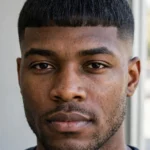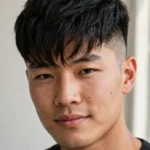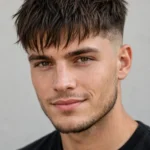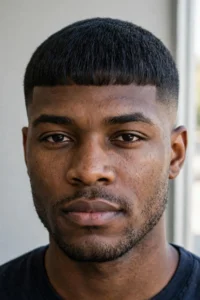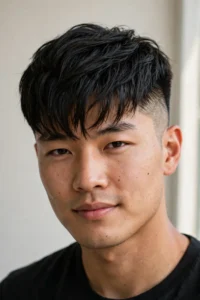



If your crown is thinning, the best haircuts for balding crown are short, textured styles that close the gap between the thick hair and the thin patch. Length works against you here — the longer the hair around a bald spot, the more the scalp shows through. Short cuts even everything out, and a bit of texture on top breaks up the line where hair meets skin.
Three styles stand out above the rest. The Textured Crop is the best all-rounder: choppy layers create the look of fullness right where you need it. The Classic Buzz Cut (#3 Guard) is the simplest, most reliable reset — one even length, no styling, no fuss. And the Low Bald Fade is the sharpest of the three, pulling the eye down to a clean fade instead of up to the crown. The 39 styles below cover every stage of thinning, from the first hint of scalp to a fully shaved head, each with its own photo and exact barber ask. One honest note: a haircut can hide thinning brilliantly, but it can’t regrow hair — if your hair loss is sudden, patchy or worrying you, a dermatologist can advise on the medical options, and the American Academy of Dermatology has useful guidance on hairstyles and hair loss.
Which Haircut Suits Your Thinning Pattern?
Not every thinning head needs the same cut. Match the style to where you’re actually losing hair and you’ll get a far better result than copying a photo of someone with a full head of hair.
| Thinning pattern | What it looks like | Best style groups | Idea numbers to try first |
|---|---|---|---|
| Receding temples | Hairline pulling back at the corners, crown still fairly full | Forward fringe, Caesar cuts, temple fades | 8, 14, 33, 35 |
| Thinning crown | Bald spot or see-through patch at the back of the head | Textured crops, crown-forward styles, buzz cuts | 1, 11, 21, 31 |
| Diffuse thinning | Hair getting thinner all over, scalp showing through everywhere | Ultra-short buzz, layered tops, messy texture | 3, 15, 22 |
| Advanced loss | Large bald areas, very little hair left on top | Clean shave, shaved head with beard or stubble | 26, 27, 28 |
If your temples are receding as well as your crown, start with the fringe-forward styles — our guide to hairstyles for hiding a receding hairline pairs well with this list.
Buzz Cuts
Buzz cuts are the honest answer to a thinning crown. One even length removes the contrast between thick and thin areas, and there’s nothing to style in the morning. If you’re not sure where to start, start here — and if you want more buzz inspiration, see our full round-up of buzz cut hairstyles for men.
1. Classic Buzz Cut (#3 Guard)
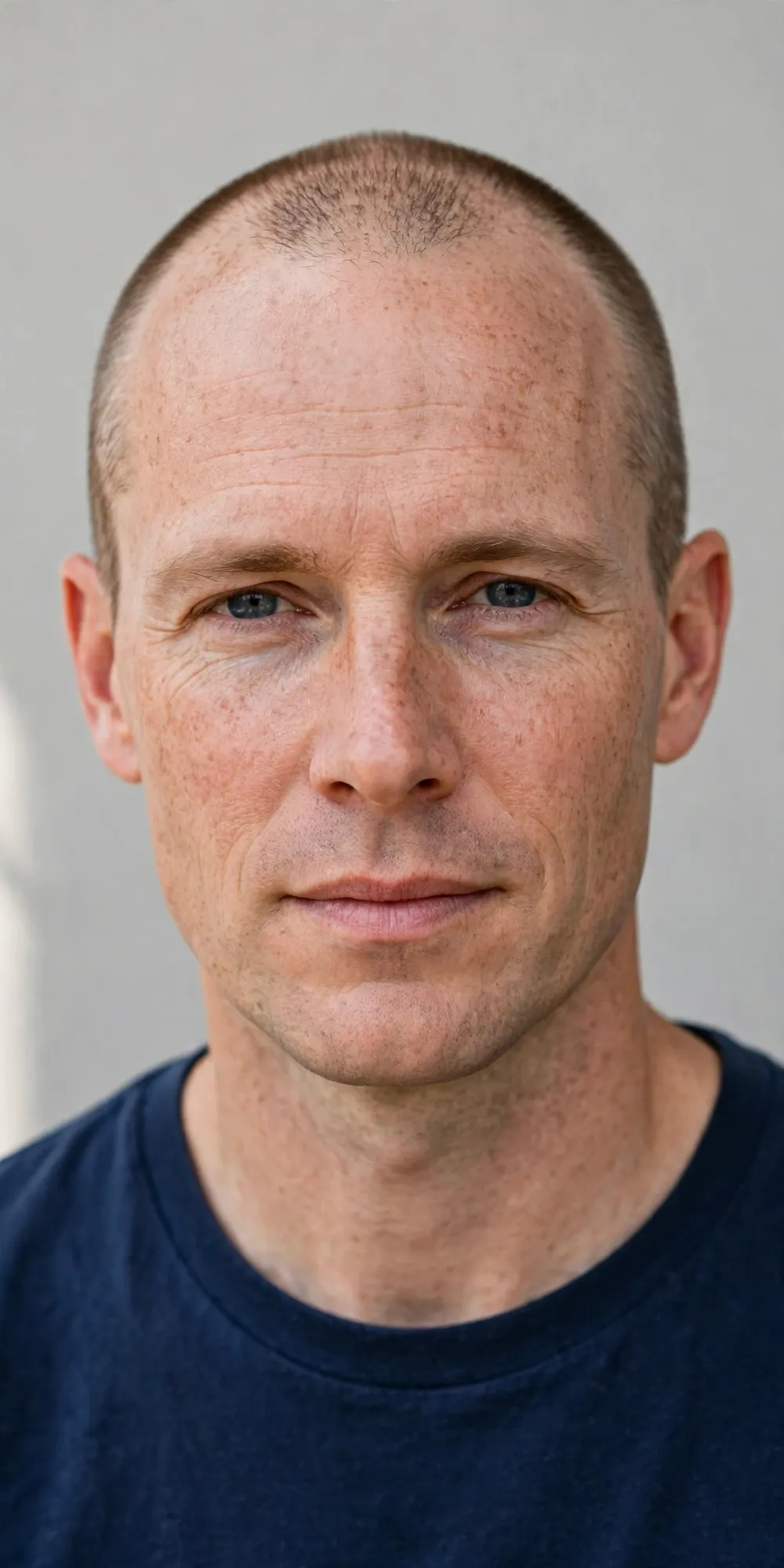
The classic buzz is the safest first move when your crown starts to thin. A #3 guard leaves about 10mm of hair all over — long enough to look like a haircut, short enough that thin patches stop standing out. It suits almost every face shape and works with straight, wavy or slightly curly hair. Ask your barber for a #3 all over with the edges cleaned up, no fade unless you want one. Finish is completely natural: no product needed, just towel-dry and go. Maintenance is the easiest here — run clippers over it yourself every two to three weeks, or book a monthly tidy-up. One catch: it shows your head shape plainly, so go longer first if you mind bumps or scars.
2. Short Buzz Cut (#2 Guard)
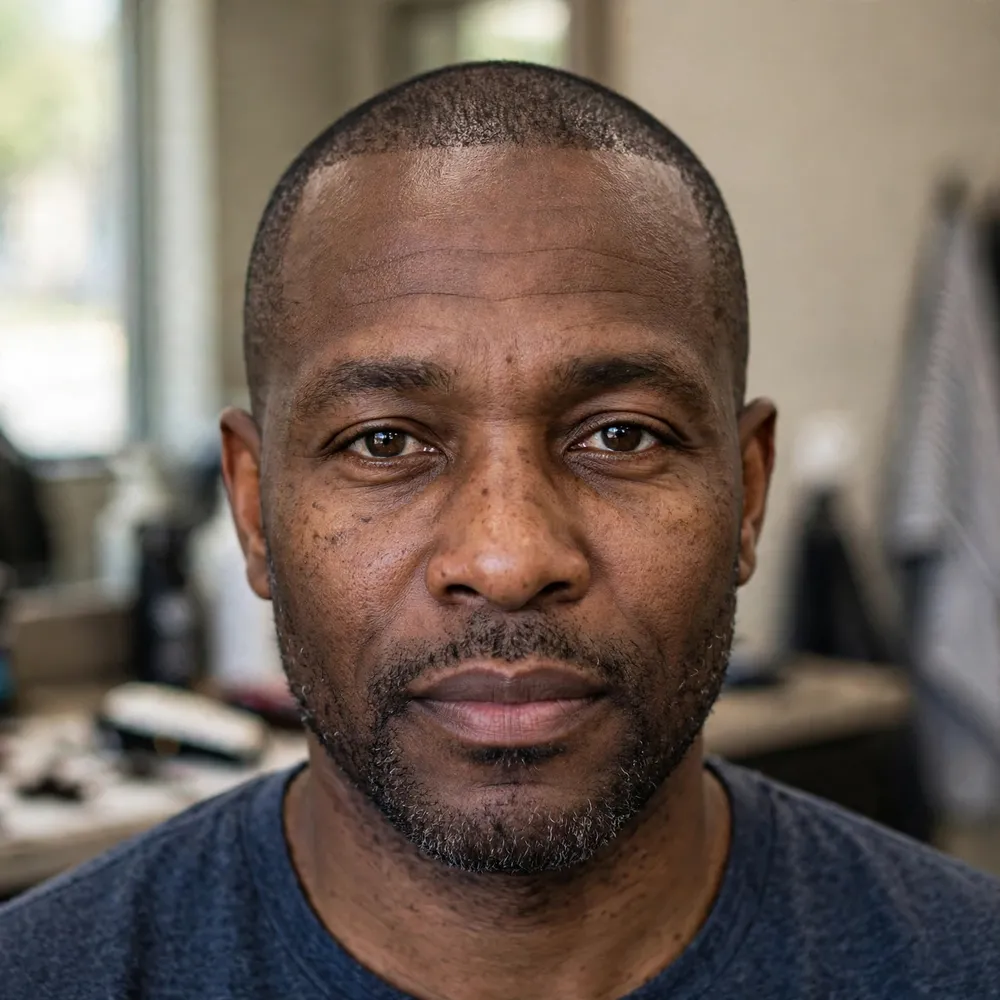
A #2 guard cuts to roughly 6mm, and that extra shortness makes thin patches far less visible than a #3. The shorter the hair, the less difference there is between the dense sides and the thinning crown, so the whole head reads as one even surface. It suits men who are ready to look noticeably short and who have a fairly even head shape. Ask for a #2 all over, with the hairline and neckline tidied rather than shaped into anything dramatic. No product, no styling — a quick towel dry is the whole routine. Re-cut every two weeks — a #2 grows out visibly fast. If you’re uneasy about going this short, try the #3 first and step down later.
3. Ultra-Short Buzz (#1 Guard)
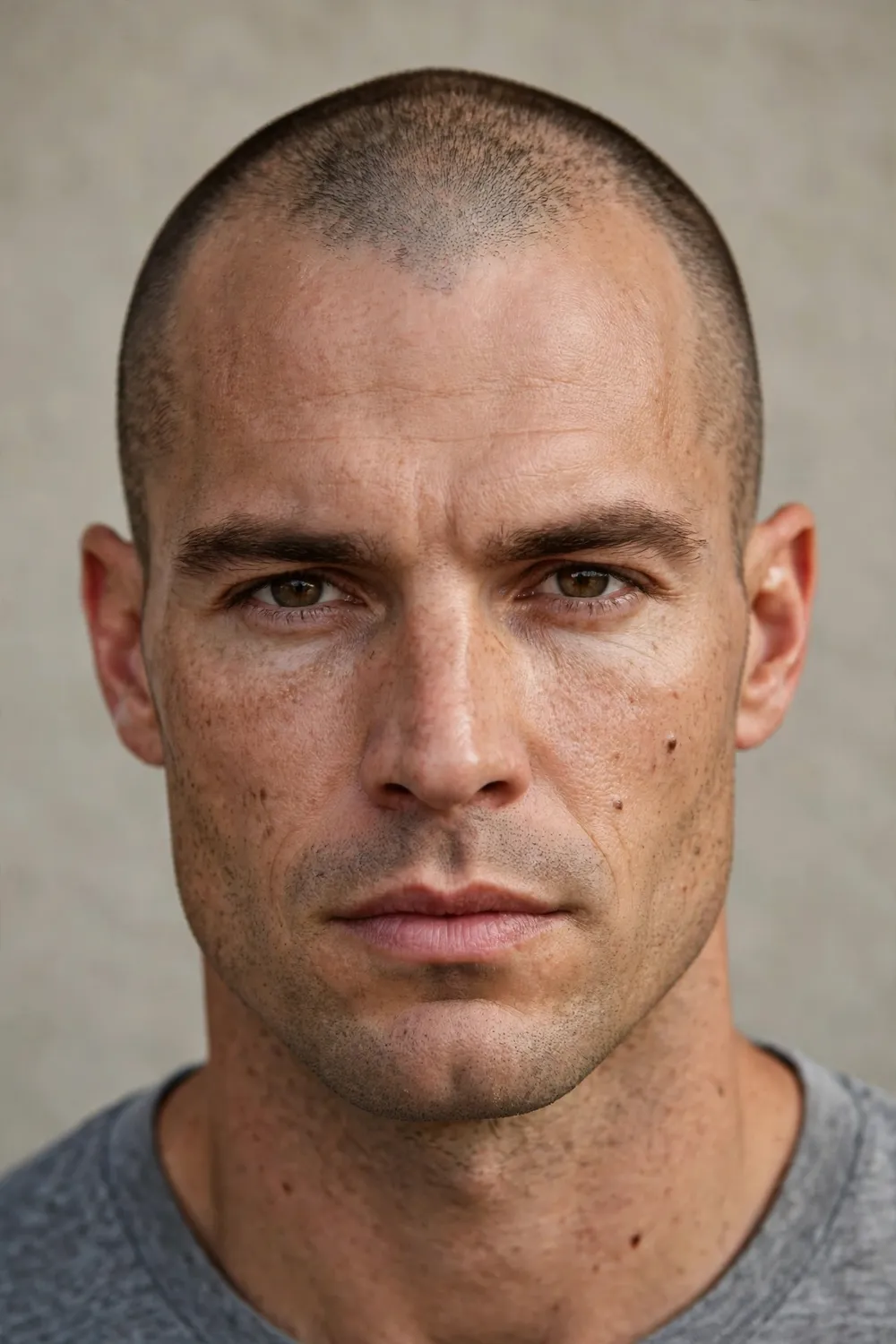
The #1 guard leaves just 3mm of stubble, and at that length the contrast between thick and thin areas practically disappears. There’s simply not enough hair left for a bald spot to hide behind — or to stand out against. It suits strong jawlines and men who want the lowest-maintenance routine possible, and it flatters wavy or coarse hair as much as straight. Ask your barber for a #1 all over with a clean neckline, and keep the edges sharp. Styling is non-existent: wash, towel off, done. The trade-off is upkeep — it needs a re-cut every seven to ten days to stay crisp, though it’s easy to do at home with clippers. It also exposes your scalp to the sun, so sunscreen on the head becomes a daily habit.
4. Buzz Cut with Lineup
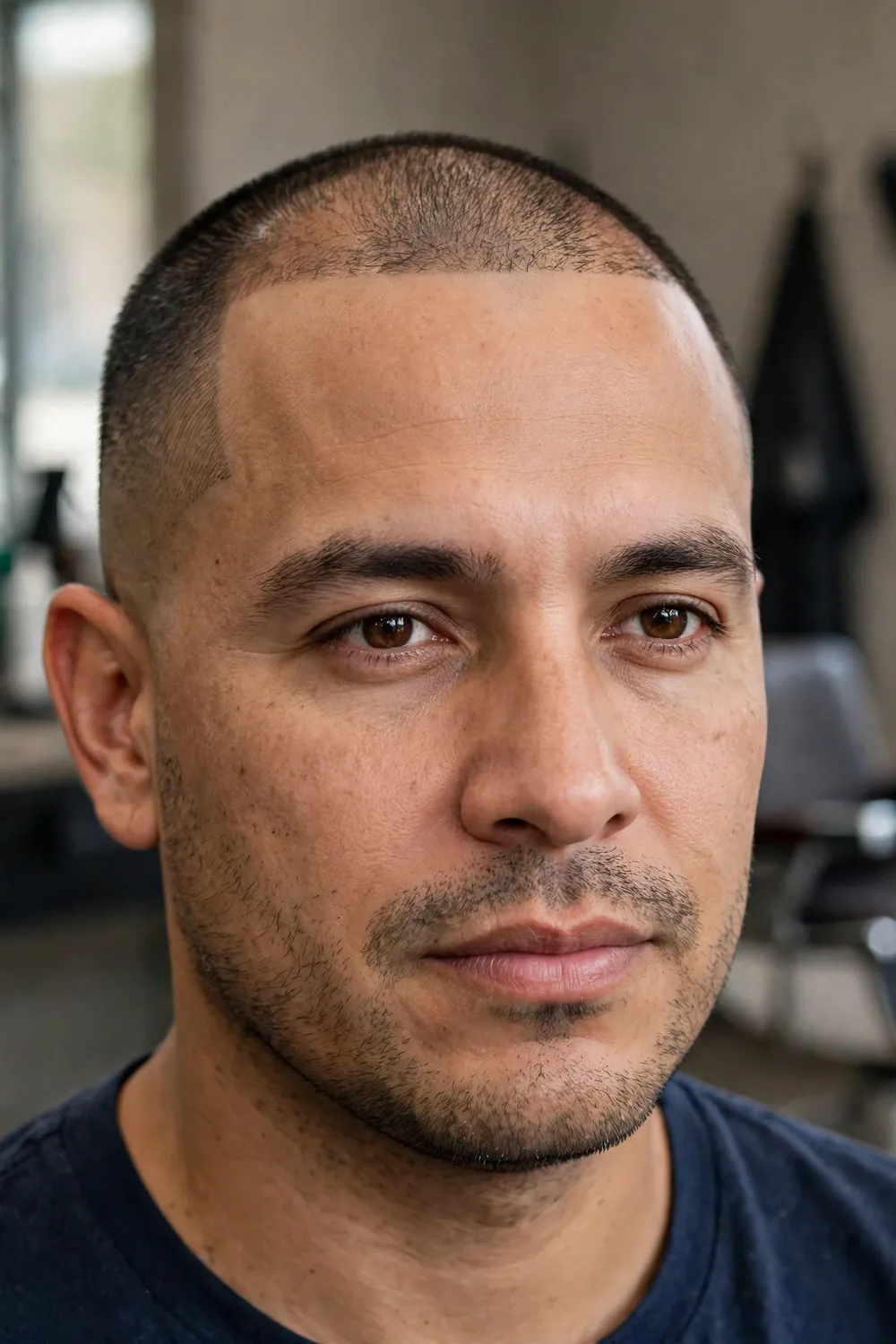
A lineup takes a plain buzz and makes it look deliberate. The top stays short and even, usually a #2 or #3, while the hairline is edged into crisp, straight lines with a trimmer. That sharp frame draws the eye to the hairline instead of the crown. It suits men who like a sharp, deliberate look and have a fairly straight natural hairline. Ask for your usual buzz guard on top, then a lineup on the forehead and temples — and say whether you want the corners squared or kept natural. No product needed; the finish is clean and matte. The catch is maintenance: a lineup blurs within a week, so you’ll need a touch-up every seven to ten days or it loses the effect.
5. Buzz Cut with Tapered Sides
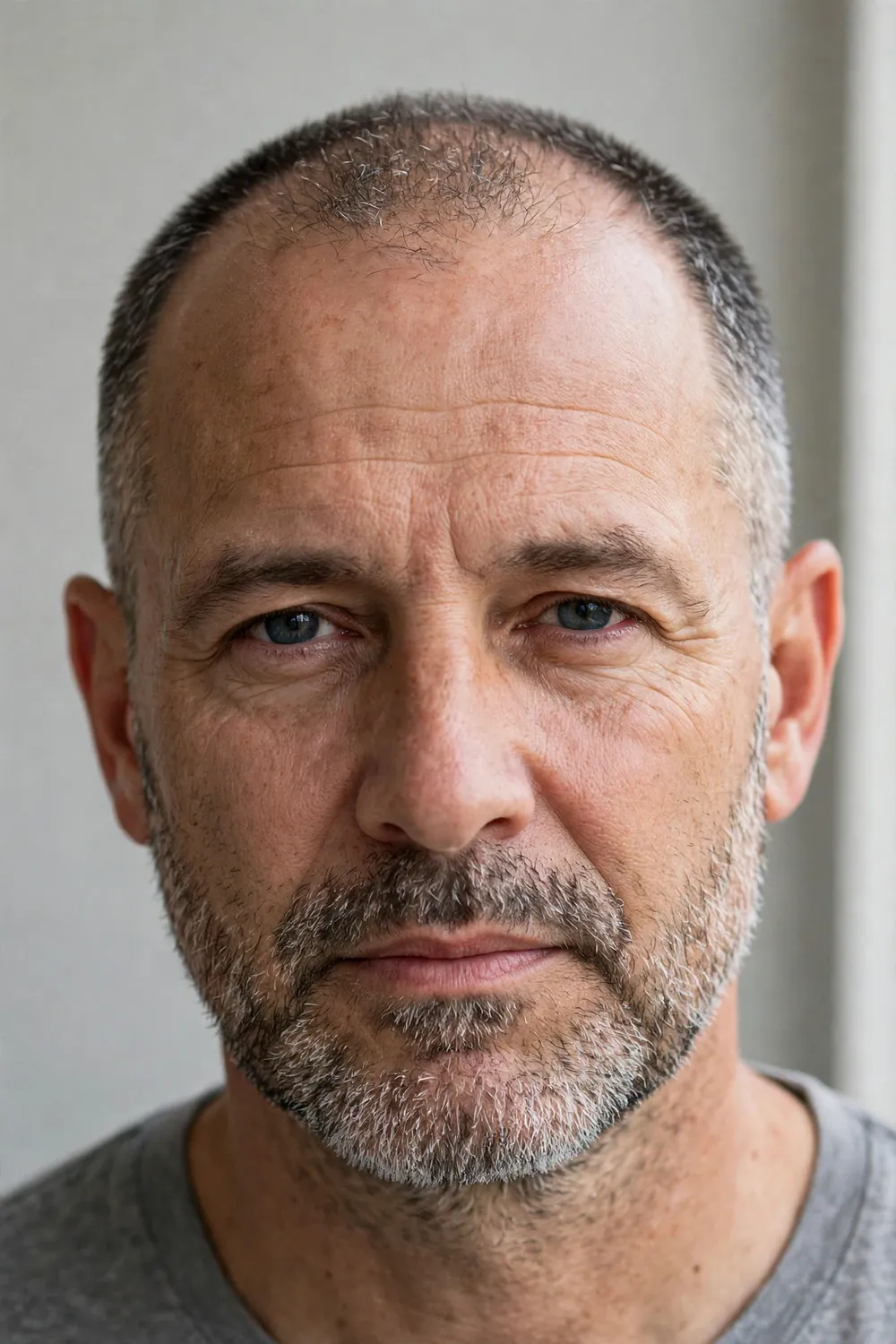
This is the buzz for men who want short hair that still looks barbered. The top is buzzed evenly, usually a #2 or #3, while the sides and back taper gradually from short to shorter, instead of staying one flat length. That gentle graduation gives the cut shape and stops it looking like a home clipper job. It suits most face shapes and men easing into shorter hair. Ask your barber for a #3 on top with a taper on the sides, faded down to a #1 at the edges, and a natural neckline. No product, just a towel dry. Maintenance is a tidy-up every two to three weeks. The taper grows out more gracefully than a skin fade, so it’s forgiving if you stretch the gap between cuts.
Short Classics
Short classics are the smart, grown-up answer to thinning hair. They keep enough length to look styled, but stay short enough that the crown never becomes the focal point.
6. Textured Crew Cut

The textured crew cut is a short top — usually 2 to 3cm — cut with point-cutting or thinning shears so the ends look choppy rather than blunt. That texture is the whole trick: it breaks up the scalp showing through a thinning crown and fakes thickness. It suits straight and wavy hair, most face shapes, and men who want something neat without looking severe. Ask your barber for a crew cut with texture on top, tapered sides, and the front slightly longer so you can push it up. Style with a pea-sized amount of matte clay, worked through damp hair and pushed forward or up. Re-cut every three to four weeks — and go easy on product, since too much clumps and shows scalp.
7. Ivy League Cut

The Ivy League is a slightly longer crew cut with a neat side part — a smart option for early crown thinning when you still need to look polished at work. The top is left around 3 to 4cm, long enough to part; the sides stay short and tapered. That side part gives the hair a natural direction and helps cover the crown without looking like a comb-over. Ask your barber for an Ivy League haircut with tapered sides and enough length on top to part. Style with light cream or matte paste, combed aside from a natural part. It suits straight hair, oval and square faces. Book a tidy-up every three to four weeks, and keep the part natural — forcing it over looks like you’re hiding something.
8. Caesar Cut
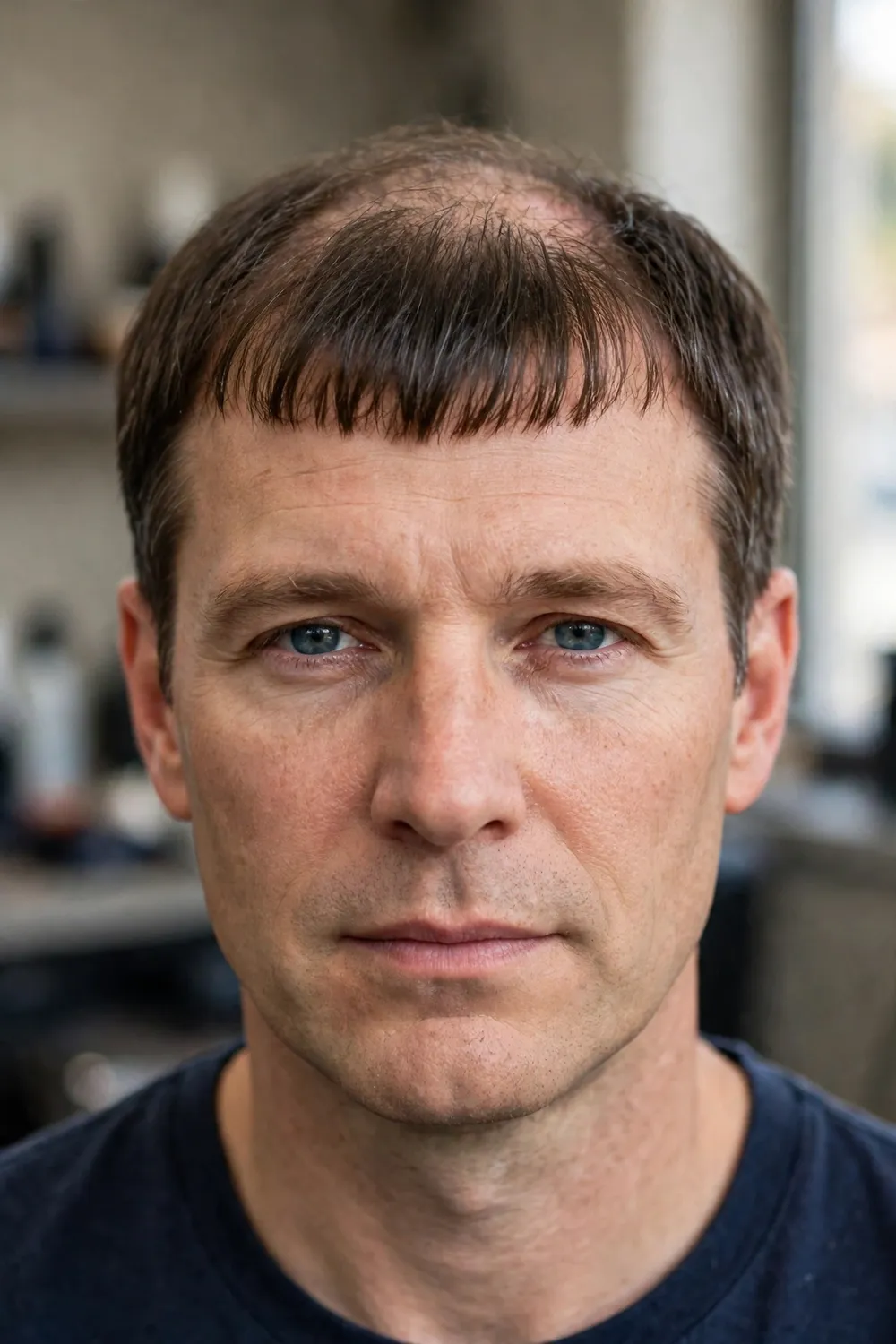
The Caesar is a short cut with a straight fringe pushed forward over the hairline — covering receding temples since Roman times, genuinely. The fringe sits low, hiding a retreating hairline, while the short, even length on top keeps a thinning crown from standing out. It suits straight hair best, and men whose thinning starts at the front as well as the crown. Ask for a Caesar: top around 2 to 3cm, straight fringe cut blunt across the forehead, short tapered sides. Style by pushing the fringe forward with a little matte clay — direction, not volume. It needs a re-cut every three weeks. It doesn’t suit very curly hair, which won’t sit flat in a straight fringe, and the fringe needs frequent trimming or it creeps into your eyes.
9. Short Side Part
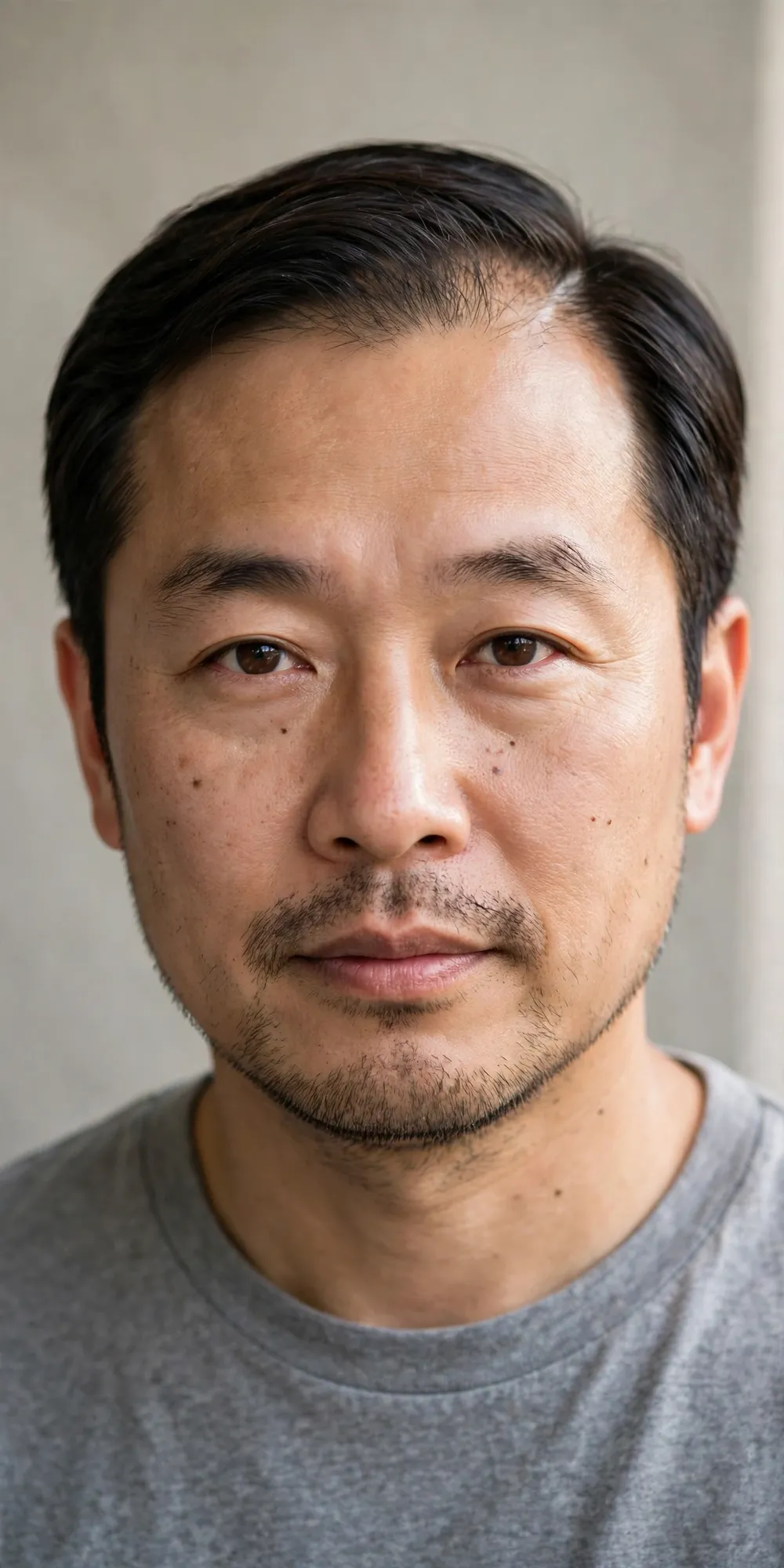
The short side part is the quiet classic: clean part, short length, nothing flashy. It works best with mild thinning and good density on top: the part gives the hair direction, the short length keeps the crown tidy. The top is usually 3 to 4cm, combed aside from a natural part, sides tapered short. It suits straight hair and most face shapes, and it’s one of the easiest styles to keep professional. Ask your barber for a short side part with a low taper and a natural part line, combed, not shaved in. Style with a dab of light pomade or cream for soft hold and a slight sheen. Re-cut every three to four weeks. Avoid heavy, greasy product: it clumps thin hair and shows more scalp, not less.
10. Short Side-Swept Top

The side-swept top is the softer cousin of the side part. The top is kept short, around 3 to 4cm, and swept to one side with natural movement instead of a hard part line. That sweep gives gentle coverage over a thinning crown without looking over-styled. It suits straight or slightly wavy hair and men who want an easy, everyday finish. Ask your barber for a short top with texture through the ends, tapered sides, and enough length on top to sweep across. Style with matte clay on damp hair, pushed to your better side, ends falling naturally. It needs a re-cut every three to four weeks. The honest limit: if your crown is quite advanced, the sweep won’t cover it — a crop or buzz does the job better.
Textured Crops
Textured crops are the best all-rounders for a balding crown, and it’s no accident the top pick of this list sits in this section. Choppy, uneven ends scatter light and shadow across the scalp, which is exactly what makes thin patches disappear.
11. Textured Crop
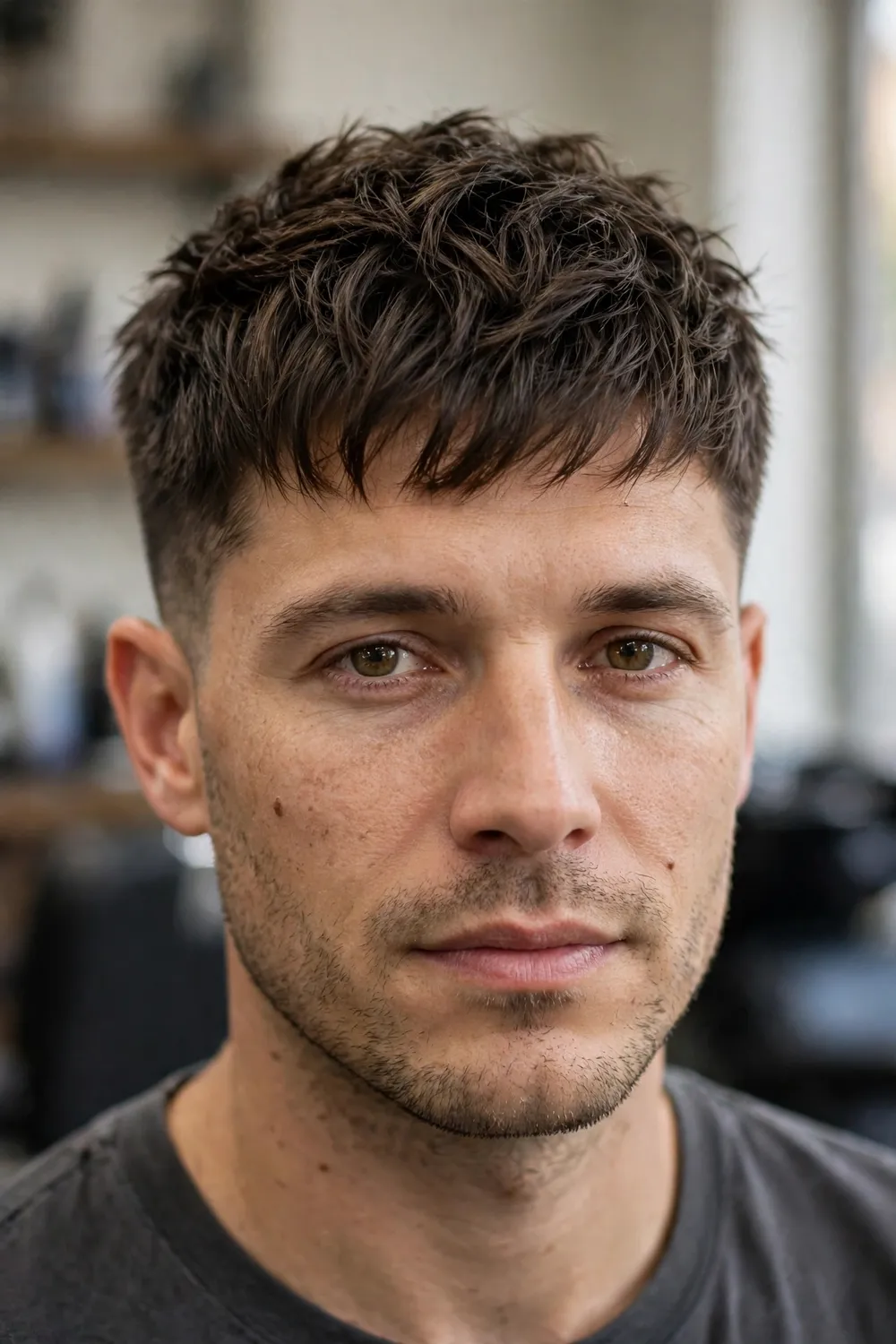
The textured crop is the single best haircut for hiding a thinning crown: choppy, uneven layers create the illusion of fullness where the hair is thin. The top is cut short, around 3 to 5cm, with heavy point-cutting so no two strands sit at the same length, fringe worn forward. It suits most hair types and face shapes. Ask your barber for a textured crop with a low taper or fade on the sides and plenty of texture on top — say “choppy, not blunt” so the ends don’t sit in one flat line. Style with a little matte clay or texture powder, ruffled through damp hair. Re-cut every three to four weeks. Keep product light — heavy wax glues the texture flat and undoes the whole effect.
12. Crop with Low Taper
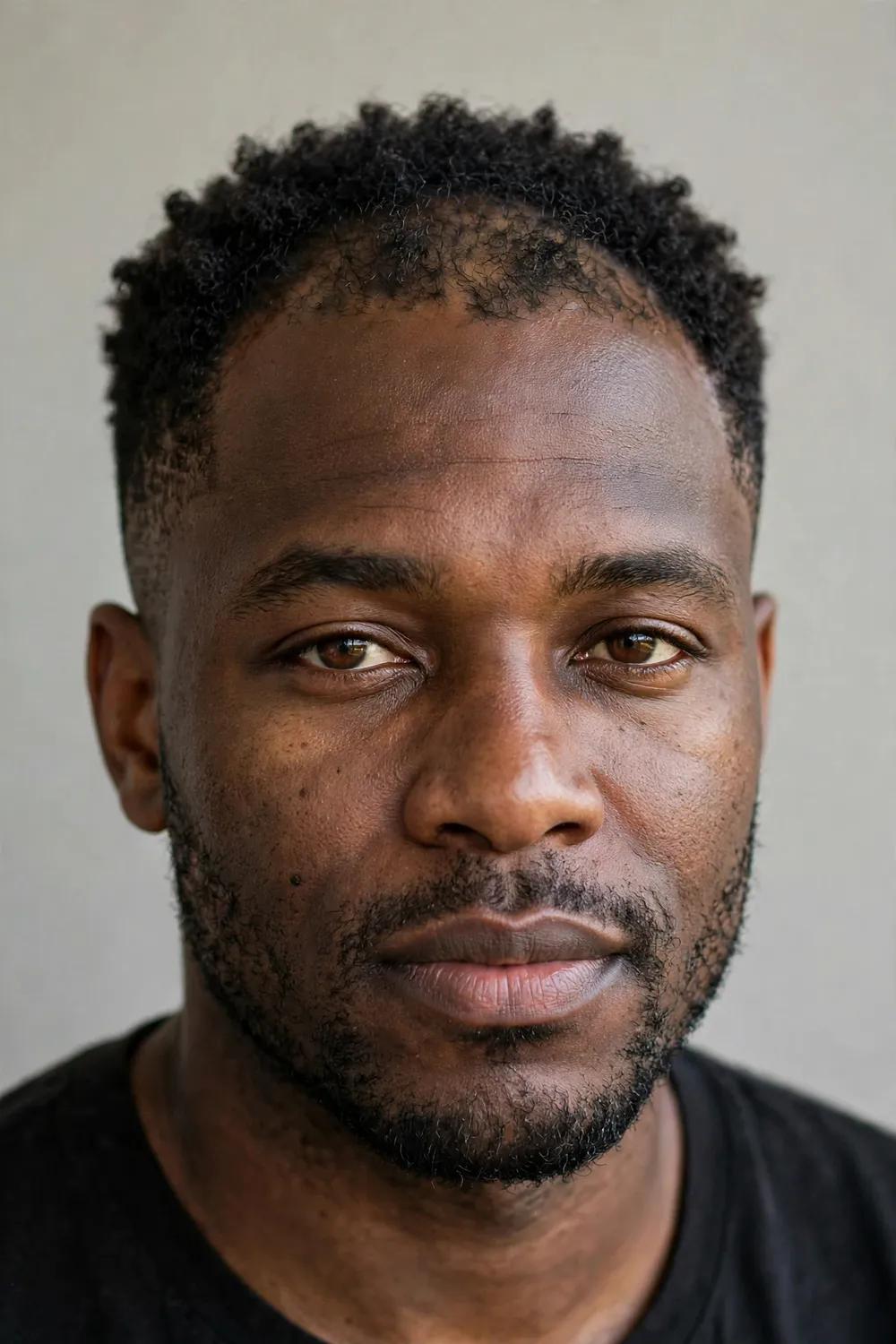
This is the textured crop with a gentler, tidier finish. The top keeps all the choppy texture of a crop, but the sides taper gradually and stay low, shortest just above the ears. That keeps the focus on the textured top and hides scalp at the sides. It suits men who want a modern crop without a skin fade’s boldness, and it works on straight and wavy hair alike. Ask your barber for a textured crop on top with a low taper on the sides and back, blended, not faded to skin. Style with matte clay, pushing the top forward and slightly to the side. It needs a re-cut every three to four weeks. It grows out gracefully, so it’s forgiving if you can’t reach the barber every fortnight.
13. French Crop
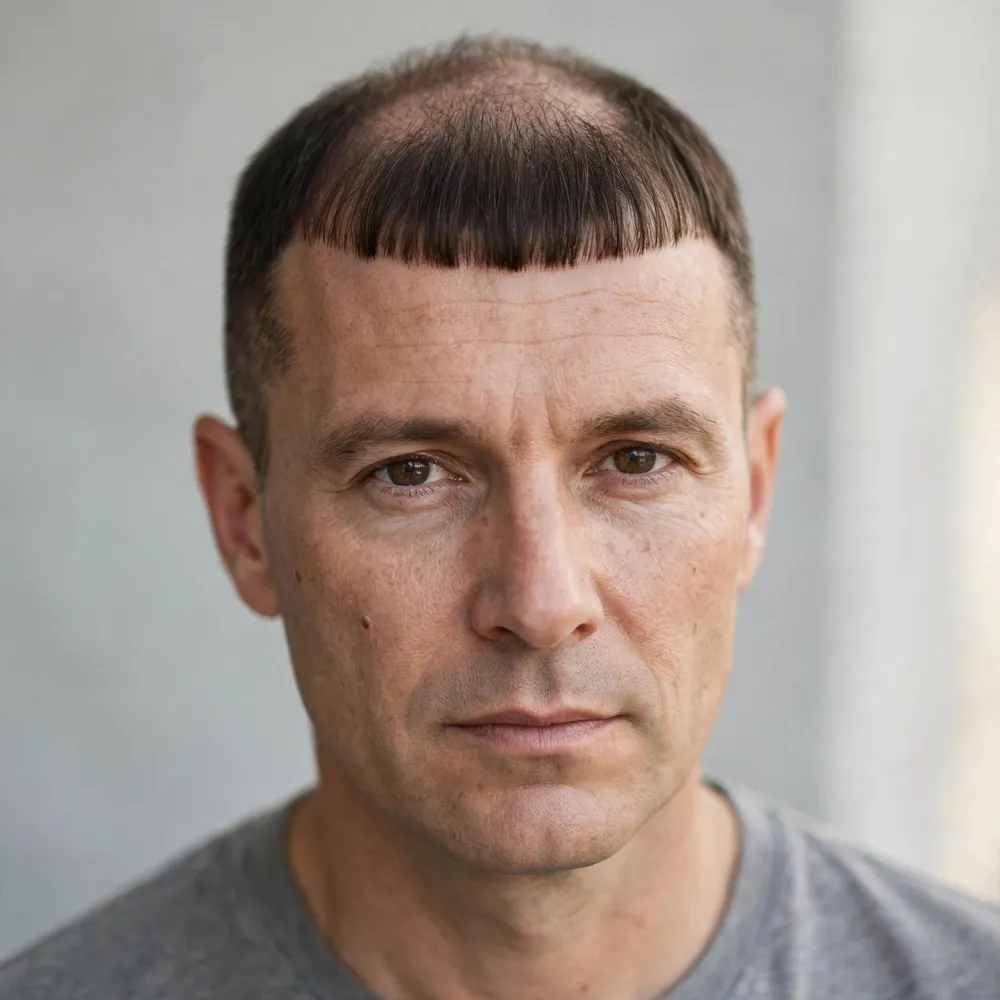
The French crop is a short crop with a blunt fringe worn straight forward — a flattering cut for a receding hairline paired with a thinning crown. The fringe covers the hairline, the short textured top disguises the crown, and tapered sides keep everything neat. It suits straight hair and oval, square or oblong faces; the blunt fringe needs hair that sits flat. Ask your barber for a French crop haircut — blunt fringe, texture through the top, low fade or taper on the sides. Style with a touch of matte clay pushed forward; let the fringe sit naturally, don’t force it down. Re-cut every three weeks to keep the fringe sharp. Very curly hair fights the blunt fringe — if yours curls strongly, try the forward fringe crop below.
14. Forward Fringe Crop
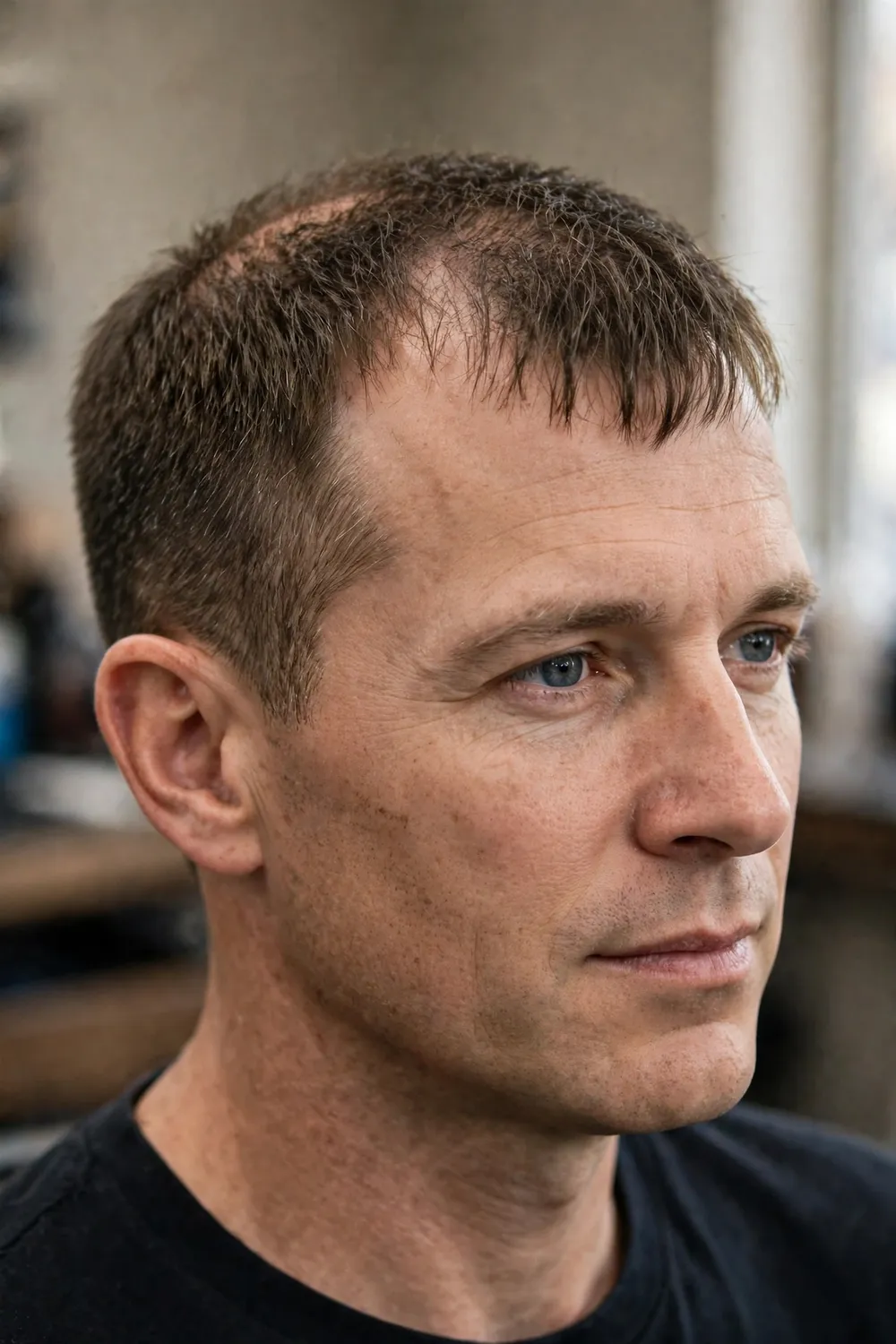
The forward fringe crop is built for men whose thinning starts up front. The fringe is left longer than a French crop, pushed forward and slightly to the side — covering a receding hairline while the textured top takes care of the crown. It suits straight and slightly wavy hair, and men who want coverage without a blunt fringe’s hard line. Ask your barber for a crop with the fringe long enough to reach the eyebrows when pushed forward, texture on top, tapered sides. Style with a pea-sized amount of matte clay, worked forward by hand. Trim it every three weeks — once the fringe gets long it looks untidy, not intentional. Don’t over-style it — the charm of this cut is that it looks like you didn’t try.
15. Messy Textured Top
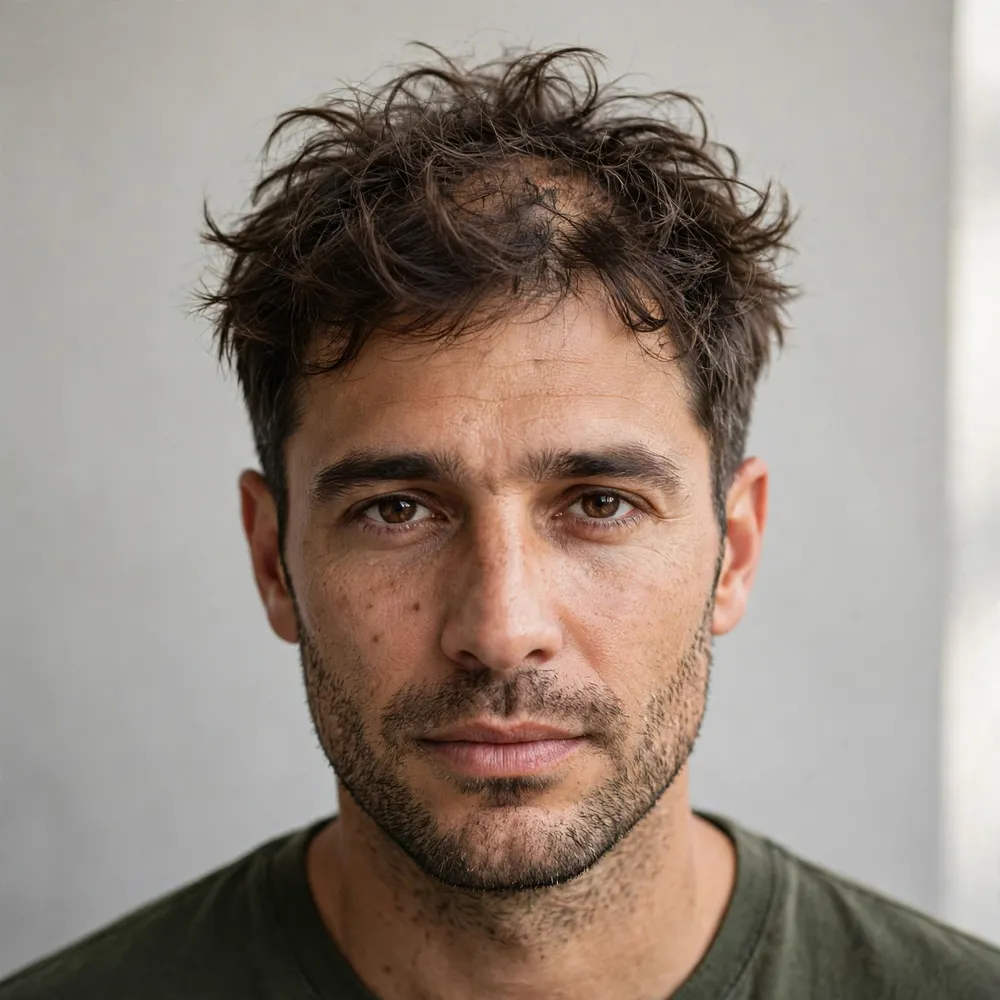
The messy textured top turns a weakness into a style: deliberately tousled, uneven hair hides where the thin patches are. The top is kept short, around 3 to 5cm, cut with lots of texture and styled in different directions, so the eye never settles on one spot. It suits wavy hair best — natural wave does half the work — and men who like a relaxed finish. Ask your barber for a short textured top with a taper on the sides, ends point-cut so they don’t sit flat. Style with texture powder or a little matte clay on dry hair, scrunched up and apart with your fingers. Maintenance is minimal between cuts every three to four weeks. Don’t overdo product: too much looks greasy rather than artfully messy.
Fades
A fade doesn’t cover a thinning crown — it distracts from it. By keeping the sides razor-sharp and the top short, a fade pulls attention to the clean gradient at the sides and away from the back of the head. The trick is picking the right fade height for how much thinning you have.
16. Low Bald Fade
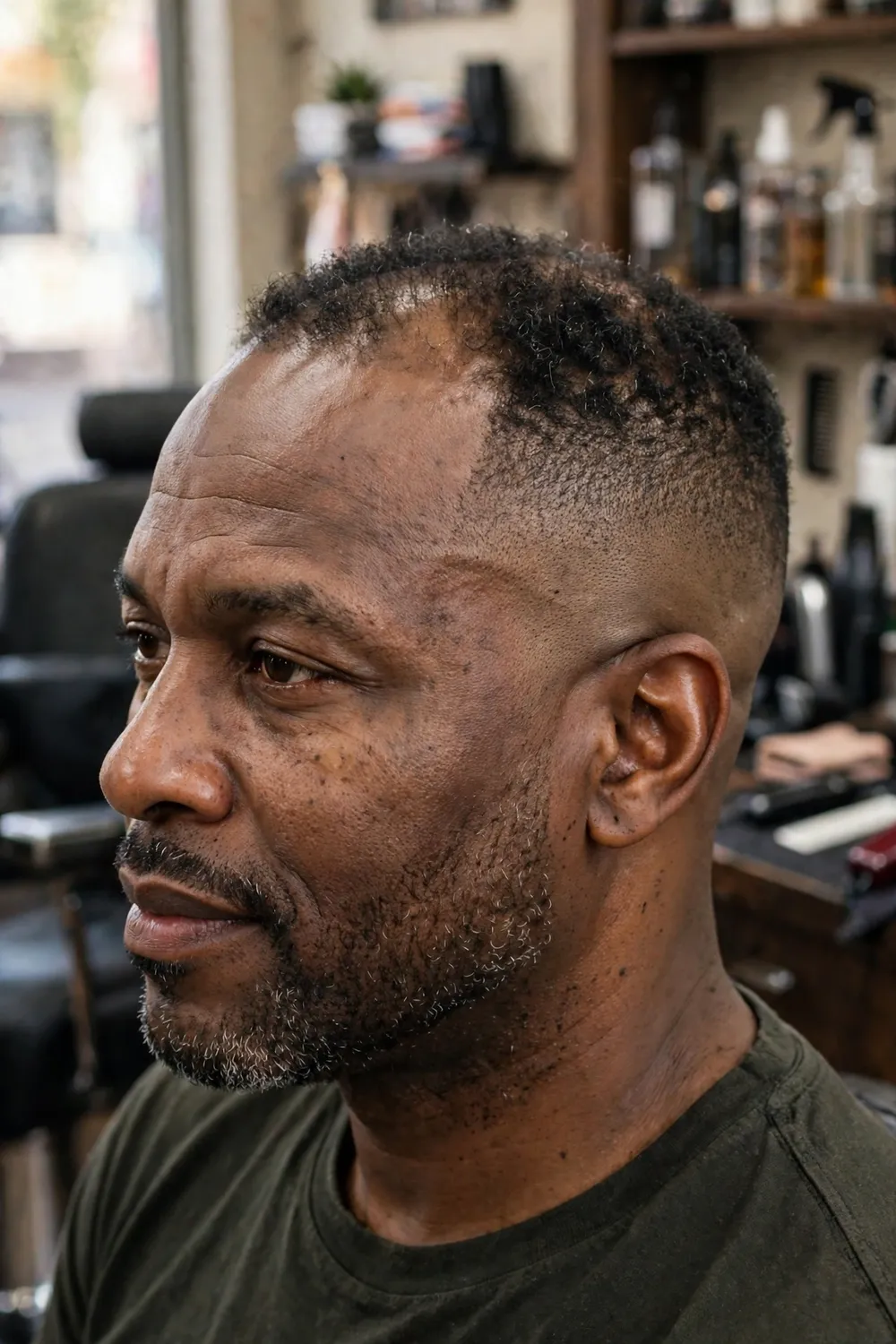
The low bald fade is the sharpest look here that still keeps things subtle. The top stays short and textured, around 2 to 4cm, while the sides fade to skin — but the fade stays low, just above the ears. That low placement is what makes it work: a skin fade’s clean, crisp look without drawing the eye upward. It suits most face shapes and straight or wavy hair. Ask your barber for a low bald fade with a short textured top, fade kept low, not pushed up. Style the top forward with matte clay. It needs a re-cut every two weeks — a grown-out bald fade loses its edge fast. It’s also the most forgiving fade if you’re trying a skin fade for the first time.
17. Mid Bald Fade
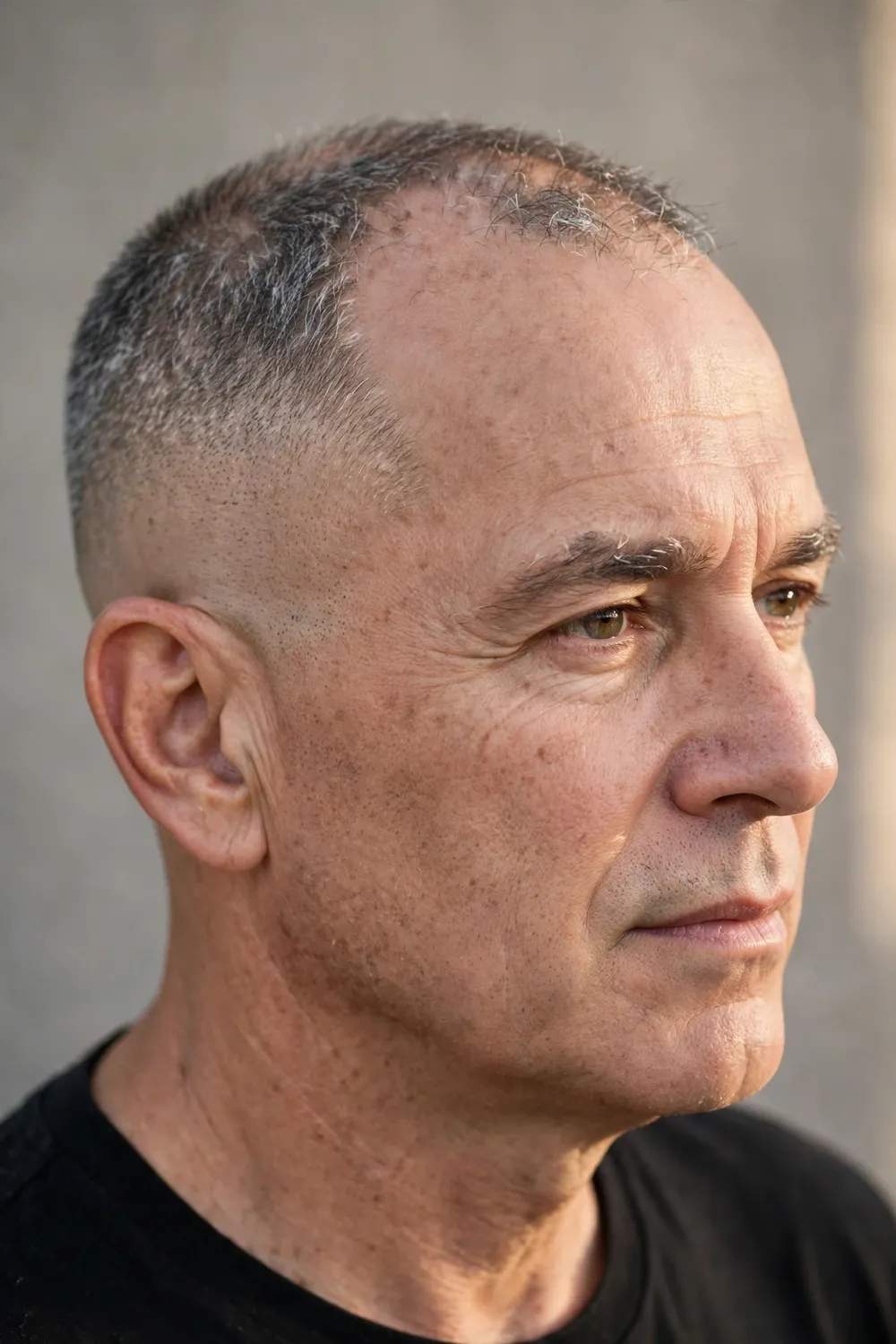
The mid bald fade starts the skin fade halfway up the sides — bolder than a low fade, not as dramatic as a high one. The top is kept short, around 2 to 4cm, usually textured, so the contrast sits between the faded sides and the top, not between thick and thin hair. It suits most face shapes and straight and wavy hair. Ask your barber for a mid bald fade, fade line roughly at temple height, with a short textured top. Style with matte clay, pushed forward or slightly up. Re-cut every two weeks; the fade line blurs quickly as it grows. One honest note: a mid fade shows more scalp at the sides, so if your thinning extends down the sides, stick with the low version.
18. High Bald Fade
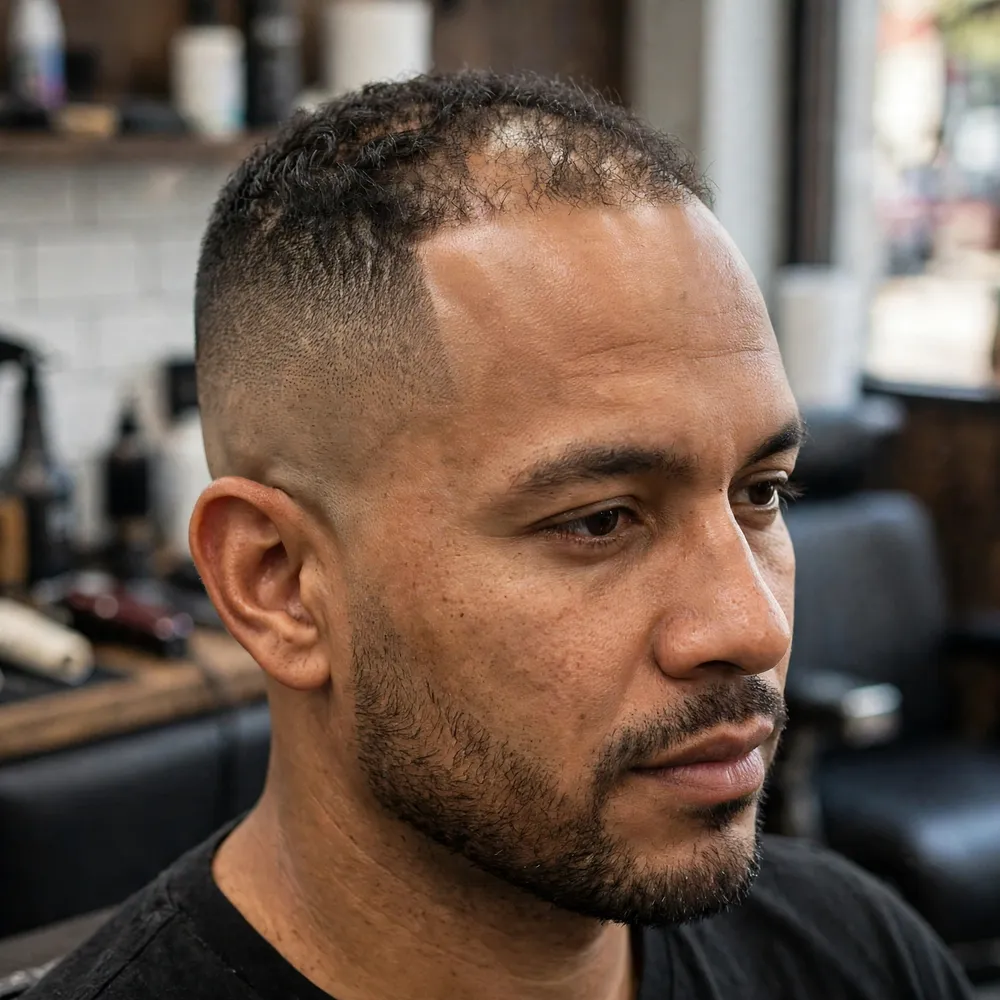
The high bald fade is the boldest fade here — it works by misdirection. The skin fade climbs high up the sides, almost to the crown, pulling the eye to the sharp contrast there, away from the thinning on top. The top is kept very short, around 2 to 3cm, so nothing flops over the bald spot. It suits confident men with strong features, straight or wavy hair. Ask your barber for a high fade haircut with the fade taken high and a short textured top, blended, not harsh. Style with a little matte clay, pushed forward. Re-cut every one to two weeks to keep it at its best. The trade-off: a high fade exposes the most scalp, so it’s best when thinning is mostly on the crown.
19. Skin Fade with Buzzed Top
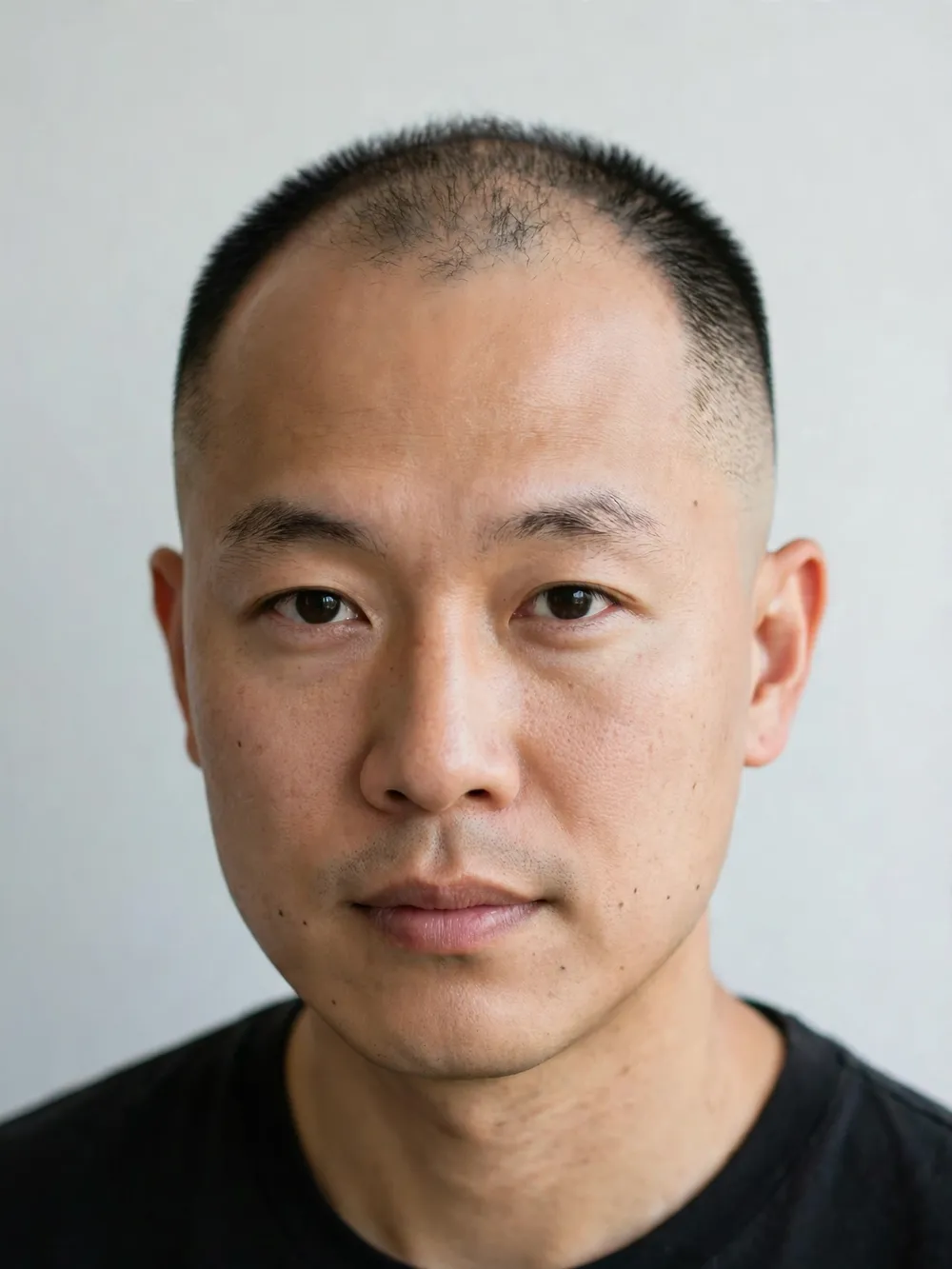
This pairs the lowest-maintenance top with the sharpest sides: a buzzed top, usually a #2 or #3, sides faded to skin. There’s no styling on top; the fade does all the visual work, giving a clean, deliberate finish that looks far more considered than a plain buzz. It suits men who want a fade without morning styling, and it works on every hair type. Ask your barber for a buzzed top on a #2 or #3 with a skin fade, low or mid to suit how bold you want it. No product needed; towel-dry and go. The fade needs touching up every two weeks, though the buzzed top is easy to maintain at home. It’s a good middle ground if you like the buzz but find a plain one flat.
20. Taper Fade with Short Top
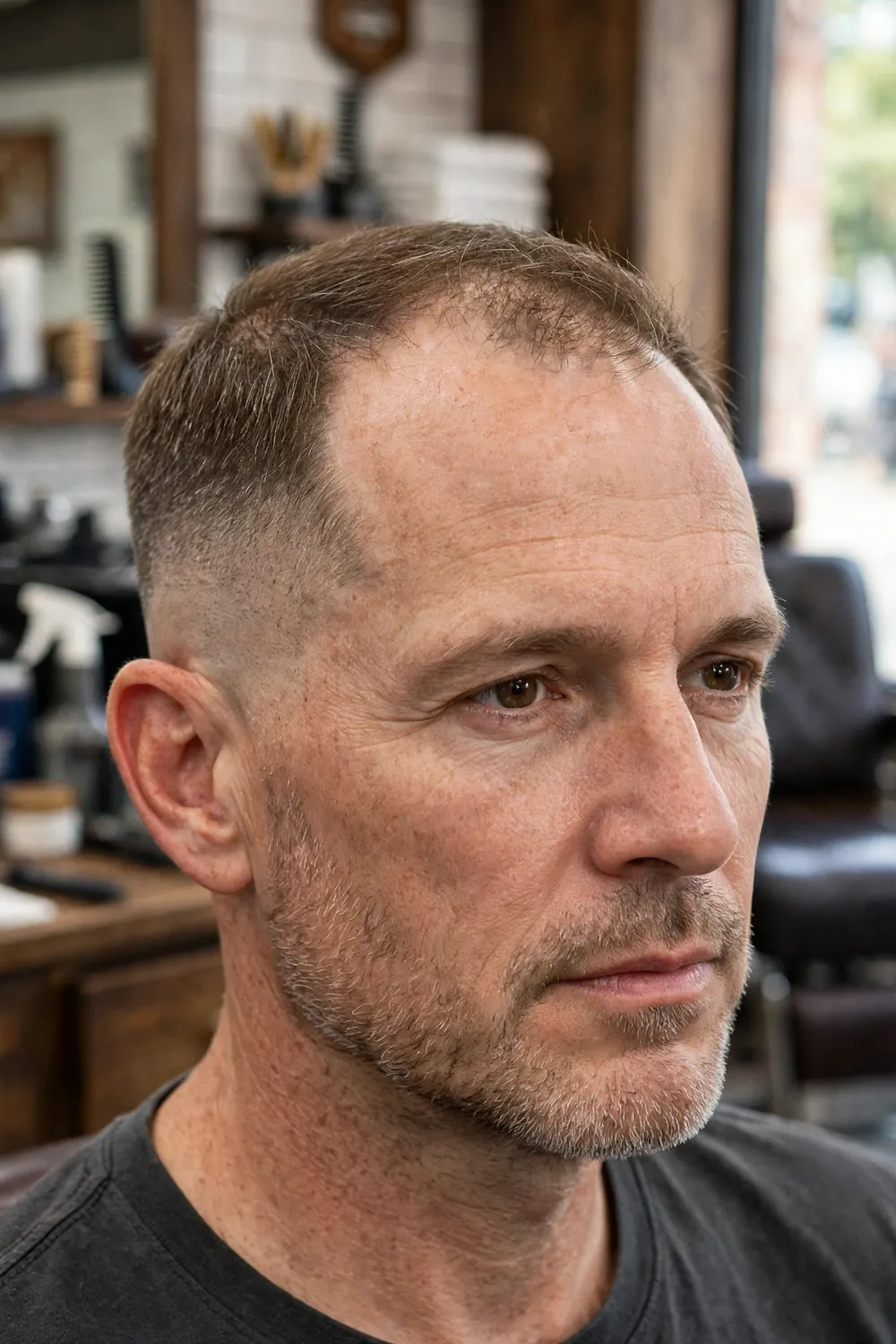
The taper fade is the gentle option in the fade family: instead of fading to skin, the sides taper gradually, giving a softer finish that grows out gracefully. The top stays short, around 2 to 4cm, lightly textured. It suits men who want a fade look without a skin fade’s upkeep, and it’s the easiest fade to live with between barber visits. Ask your barber for a short top with a taper fade on the sides and back — no skin, just a clean graduation to a #1. Style with a dab of matte clay or light cream, pushed forward. Re-cut every three to four weeks. The finish is neat rather than dramatic, a strong everyday choice, and it pairs well with a beard for extra balance around the face.
Crown Specialists
These five are built specifically around the crown — they push hair forward, add texture, or use natural curl to take the eye off the thin spot at the back.
21. Crown-Forward Crew
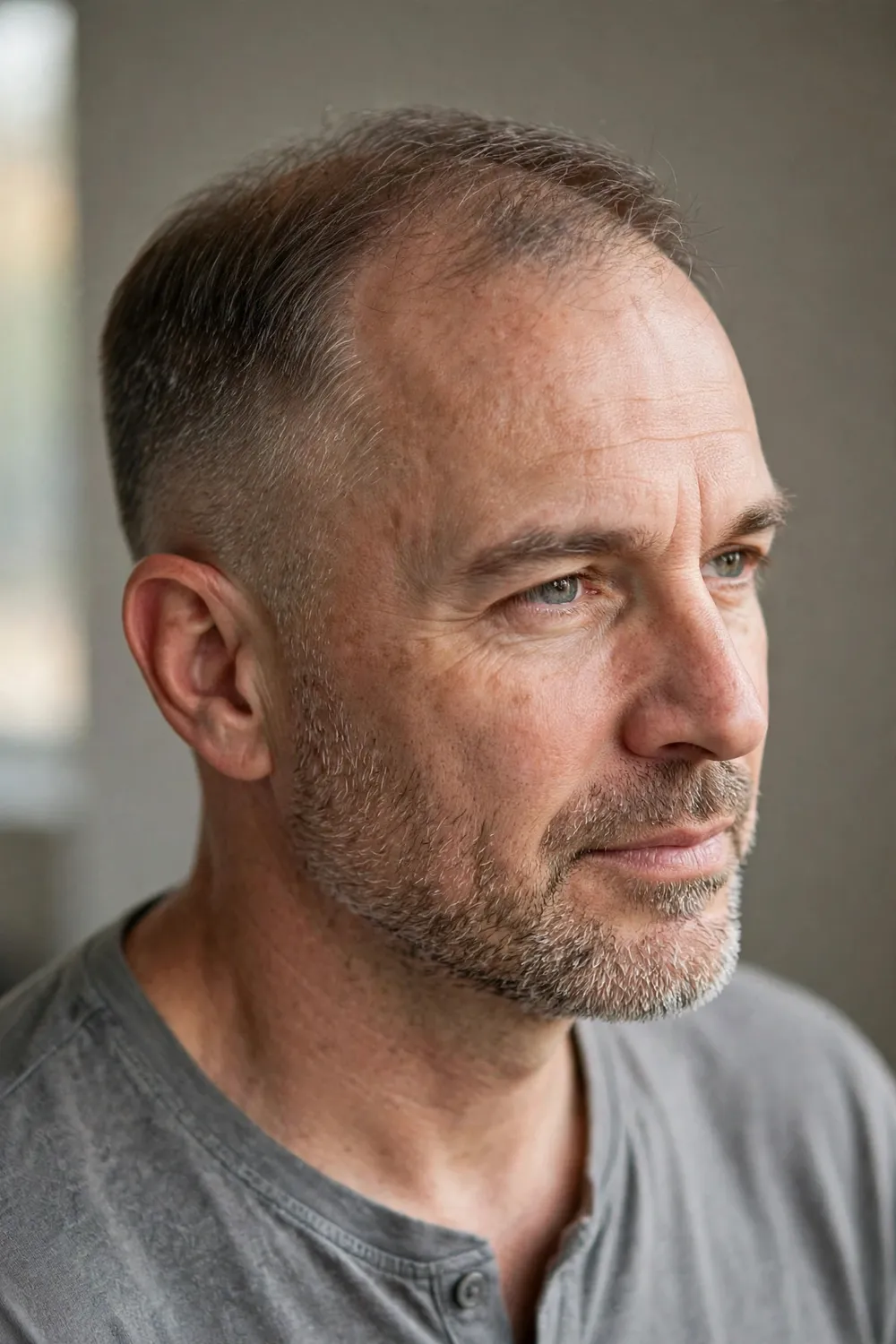
A crew cut with one simple change: instead of brushing the top back or to the side, everything is combed forward so it lies over the crown. That forward direction is the whole trick — the hair overlaps the thinning patch rather than parting away from it and exposing it. It suits men whose bald spot sits right at the crown while the front is still holding up, and it works on straight and slightly wavy hair alike. Ask your barber for a short crew on top, around 1–1.5 inches, with the crown area left a touch longer than the front and the sides tapered. A pea-sized amount of matte clay, worked through and pushed forward, keeps it in place without shine. Maintenance is easy: a trim every three weeks keeps the forward fall neat.
22. Short Layered Top

Short layers are one of the best illusions in barbering for fine, thinning hair. Instead of one flat length that lies limp and shows scalp, the barber cuts the top in short, staggered layers so the hair overlaps itself and looks thicker than it is. It suits fine hair especially well — coarse hair doesn’t need the help — and works on round, oval and square faces. Ask for a short layered top, about an inch on top, with point-cut texture through the ends and a clean taper on the sides. Style it with a light matte paste or a dusting of texture powder, ruffled up with your fingers rather than combed flat. It grows out gracefully, so you can stretch cuts to four weeks, though the layers lose their shape after that.
23. Brush-Up Short Top
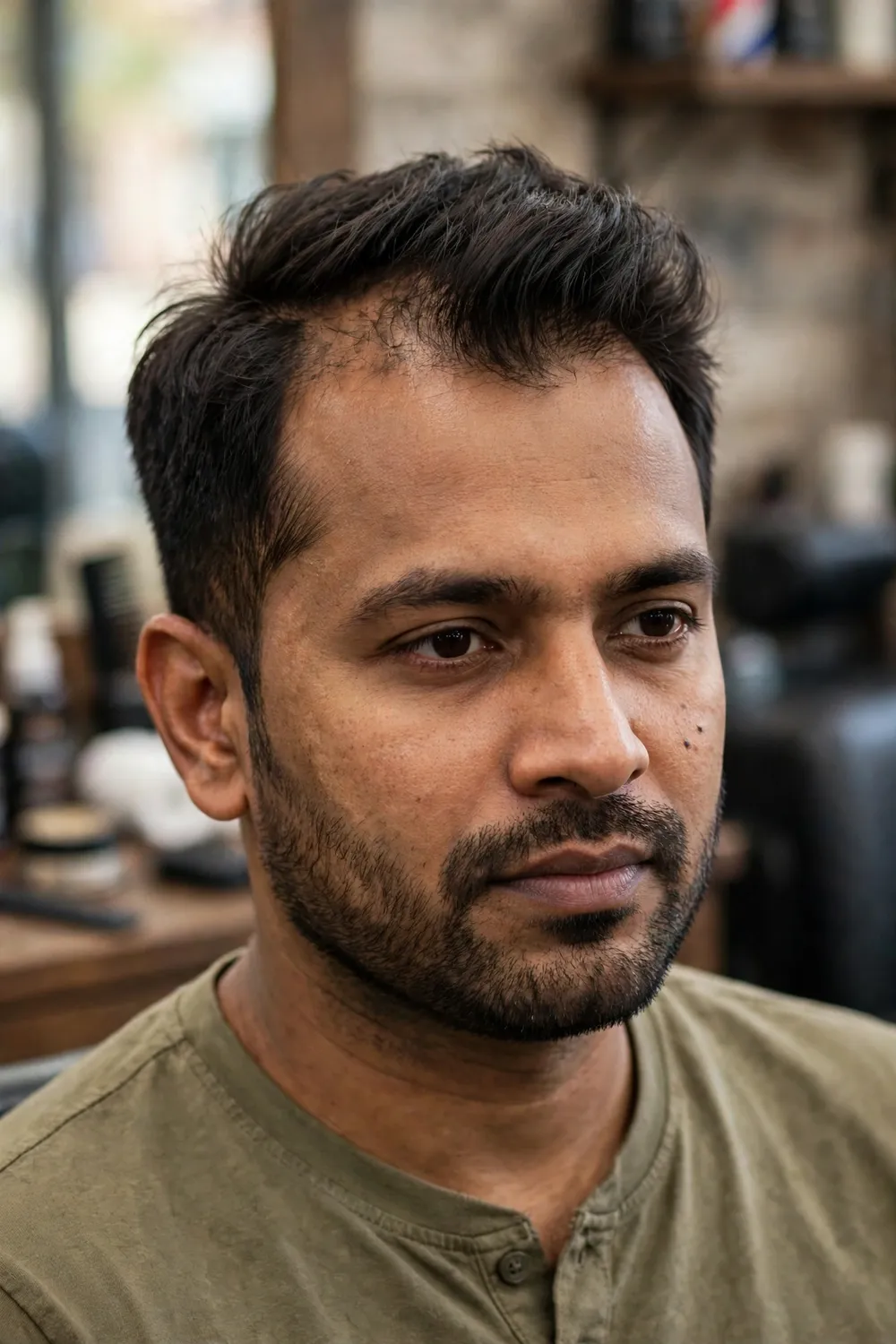
This one leans into height at the front to pull attention forward, away from the crown. The top is kept short — about 1.5 inches — and brushed upwards and slightly back, so the eye lands on the volume at the front hairline instead of the thin patch behind it. It suits men with a thinning crown but a solid front hairline, and it flatters longer and oval faces in particular. Ask your barber for a short textured top with a low taper on the sides, and tell him the front needs enough length to stand up. Blow-dry the front upwards for ten seconds, then work in a small amount of matte clay. Skip heavy pomade here — weight is the enemy. A trim every two to three weeks keeps the shape from going floppy.
24. Short Spiky Top
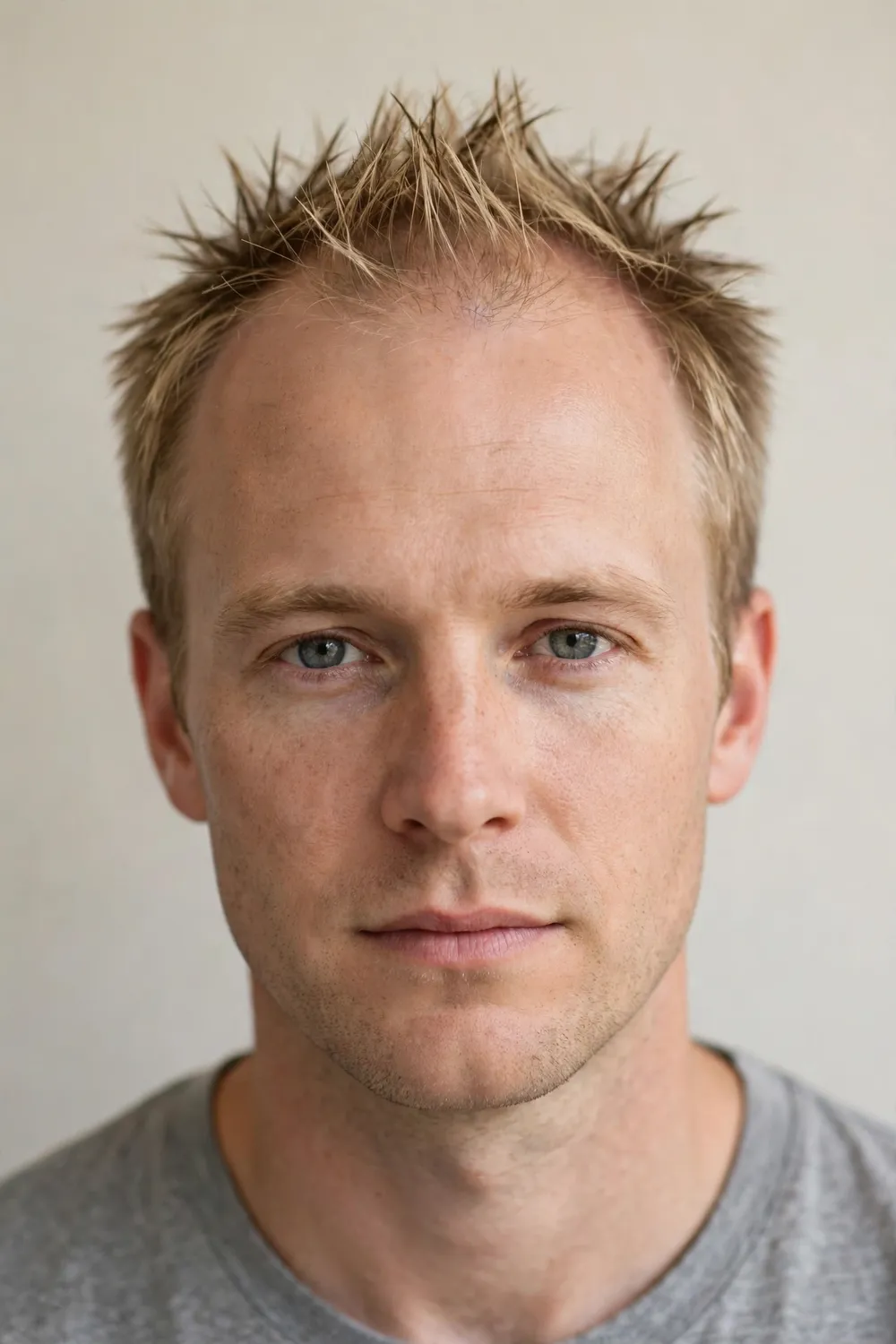
Spikes sound like a young man’s style, and they are — but the reason they work on a thinning crown has nothing to do with age. Short, separated spikes break up the line of the scalp so the eye can’t settle on any one thin patch. It suits straight hair best, since straight hair holds a spike with very little product, and it works well on younger men or anyone who likes a bit of edge. Ask for a short textured top, about an inch long, with the sides tapered and the top point-cut so it separates naturally. A dab of strong-hold matte clay, twisted between your fingers and pushed up in small sections, is all you need. It takes two minutes in the morning and a cut every three weeks.
25. Curly Short Top
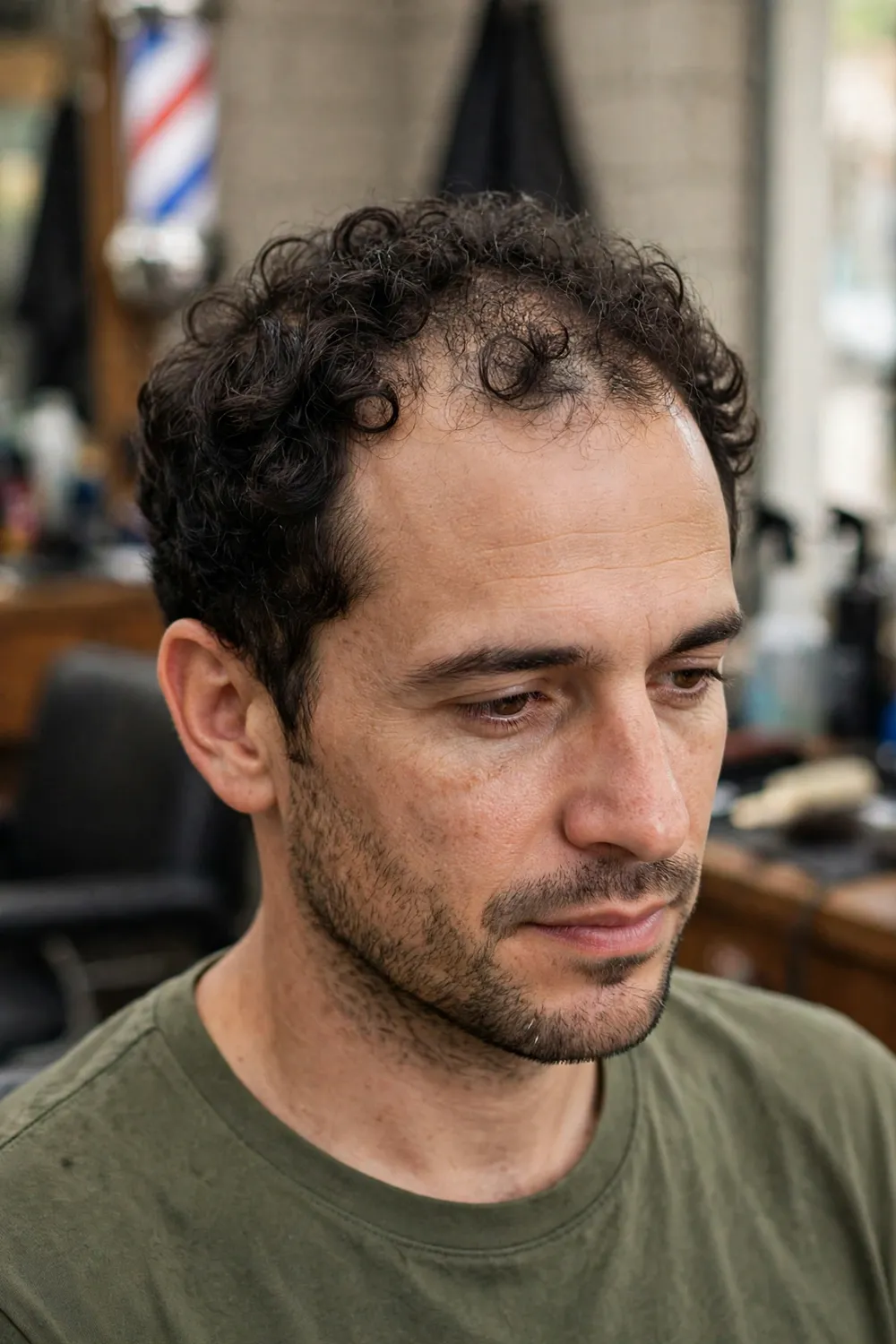
If you have natural curl, a thinning crown is far less of a problem than it is for straight hair — curls create volume and shadow that cover thin areas on their own. This style simply lets them do their job: the top is kept short, around 1–1.5 inches, so the curls sit tight and springy instead of weighing themselves down. It suits naturally curly and wavy hair and flatters most face shapes, since the texture softens everything. Ask your barber to cut the curls dry or only slightly damp, with a taper on the sides and no thinning shears on top, which only makes curly hair frizz. A little curl cream scrunched in while damp defines the pattern. Trim every four weeks.
Shaved & Beard Pairings
When the crown has thinned past the point where styling can hide it, the honest move is to take control of the look completely — and a beard gives the face a new focal point.
26. Clean Head Shave
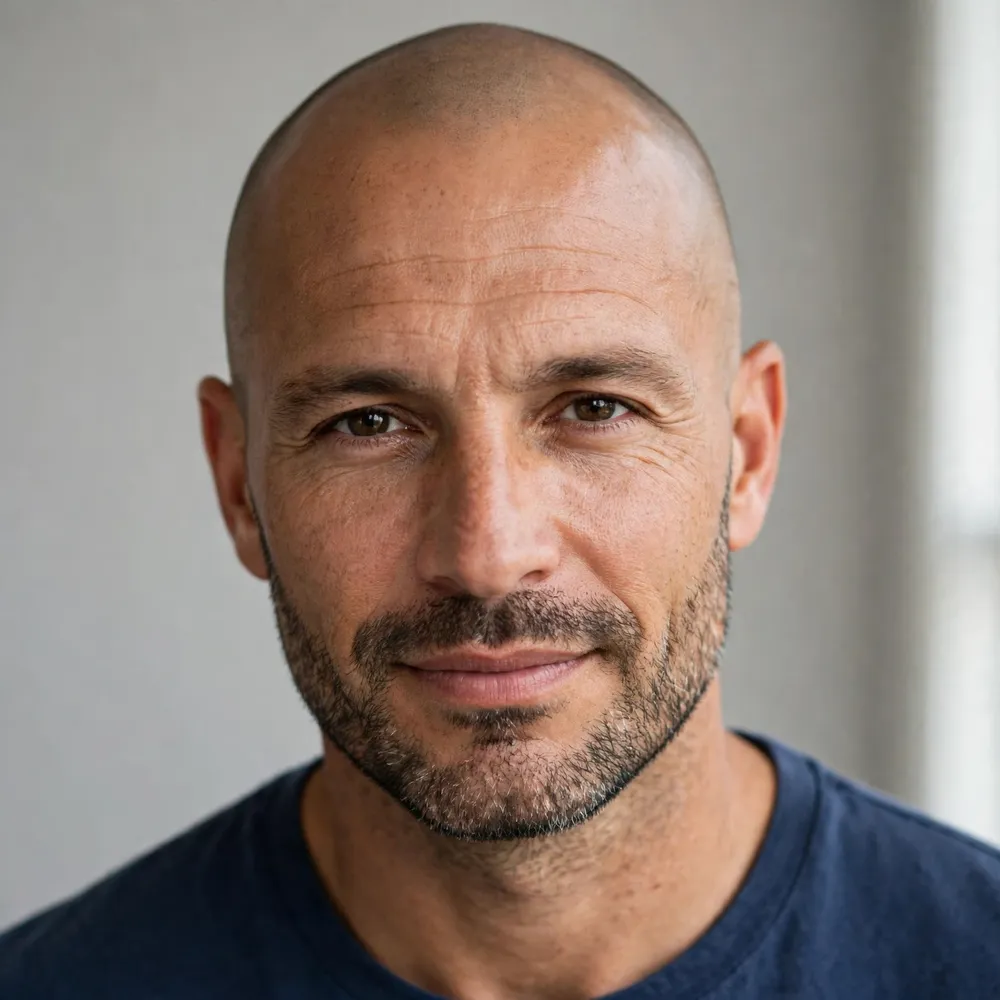
There comes a point where the sharpest haircut is no haircut at all. A clean head shave removes the patchy contrast entirely and replaces it with one smooth, deliberate surface — and the confidence that comes with owning it usually shows. It suits advanced thinning, men with a good head shape, and anyone tired of checking the crown in every mirror. The barber’s role is simple: a razor shave with hot lather, or a zero-guard buzz if you want to try it first. At home, shave every two to three days with a fresh blade, then moisturise — and use sunscreen on the scalp, because newly exposed skin burns fast. It’s the lowest-maintenance look on this list once the routine clicks.
27. Shaved Head with Full Beard
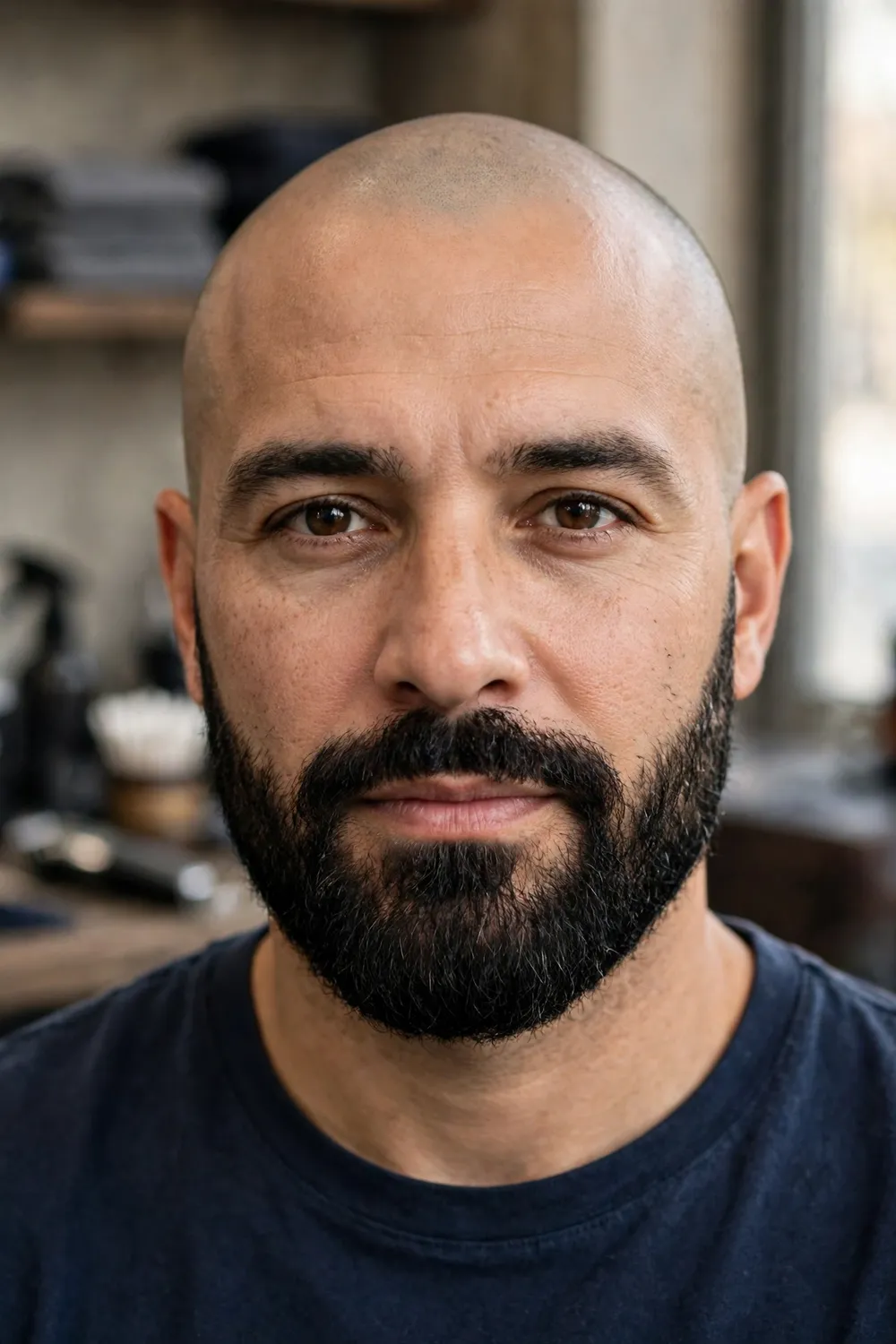
This is the classic pairing for a reason: the beard takes over as the statement while the shaved head stays clean and intentional. A full beard balances the face, adds shape to the jaw, and gives people something to look at besides the scalp. It suits men who can grow a decent beard — patchy beards don’t carry the look — and it works on most face shapes, especially rounder ones that benefit from the beard’s length. Ask your barber to shave the head smooth and shape the beard with a defined cheek line and a tidy neckline. Keep the beard oiled and brushed daily; a scruffy beard next to a sharp head looks unfinished. The head needs a shave every two to three days, the beard a trim every week or so.
28. Shaved Head with Stubble
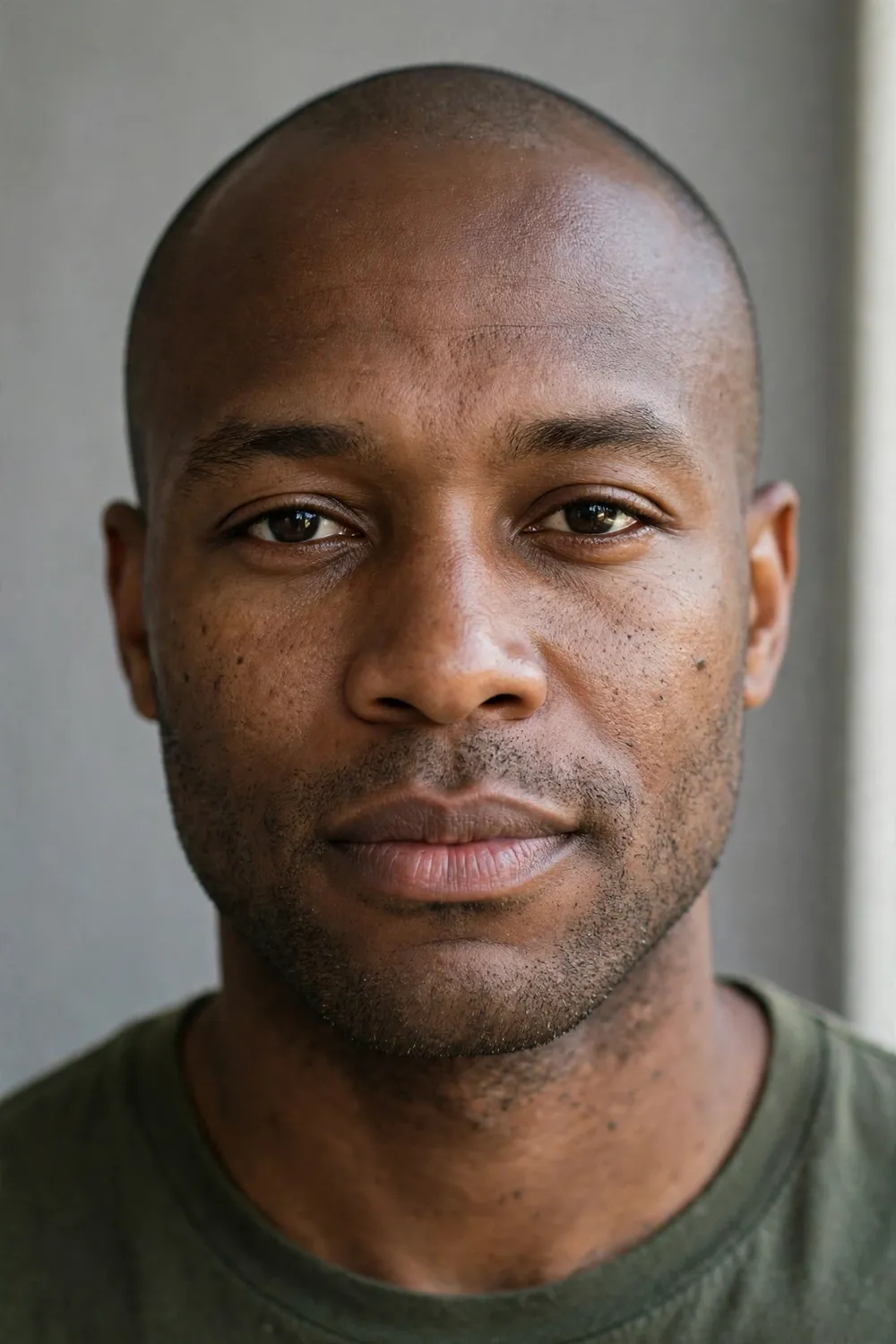
Not every man wants — or can grow — a full beard, and stubble gives you most of the same balance with a fraction of the upkeep. A few days of growth softens the jawline and stops the shaved head from looking stark, while still reading as deliberate and clean. It suits men whose beard grows in patchy at longer lengths, and men who want the shaved look without the daily beard routine. Ask your barber for a smooth head shave and a stubble trim at a 2–3 mm guard, with the neckline cleaned up. At home, keep the stubble at the same length with a trimmer every two to three days and shave the head on the same schedule. Sunscreen on the scalp still applies — stubble doesn’t cover it.
29. Buzz Cut with Beard
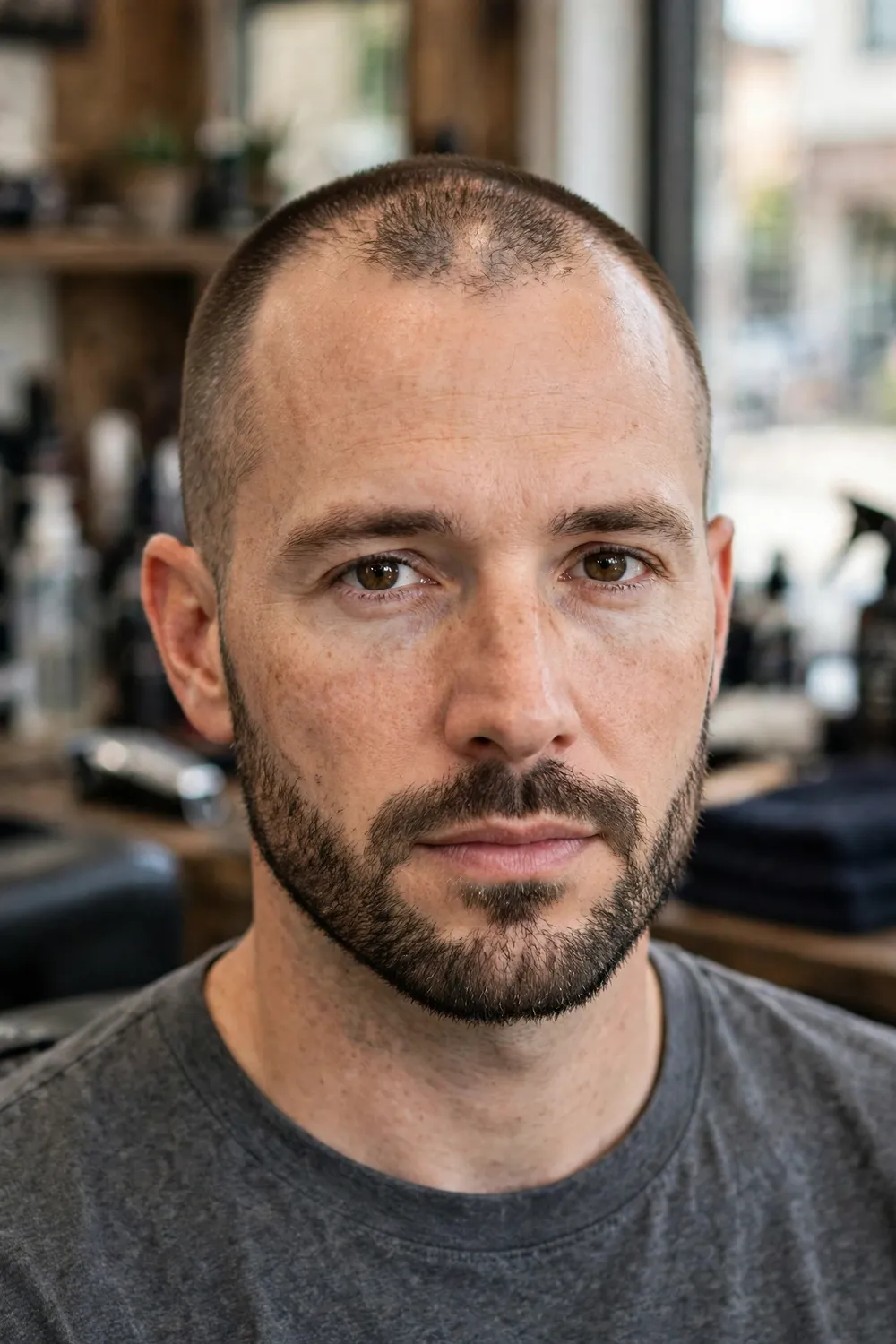
If a full shave feels like a step too far, a short buzz with a neat beard is the halfway house — and for many men it’s the sweet spot. The buzz evens out the crown so the thinning stops drawing the eye, while the beard adds weight and structure to the lower face. It suits men whose beard is fuller than their crown hair, which is a lot of men, and it works on square and oval faces particularly well. Ask for a #2 or #3 guard all over the head, blended into the beard with a short taper at the sideburns, and have the beard shaped with a clean cheek line. A little beard oil keeps it soft. Both parts need attention every week — a buzz grows out unevenly if you leave it, and so does a beard.
30. Short Crop with Goatee
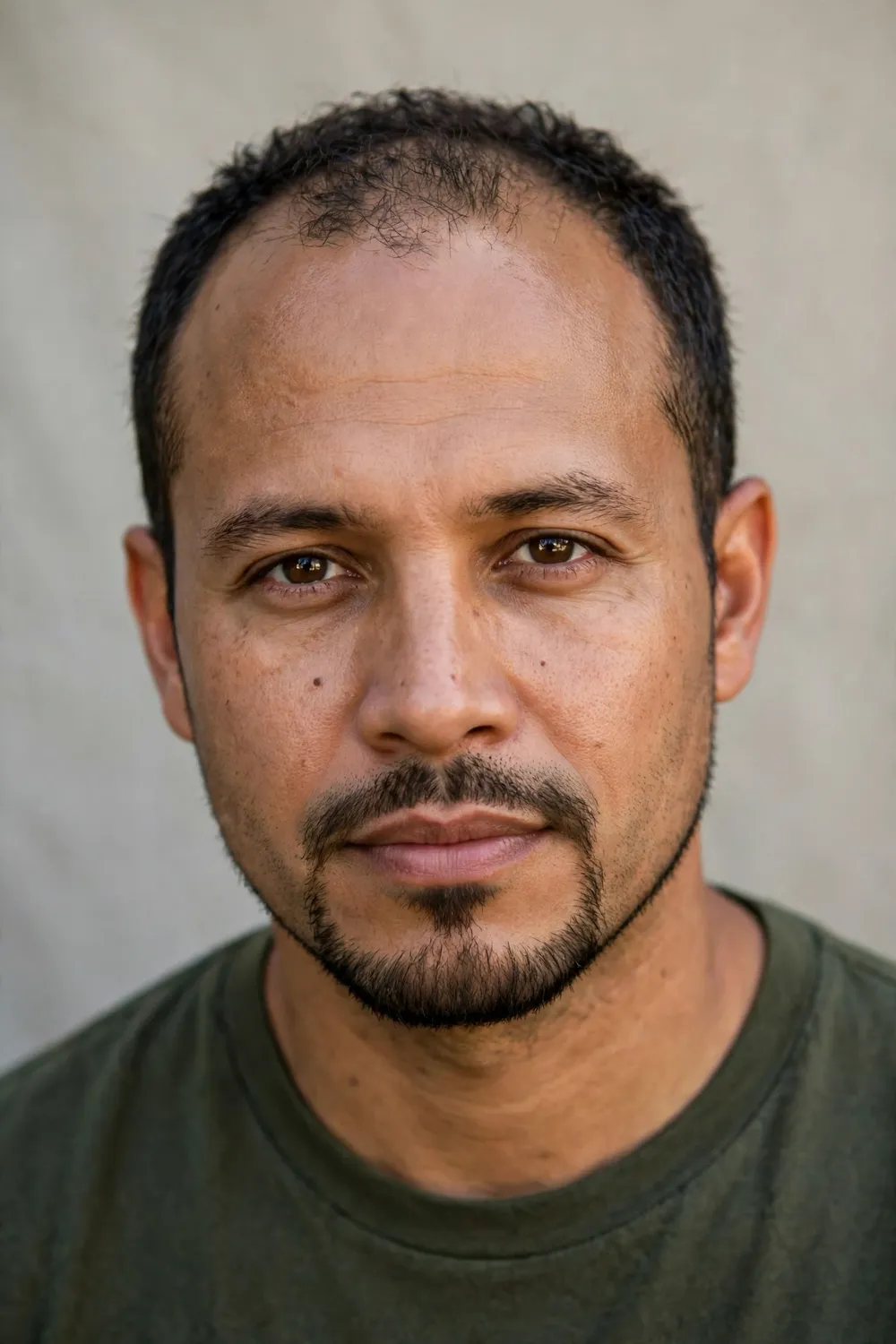
A goatee does something clever: it draws the eye down to the chin and mouth, away from the crown, without asking you to grow a full beard. Paired with a short textured crop on top, it’s a tidy, low-effort combination that suits men who grow a good chin beard but patchy cheeks. Ask your barber for a short crop with light texture on top, tapered sides, and a goatee shaped to follow your jawline — joined to a moustache if yours grows in well, or a standalone chin beard if it doesn’t. Keep the goatee trimmed to one length every few days and the cheeks shaved clean, or the contrast gets messy. The crop needs a cut every three to four weeks.
Extra Styles Worth Trying
Nine more cuts that didn’t fit the main groups but earn their place — some are classics, some are modern twists, and all of them work with a thinning crown rather than against it.
Short Classics & Crops
31. Textured Quiff for a Thinning Crown

A quiff sounds risky with a thinning crown, but the trick is where the height goes: all of it at the front, none of it at the back. The front is lifted and textured while the crown is kept short and flat, so the volume sits where your hair is strongest and the thin patch never gets a spotlight. It suits men whose thinning is mainly at the crown while the front hairline is still solid, and it flatters oval and longer faces. Ask your barber for a textured top, about 2 inches at the front tapering to under an inch at the crown, with tapered sides. Blow-dry the front up and back with a vent brush, then finish with matte clay. It needs a cut every three weeks — once the crown grows, the balance tips the wrong way.
32. Slicked-Back Short Top

A slicked-back style on thinning hair only works when it’s short — and this version is. The top is kept to about an inch, slicked straight back with light hold, which gives a polished, boardroom-ready finish without the heavy, greasy look that exposes the scalp. It suits men with mild crown thinning and straight hair; wavy hair fights the direction and curls at the ends. Ask for a short top with a taper on the sides and tell your barber you want it slicked back, not side-parted. Use a light-hold cream or a water-based pomade — never a heavy oil-based one, which clumps thin hair and shows scalp. A comb and thirty seconds is the whole routine, and a trim every three weeks keeps it sharp.
33. Side-Swept Caesar
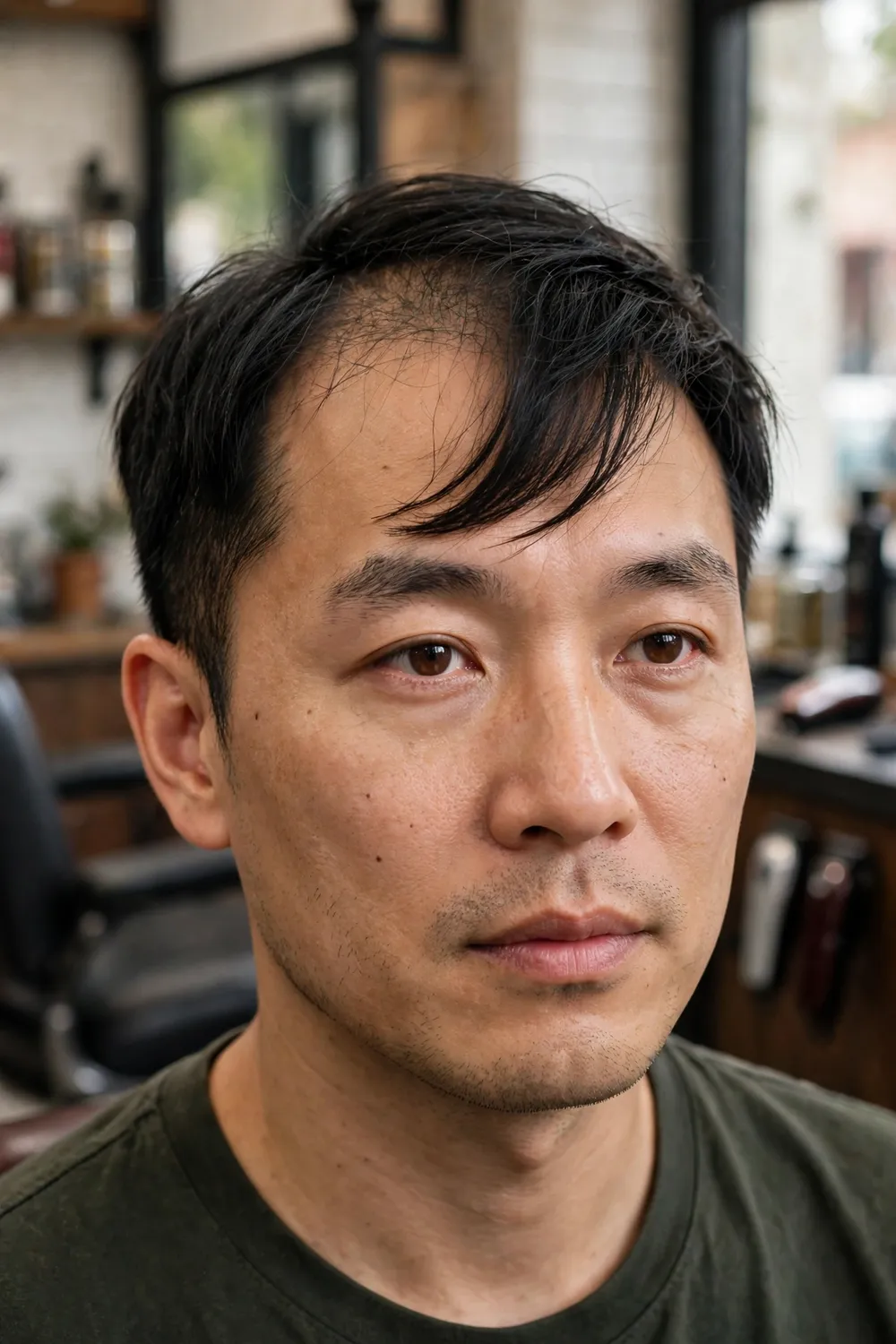
Take the classic Caesar, then sweep the fringe diagonally instead of straight forward, and you get a softer line that covers the hairline without looking like a helmet. The diagonal sweep gives natural coverage across the front while the short, textured top keeps the crown tidy. It suits men who want the forward coverage of a Caesar but find the straight fringe too blunt, and it works on straight and slightly wavy hair. Ask for a short Caesar — about an inch on top — with the fringe cut on a diagonal and the sides tapered. Style it with a fingertip of matte paste, swept across from a low side part. It grows out well, so four weeks between cuts is fine, though the fringe needs a quick tidy if it starts falling into the eyes.
36. Regulation Cut

The regulation cut is the military classic: short on top, tapered sides, nothing flashy — and that plainness is exactly why it works on a thinning crown. With everything kept short and even, there’s no long hair to draw attention to the thin patch, and the clean taper makes the whole thing look intentional rather than neglected. It suits men who want a traditional, no-fuss look, and it works on every face shape. Ask your barber for a regulation cut — roughly a #4 or #5 guard on top with a taper down the sides and back — and make sure he blends the taper rather than leaving a hard line. Product is optional; a little matte paste on the top if you want it neat. A cut every three weeks keeps the taper crisp.
Fades with a Twist
34. Short Curly Fade
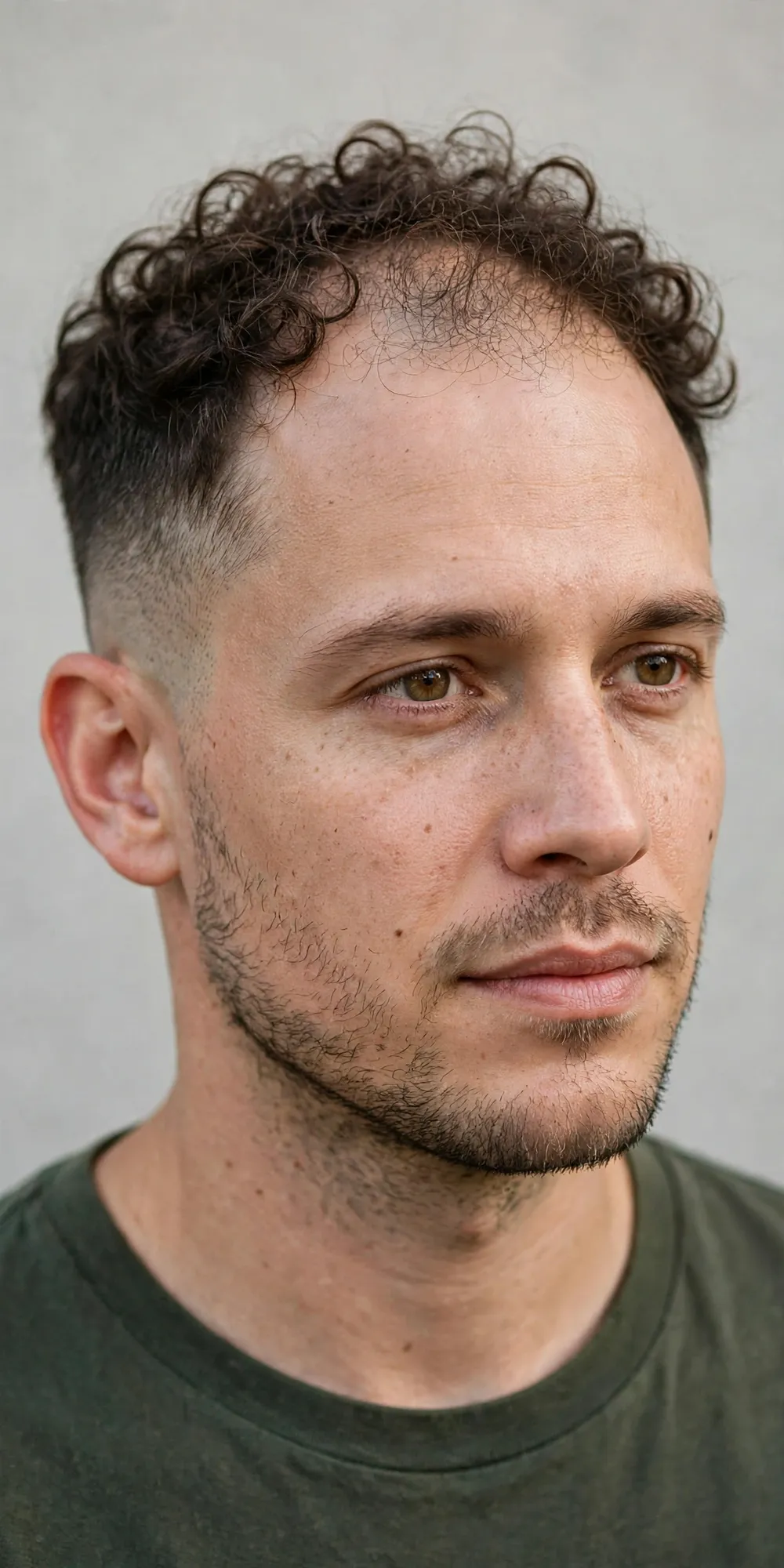
Curly hair and a fade are a natural match: the curls on top create volume that covers a thinning crown, while the faded sides keep the shape sharp and modern. The contrast between the textured top and the clean sides also pulls the eye to the outline of the cut rather than the scalp underneath. It suits naturally curly hair — if your curls are tight, keep the top shorter; if they’re loose, you can leave a little more length. Ask for a short curly top, about 1–1.5 inches, with a low or mid fade on the sides, and have the barber cut the curls dry so the length is honest. Curl cream, scrunched in damp, defines the pattern without weighing it down. Trim every three to four weeks.
35. Buzz with Temple Fade
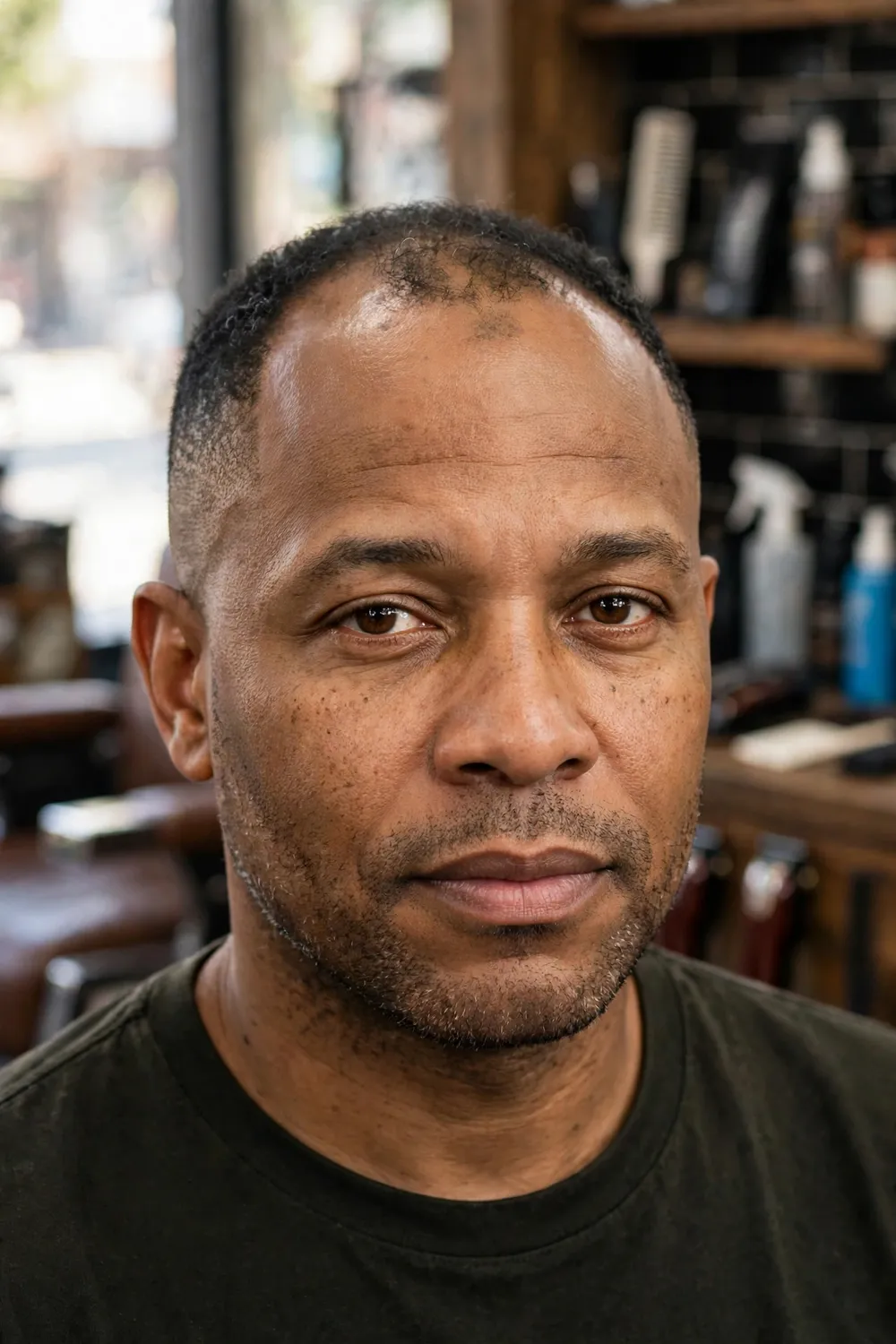
This one pairs a short buzz on top with a fade concentrated at the temples, which does double duty: the buzz evens out the crown, and the temple fade cleans up the corners where receding hairlines show first. It suits men dealing with both a thinning crown and receding temples — a very common combination — and it looks sharp on most face shapes. Ask for a #2 or #3 buzz on top with a temple fade that blends from skin at the temples into the buzz length. No product needed, just a wash and go. The catch is upkeep: a temple fade grows out visibly in about ten days, so book a tidy-up every two weeks or learn to clean the temples yourself between visits.
37. Short Faux Hawk Fade

A faux hawk on thinning hair sounds like a dare, but kept short it’s genuinely flattering: the centre strip is pushed up into a soft ridge, which creates height and texture, while the faded sides keep everything else tight. The height at the centre draws the eye along the middle of the head rather than to the crown. It suits men who want an edgy look without much length, and it works best on straight to slightly wavy hair that holds a shape. Ask for a short top, about 1.5 inches at the centre, with a mid fade on the sides and the top point-cut for texture. A small amount of strong-hold matte clay, pushed up through the centre, holds it all day. It needs a cut every two to three weeks before the sides blur.
38. Short Pompadour with Low Fade
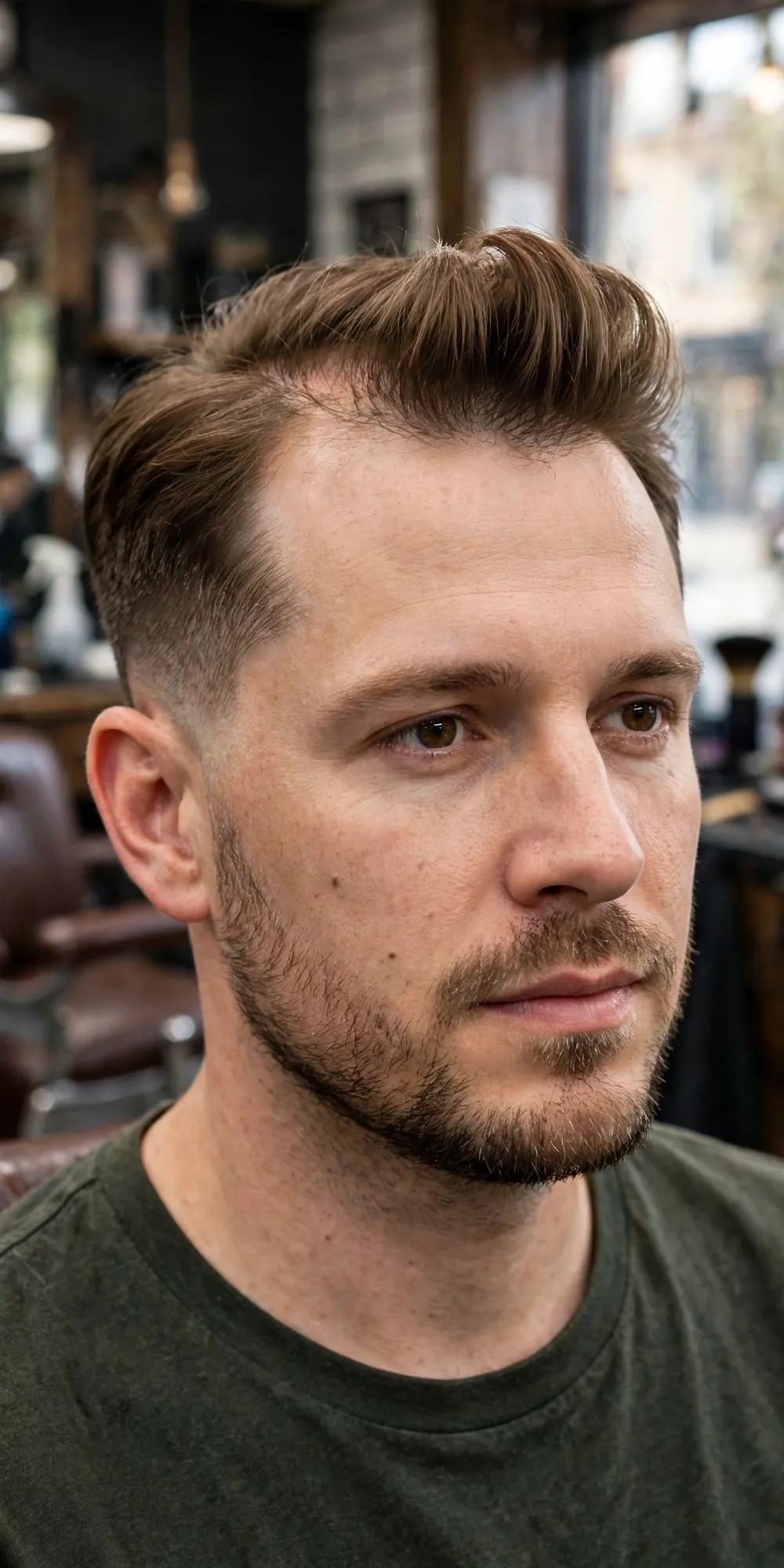
A full pompadour needs a lot of hair, but the short version works with far less: the front is lifted just enough to give height while the crown stays short and the low fade keeps the sides tidy. It suits men who still have good density at the front — that’s the non-negotiable part — and it flatters rounder faces, since the height lengthens them. Ask your barber for a short pompadour, about 2 inches at the front tapering back to under an inch at the crown, with a low fade. Blow-dry the front up and back with a round brush, then set it with a light-hold matte paste. It takes a few minutes each morning and a cut every three weeks, and it falls flat if you skip the blow-dry — so be honest with yourself about the routine.
39. Comb Over with Low Fade

Before you flinch: this is not the comb-over you’re picturing. The modern version is a short, neat sweep across a low fade — a couple of inches of hair combed to one side from a low part, with no long strands dragged across a bald patch. It suits men with mild crown thinning who like a classic, groomed finish, and it works on straight hair with a natural side part. Ask for a short top, about 2 inches, with a low fade and a clean side part cut in. Use a light-hold cream and a comb, and keep the sweep short — the moment strands start reaching across the crown, you’ve crossed the line. A trim every three weeks keeps the part and the fade defined.
What to Ask Your Barber
Walking in with the right words matters more than the cut itself — a vague request gets you a vague result. Here’s what to actually say.
Lead with the crown, not the style. Start with: “My crown is thinning — I want something short that doesn’t show the scalp.” That one sentence tells your barber more than a photo of a model with a full head of hair ever will.
Name the guard. For a buzz, say the number out loud: “#3 on top, tapered down to a #1 on the sides” or “#2 all over.” Guards are precise; “short” is not, and every barber’s idea of short is different.
Name the fade height. Say “low fade,” “mid fade” or “high fade” — and point to where you want it to start. A low fade sits just above the ear; a high fade climbs well up the side of the head. If you’re unsure, ask for a low fade first: it’s the safest place to start with a thinning crown.
Ask for texture, not thinning shears. Say “point-cut the top for texture” and avoid the words “thin it out.” Thinning shears remove bulk, which is the opposite of what thinning hair needs.
What not to ask for. Don’t ask for length on top to “cover” the crown, don’t ask for a heavy slick-back with no texture, and don’t ask your barber to copy a photo of someone whose hair is nothing like yours. Bring a photo of the style, yes — but bring one of a man with a similar thinning pattern, not a model with a thick head of hair.
Book the next visit before you leave. Fades and buzz cuts need a tidy-up every two to three weeks. Put it in the diary while you’re still in the chair.
Haircuts to Avoid with a Balding Crown
Some styles don’t just fail to hide a thinning crown — they put it on display. Avoid these five.
The long comb-over. Dragging long strands across a bald patch fools no one, and the first gust of wind gives the game away. If your hair is long enough to comb across the crown, it’s too long for the crown. Go shorter instead.
Heavy slicked-back styles with no texture. A slicked-back look with oil-based pomade clumps the hair into shiny, separated strands — and every gap between them shows scalp. Texture is what hides thinning; a flat, greasy finish does the opposite.
Long hair left to flop over the crown. Growing it long to hide the spot is the most common mistake on this list, and it backfires every time: long, thin hair lies flat, separates, and frames the bald patch instead of covering it.
High-and-tight cuts that frame the bald spot. A very short back and sides with a slightly longer top creates a hard border around the crown — a frame that draws the eye straight to the thin area. A gradual taper works far better.
Styles that need daily heat styling on fragile hair. If a style only works with a straightener or a hot blow-dry every morning, it’s a bad match for thinning hair, which is typically finer and more fragile. The American Academy of Dermatology notes that certain hairstyles and styling habits can stress the hair — keep the routine simple and gentle. And if your hair loss is sudden, patchy or worrying, see a dermatologist rather than trying to style around it.
5 Mistakes Men Make with a Balding Crown
- Growing it longer to hide the spot. Longer hair lies flatter, separates more easily and frames the bald patch instead of covering it. Shorter almost always looks thicker than longer on a thinning crown.
- Using heavy, greasy product. Oil-based pomades and heavy waxes clump thin hair together, and every clump leaves a gap that shows scalp. Matte clay or a light paste — used sparingly — does the opposite.
- Skipping the barber and letting the sides grow wild. A thinning crown with overgrown sides looks neglected, not natural. Short styles need a tidy-up every two to three weeks to hold their shape.
- Choosing a style from a photo of someone with full hair. A cut that looks great on a thick head of hair can look completely different on a thinning one. Pick a style shown on a man with a similar thinning pattern — the result will actually match.
- Ignoring the scalp. Once the crown is exposed, the skin needs care: sunscreen outdoors, gentle washing, and a moisturiser after shaving. Sunburn on a bare crown is painful, and it makes the thinning far more noticeable. If your hairline is receding too, our guide to hairstyles for hiding a receding hairline covers styles that handle both problems at once.
Frequently Asked Questions
What is the best haircut for a bald spot on the crown?
The best all-rounder is a textured crop: short, choppy layers on top create the illusion of fullness and break up the scalp showing through, while tapered sides keep it tidy. If you want the simplest answer, a classic buzz cut with a #3 guard evens out the contrast between thick and thin areas and needs almost no styling. Men who prefer a sharper look should try a low bald fade, which draws the eye to the clean fade rather than the crown.
Should I buzz or shave my head if my crown is balding?
It depends how far the thinning has gone. A buzz cut is the better first step — it evens out the crown while keeping some hair, and you can always go shorter later. A clean shave suits advanced thinning, when the contrast between the bald patch and the surrounding hair is too stark for a buzz to even out. If you’re unsure, try a #2 buzz first and live with it for a week; the shave will still be there if you want it.
Does a fade hide a balding crown?
A fade doesn’t cover the crown directly, but it helps in two ways: the sharp, clean sides draw the eye to the outline of the cut rather than the scalp, and the contrast makes the top look fuller by comparison. A low fade is the safest choice — it keeps the sides tidy without exposing too much scalp. A high fade can work too, but it puts more focus on the top, so it suits men who are confident about the look. Pair any fade with a short textured top for the best result.
Can I grow my hair over a balding crown to cover it?
In most cases, no — and trying usually makes it look worse. Longer, thinner hair lies flat and separates, which frames the bald patch instead of hiding it, and the first bit of wind undoes the whole arrangement. The one exception is a short, neat comb over of an inch or two on mild thinning, kept with a low fade. For anything beyond mild thinning, going shorter is the honest fix, and it almost always looks better than a cover-up.
What is the best haircut for a thinning crown and a receding hairline together?
You need a style that works forward, not back: a French crop, a Caesar cut, or a buzz with a temple fade. The forward fringe covers the receding hairline while the short, textured top keeps the crown tidy. Our guide to buzz cut hairstyles for men covers the buzz options in more detail, and the temple fade is worth asking about specifically, since it cleans up the corners where a receding hairline shows first.
How short should I go with a balding crown?
Shorter than you think — that’s the honest answer most barbers give. A good starting point is a #3 guard buzz (about 10 mm) or a textured crop at about an inch on top. If the crown still shows through, drop to a #2 guard or an ultra-short #1. The rule is simple: the shorter the hair, the less contrast there is between the thick areas and the thin ones, and the less noticeable the thinning becomes. Going short feels like a big step the first time; most men wonder why they waited.
Does growing a beard help when your crown is balding?
Yes, genuinely. A beard gives the face a new focal point and balances out a shaved or buzzed head — it’s why the shaved-head-with-beard combination is so popular. A full beard works best, but even a few days of stubble softens the look and stops a shaved head from appearing stark. The key is keeping the beard groomed: a scruffy, uneven beard next to a sharp head looks unfinished, while a shaped beard with a clean cheek line makes the whole look deliberate.
Final Word
A balding crown isn’t a problem you solve by hiding it — it’s a shape you work with. Go shorter than you think, keep texture in the top, and pick the style that fits your thinning pattern rather than someone else’s hair. The men who look best with a thinning crown aren’t the ones fighting it; they’re the ones who chose a cut that suits it and keep it tidy. If you want more ideas, browse more men’s haircut guides on our blog — and if your hairline is receding too, our hairstyles for hiding a receding hairline guide pairs with everything in this list.