

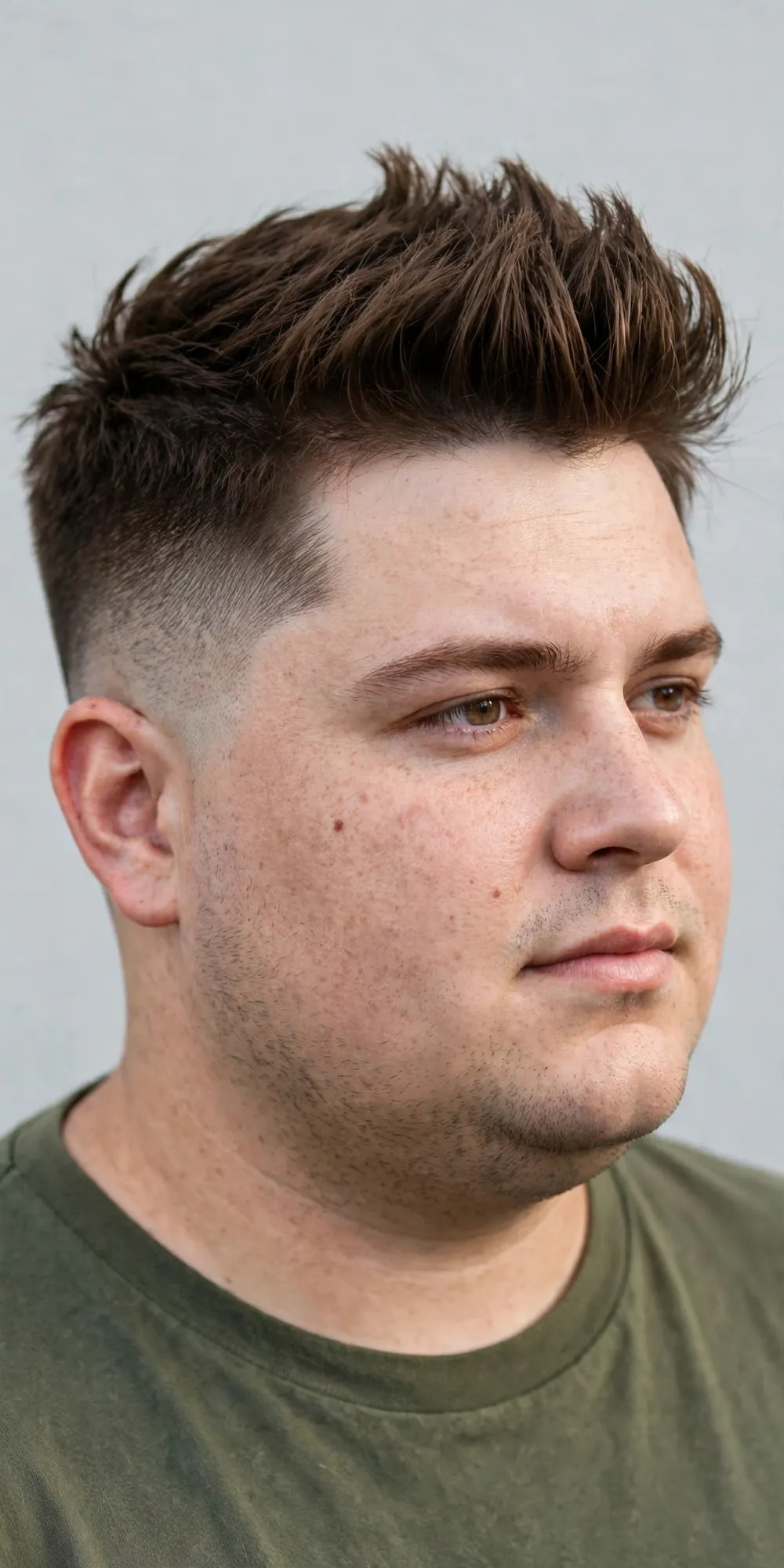
If your face is round, your haircut has a clear job to do: make the face look longer and sharper than it is. A round face is about as wide as it is long, with full cheeks, a soft curved jaw and no real angles — so every good cut for it does the same three things. It builds height on top, it keeps the sides tight, and it puts an edge or a diagonal somewhere on that soft outline. The short answer: a textured quiff, a pompadour or a textured crop over a mid or high fade will flatter almost any round face. The 39 cuts below run from a two-minute buzz to shoulder-length hair, each with the lengths to ask for, the hair it suits, and how much morning effort it honestly takes.
How to Tell If You Have a Round Face
Plenty of men guess their face shape and guess wrong, so measure before you commit to a cut. You only need a phone camera or a flexible tape and thirty seconds.
Stand in front of a mirror with your hair pushed back off your face. Measure four things: your face length (hairline to the tip of your chin), your cheekbone width (across the fullest part of your cheeks), your forehead width, and your jaw width. A round face has a clear pattern:
- Face length and cheekbone width are nearly equal — the ratio is close to 1:1, nothing like the 1.5:1 of an oval.
- The cheeks are the widest of the three width measurements, and they look full rather than flat.
- The forehead and jaw are both narrower than the cheeks, and neither one tapers to a point.
- The jawline curves in one soft arc from ear to chin, with no corner where the jaw turns.
No tape? Use the mirror test. Trace the outline of your face on the mirror with a bar of soap or a dry-erase marker, step back, and look at the shape. A round face reads like a circle: widest through the middle, curving gently at the top and bottom, with no straight sides and no angles anywhere.
The close cousin to watch for is the oval. If your face length comes out clearly longer than the width — around 1.4 times or more — and the outline narrows softly at both ends like an egg, you are oval, not round, and your rules are different: almost everything suits you, and height is optional rather than essential. If that sounds like you, our guide to haircuts for oval face men is the one to read. Everything below assumes a true round face, where the haircut has real correcting work to do.
What Makes a Haircut Work for a Round Face
Oval faces need a haircut that preserves balance. Round faces need one that creates it. Your face is short on length and angles, and long on width and curves — so the haircut has to supply what the bone structure does not. Three rules do almost all of the work.
Height on top is the whole game. Hair that stands up adds visible length to the outline of the head, and the eye reads that extra height as a longer face. Two to four inches of lifted, textured top over short sides can shift how long a round face looks more than any other single change. The opposite is equally true: a flat top on a round face confirms the circle.
Tight sides remove the width you cannot change. Your cheeks are the widest point of your face, and hair sitting on top of them — full, scissored sides at cheek level — widens the silhouette further. A mid or high fade strips that width away exactly where it does the damage, at the temples and above the ears. That is why nearly every cut below is built on a fade rather than a soft taper.
Angles break the circle. A round face has no straight lines, so the haircut should add some: a hard part, a diagonal fringe, a squared-off hairline, a beard with a defined jaw. One deliberate angle is often the difference between a cut that merely sits on a round face and one that sharpens it. Texture does quieter work in the same direction — choppy, separated layers look angular next to a soft jawline, while smooth, rounded styling repeats the face’s curves and doubles them.
39 Best Haircuts for Round Face Men
Every cut below follows the three rules in its own way. They run from the shortest and simplest to long and tied-up, and each one lists the length to ask for and who it suits best. Save the photo of the one you like — showing your barber beats describing every time.
1. Buzz Cut with High Skin Fade

A plain one-length buzz is one of the few short cuts that fails a round face — with no height and no edges, the head and the face read as two stacked circles. The high skin fade fixes it. The sides disappear up to the temple line, the top keeps a visible step of length at a #2 or #3, and that step becomes the corner your outline was missing. It is the lowest-upkeep cut on this list: nothing to style, nothing to buy, just a re-fade every two weeks to keep the step crisp. If your hair is thinning, this is also the most forgiving version — short and even makes density look uniform.
2. Crew Cut Styled Upward
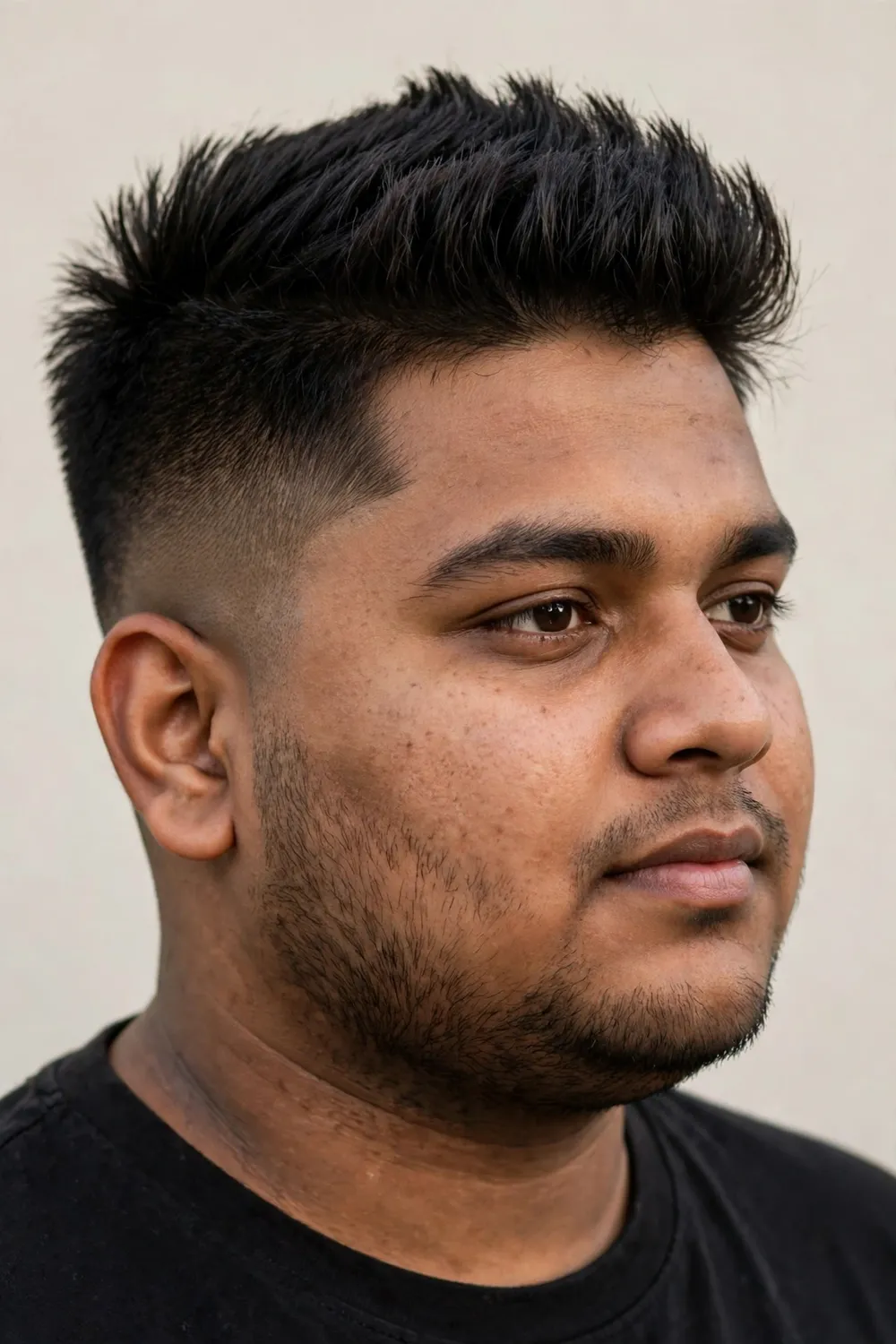
A standard crew cut dried flat does nothing for a round face. The same cut — 1.5 to 2 inches on top, slightly longer at the front, with a mid fade — blow-dried upward is a different haircut entirely. The lifted front adds just enough vertical line to stretch the face, and the whole routine takes about two minutes: dry the front up while damp, then a fingertip of matte cream to hold it. It suits every hair type, grows out evenly for three weeks, and is the safest pick here for conservative workplaces and men who will not spend longer than that on their hair.
3. Textured Caesar Cut
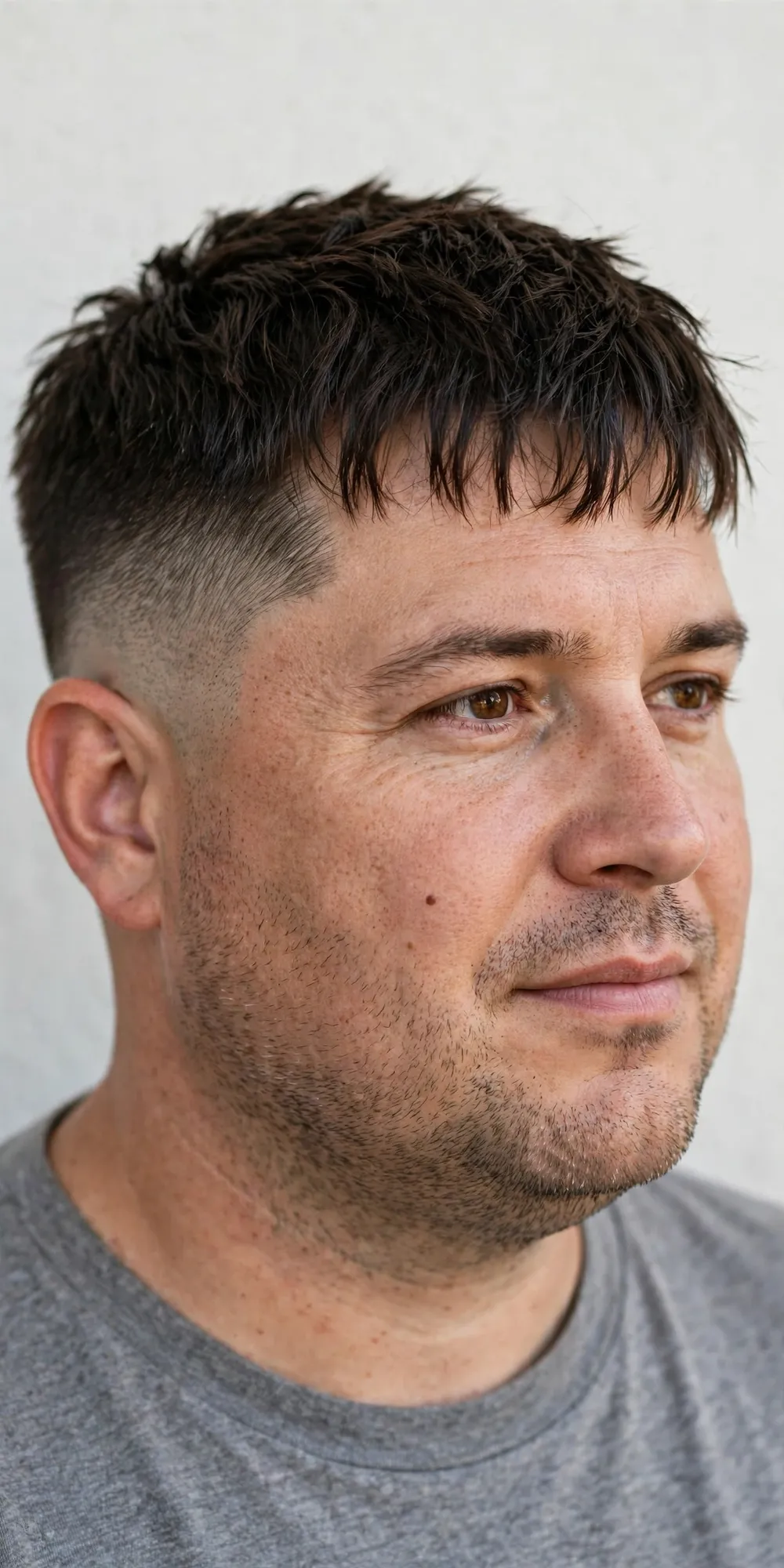
The classic Caesar ends in a blunt horizontal fringe, which is a straight line drawn across a round face in the worst possible place. This textured version keeps the Caesar’s short, uniform top — around an inch to an inch and a half — but point-cuts the fringe into broken, separated pieces so it never sits as a solid bar. Paired with a low taper or a short fade, it is tidy, masculine and close to maintenance-free. It suits straight and slightly wavy hair, and it flatters men with smaller foreheads or early thinning at the front, because the forward direction covers without looking like it is hiding anything.
4. Skin Fade with Lifted Crop
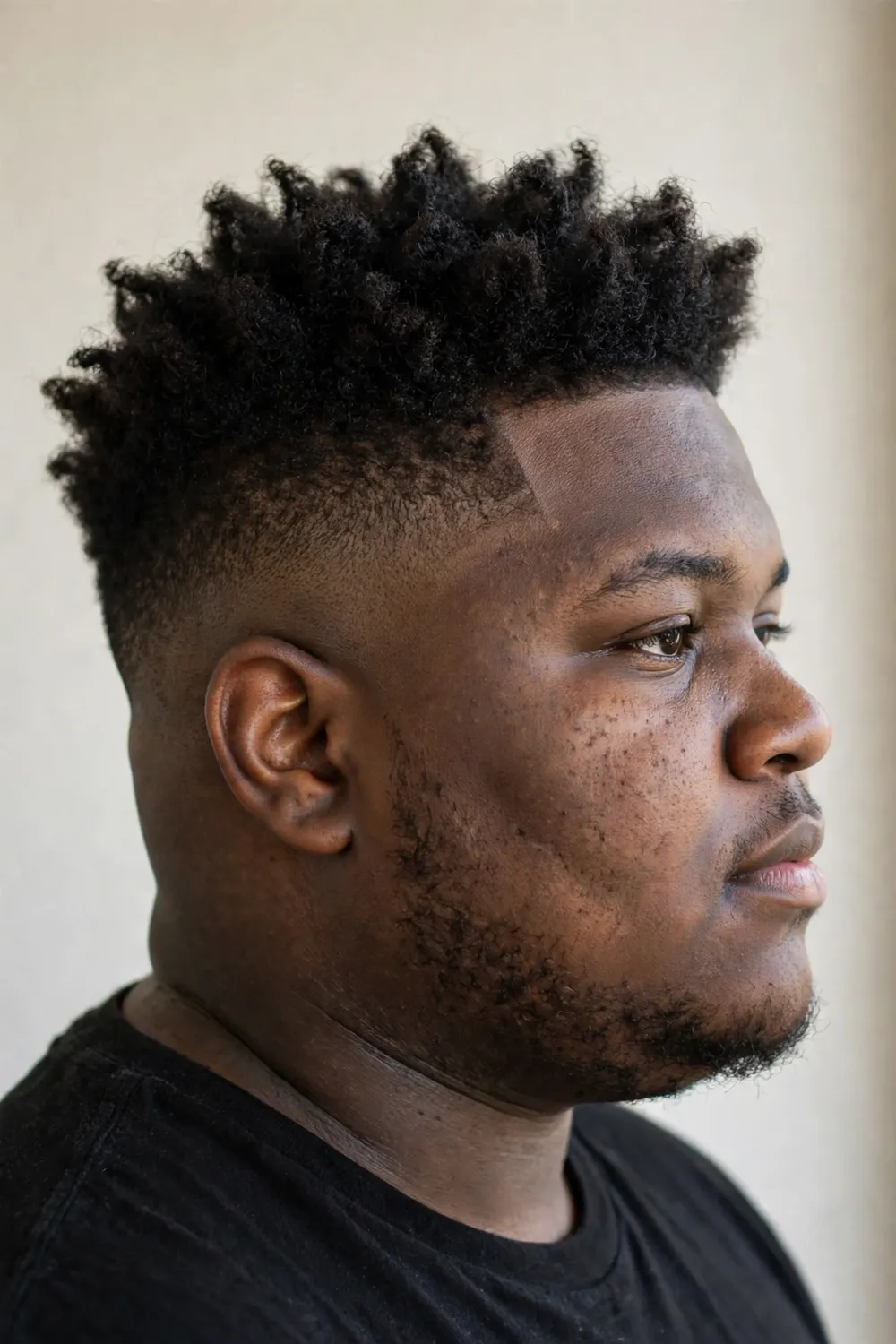
The trick is in the name: lifted. A crop worn flat and forward shortens a round face, but a crop whose top is cut to about 2 inches, point-cut for texture and styled up-and-forward gains height the flat version gives away. Underneath it, a skin fade takes the sides to zero so there is no width left at cheek level at all. Dust a little texture powder at the roots in the morning and push the top up with your fingers — thirty seconds, done. Be honest about the upkeep, though: a skin fade wants a fresh edge every two to three weeks or the contrast that makes this cut work starts to blur.
5. Textured Crop with High Fade
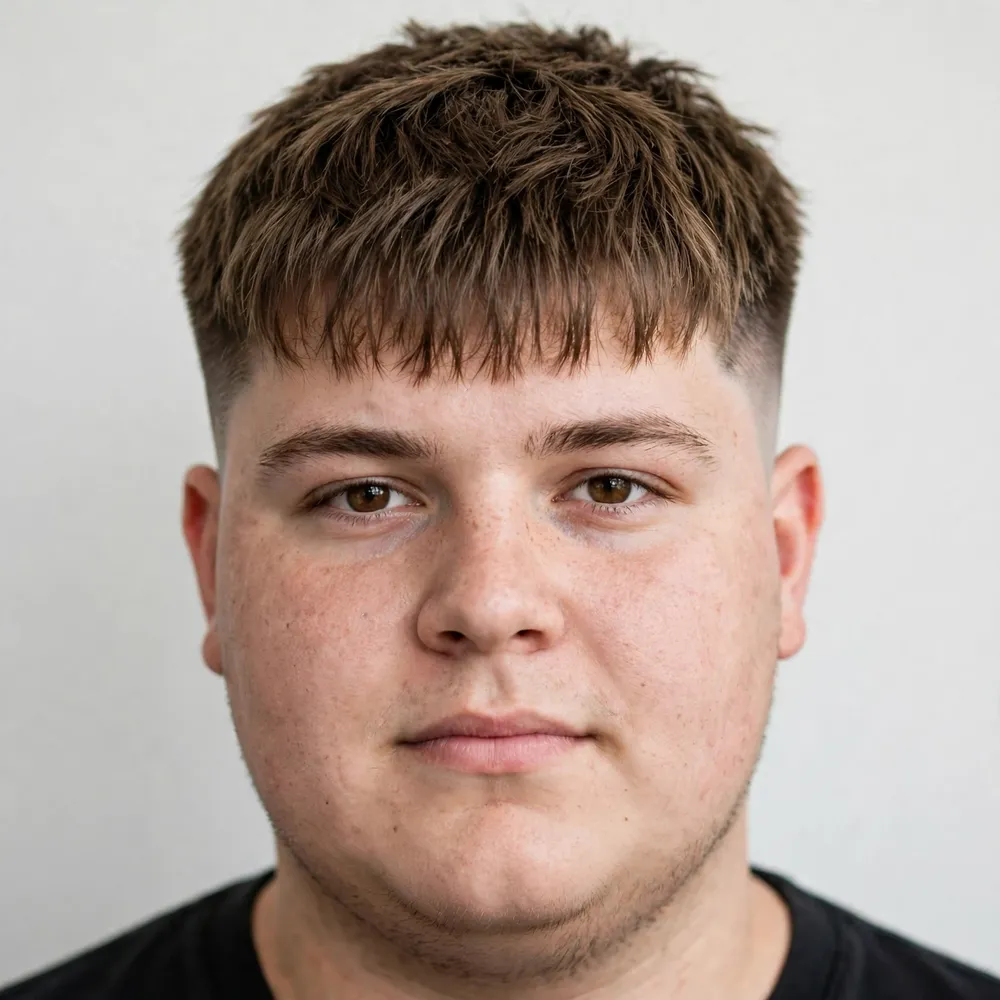
This is the most requested men’s cut of 2026, and on a round face it might be the single most reliable one. The top is cut to 1.5 to 2 inches and point-cut or razor-textured into separated pieces, worn forward into a short broken fringe that stops high on the forehead. The high fade strips the sides right up to the temples, which is exactly where a round face carries its width. Height, tight sides, broken angles — all three rules in one cut, and it works on straight, wavy and most curly hair. Style it with matte clay on dry hair, pushed slightly forward; a comb makes it look too neat and too flat. Expect the fade to soften around week three.
6. Messy Textured Crop
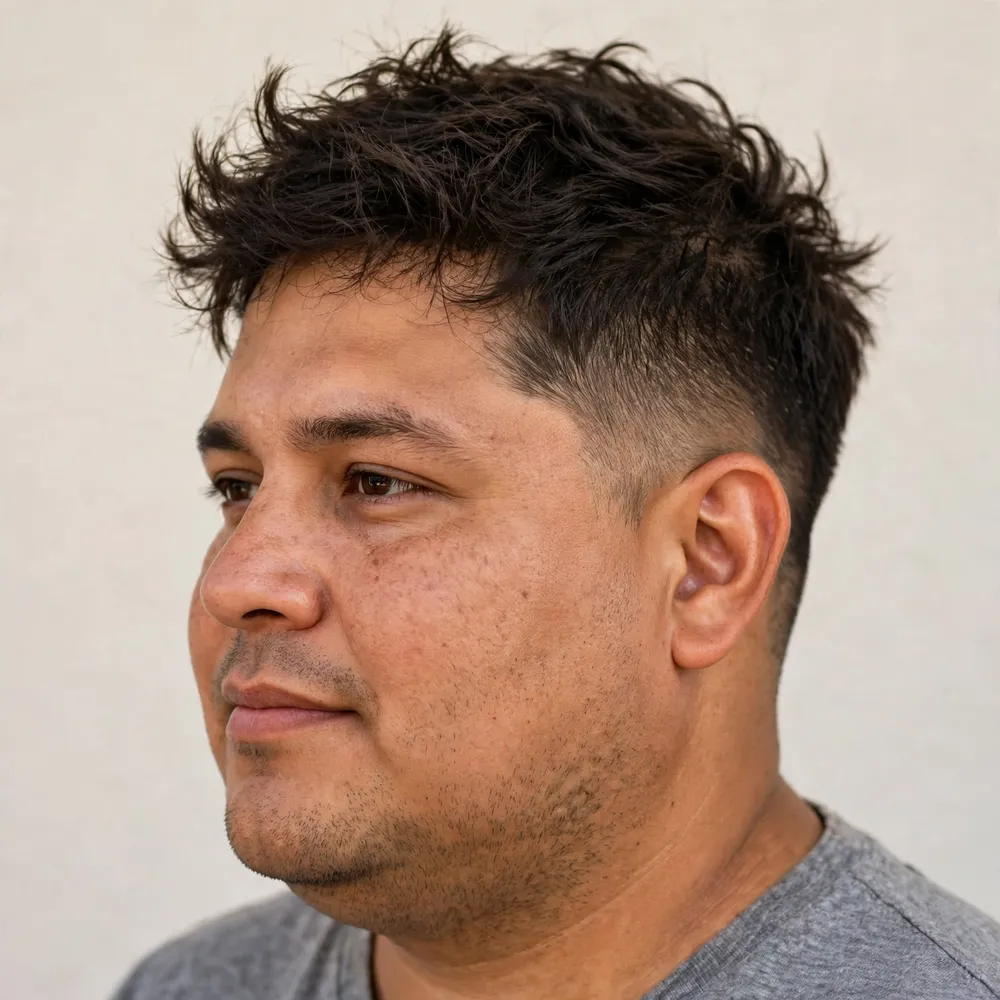
The messy crop is the textured crop with the polish removed: the same short, point-cut top, but the layers are left pointing in soft, mixed directions and the finish is deliberately undone. On a round face the chaos is useful — pieces going in different directions break up the outline the way a diagonal fringe does, just all over. The one thing you cannot relax is the sides. Messy on top with full sides reads wide and round; messy on top with tapered or faded sides reads deliberate. It suits wavy hair best, because the wave supplies the mess for free. Texture powder, tousle with your fingers, and stop before it looks combed. If you like this undone direction, our 51 Best Messy Hairstyles for Men guide has 51 more like it.
7. Angular Fringe with Fade

A fringe is not automatically bad for a round face — a badly cut one is. A fringe sliced straight across the forehead repeats the face’s width and shortens it. The same fringe cut on a diagonal, longer on one side and sweeping down across, puts a long slanting line exactly where a round face has none, and the face instantly reads longer. Keep the top at 2 to 3 inches so the angle has room to travel, pair it with a mid fade, and choose straight or slightly wavy hair — curl will not hold a clean diagonal. Pull the fringe forward and to one side with matte paste, and pinch the ends so the edge looks broken rather than heavy.
8. Spiky Textured Top
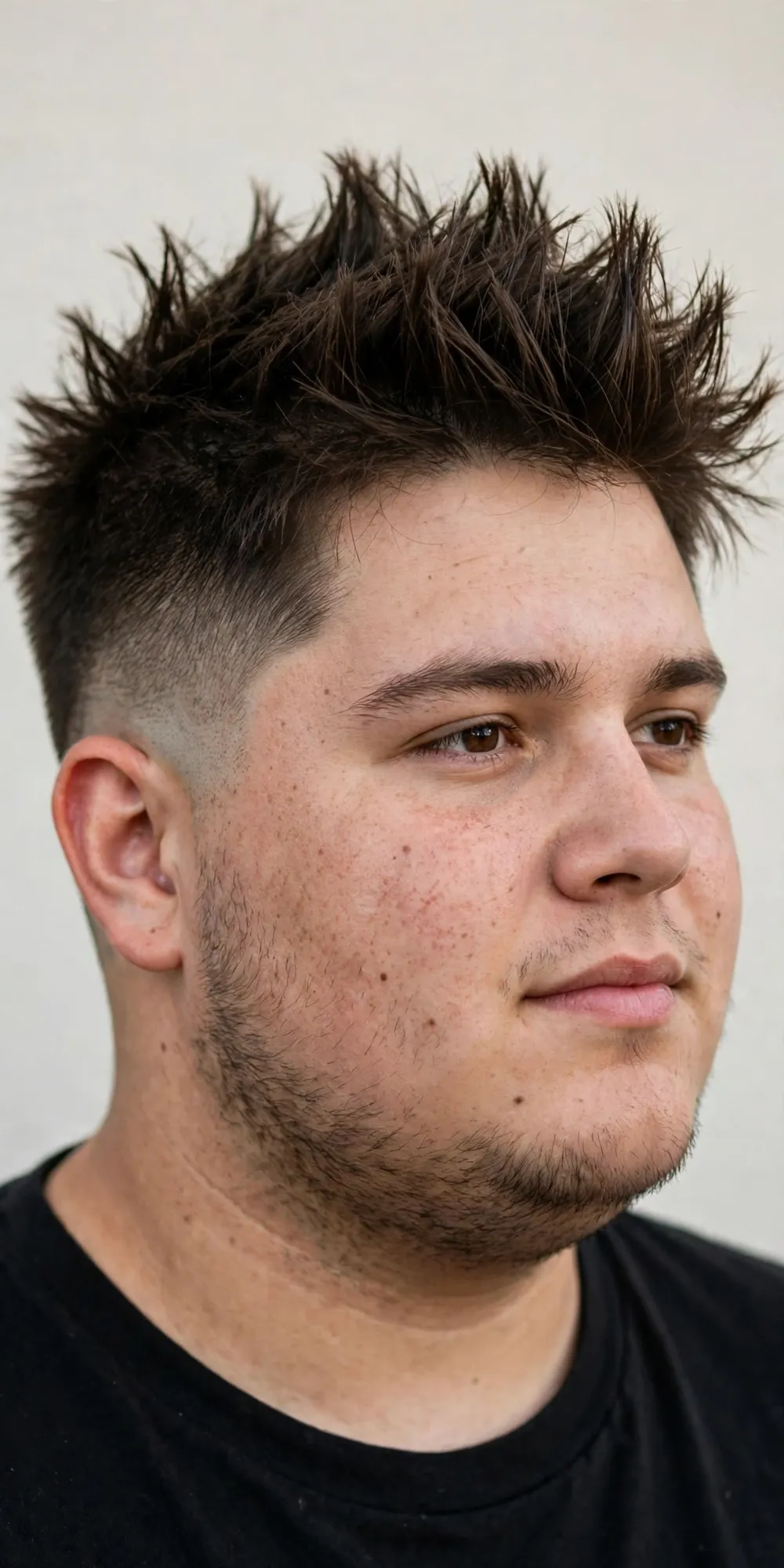
Spikes are the most direct form of height there is: every piece of hair points up, so every piece adds length to the silhouette. The 2026 version is not the wet, gelled spikes of the 2000s — it is short, dry separation, worked up with matte clay and pinched at the tips so the top looks textured rather than stiff. Keep the top around 1.5 to 2.5 inches; longer spikes flop, shorter ones disappear. Faded sides are non-negotiable, because spikes over full sides just make a wide head look spiky. It suits straight and wavy hair, and it is a smart pick for fine hair, since spiking and separation make thin coverage look denser than it is.
9. Brush Up with High Fade
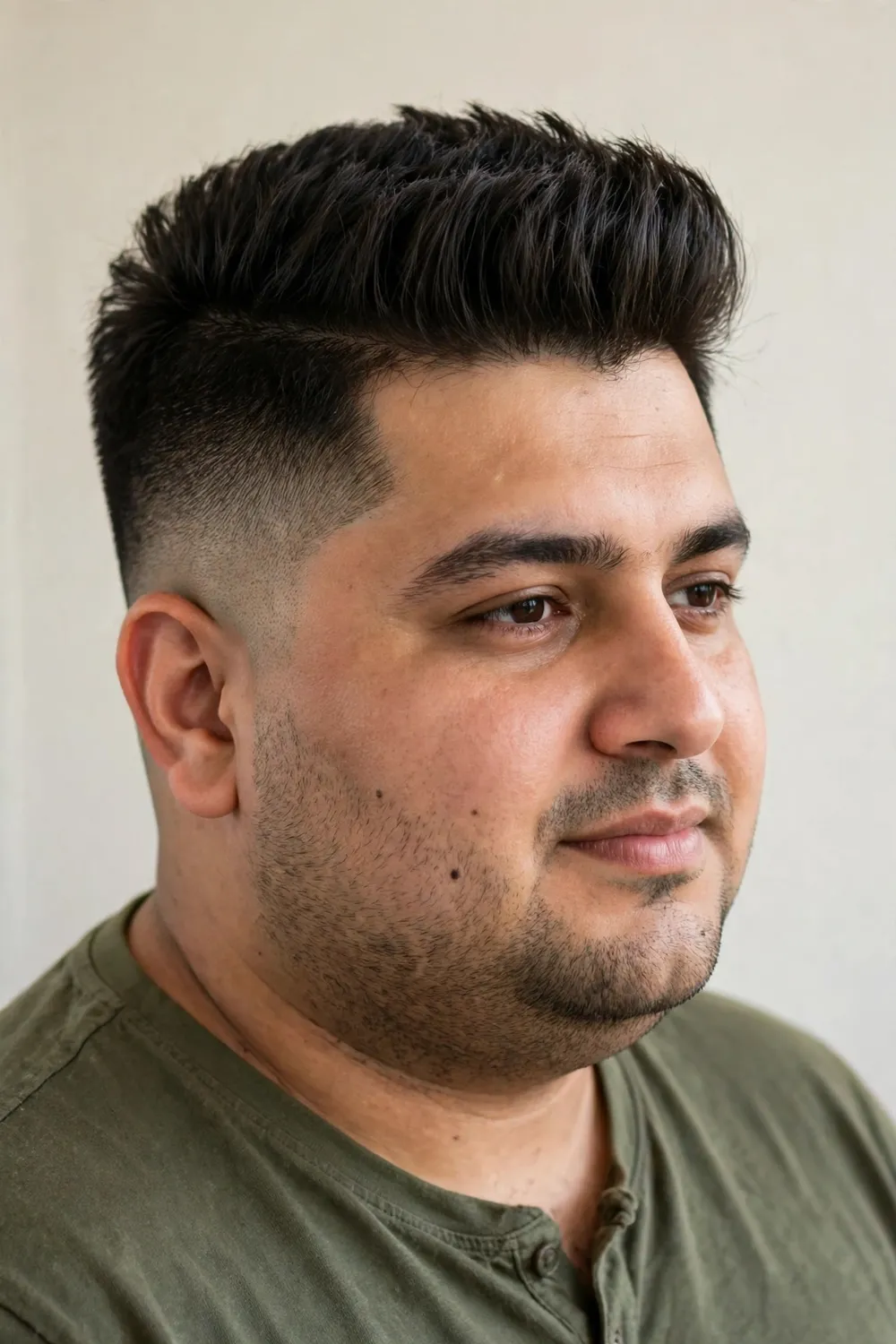
The brush up does exactly what the name promises: 2 to 3 inches of top, brushed straight up and slightly back, over a high fade. There is no part, no sweep and no fringe — just a clean block of vertical hair, which is why it lengthens a round face so efficiently. It suits straight hair best, because straight hair stands where it is put; wavy hair needs a blow-dry and strong clay to hold the line. Two technique notes that make or break it: dry the hair upward while it is damp, because product alone will not lift dry flat hair, and keep the product off the faded sides — shine on the sides draws the eye sideways, undoing the vertical line you built.
10. Short Back and Sides with Textured Top

The barbershop classic still earns its place. Short back and sides — scissored or clippered, but genuinely tight at the temples — with 2 to 3 inches of textured top that you lift rather than lay flat. It is less extreme than a skin fade and sharper than a taper, which makes it the version most men can wear to any job, any age, any day of the week. Its one rule on a round face: the top has to be long enough to lift. Ask for the top “long enough to push up” and have the barber point-cut it, because a short-back-and-sides with a flat, blunt top is just a neat circle. It grows out gracefully for four weeks, which is part of why it has outlived every trend around it.
11. High and Tight
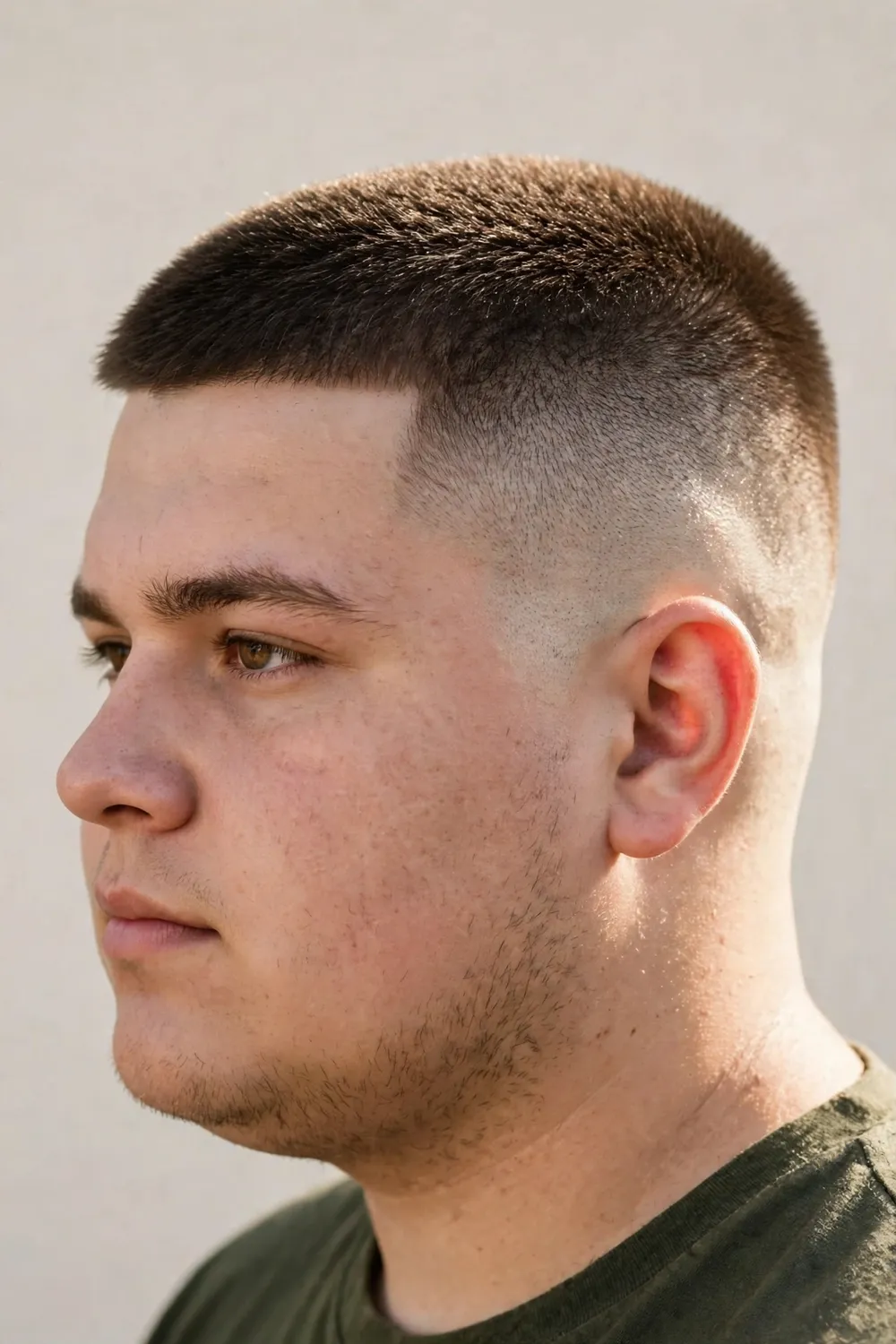
The military high and tight is the buzz cut’s more deliberate cousin: the sides and back are faded very high and very short — often to skin — while a short strip of length stays on top, usually a #2 to #4. On a round face the extreme fade does heavy lifting, removing every trace of width at the temples and leaving a head shape that reads longer and more angular than the face underneath it. There is no styling at all and barely any decision-making, which is the point. It suits men with strong features and thick hair, and it is not the cut for a receding hairline — the high fade exposes the corners as much as it exposes the temples. Rebook every two weeks; it grows out fast and unevenly.
12. Temple Fade with High Top
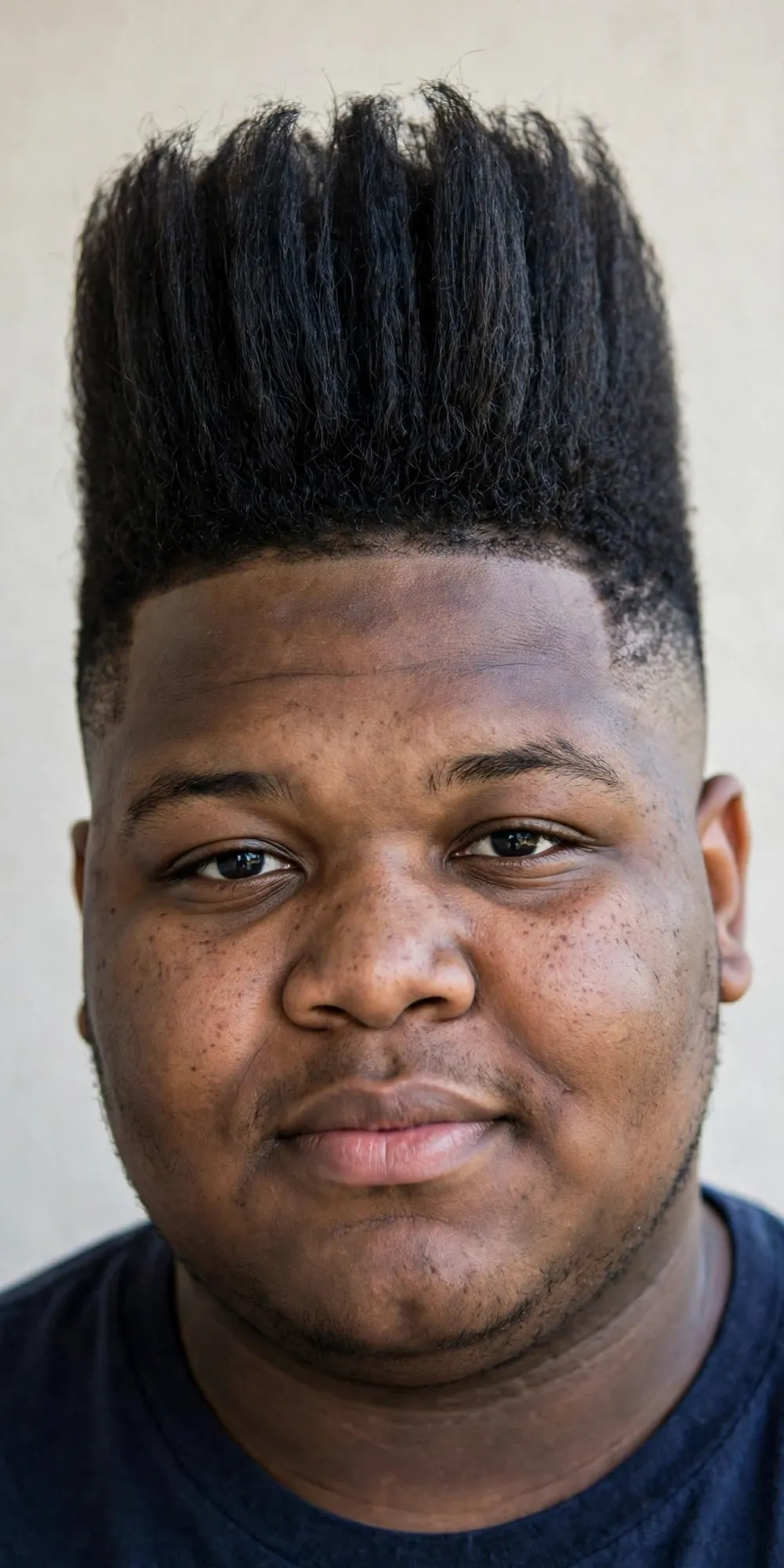
This cut concentrates everything on one contrast: the fade tightens precisely at the temples and front hairline, while the top carries real length and volume, brushed upward. The tight temple against the tall top draws a strong vertical line up the side of the head, and a round face — which has no vertical lines of its own — borrows it. It works best on thick hair that holds an upright shape without collapsing by midday, and on coily hair, where the lined-up temple and hairline do the sharpening while the top stays full. Ask for the top to be shaped tall rather than round; a high top cut into a dome just echoes the face.
13. Textured Quiff with Mid Fade
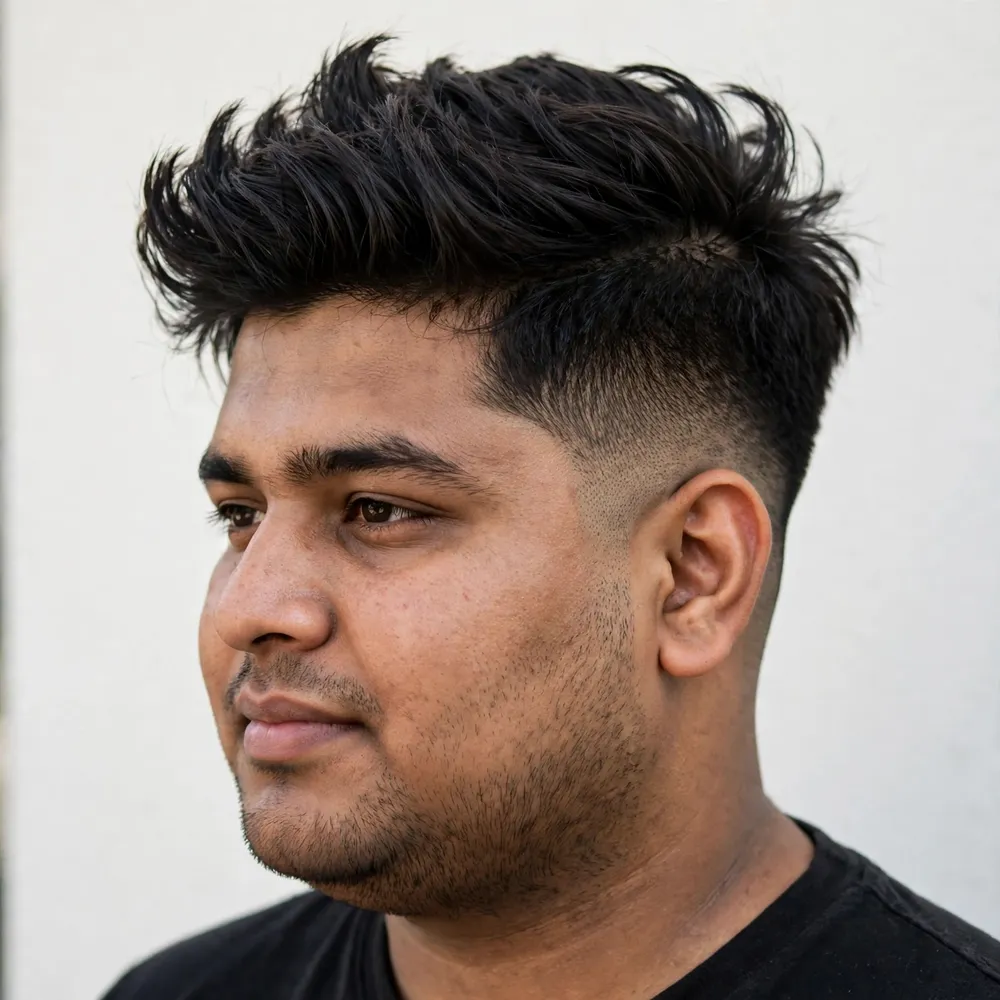
Ask a room of barbers for the default round-face cut and most will say this one. The quiff keeps 3 to 4 inches at the front, brushed up and slightly back into a soft wave of height, with the length grading shorter toward the crown. The mid fade underneath keeps the sides controlled without the aggression of a skin fade, so the result is professional rather than extreme. It is also the most adaptable cut here — on thick hair it holds its height almost by itself, and on very thick hair it stays the pick even when other lifted styles get bulky. The styling is in the drying, not the product: blow-dry the front up and back from the roots first, then set with matte clay. A quiff built on dry hair with product alone collapses by lunch, on any face shape.
14. Modern Pompadour with High Fade
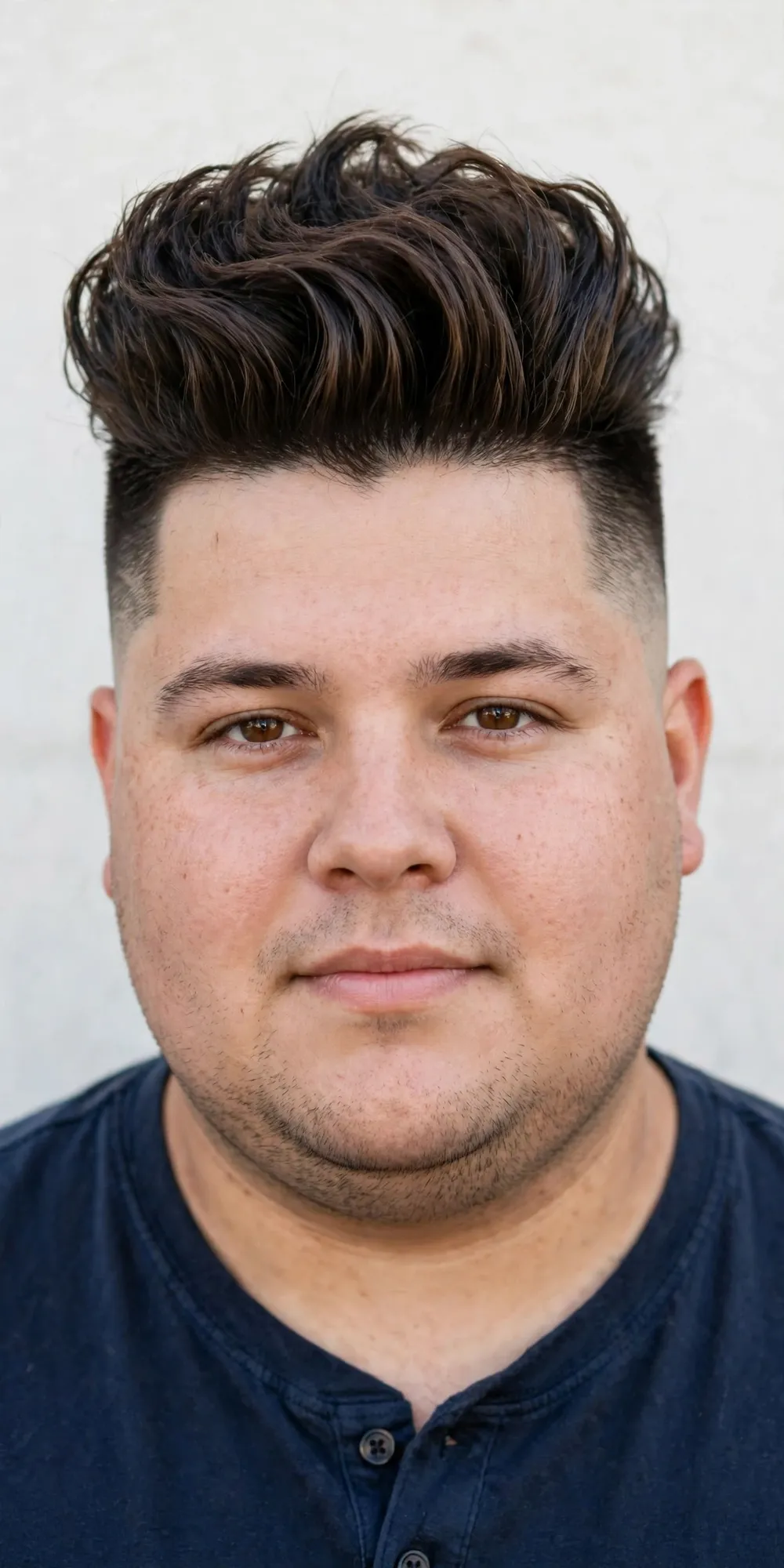
The pompadour is the maximum-height option: 4 to 5 inches at the front, swept up and back into a rolled wave of volume. The style takes its name from Madame de Pompadour, and on a round face its exaggerated vertical line does more face-lengthening than any other cut on this list. The high fade matters as much as the pomp — it strips the sides at the widest point so nothing competes with the height. Be realistic about the deal you are making: this is ten minutes of blow-drying and product every morning, and it needs thick, straight-to-wavy hair to hold. In exchange, no cut changes a round face’s proportions more. Dry the front up with a round brush before any pomade goes in; height built with product alone never survives the day.
15. Faux Hawk with Burst Fade
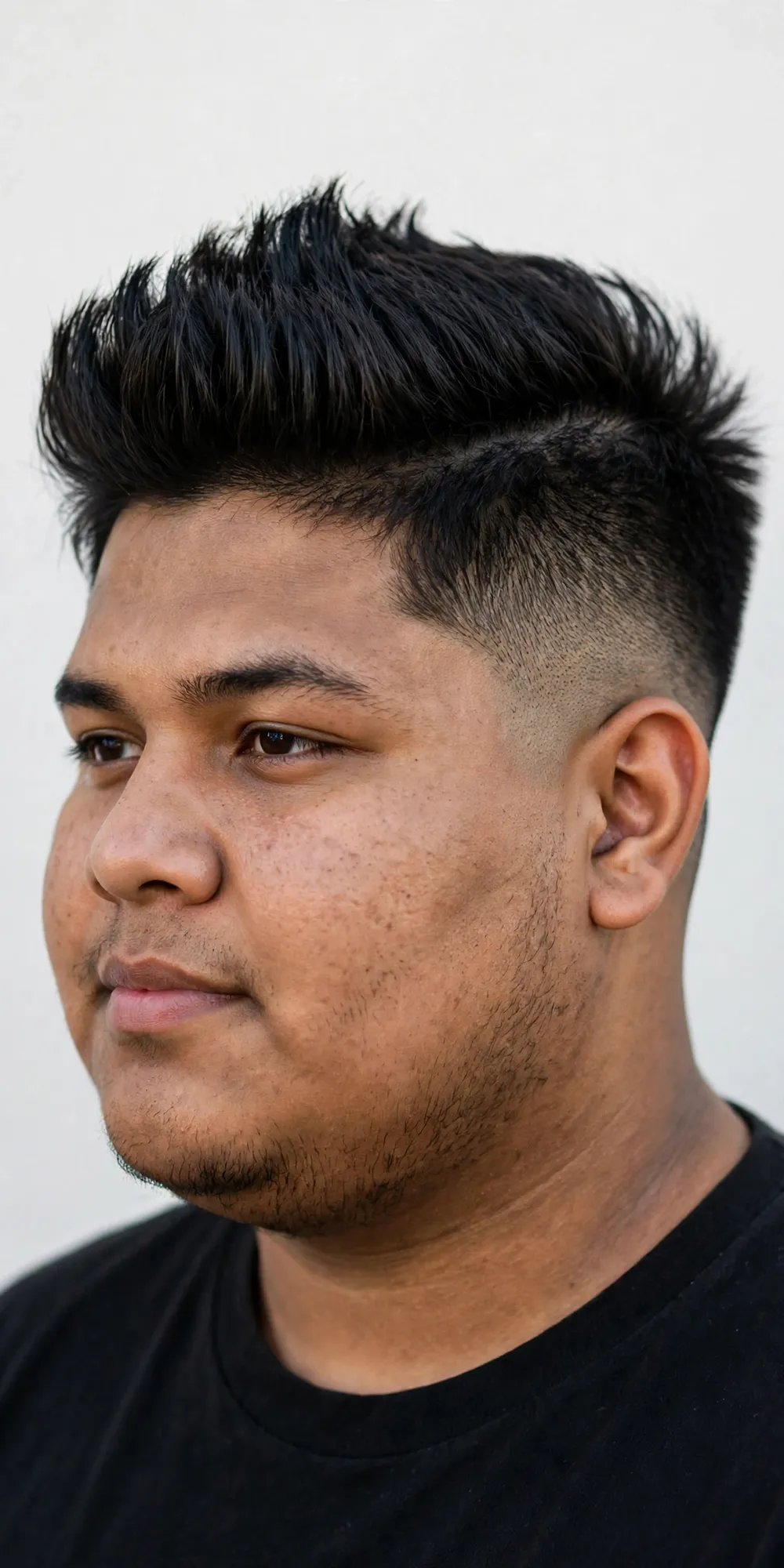
A faux hawk concentrates all the length into a strip down the centre of the head and fades everything else — the single most direct way to make a head read tall and narrow. The burst fade, which arcs around the ear rather than running straight, suits it best because it leaves the outline smooth behind the ear while the centre strip does the talking. Keep the strip at 2 to 3 inches and push it up and slightly forward with matte clay; much taller and it stops reading as a style and starts reading as a costume. It needs thick hair to fill the strip without heavy product, and it suits younger, athletic looks better than boardrooms. One advantage over a true mohawk: combed down flat, it passes as an ordinary short cut on days you need it to.
16. Side Part with Volume

Every face-shape guide returns to the side part for round faces, and the reason is geometry: the part lays a long diagonal line across the top of the head, and a diagonal is the closest thing to an angle a soft outline can wear. What makes it work — or fail — is the volume. A side part combed flat adds the line but no height, and the face stays round; the same part with 3 to 4 inches on top, dried upward before it is combed over, adds both. Ask for a mid to high fade underneath, find the part where your hair naturally splits rather than forcing a new one, and keep the product light. It is the most office-safe cut on this list and the one that ages best — men wear it at twenty and at sixty, unchanged.
17. Hard Part with Side Sweep
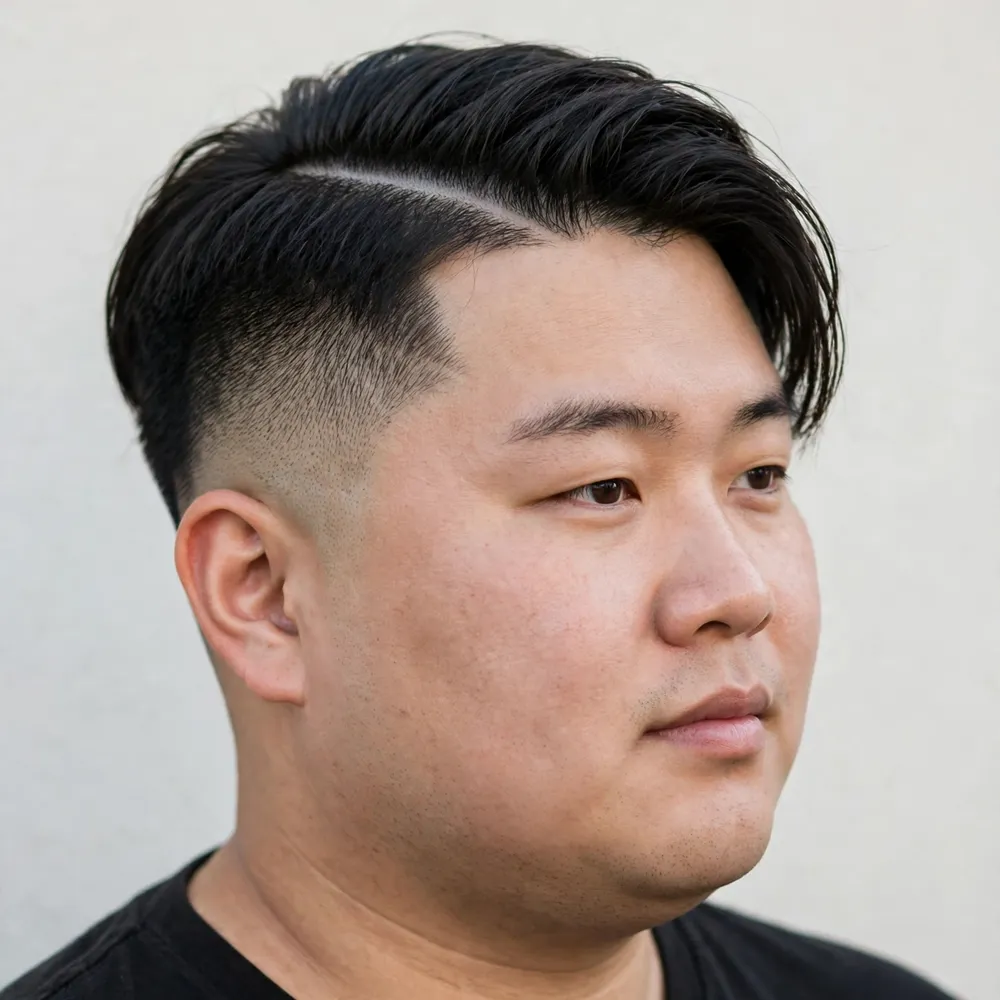
Take the side part and sharpen its one line into a statement. A hard part is a thin line shaved in with a razor exactly where the hair divides, and on a round face it does something no styling can: it engraves a crisp, straight, geometric edge onto a head that has no straight edges anywhere. The top sweeps to one side with volume, the mid fade keeps the sides tight, and the whole head reads longer and more deliberate. It works best on straight hair, where the line stays clean and visible. Two honest warnings: the shaved line softens within two to three weeks, faster than the rest of the cut, so this is a standing-appointment haircut — and a hard part is unforgiving of a wobbly natural part line, so let the barber place it where the hair already wants to split.
18. Textured Side Part (Matte Finish)
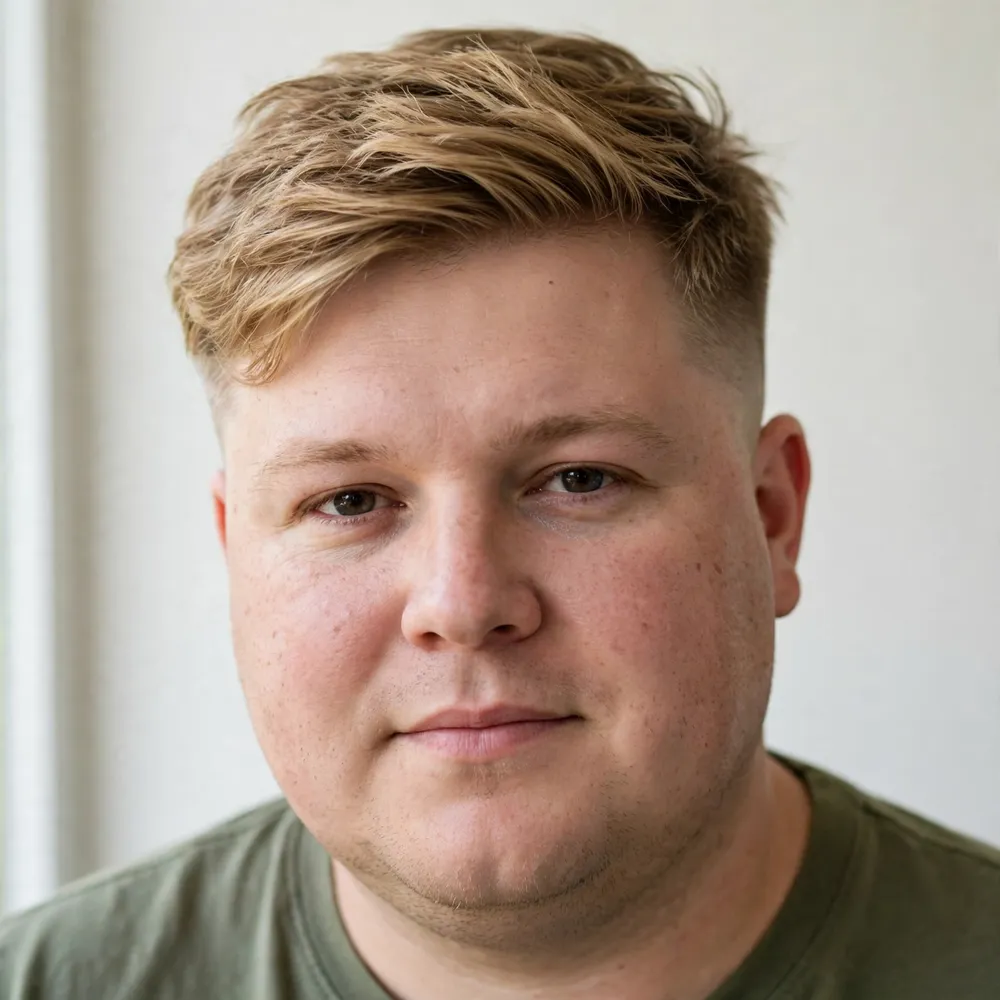
Same diagonal, different attitude. The textured side part skips the polished pomade finish of idea 16 and instead keeps the top point-cut, piecey and matte, so the part reads as a natural split in textured hair rather than a drawn line. It is the better choice for wavy and medium-thick hair, which looks overdone when it is combed too neatly, and for men whose week is more smart-casual than suited. The round-face mechanics are unchanged — height at the front as you dry it, a mid fade under the sides, the diagonal doing the slimming. Style it with matte clay worked through dry hair and set the part with your fingers, not a comb. Rebook in about three weeks, when the fade softens.
19. Ivy League with Height

The Ivy League is a crew cut that kept its options: 2 to 3 inches on top, longest at the front, scissored sides, and the choice of a small side part or a gentle forward sweep. The standard version is merely neat — the round-face version is cut and styled with the front brushed upward, so the longest hair on the head is also the tallest. That one habit turns a preppy classic into a face-lengthening cut that still passes in the most conservative office in the building. It suits straight and wavy hair, fine hair included, because the short length keeps fine hair from separating. A light cream or a touch of matte paste is all it ever needs, and it grows out gracefully for a full four weeks.
20. Side Swept Fringe with Height

A fringe can work on a round face, but only when it moves diagonally and keeps its lift. The side swept fringe keeps 3 or more inches on top, lets the front fall forward, then sweeps it across to one side rather than combing it flat — and the barber builds a little height at the roots first, so the sweep travels across a raised top instead of a flattened one. That combination — diagonal line plus root lift — is why this fringe lengthens while a straight fringe shortens. It suits oval-adjacent round faces (the ones close to the 1.2:1 border), straight-to-wavy hair, and men who want a softer, less barbered look. Style it with a light cream on damp hair, swept with your fingers; heavy product makes the fringe clump and fall straight, which is the one direction it must never go.
21. Off-Center Curtain Part
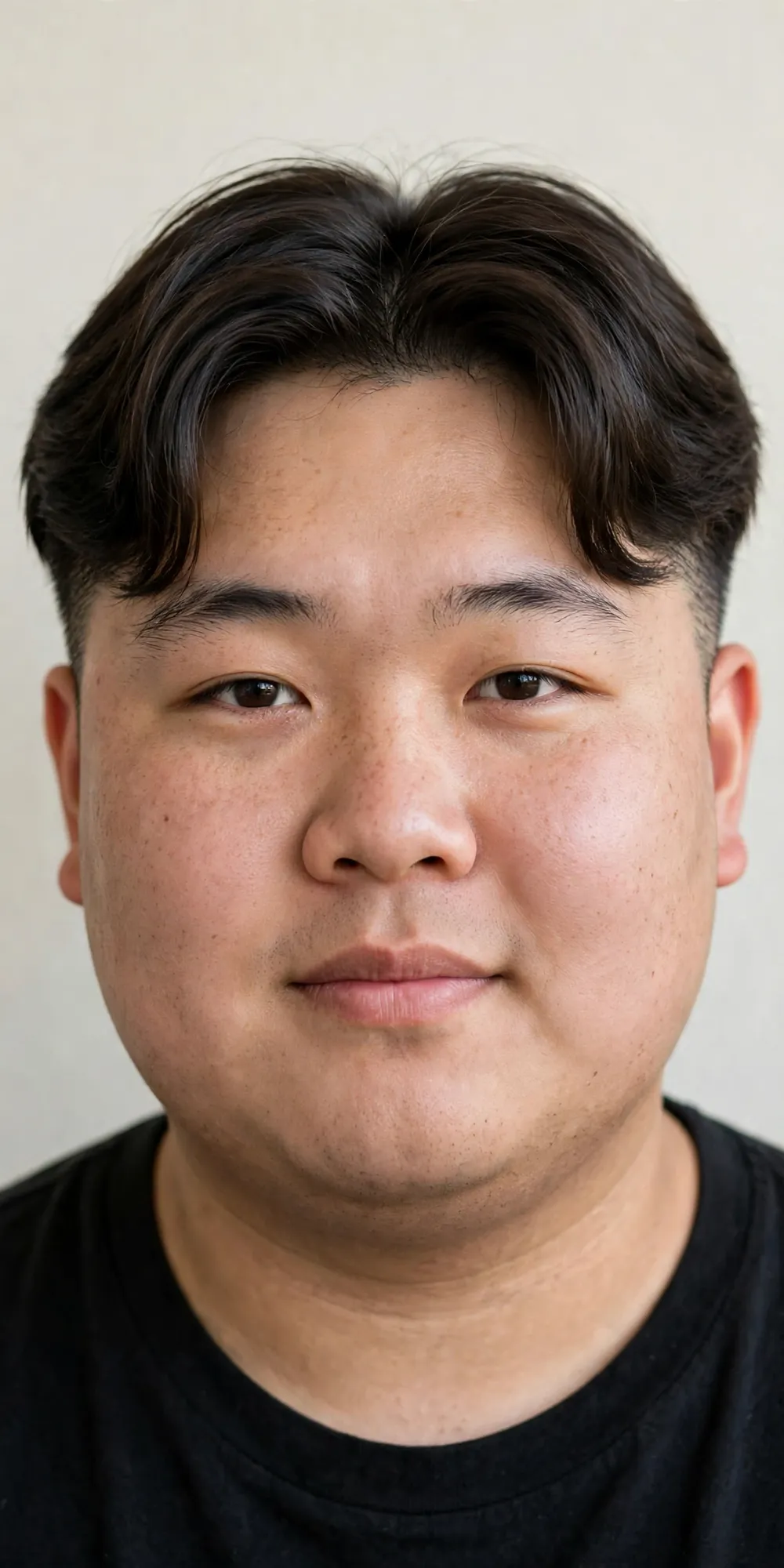
Curtains are where round-face advice gets specific, because the detail is everything. A dead-centre part on a round face creates two identical curved halves — the symmetry frames the circle and confirms it. Move the part half an inch off-centre and the same hair behaves differently: one side falls longer, the eye travels diagonally instead of straight down, and the face reads less round. You need medium length for it — the front should reach at least the cheekbones — and the sides must be faded, not grown out, because curtains over full sides add width at exactly cheek level. It suits straight to wavy hair and younger styles. If your face is strongly round rather than borderline, be honest with yourself: this is the most conditional cut on the list, and the quiff or side part will do more for you.
22. Slick Back with Root Lift

A flat slick back is on the avoid list for round faces, and it should be — hair plastered straight back removes all height and rounds the outline further. This version survives by doing the work in the opposite order: volumising spray at the roots, blow-dry the hair upward first until it stands, and only then sweep it back, so the finished style keeps a visible lift at the front even though every strand points backwards. You need at least 4 inches on top and straight-to-wavy hair. Pair it with tapered or lightly faded sides rather than a skin fade; a little side weight balances a long swept top better here. It is the most formal cut on this list, and the one most likely to be ruined by skipping the blow-dryer — there are no shortcuts in it.
23. Undercut with Textured Top

The undercut is the high-contrast extreme: sides clipped short with little or no blending into a top that keeps 3 to 4 inches or more of textured length. For a round face, the appeal is that the boundary between the two is a hard horizontal-ish step — and like the buzz cut’s step in idea 1, a step is a corner, and corners are what the face is missing. The top must be textured, not slicked flat: point-cut it, style it up and slightly back or up and across, and never let it lie as a smooth cap, because a smooth cap on shaved sides outlines the circle perfectly. It suits thick and wavy hair best. One practical warning: the disconnection grows out awkwardly, with a visible shelf by week four, so it commits you to regular trims in a way faded cuts do not.
24. Drop Fade with Textured Top
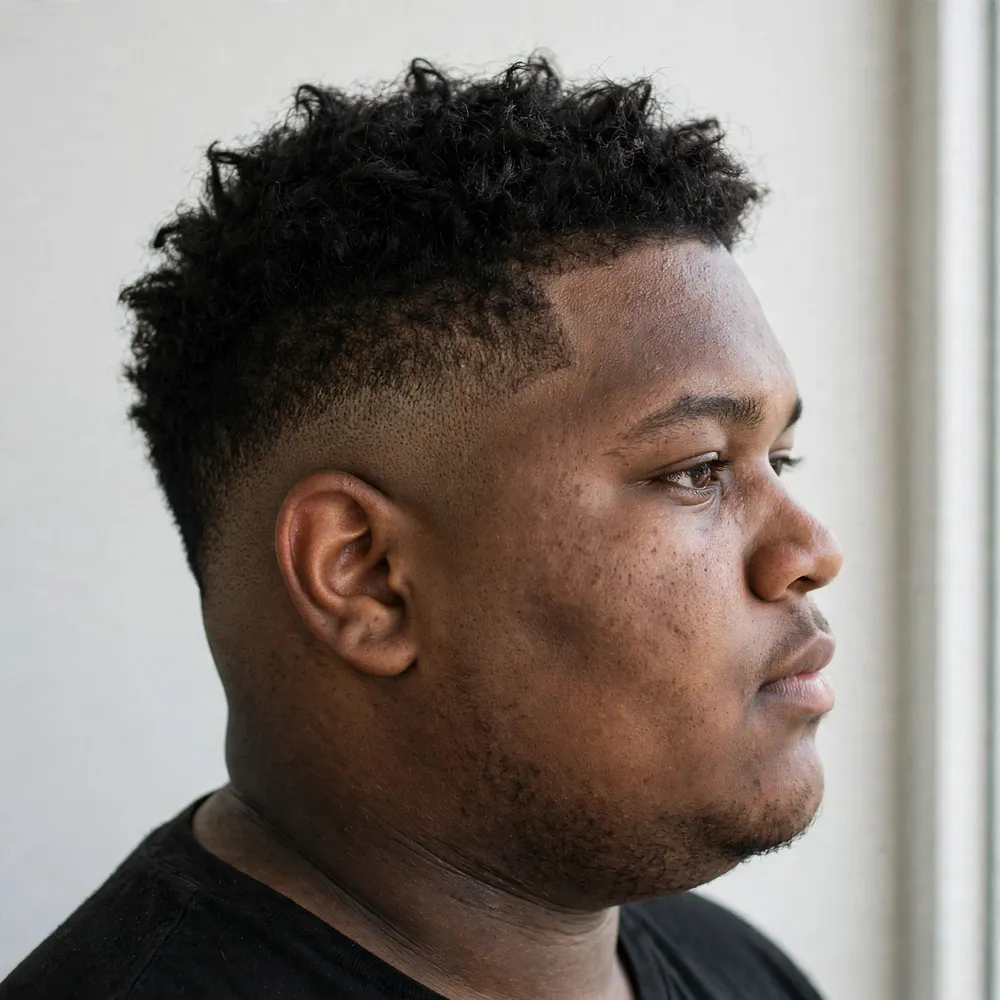
The drop fade is the gentle cousin of the high fade: instead of running in a straight line, the fade arcs downward behind the ear, following the curve of the head. On a round face that curve sounds like a problem, but it works because the fade still starts high at the temples — the width comes off where it matters — while the dipped back keeps the silhouette softer and less severe than a straight high fade. It pairs naturally with a textured top of 2 to 3 inches, styled with height at the front. Wavy and curly hair wear it best, because the arc follows the direction that hair already grows in. Ask for the drop explicitly; barbers default to a straight line unless you name the curve.
25. Curly Crop with High Fade
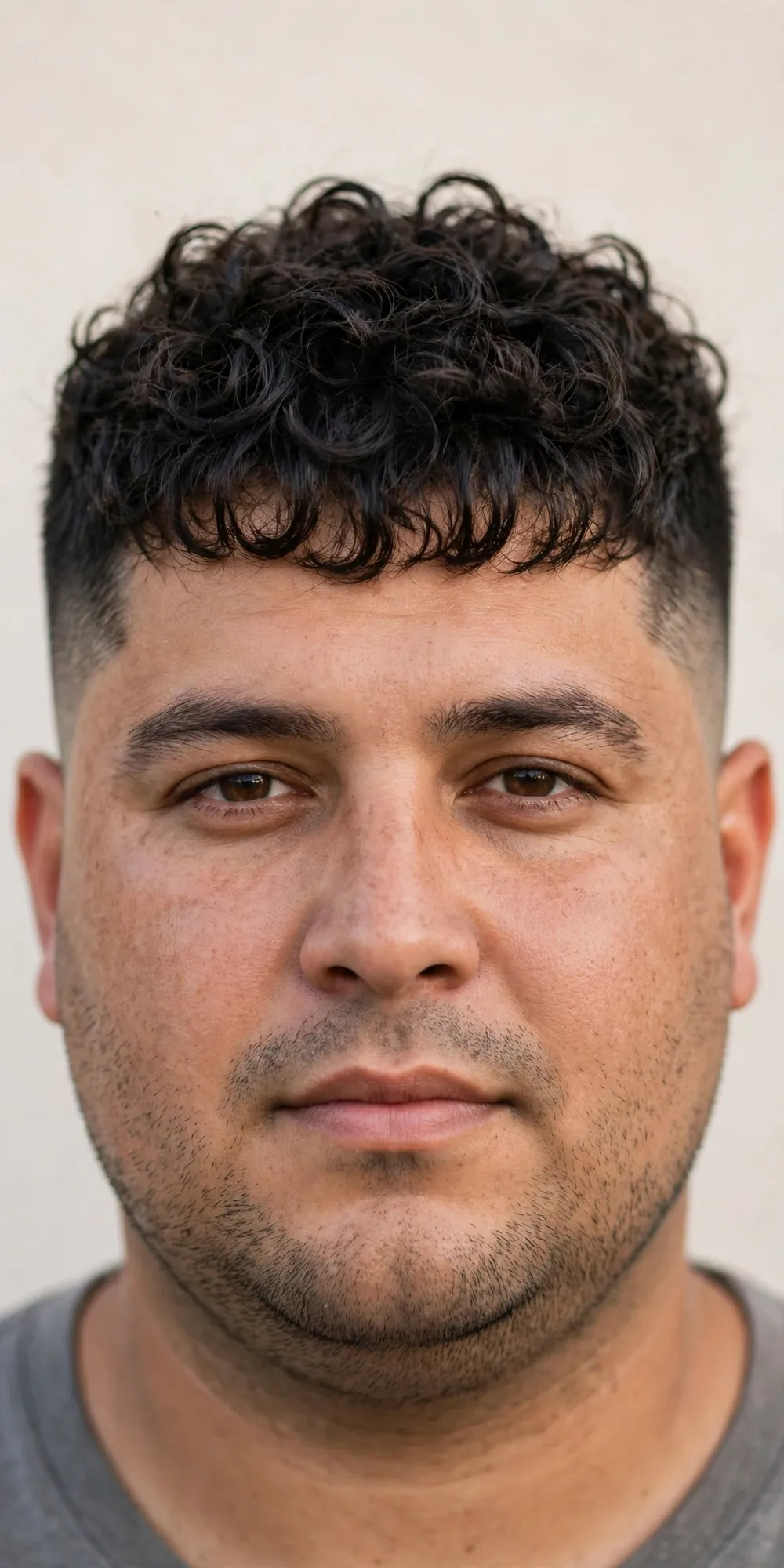
Curly hair hands a round face a gift and a trap. The gift: curl adds volume on top with no styling at all, and volume on top is the whole objective. The trap: the same curl expands sideways at the temples if the sides are left long, and volume at the sides is the one thing a round face cannot afford. The high fade settles it — sides taken tight so every bit of the curl’s natural fullness registers as height. Keep 2 to 4 inches of curl on top, shaped dry, and ask for the blend at the sides to be done with shears or scissor-over-comb if your curl pattern is dense; clipper-only blending can leave a shelf under tight curls. Dense curls may need no product at all. Looser curls hold their shape better with a little curl cream scrunched in on damp hair.
26. Curly High Top with Taper
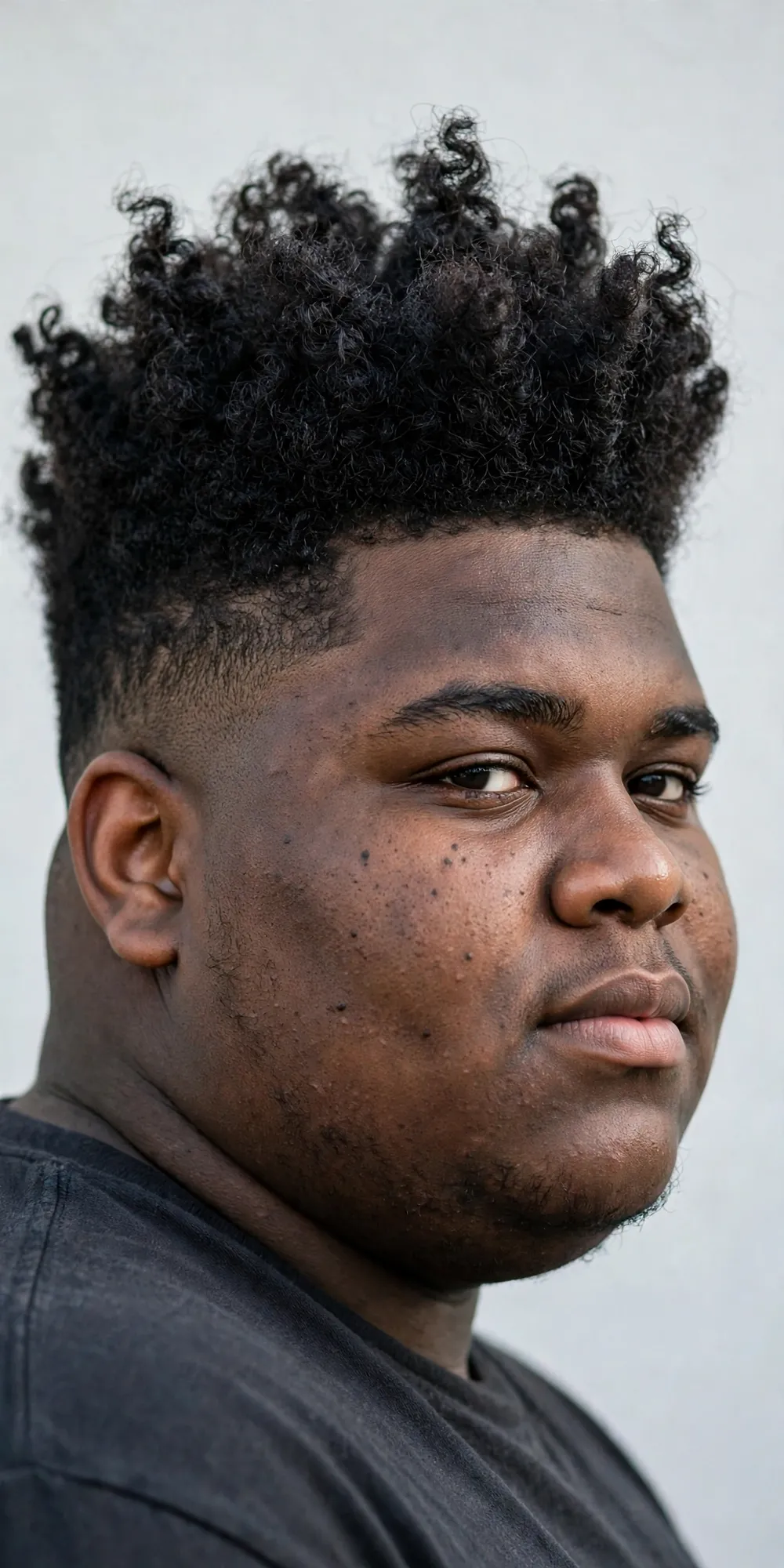
Where the curly crop keeps things moderate, the high top commits: curls are left genuinely tall on top — shaped into a high, slightly squared silhouette — with a clean taper keeping the sides close. Shaping is the operative word. A high top left to grow into a rounded dome mirrors the face under it; a high top shaped tall, with the front a touch higher than the back, stretches the whole head upward. Ask your barber to shape it dry and to keep the top tall, not round — that sentence, said in the chair, is the difference between the two versions. It suits curly and coily hair that stands on its own, needs nothing more than curl cream and a light pick at the roots for lift, and it grows upward for weeks before the taper needs refreshing.
27. Coily Taper with Height
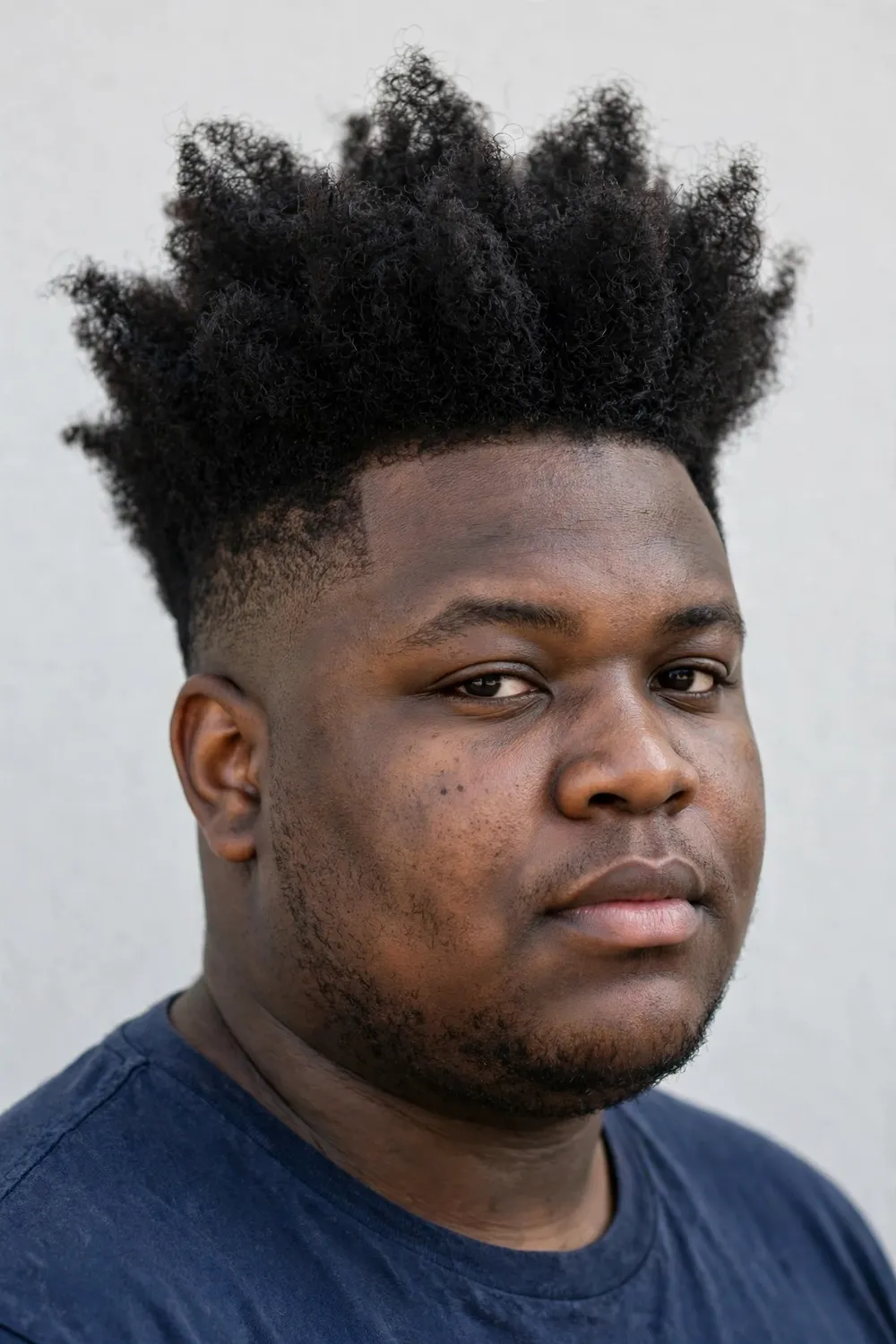
Tight coils are the easiest texture in the world to give height to — they grow up before they grow out — and the easiest to accidentally make round, because an even-length coil cut settles into a sphere. The coily taper avoids the sphere: coils kept tall and shaped on top, a neat taper below, and a clean, natural hairline to supply the angles. Ask for the blend to be done with shears rather than clippers alone; on tight curl patterns shears hold the shape through the grow-out instead of fuzzing by week two. Keep the hair moisturised with a light cream, because dry coils shrink unevenly and the silhouette you are relying on goes with them. Pick the roots lightly in the morning to restore lift, and keep your hands off the sides.
28. Wolf Cut with Crown Layers
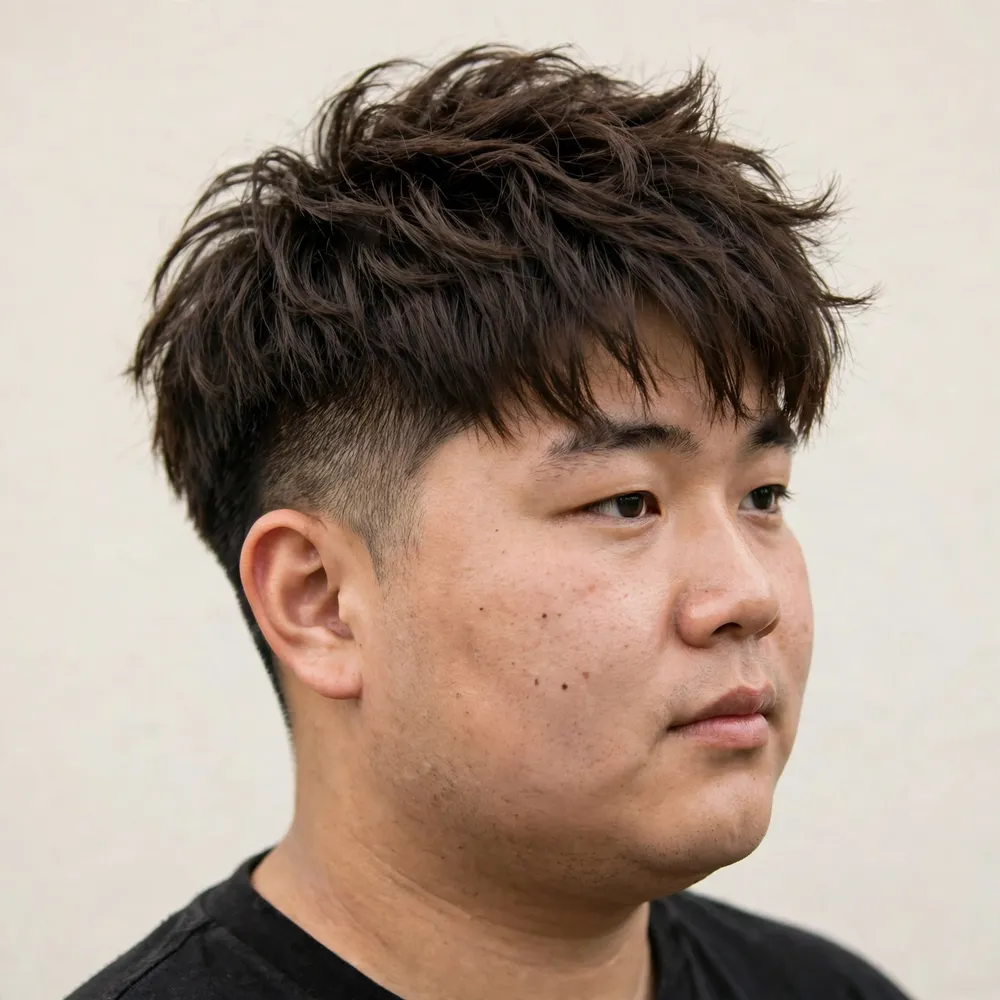
The wolf cut is the shaggy, layered option: heavy choppy layers through the crown, shorter pieces framing the top, longer pieces falling toward the neck. Most guides warn round faces away from shaggy length, but the wolf cut’s layering is concentrated exactly where a round face needs it — up high, at the crown — and that is what rescues it. The condition is the sides. A wolf cut with full, layered sides is a width machine; the round-face version keeps the sides tight, faded or closely tapered, so the crown layers read as height and the longer back adds movement instead of bulk. It suits fine to medium hair best, because thick hair’s natural volume at the back fights the shape. Sea salt spray on damp hair, scrunch, air-dry — the messier it dries, the better it looks.
29. Bro Flow with High Fade
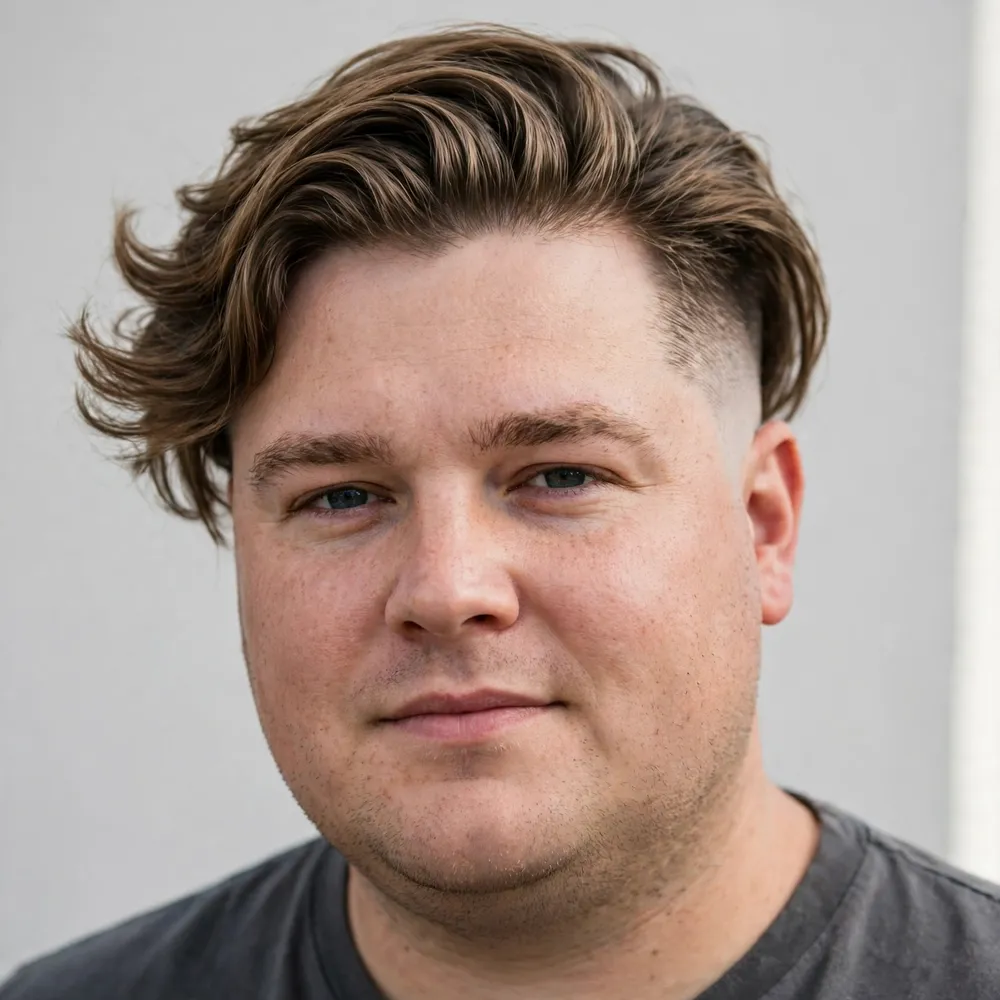
The bro flow is medium-length hair left to move naturally — and the standard version, with grown-out sides, is close to a worst-case scenario for a round face, because natural volume at medium length sits right at the cheeks. The high fade is what makes this version legitimate. The top and back keep their flow and length, worn back off the face, while the faded sides remove the cheek-level width the style would otherwise add. It only works on wavy hair with real movement; straight hair in a bro flow just hangs. Grow-out is the trade: the top can go eight weeks or more, but the fade needs refreshing every three, and if you let the fade lapse the whole cut quietly crosses back into too-wide territory.
30. High Man Bun with Faded Sides
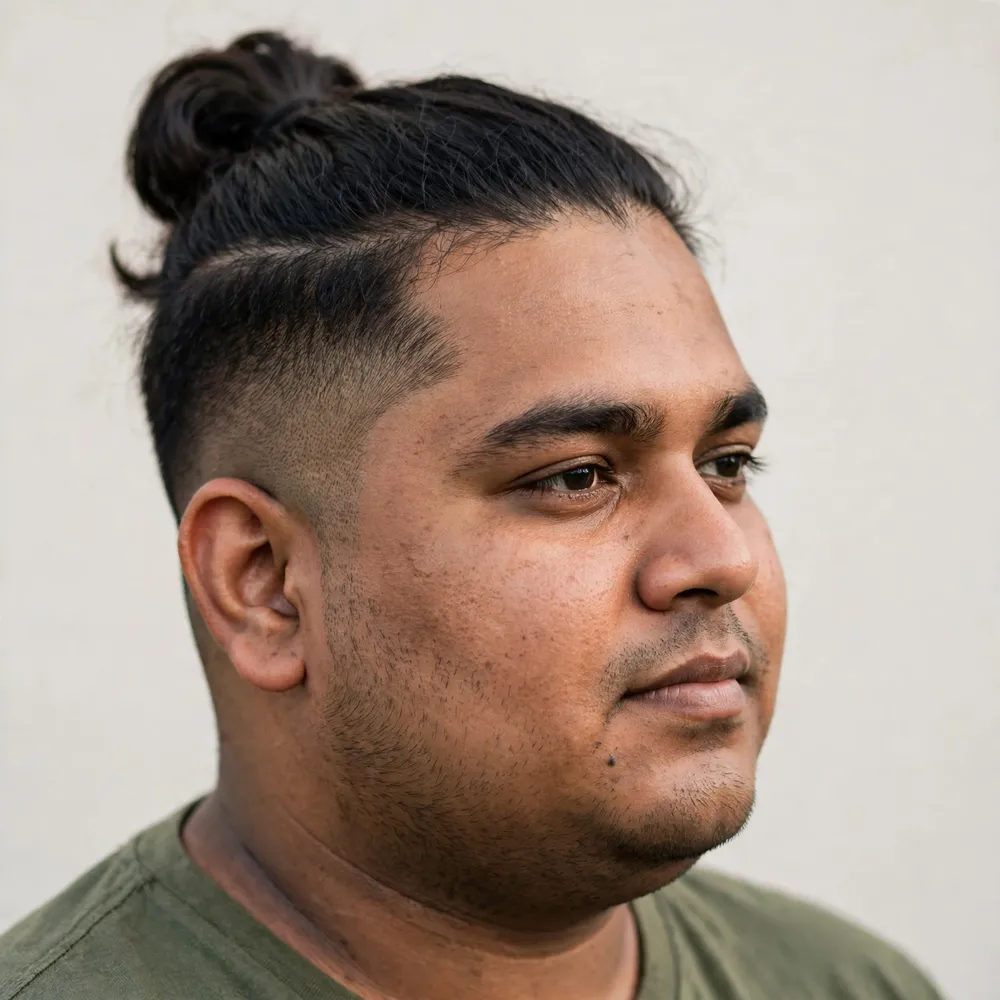
Position is everything with this one. A bun tied low, at the back of the head, adds its bulk at the widest point of the silhouette and makes a round face look rounder. The same hair tied high on the crown puts the bun on top of the head, where it adds visible height — the bun itself does the lengthening. Underneath, the sides must be faded or undercut and kept fresh every four to five weeks, because the contrast between a deliberate high bun and scruffy grown-out sides is what makes most man buns look neglected. You need at least 6 inches on top to tie it properly, and it suits straight to wavy hair. If you are growing your hair out with this as the goal, the faded sides carry you through the awkward middle months without the width penalty.
31. Long Slicked-Back Undercut
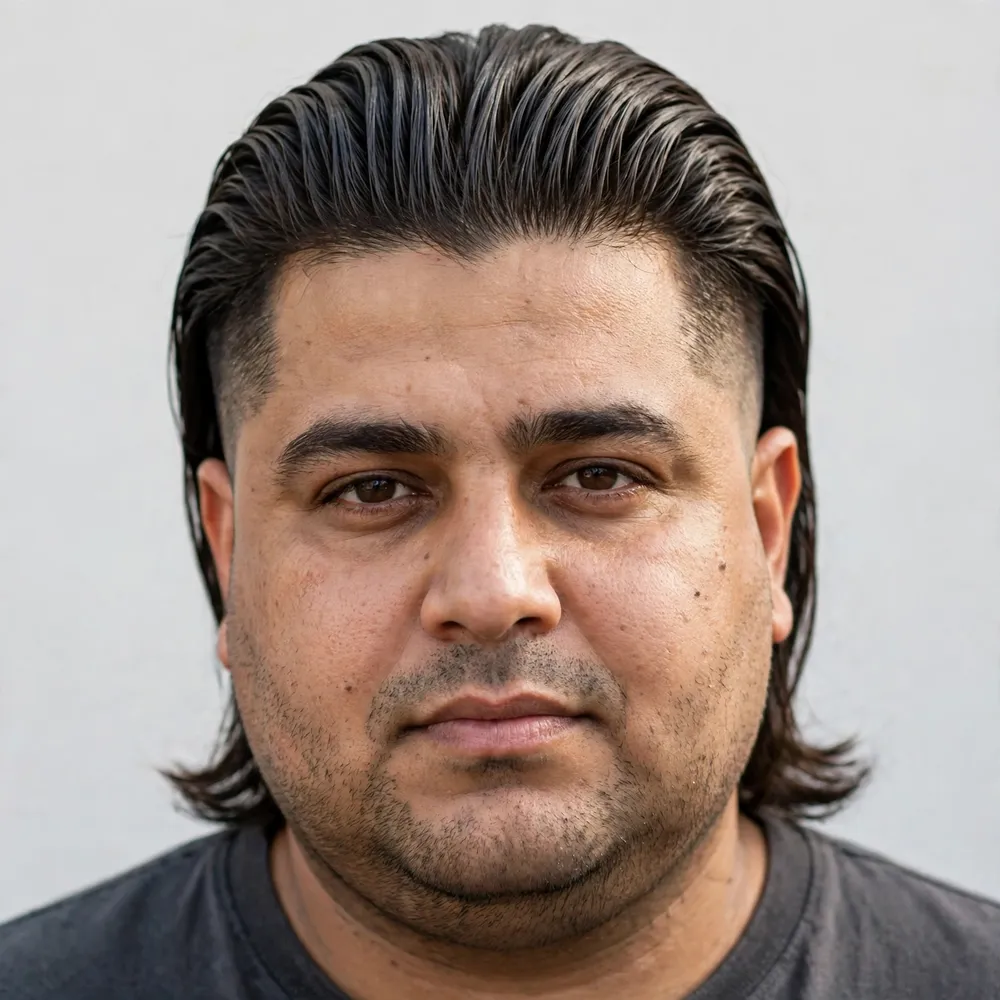
This is the long version of idea 22 with the sides taken further: 4 inches or more on top, swept back with genuine root volume, over an undercut rather than a fade — so the contrast between the long top and the clipped sides is total. On a round face the two parts share the work equally: the undercut guarantees zero width at the cheeks, and the lifted sweep guarantees the length reads vertical rather than flat. The order of operations is not negotiable — root volume built with the dryer first, then styled back. Reverse it and you have a flat slick back over shaved sides, which outlines the circle perfectly and lands on the avoid list below. It suits straight to wavy hair and formal-leaning styles, and the undercut’s hard line needs re-cutting every three to four weeks.
32. Shoulder-Length Layers with High Fade
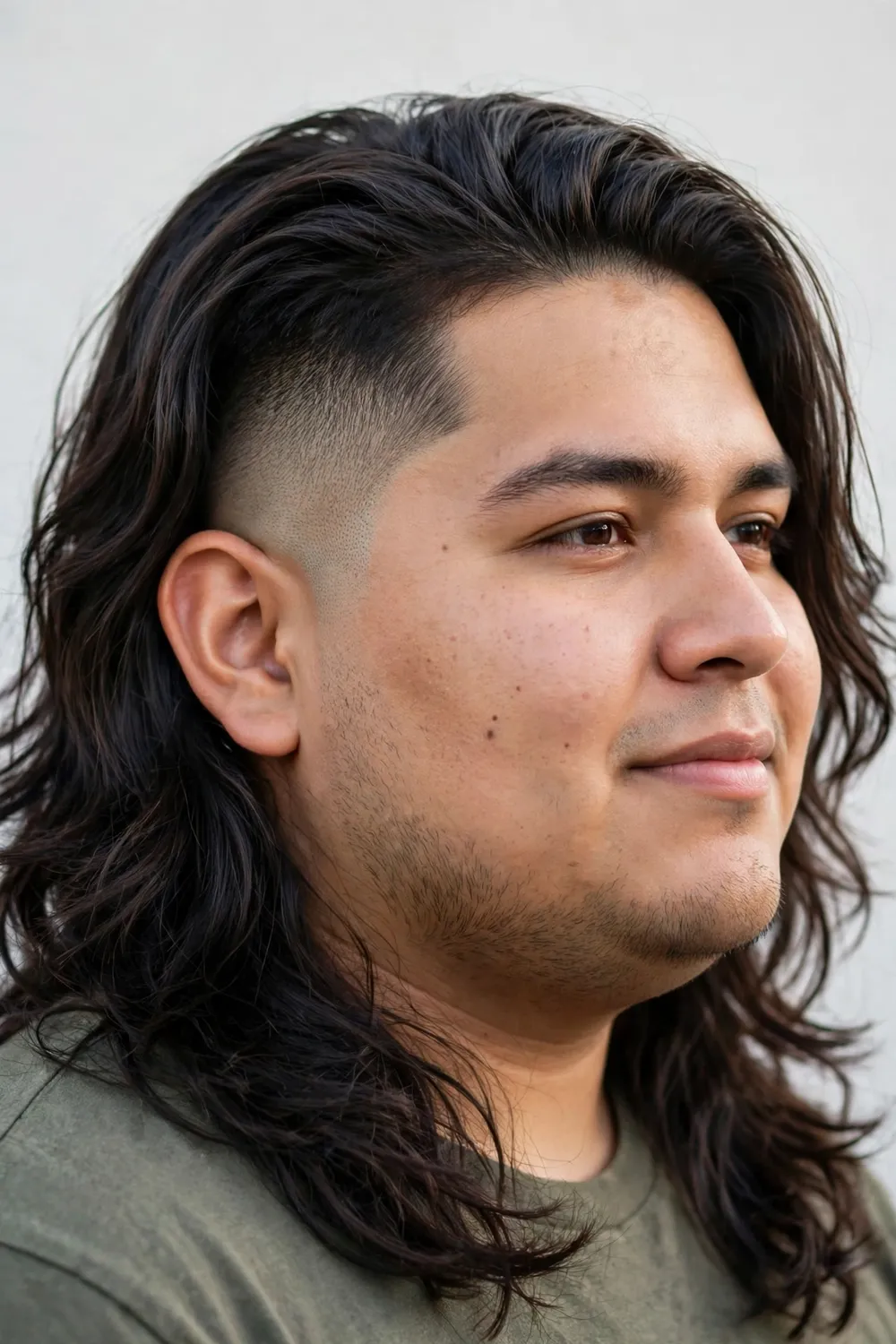
Yes, a round face can wear genuinely long hair — but only in this engineered form. The length falls to the shoulders, cut in layers so it moves instead of hanging in one heavy sheet, and a high fade underneath keeps the sides at temple and cheek level completely tight. The layers matter as much as the fade: long hair worn straight down at full width frames the face at its widest point for its entire length, while layers break that wall of hair and let the faded sides show through near the top. It suits wavy hair best, because the wave keeps long layers separated. Be honest about the commitment — long hair is a routine of conditioning, careful drying and a fade refresh every three to four weeks to stop the top half and bottom half becoming two different haircuts.
33. Best Styles for Straight Hair
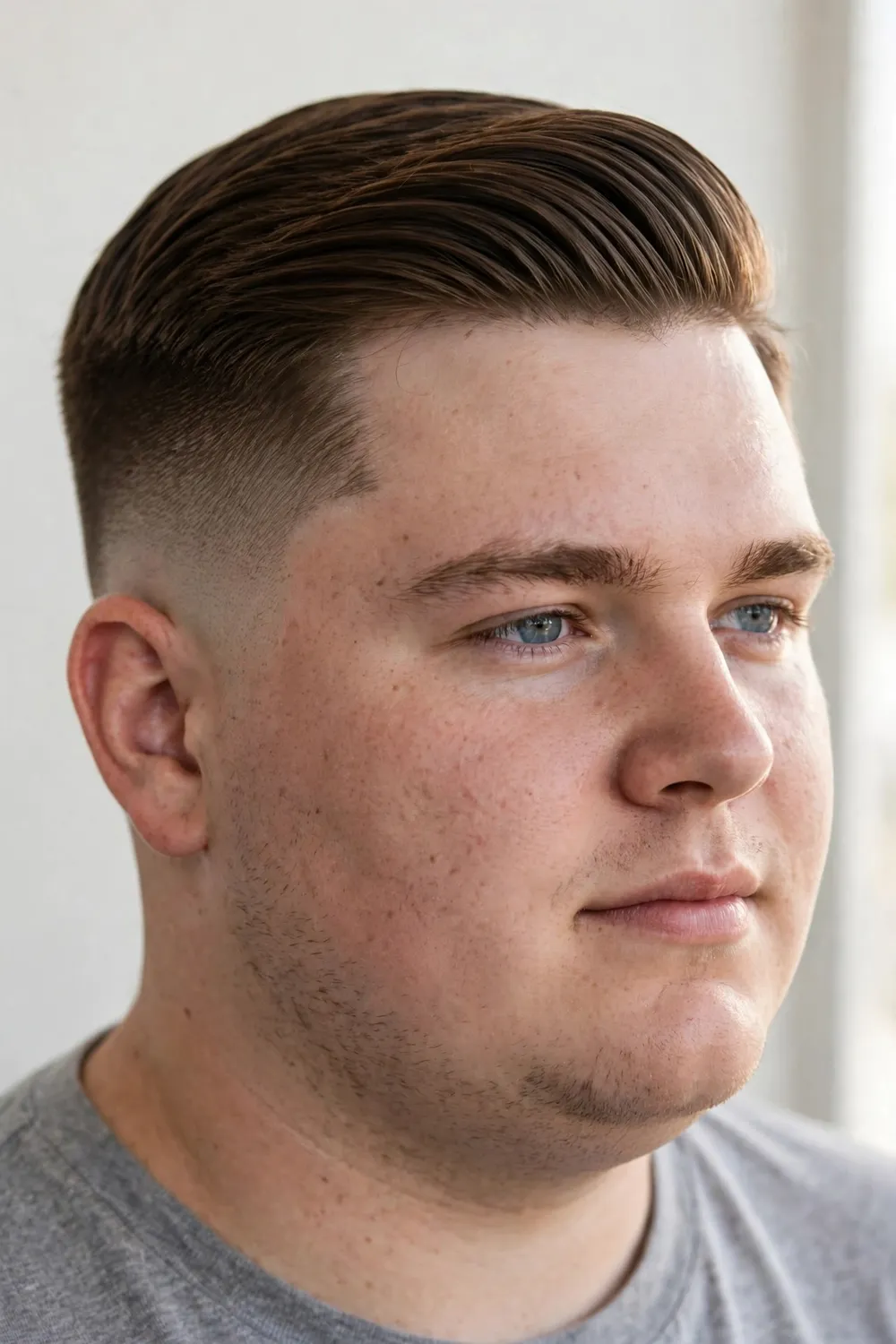
Straight hair is the precision texture, and on a round face precision is an asset: it holds a razor-sharp part, a clean diagonal fringe and exact fade lines better than any other hair type, so the geometric cuts on this list — side part, hard part, angular fringe — reach their best form on it. Its one weakness is the round face’s main enemy: flatness. Straight hair cut blunt lies like a sheet against the head and confirms every curve. The fix is in the cutting, not the product. Ask for the top to be point-cut rather than blunt so the ends break up and catch light, and build your height with a blow-dryer and a volumising spray at the roots rather than pomade, which mostly greases straight hair flat. If your straight hair is also fine, stay in the shorter half of this list, where the cuts manufacture their own lift.
34. Best Styles for Wavy Hair

Wavy hair might be the kindest texture a round face can have. The wave lifts and separates on its own, which means the height and texture the other hair types have to build with dryers and clay arrive almost free — the side sweep, textured crop, quiff and wolf cut all lean on exactly that natural movement. Sea salt spray before drying brings the wave out without flattening it, and a light cream keeps it from puffing sideways. The mistake is fighting it: heat-straightened, product-flattened wavy hair loses the lift that made it flattering and keeps only the width. Whatever cut you choose from this list, keep a mid or high fade under it, because the wave’s volume is only an asset while the sides stay tight.
35. Best Styles for Curly Hair
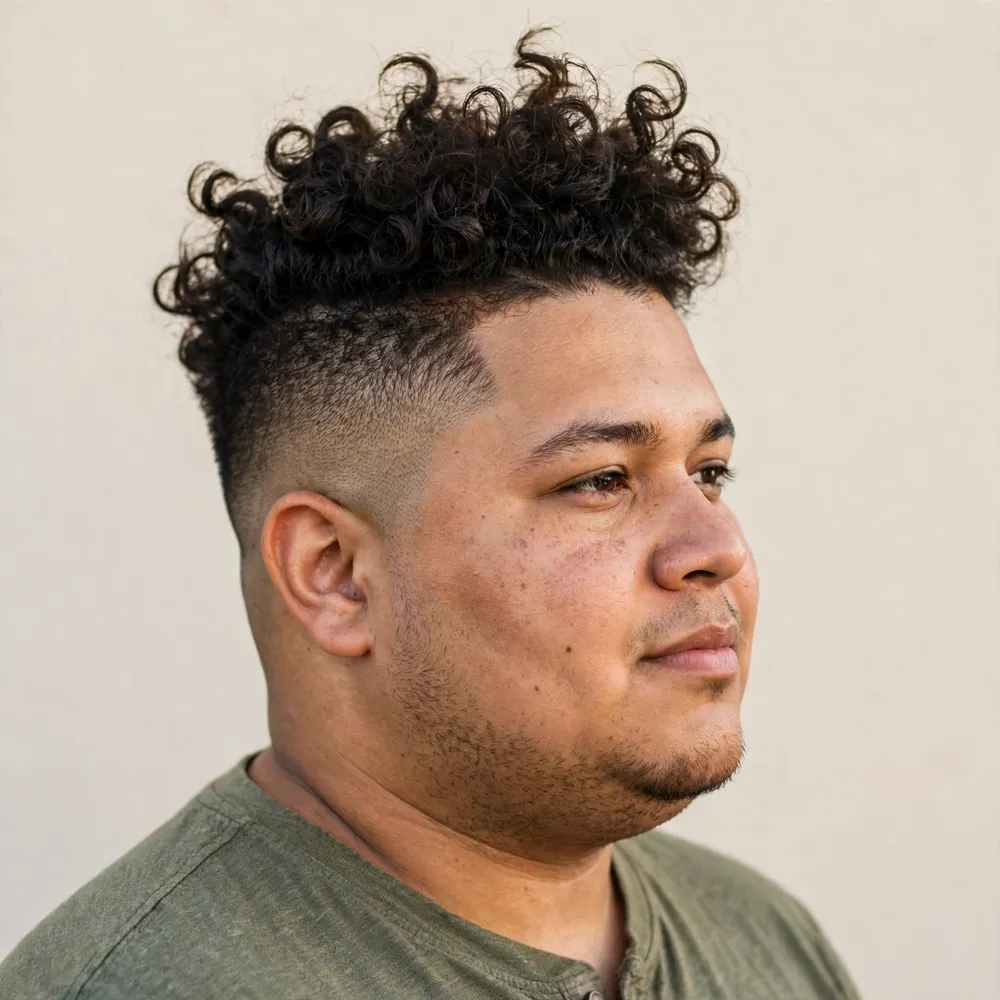
The whole curly strategy for a round face fits in four words: volume up, not out. Curls generate fullness in every direction, and the haircut’s job is to decide which directions survive — the top keeps its volume and height, the sides get faded or shear-blended tight so none of the fullness lands at cheek level. Ideas 25 and 26 are the templates: a curly crop for moderate height, a shaped high top for maximum height. Two rules hold across all of it. Get the top shaped dry, because curls cut wet spring up shorter and rounder than planned. And never let a barber thin the top with aggressive clipper work to “reduce bulk” — bulk on top is the asset; bulk at the sides is the problem, and they are removed in completely different places. Leave-in conditioner between washes keeps the top’s shape defined rather than frizzy.
36. Best Styles for Fine or Thin Hair

Fine hair changes the round-face maths, because the standard advice — build height — is exactly what fine hair struggles to hold. The answer is to go shorter rather than taller. Short textured cuts (the crew cut styled up, the textured crop, the lifted crop, the spiky top) create the impression of height with separation and matte texture instead of real vertical inches, and short hair does not have the weight to pull itself flat by midday. Two product rules are non-negotiable. A lightweight volumising spray at the roots before you blow-dry upward is essential, not optional — it is the scaffolding the style stands on. And heavy pomade is banned: it weighs fine hair down, separates it into strings, and deletes both the height and the coverage at once. If your hair is not just fine but noticeably thinning at the crown or hairline, keep lengths even and short like idea 1, and if the shedding itself is new or patchy, that is worth a conversation with a doctor rather than a barber — a haircut can redistribute what you have, but it cannot explain why it is changing.
37. Best Styles for Thick Hair
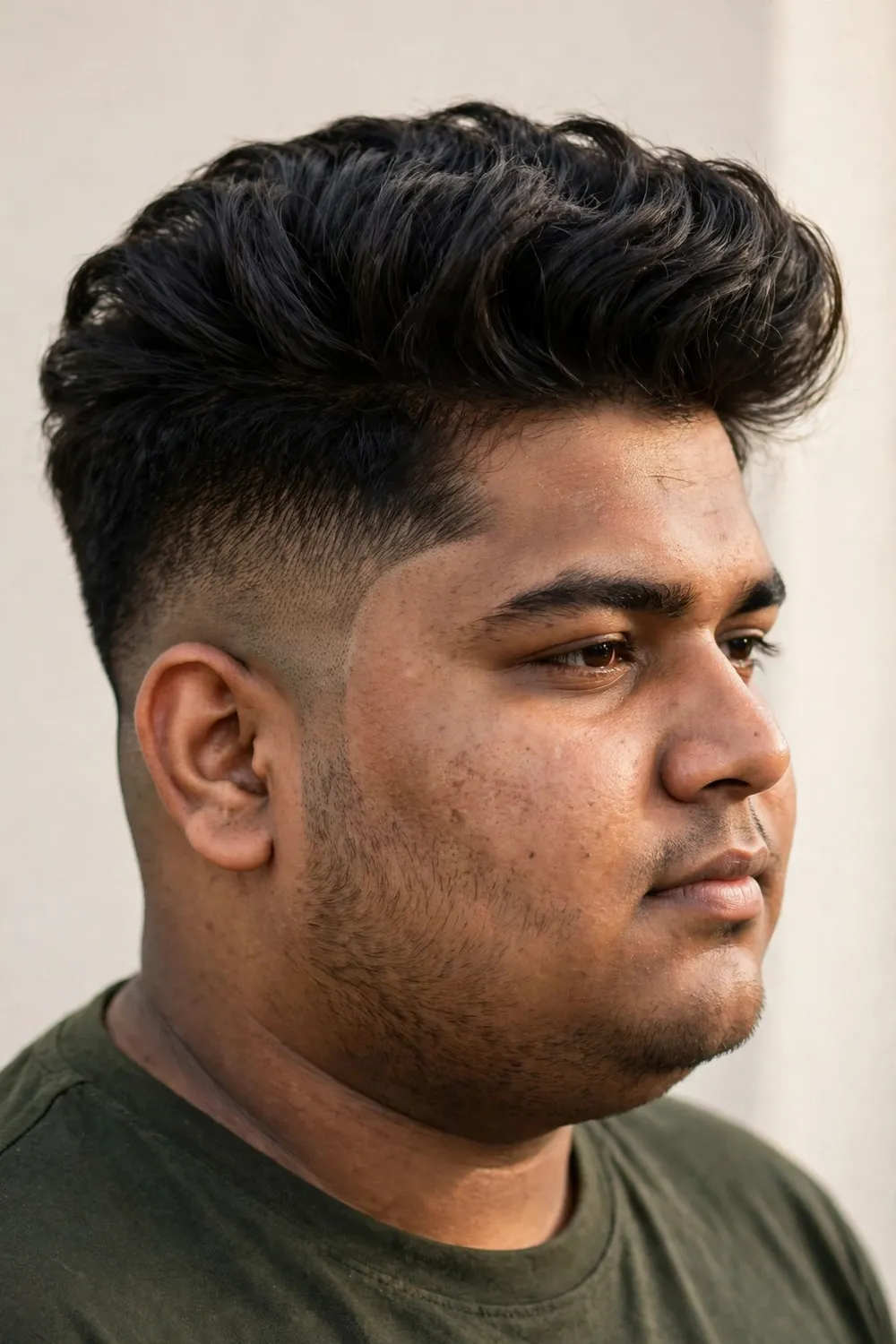
Thick hair has the opposite problem: height is effortless, and width is the constant threat. Thick hair holds a quiff, a pompadour or a brush up all day without trying — but left unthinned at the sides it balloons out at exactly cheek level, and a round face under ballooning sides looks rounder than it did with no haircut at all. So for thick hair, the most important sentence in the barber’s chair is about the sides, not the top: ask for the sides to be point-cut or thinned with shears as well as faded, so the silhouette stays narrow while the top carries the volume. The volume quiff in idea 13, styled with strong matte clay kept strictly on the top, is the showcase version. Avoid blunt, one-length tops — on thick hair they sit like a helmet, round on top of round.
38. Buzz Cut with a Shaped Beard
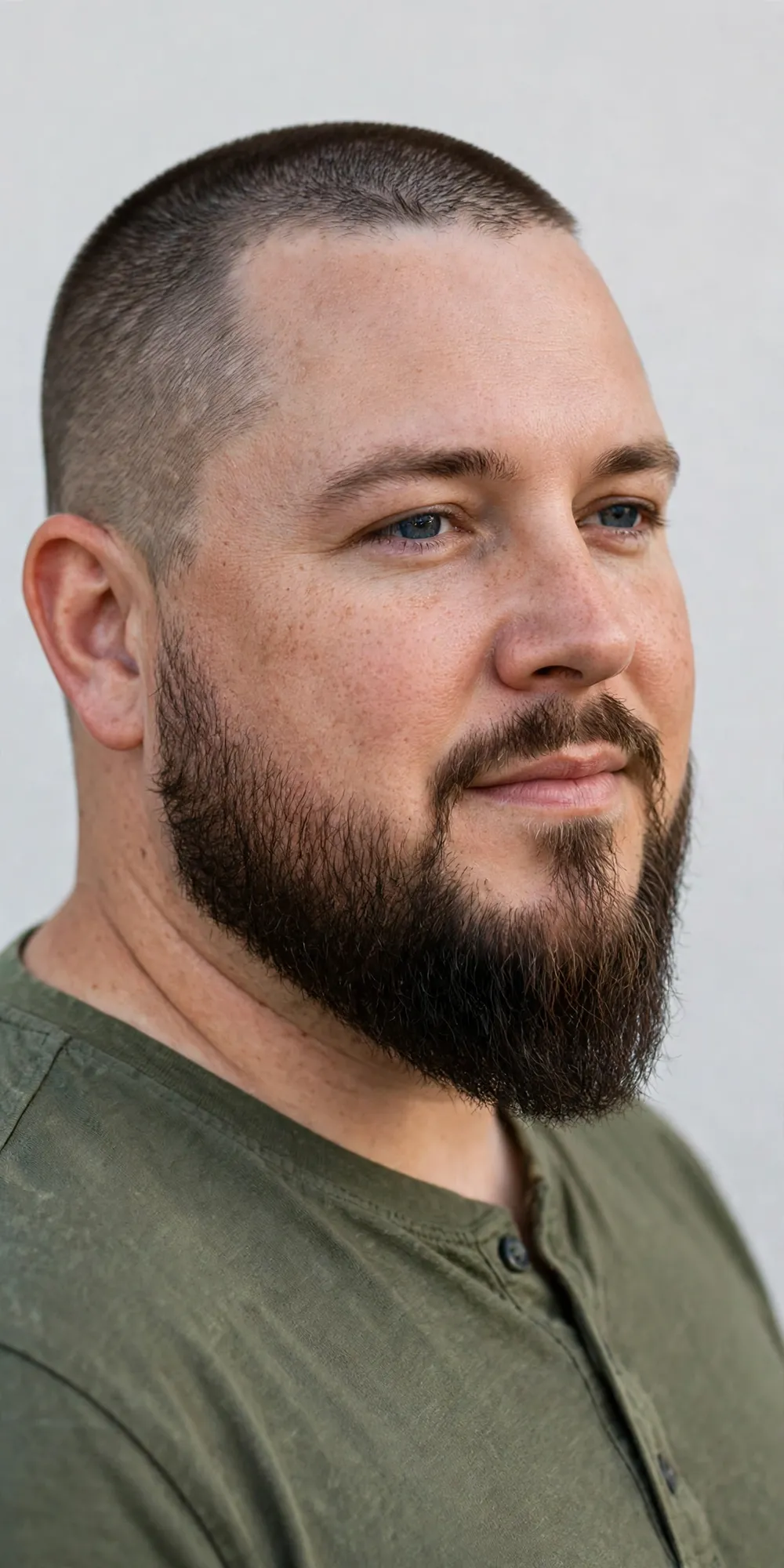
Idea 1 warned that a buzz cut alone exposes the full round outline — and plenty of men still want one, which is where the beard earns its keep. A buzz at a #2 or #3 with a natural line-up, paired with a beard kept longer at the chin and tight at the cheeks, splits the work: the faded buzz keeps the top of the head tidy, and the shaped beard draws the jawline the face does not have. The beard’s shape is not a detail, it is the entire mechanism. A beard grown uniformly full adds volume at the cheeks and makes the combination worse than the buzz alone. Keep the cheek lines clean and a little high, let the chin carry the length, and brush the beard downward so it reads as length, not width. If you prefer softer edges than a skin fade up top but still want the beard to do the slimming, the same pairing works over a low taper fade — the taper keeps more hair at the edges, and the beard supplies the angles instead.
39. The Boxed Beard That Slims a Round Face

It is worth ending on the beard itself, because for a round face a well-shaped beard changes the face’s outline more than any haircut on this list — it redraws the jaw rather than working around it. The slimming shape is called a boxed beard: squared-off lines instead of curves, kept close and tight through the cheeks, with the length concentrated at the chin so the beard’s outline is longer than it is wide. Every element is doing the same job as the haircuts above it, translated below the jaw — tight where the face is wide, long where the face is short, angular where the face is curved. Maintain the lines weekly with a trimmer: a boxed beard that grows out for a month softens back into a round beard, and a round beard on a round face is the one combination this entire guide exists to prevent. Clean-shaven men are not excused from the principle, either — a sharp hairline and clean edges around the ears and neck still frame the face with the angles it lacks.
Haircuts Round Face Men Should Avoid
The cuts that flatter a round face all add length or subtract width. The ones that fail it do the opposite — each entry below is a popular style that works against a round outline in a specific, predictable way:
- Bowl cuts and mushroom cuts. A circular shape sitting on a circular face — the rounded silhouette repeats the face’s outline at a larger size. The single worst choice available.
- Heavy fringes cut straight across. A thick, blunt fringe at eyebrow level draws a horizontal line across the forehead, shortening the face and emphasising its width. Fringes only work here textured, broken or on a diagonal (ideas 5 and 7).
- A one-length buzz cut with no fade. No step, no height, no edges — the head simply continues the face’s circle. The fix is cheap: the same buzz with a high skin fade becomes idea 1.
- Flat slick backs with full sides. Combed straight back with no root lift, a slick back removes its one asset — height — while grown-out sides add width. Double failure.
- Bulky, scissored sides at cheek level. The classic mop, an unlayered medium cut, a rounded afro with no taper — all put the head’s widest point exactly where the face is already widest.
- Dead-centre parts with flat sides. A perfectly centred part over flat hair frames the circle symmetrically. Off-centre, with lift and faded sides, the same hair becomes idea 21.
- The modern mullet, worn standard. The usual mullet pairs a shorter top with fullness at the back and sides — width without vertical lift, a round face’s problem stated as a haircut.
- A full, round beard. Grown evenly in every direction, a beard repeats the face shape below the jaw. The slimming beard is boxed, tight at the cheeks, longer at the chin (idea 39).
Notice the pattern: every mistake either removes height, adds width at the cheeks, or draws a horizontal or circular line. If a style you like does none of those three things, it will almost certainly work on you — whatever list it appears on.
How to Ask Your Barber for a Round Face Haircut
Barbers do not need a lecture on face geometry — they need four clear pieces of information. Give them in this order:
- Name the style and show the photo. “Textured quiff, like this” with a picture from this guide beats any verbal description. The photo settles the top length, the fade height and the fringe in one glance.
- Say the face-shape brief out loud. One sentence — “my face is round, so I need height on top and the sides kept tight” — changes the details a good barber chooses: where the fade starts, whether the top is point-cut, how the fringe is finished. Barbers adjust for a stated brief; they cannot guess one.
- Give the top length and the fade height as numbers. Most cuts on this list live between 2 and 4 inches on top, with a mid or high fade underneath. Say both numbers. “Short back and sides” gets interpreted differently in every shop, and a low fade when you needed a high one leaves the width you came in to remove.
- Agree on the fringe and hairline finish. Textured or diagonal fringe, never blunt and straight across. A natural hairline or a light line-up — the line-up adds the angles a round face borrows, so it is usually worth it on shorter cuts.
- Ask how it grows out, and book the refresh before you leave. Round-face cuts live or die by the fade: once the sides fill in, the slimming contrast fades with them. Sharp and skin fades need a trim every two to three weeks; crops, tapers and side parts hold three to four; longer styles can stretch the top to six or eight weeks but the sides still need attention around week three or four.
Round Face Haircut FAQs
What is the best haircut for a round face for men? Three cuts suit the widest range of round faces: the textured quiff with a mid fade (the best all-rounder — height, tight sides, office-safe), the textured crop with a high fade (the same effect for the least styling effort), and the side part with volume (the most timeless, and best for professional settings). Choose by your hair type and how many minutes you will honestly spend styling each morning.
What haircut makes a round face look slimmer? Anything that adds vertical height while removing width at the temples — a quiff, pompadour or faux hawk over a mid or high fade is the strongest combination. Height makes the outline longer, tight sides make it narrower, and the face inside reads slimmer without changing at all. A boxed beard longer at the chin extends the same effect below the jaw.
What fade height works best for a round face? Mid to high, as the default: a high fade strips width at the widest point of the head, around the temples and above the ears. A low fade can work, but only when the top carries real height and the barber removes the side bulk above the fade line; if you want softer edges, our low taper fade guide shows how to keep a round face’s proportions in check with one.
Can men with round faces wear long hair? Yes, with engineering. Worn loose, full and straight down, long hair frames the face at its widest point and makes it look wider. The versions that work (ideas 29 to 32) are layered so they move, kept off the face or tied high, and paired with faded sides so the cheek-level width is removed even though the length stays.
Does a beard suit a round face? Yes — shaped correctly, a beard helps a round face more than any other shape, because it redraws the jawline the face lacks. Keep it boxed: tight at the cheeks, longer at the chin, clean straight lines. A beard grown uniformly round and full simply extends the circle downward.
How do I know if my face is round or just chubby? Measure, do not guess from weight. A round face is bone structure — length and cheekbone width nearly equal, cheeks widest, jaw curved without a corner — and it stays that shape at any weight. If your face measures clearly longer than wide (around 1.4:1 or more), the structure is oval or oblong carrying extra softness, and those rules apply instead.
How often should a round face haircut be trimmed? Every three to four weeks for most cuts here, and every two to three for skin fades and hard parts, whose sharp lines soften first. These cuts slim through contrast between a lifted top and tight sides, and the sides grow out first — once they bulk up, the cut stops doing its job even if the top still looks fine.
Final Word
A round face is not a difficult face — it is a face with a clear brief. Build height on top, keep the sides tight, put an angle somewhere the outline needs one, and nearly any style family — crop, quiff, part, flow, even a bun — can be made to work for you. Start with the cut above that matches your hair type, state the brief to your barber in one sentence, and protect the fade with regular trims; the haircut will keep doing its job between visits as long as the sides stay honest. For more cuts organised by face shape, hair type and length, browse the rest of our men’s haircut guides.