


A slick back does exactly what the name says: the hair on top is combed straight back from your forehead and held in place with product. It has been worn for over a century because it works on almost any hair type — straight, wavy, even curly — as long as the top is long enough to actually lie back, roughly 3 to 6 inches. Shorter than that, it springs up instead of slicking down.
If you only look at three styles, make it these. The Classic Slick Back (#1) is the timeless one — pomade shine, neat tapered sides, never out of place. The Slick Back Taper Fade (#12) is the most versatile: sharp enough for photos, soft enough for any office. And the Slick Back Undercut (#18) is the boldest version, with short disconnected sides that make the long top the whole show.
Slick back hairstyles live or die on two things: having enough length on top, and choosing a product that matches your hair (the products section further down covers that honestly). The list below is grouped so you can jump straight to your situation — classic versions, fades at every height, undercuts and sharp detail, short and professional cuts, long styles, textured and hybrid looks, slick backs worn with a beard, and a final group for specific hair concerns like a receding hairline or fine hair.
Every idea below tells you who it suits, exactly what to ask your barber, which product and finish to use, and how often it needs a tidy — because a style that needs a barber every two weeks is a real commitment, and you should know that before you sit in the chair.
Which Slick Back Should You Get? Quick Picks
| Your goal | Best pick | Idea |
|---|---|---|
| Lowest maintenance | Short Slick Back | #24 |
| Best for the office | Professional Slick Back · Slick Back Taper Fade | #27 · #12 |
| Thick, dense hair | Voluminous Full Slick Back · Thick Slick Back with High Taper Fade | #4 · #17 |
| Curly hair | Curly Slick Back | #36 |
| Thinning hair or a receding hairline | Slick Back for a Receding Hairline · Slick Back for Thin or Fine Hair | #45 · #46 |
| Sharpest lines | Slick Back with Skin Fade (needs a tidy about every 2 weeks) | #11 |
One rule before the list: shine makes thin hair look thinner, while a matte finish makes it look fuller. That single choice matters more than most guys expect.
Group A — Classic & Timeless Slick Backs
1. Classic Slick Back

This is the original: a medium-length top, around 4–5 inches, combed straight back with no part, and sides trimmed neat and tapered rather than faded. It suits straight and wavy hair best, and oval or square faces, because the swept-back top adds a little visual length to the face. Tell your barber: keep 4–5 inches on top, scissor-taper the sides, no fade line, and nothing taken off the front corners. Style it with a water-based pomade — medium-to-strong hold with a proper shine — worked through towel-dried hair and combed back in one pass. Maintenance is friendly: a tidy every 3–4 weeks, and about two minutes of combing each morning.
2. Modern Slick Back

Think of this as the classic shape rebuilt for 2026: the top is still combed back, but with visible texture and a little lift instead of a flat, glued-down sheet, and the sides are usually a fade or a soft undercut. You need 4–6 inches on top; thick and wavy hair holds the texture best, though straight hair gets there with the right cut. Ask your barber to point-cut the top for texture and take the sides to a mid fade (Group B below covers every fade height). Swap the pomade for a matte clay or paste — same hold, no shine — and push the hair back with your fingers rather than a fine comb. Faded sides need a tidy every 2–3 weeks.
3. Wet Look Slick Back

The wet look is a finish more than a cut: any slick back worn with high-shine gel or an oil-based pomade so the hair stays glossy and sharp all day. It works on tops from about 3–5 inches and reads best on dark, straight-to-wavy hair, where the shine looks rich instead of greasy. Ask your barber for a simple slick back shape with tapered or low-faded sides, then do the finish at home: product through damp hair, comb back, and don’t touch it while it sets. Be honest about gel — too much flakes by evening. An oil-based pomade avoids flakes and can be re-combed, but it needs a proper degreasing shampoo to wash out. A tidy every 3 weeks keeps the shape clean.
4. Voluminous Full Slick Back

No fade, no skin showing — this one keeps full sides and puts all the drama on top, with the hair lifted high as it sweeps back. It is built for thick, wavy hair; fine hair simply doesn’t have the bulk, and you would fight it every single day. You need a good 5–6 inches on top. Ask for a scissor cut all over with light layering so the top can stack and lift, keeping the sides full but shaped neatly around the ears. Styling is the real cost: mousse or pre-styler on damp hair, blow-dry backwards with a brush for lift, then a medium pomade to hold it. The reward is low barber maintenance — a reshaping every 4–5 weeks — but expect ten minutes with the dryer most mornings.
5. Rockabilly Slick Back
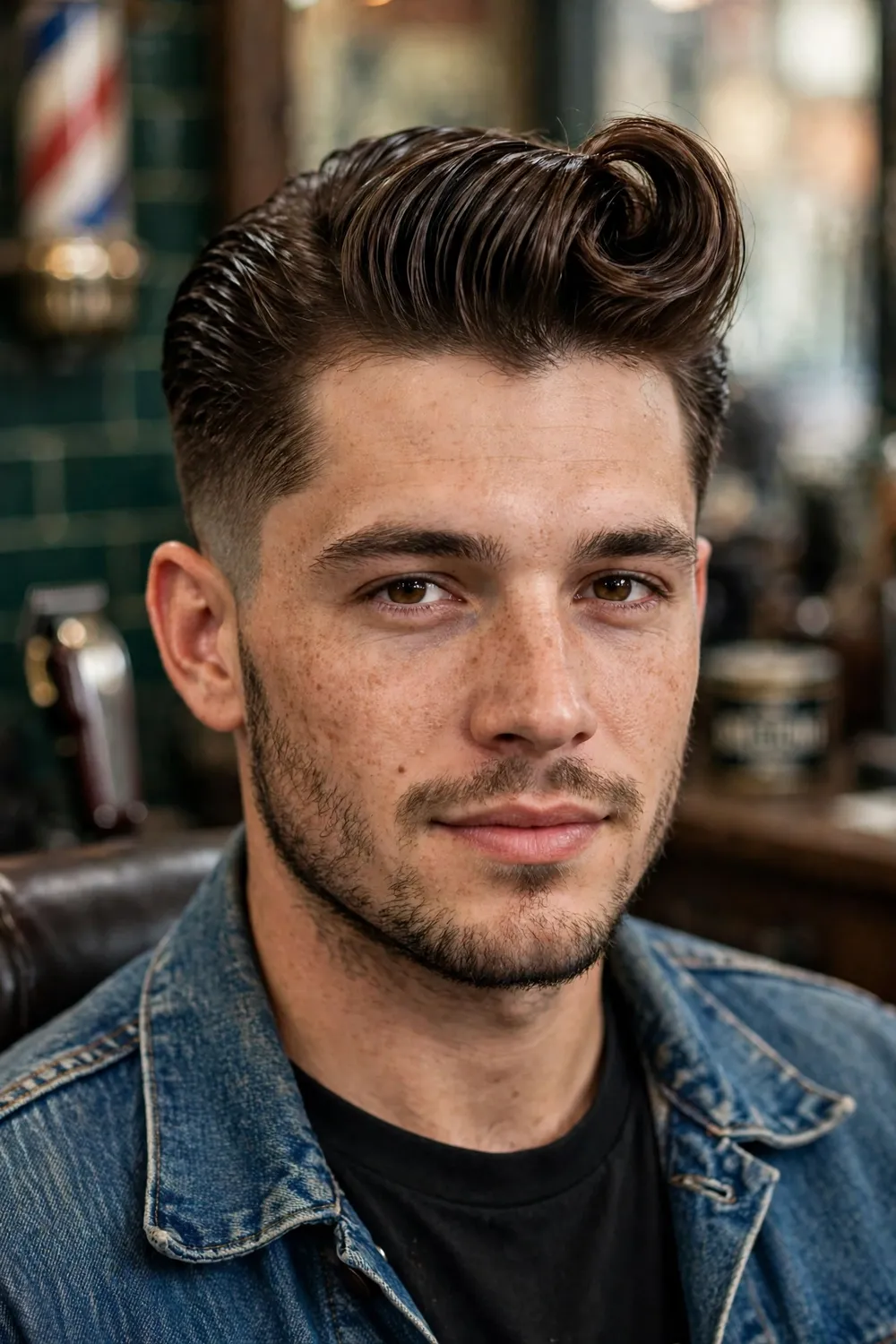
A 1950s throwback: the front is lifted and rolled back on itself like the edge of a pompadour, then the whole top is slicked with high-shine pomade over tight faded or undercut sides. The front needs real length — 5–6 inches — and straight to wavy hair thick enough to hold the roll. Tell your barber to keep every bit of the front length, take the sides to a high fade or undercut, and blend the top backwards. At home it is heavy-hold pomade on damp hair, blow-dried up and back first so the roll forms before the product sets. Be ready for the effort: this is the highest-maintenance classic here, with the front rebuilt every morning and sides tidied every 2 weeks.
6. Loose Slick Back (Natural Finish)

The relaxed everyday version: hair finger-combed back with a light cream — no shine, no stiffness, nothing that looks like you tried hard. It suits wavy and fine hair especially well, because light product won’t weigh either of them down, and it only needs 3–5 inches on top. Ask your barber for a soft scissor taper on the sides and enough top length to fall back on its own. Style with a pea-sized amount of styling cream or fibre, push everything back with your fingers, and let it settle where it wants. If a strand falls forward by the afternoon, that’s the look working, not failing. Maintenance is the lowest in this group: a trim every 4 weeks, and some days you can skip product entirely.
Group B — Slick Back with Fades
7. Slick Back Fade
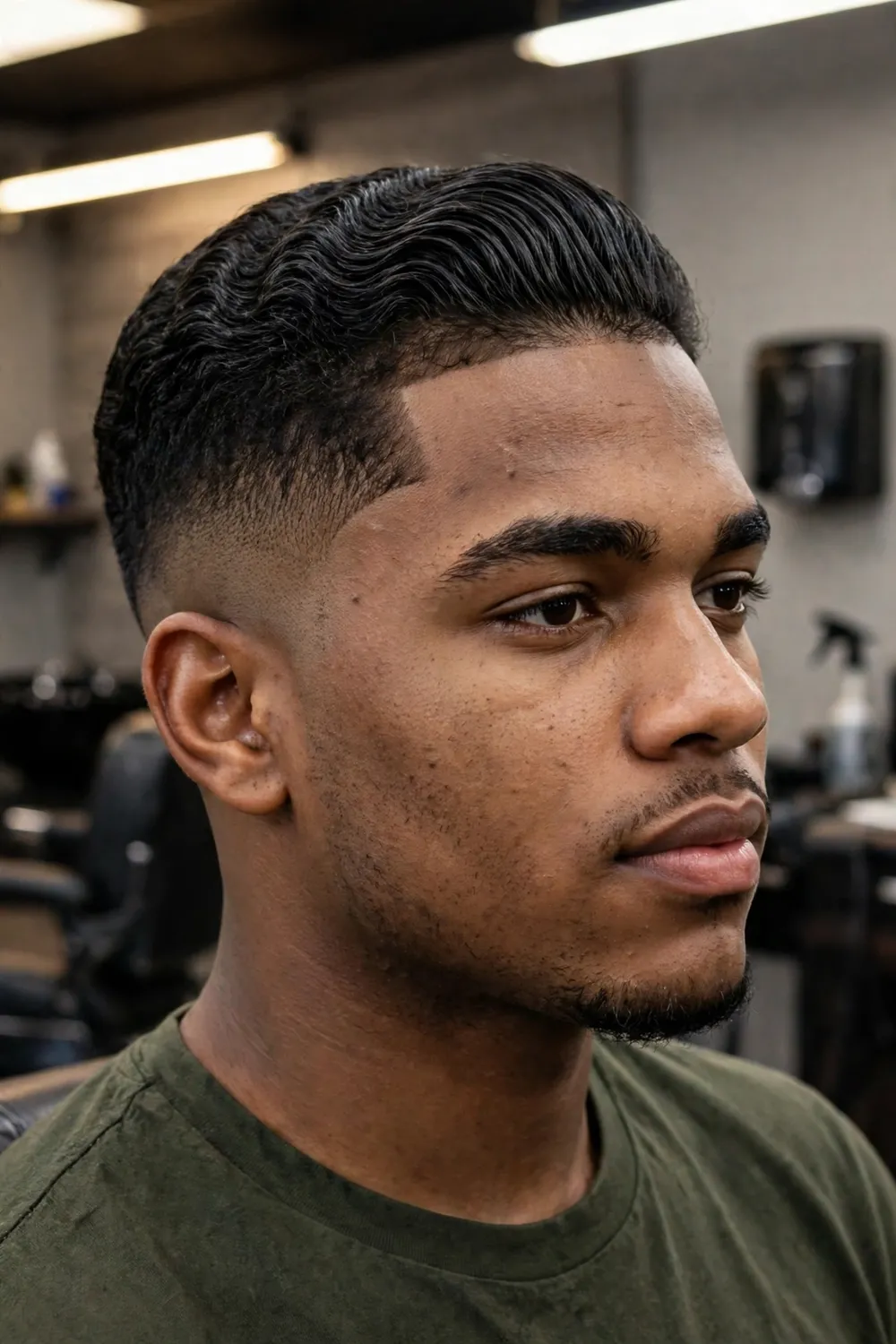
This is the base version most guys mean when they say “slick back fade”: a top of 4–5 inches combed straight back, blended into a clipper fade on the sides and back. The reason it is the all-rounder is choice — this group lists the fade at every height, and this entry is where you pick your starting point. Ask your barber to leave the top long enough to reach past the crown when combed back, then choose the fade height together based on how sharp you want it. Product depends on the finish you like: pomade for shine, clay for matte. Every fade version shares one maintenance truth, though — the sides look sharp for about two weeks, acceptable for three, and grown out after that.
8. Slick Back with Low Fade

The low fade starts just above the ears and keeps most of the side length, which makes it the softest and most conservative way to pair a slick back with a fade. It is the one to pick for a first fade, a strict workplace, or a longer face that doesn’t need extra height contrast. Ask for a low fade blended from a 0.5 or 1 guard up into the top, with 4–5 inches left on top to comb back. Because the blend sits low, it also grows out the most gracefully of any fade here — no harsh line appearing as it softens. Style it with a light-shine pomade or a cream, and book a tidy every 3 weeks instead of the usual fade fortnight.
9. Slick Back with Mid Fade
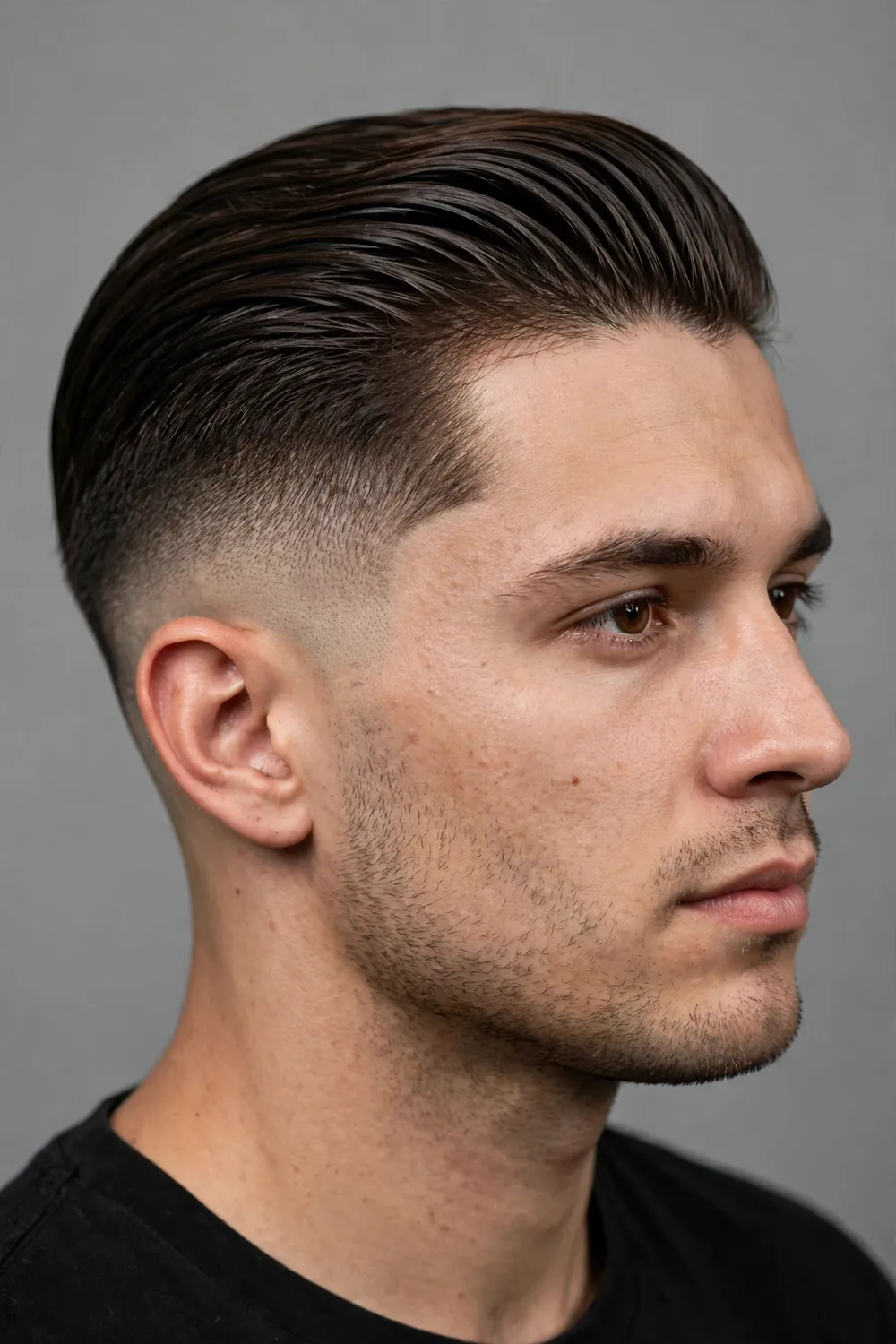
The mid fade starts at the temples, splitting the difference between the soft low fade and the aggressive high one — which is exactly why it is the most-booked fade under a slicked top. It suits most face shapes and hair types and needs the usual 4–6 inches on top. Ask your barber for a mid fade, and if you are unsure about height, start here rather than with the high fade: it is much easier to go higher on the next visit than to grow a high fade back down. Our full mid fade haircuts guide shows how the height changes the whole look if you want to compare before deciding. Clay or pomade both work on top. Tidy every 2–3 weeks.
10. Slick Back High Fade
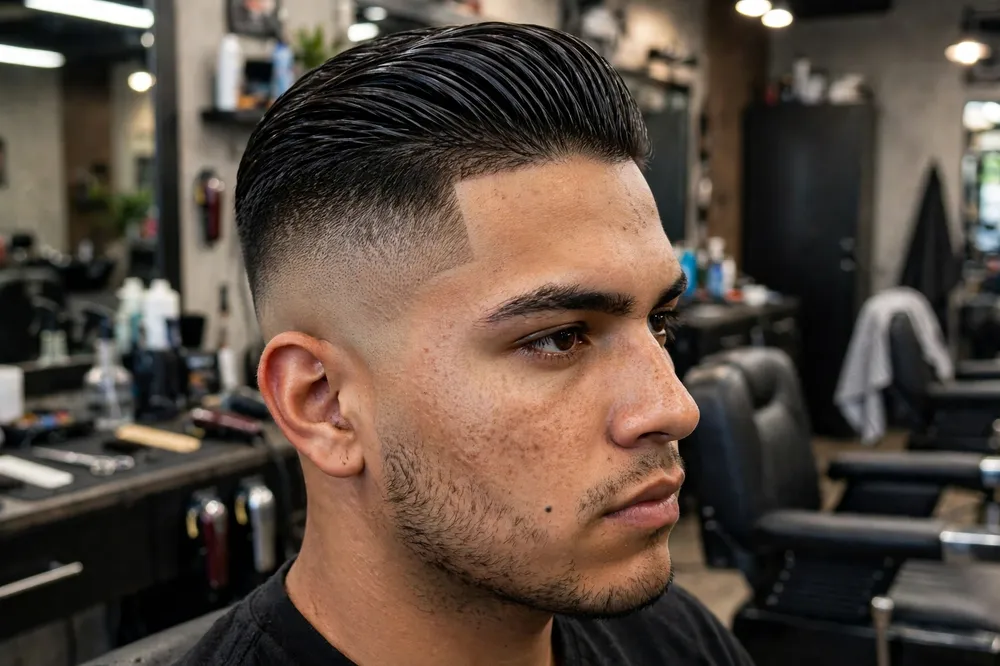
Taking the fade high strips the sides down close to the crown, so the slicked top suddenly looks longer, sharper and more deliberate. It is a strong look on thick, dark hair and on square or oval faces. One honest caution: on fine or light-coloured hair, a high fade can expose the scalp and make the top look thinner by contrast — idea #46 further down is the smarter route if that sounds like you. Ask for a high fade taken up to the parietal ridge, keeping 4–6 inches on top. Because so much of the side is clippered short, the outline grows fuzzy fast, so plan on a barber visit every 2 weeks. Style with pomade for shine or clay for a matte, modern finish.
11. Slick Back with Skin Fade
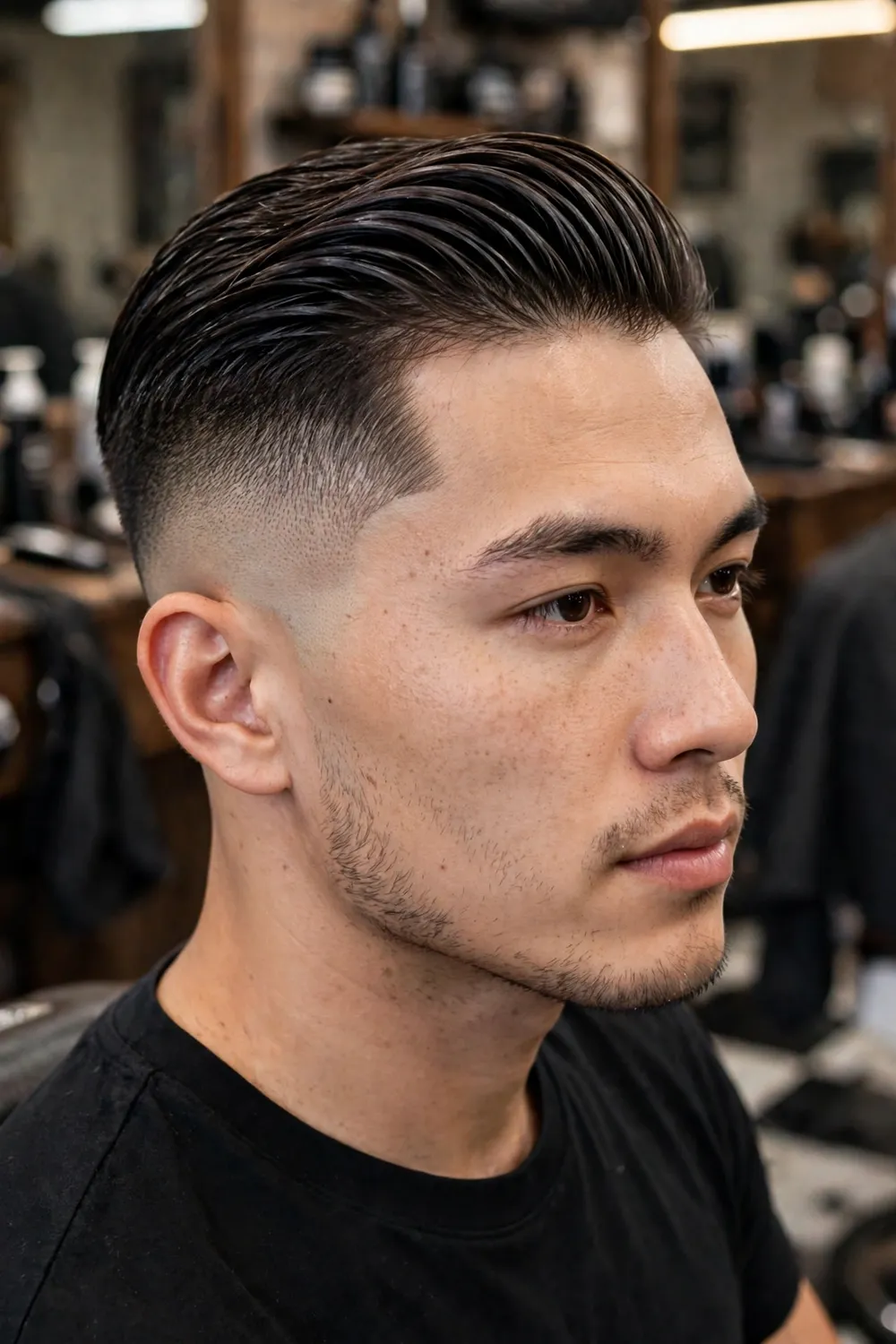
The skin fade takes the sides all the way down to bare skin at the bottom, giving a slick back the crispest, highest-contrast frame it can have. From a distance it reads as the sharpest version of all — and it stays that way for the shortest time. Realistically you get about 10–14 days of crispness before the skin section grows back into stubble, so treat this as a standing two-week barber appointment, not a monthly one. Ask for a skin (bald) fade at whichever height you like from this group, with 4–6 inches kept on top. It suits thick and medium hair best. Product choice is free — clay for matte, pomade for gloss — because with sides this clean, the finish on top does all the talking.
12. Slick Back Taper Fade

If you want one slick back that works everywhere — office, wedding, gym, job interview — this is it. A taper fade keeps a little length at the edges and only cleans up around the ears and neckline, so the cut looks clean without ever looking extreme. It also grows out softer than any true fade, which stretches your tidy interval to 3–4 weeks. Ask for a low-to-mid taper fade with 4–5 inches on top; the taper section of our low taper fade haircuts guide explains the blend in detail. It suits every hair type, including wavy and thinning hair where skin-tight fades are unforgiving. Style with a light pomade or a matte paste, depending on how much shine your workplace tolerates.
13. Slick Back with Drop Fade

Instead of running straight around the head, the drop fade arcs down behind the ears, following your head shape — a small tailoring detail that makes the cut look made-to-measure rather than off-the-shelf. It pairs naturally with a slicked top because the arc keeps the back looking clean from every angle, and it is a favourite with beards since the drop keeps the sideburn area tidy where hair meets beard. You need the standard 4–5 inches on top. Ask your barber for a low or mid drop fade, and say clearly that you want the line to drop behind the ear, not run straight. It suits wavy and thick hair especially well. Finish with pomade or clay, and tidy every 2–3 weeks.
14. Slick Back with Burst Fade

The burst fade radiates out from around the ear in a semicircle, fading the sides and sideburn area while leaving more length at the back of the head. With a slick back on top, it gives you a modern, detailed side profile without committing to a full high fade. One thing to know before you book: because the back keeps its length, this version needs the back hair combed into the slick as well, or it can look unfinished from behind. Ask for a burst fade around the ears with 4–6 inches left on top. It works on straight, wavy and curly tops alike. Style the top with clay or pomade as usual, and tidy the burst every 2–3 weeks before the arc loses its shape.
15. Slick Back with Temple Fade

The gentlest fade on this list: only the temples and sideburns are faded out, while the rest of the sides keep their scissored length. Most people won’t even call it a fade — it just looks like a very clean haircut. That makes it ideal if you like the classic slick back but want the edges freshened, or if your hair is fine and a bigger fade would expose too much scalp. Ask your barber for a temple (temp) fade only, with the sides scissor-cut and the top kept at 4–5 inches. Style with a cream or a light pomade. Maintenance is forgiving, too: the temples can be re-tidied every 3 weeks, and the rest of the cut carries comfortably for 4.
16. Medium Slick Back Fade
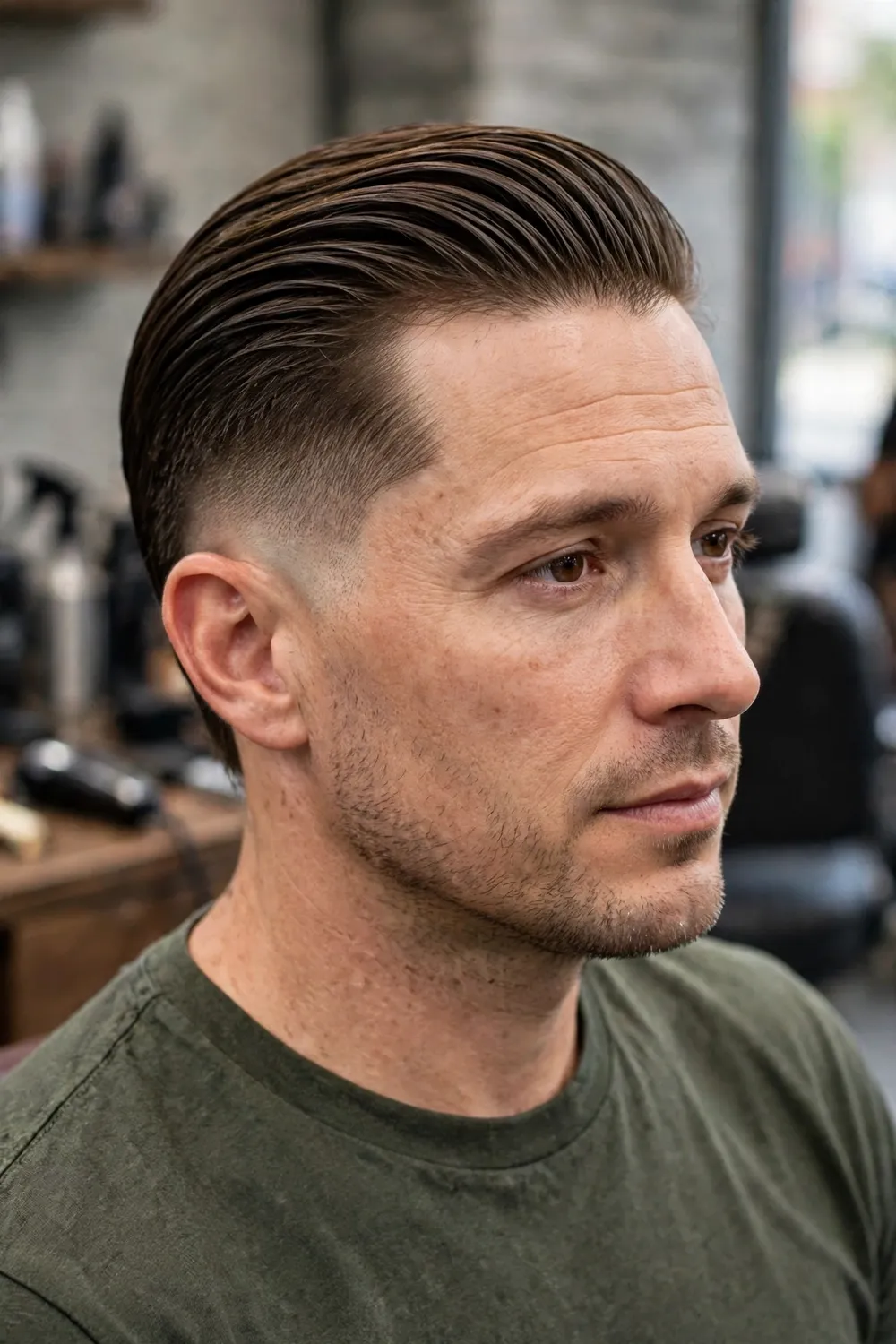
Here the top is a genuine medium length — 4–5 inches, long enough to show real flow as it combs back — over faded sides. This is the version in most of the reference photos guys bring to the barber, and it needs patience first: you have to grow the top out, because at 2 inches this style simply doesn’t exist yet. Ask for the top left at 4–5 inches with the front corners kept, and a low or mid fade underneath. It suits straight and wavy hair, and thick hair most of all. Styling matters at this length — blow-dry the top backwards to set the direction, then finish with a medium-hold pomade. Faded sides need a tidy every 2–3 weeks, while the top can go 5–6.
17. Thick Slick Back with High Taper Fade

Built for dense hair that overwhelms lesser cuts: a full, structured top with enough weight removed to behave, controlled at the edges by a high taper fade that cleans up the outline without going down to skin. If your hair is thick and straight or wavy, this is the version that stops it puffing out at the sides like a helmet. Ask your barber to keep 4–5 inches on top, point-cut or lightly layer to remove bulk — and say no to heavy thinning shears, which can leave thick hair frizzy and wispy at the ends. Clay gives the controlled, matte finish this cut wants; pomade works if you prefer shine. Tidy the taper every 2–3 weeks.
Group C — Undercut & Sharp Detail
18. Slick Back Undercut

The boldest classic-modern mix: the sides are buzzed to one short length — usually a #1 or #2 guard — with no blending into a long top that is swept straight back. That hard disconnection is the whole point, and it needs a top of 5–6 inches to read properly. It suits thick, straight or wavy hair; on fine hair the long top can look stringy against the bare sides, so be honest about your density before committing. Ask your barber for an undercut with a clear disconnection and the top left long. The honest downside is the grow-out: with no fade to soften it, the line looks untidy by week three, and the sides need re-buzzing every 2–3 weeks. Style with a strong-hold pomade.
19. Slick Back Undercut Fade
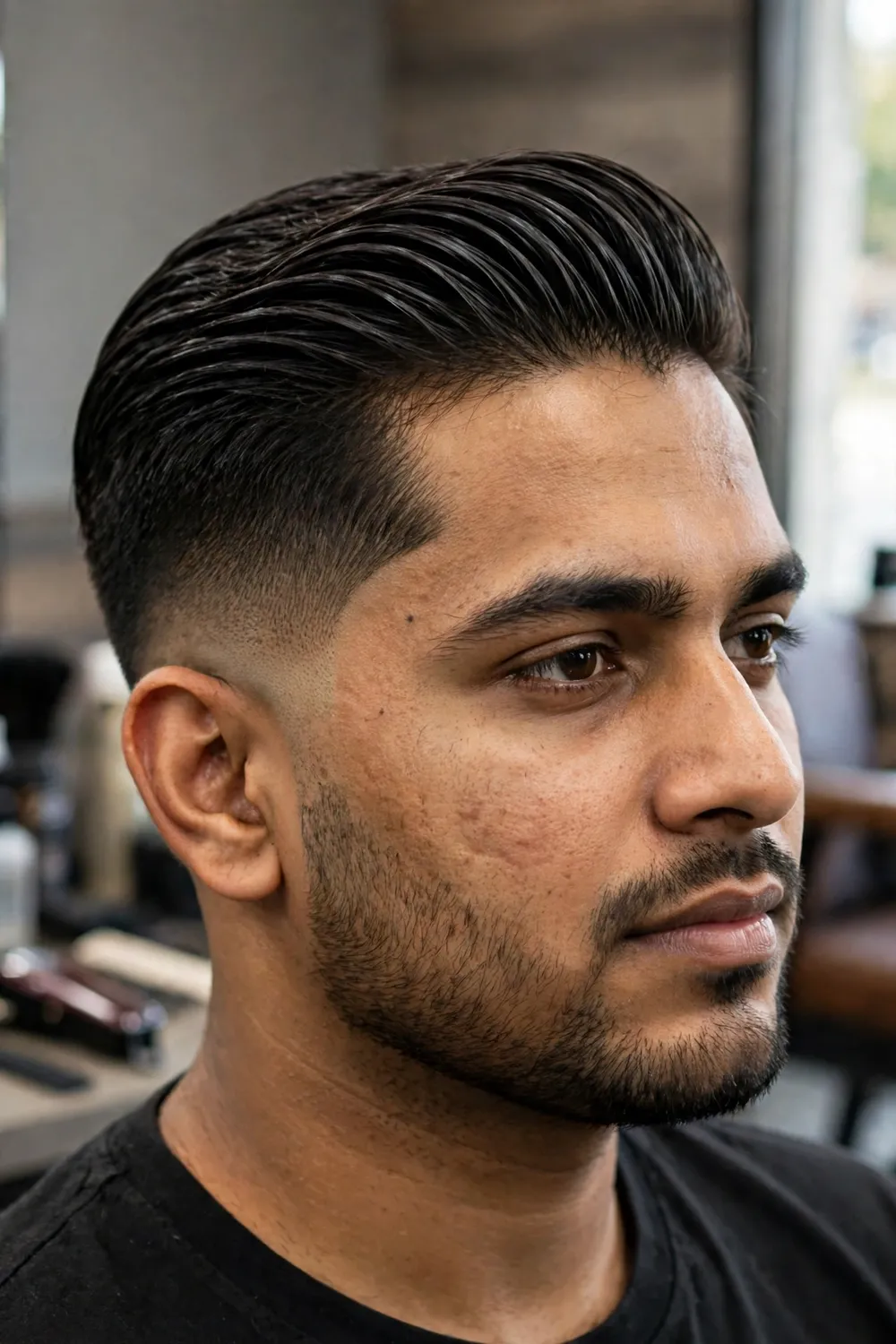
This takes the undercut’s long-top, short-sides idea and blends the bottom of the sides down into skin, so you keep the dramatic disconnect higher up but get a fade’s clean finish at the edges. The result is sharper and more current than a plain undercut. Ask for undercut length on the upper sides (around a #2 guard) faded to skin at the bottom, with 5–6 inches left on top. It suits thick hair and strong jawlines best. Because part of it is effectively a skin fade, the tidy cycle is the fade cycle: every 2 weeks if you want it crisp. Style the top back with pomade for shine, or clay if you want the contrast without the gloss.
20. Slick Back Fade with Line Up

A line up (also called an edge up) squares off the front hairline and temples with a trimmer, adding crisp geometry to any slick back fade. Treat it as a finishing detail rather than a different cut — pick your fade from Group B first, then add this on top. It reads best on dark hair, where the squared edge stays clearly visible. Ask your barber to shape the hairline conservatively, following your natural line; a line pushed too far back looks wrong for the entire grow-out, and there is no undoing it. Real talk on upkeep: the sharp edge softens within about a week, so line-up guys either touch it up weekly or accept a softer second week. The fade itself needs a tidy every 2 weeks.
21. Slick Back with Hard Part
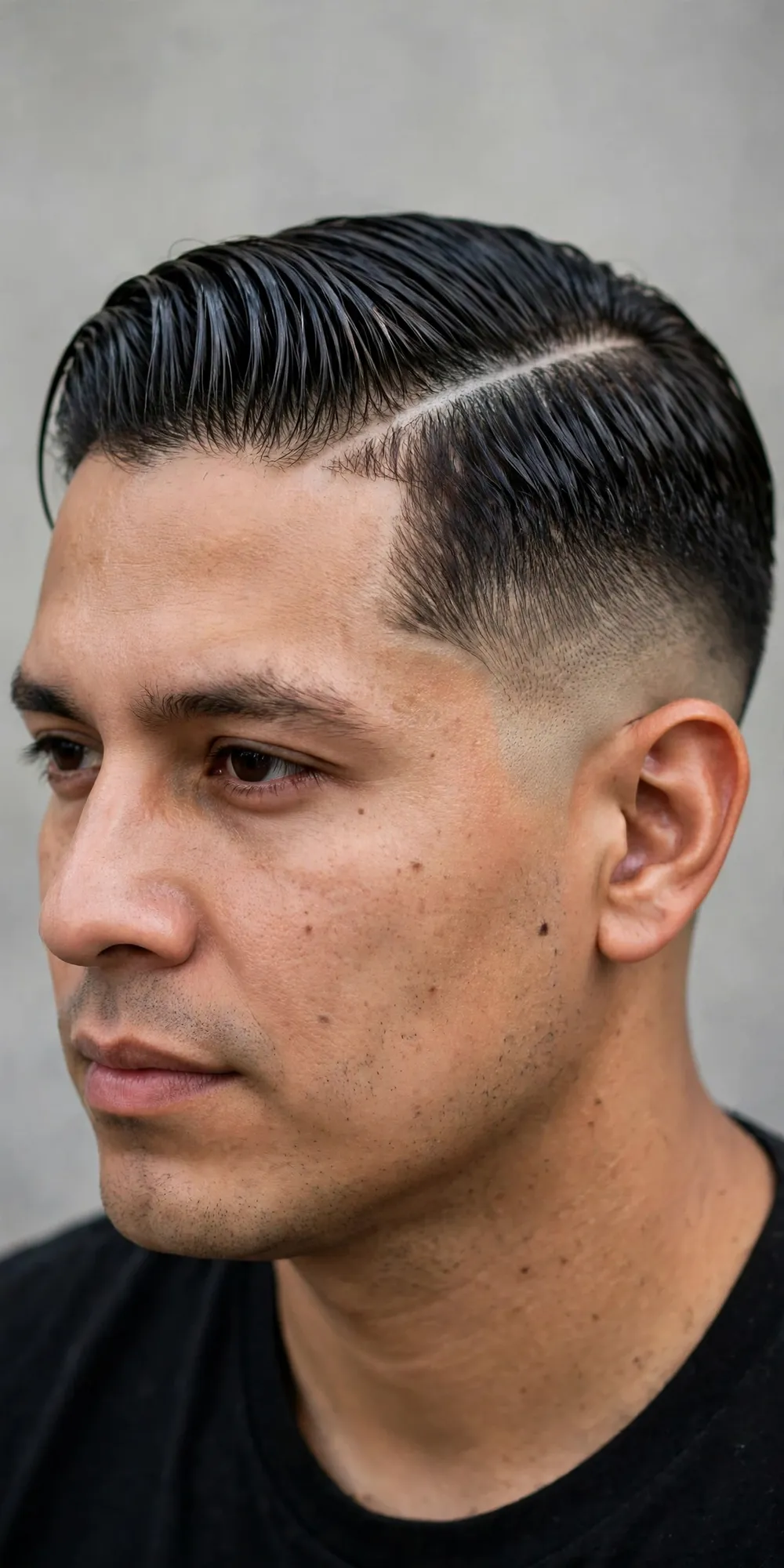
A hard part is a thin line shaved into the hair where a parting would sit; the top is then slicked back and swept slightly off that line, giving a classic slick back one sharp, deliberate break. It suits straight and wavy hair, and it works best if your hair already wants to fall to one side anyway. Ask your barber to shave the part on your natural parting side and fade or taper the sides below it. Know the upkeep before you commit: the shaved line blurs as the hair grows, so it needs re-shaving every 1–2 weeks to stay crisp — after that it simply looks like a natural part, which some guys actually prefer. Style with pomade, combing back and slightly across from the line.
22. Slick Back Side Part Fade

Part gentleman, part slick back: a defined side part gives the cut its structure, the longer side of the top is combed back rather than across, and a clean fade keeps the sides modern. It is one of the most flattering versions for round faces, because the diagonal direction of the hair adds angles where the face has few. Ask your barber to find and cut in your natural part (not a shaved hard part, unless you want idea #21), keep 4–5 inches on top, and fade the sides at your preferred height. Style on damp hair with a medium pomade, combing the big side back and the short side down. Tidy every 2–3 weeks, depending on the fade height.
23. Slick Back with Shaved Line Design

One or two shaved lines — or a small design — cut into the faded side turns a standard slick back into something personal. Keep it to a single clean line or a simple double stripe if you want it to grow out gracefully; complicated artwork is always the first thing to look rough. The design only shows properly on a fade taken short, so pair it with a mid or high fade from Group B and 4–5 inches on top. Ask your barber to cut the design last, once the fade is finished, and bring a photo of exactly what you want — describing a design in words rarely ends well. Expect it to stay sharp for about 1–2 weeks before softening into the fade. Style the top with pomade or clay as usual, and tidy the sides every 2 weeks.
Group D — Short & Professional Slick Backs
24. Short Slick Back
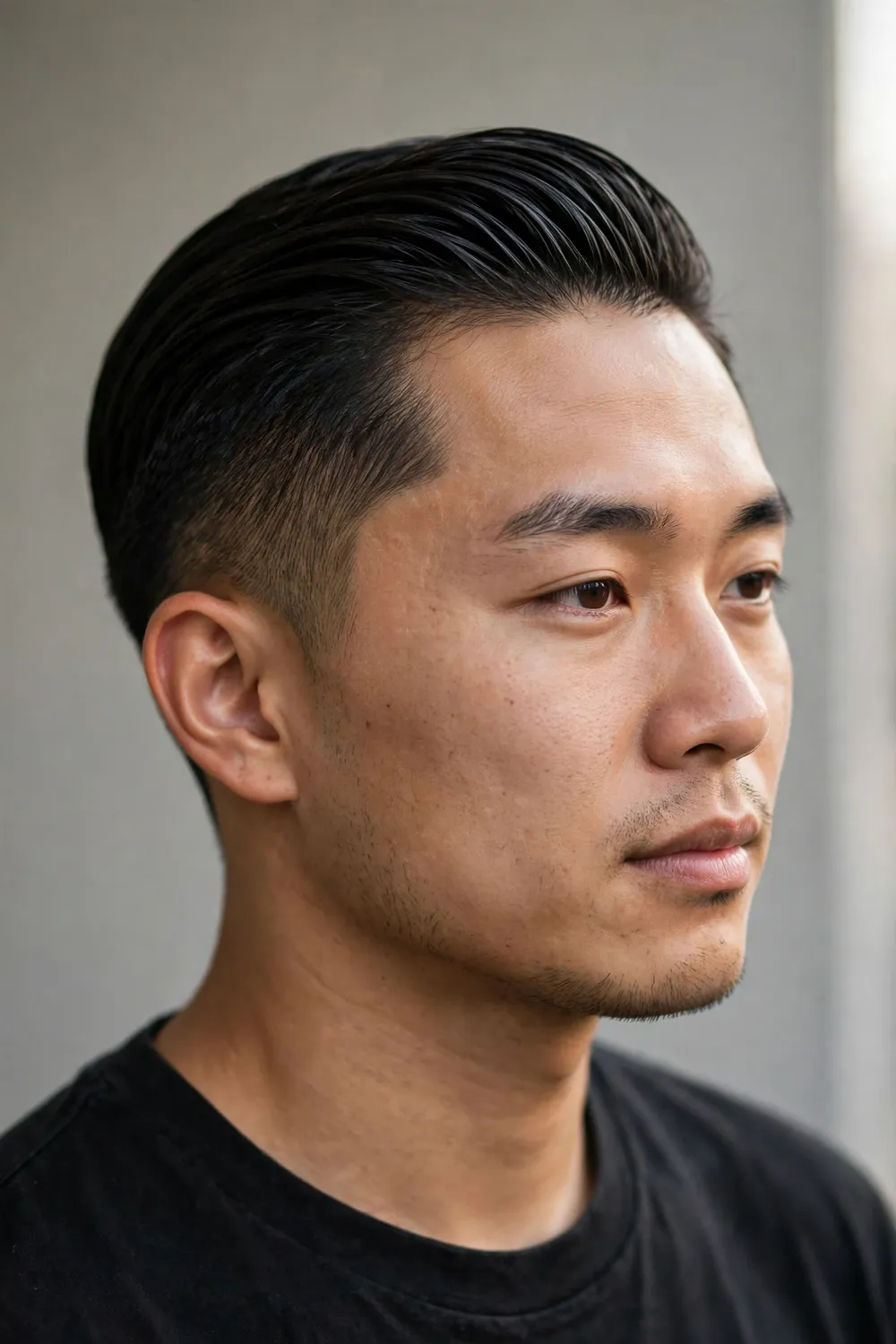
The minimum viable slick back: a top of about 2–3 inches brushed back with a light matte product. Be honest about its limit — at 2 inches, many hair types spring upright instead of lying back, so 2.5–3 inches plus a quick blow-dry backwards is the realistic recipe, especially for straight hair that grows forward. Ask your barber to keep 3 inches on top with a low taper or low fade on the sides. It suits fine hair well, because short length can’t weigh it down or make it separate into strings. Use a pea-sized amount of matte clay; heavy pomade on hair this short just looks wet. This is also the lowest-maintenance slick back in the whole list: a trim every 3–4 weeks and roughly a minute of styling a day.
25. Parted Slick Back Taper
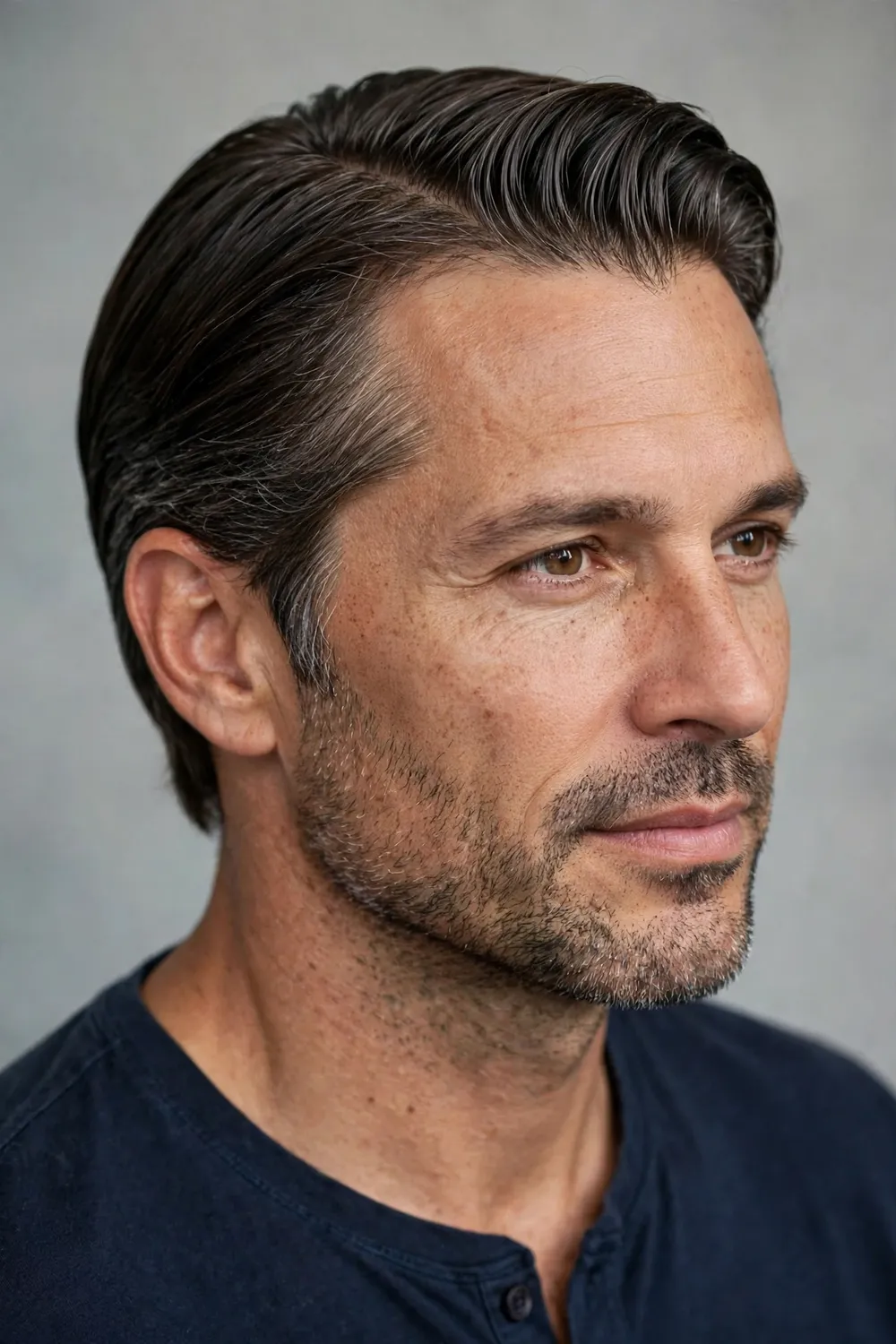
The neat boardroom classic: a soft, natural side part, the top combed back from it, and sides tapered by hand with scissors rather than clipped into a fade. Nothing about it shouts, which is precisely why it has survived every trend cycle. It needs 3–4 inches on top and suits straight and wavy hair, mature hairlines included — the soft part and the backward direction are kinder to a higher hairline than any skin-tight style. Ask your barber for a scissor taper, a natural part left undefined by the razor, and the length kept through the front. Style with a light pomade or cream for a low-shine, controlled finish. Book a tidy every 3–4 weeks; it grows out like a normal haircut, not a faded one.
26. Slick Back Taper (No Fade)
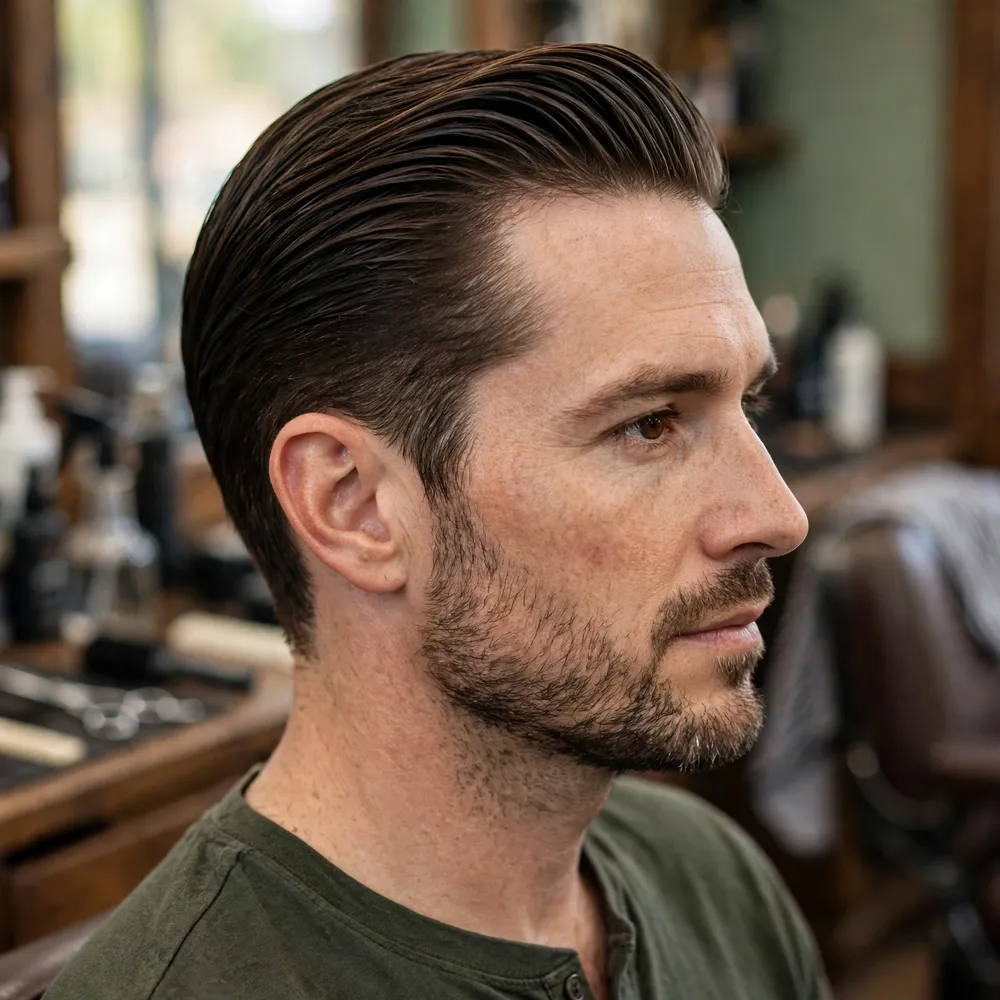
This is slick back the old-school barbering way: the sides are cut with scissors into a gradual taper, so there’s no clipper line and no skin showing anywhere. It suits men who like a traditional finish, and it works on straight and wavy hair with three to five inches on top. Ask your barber for a scissor-cut taper with a natural, soft neckline — no hard edges. Style it with a medium-shine pomade or a light cream for a softer finish. It’s one of the lowest-maintenance versions here: the taper grows out gently, so a tidy-up every three to four weeks is plenty.
27. Professional Slick Back

The office-safe formula, and the one to copy if your workplace is conservative: medium length on top, a low taper at the sides, and a low-shine product so nothing looks wet or styled within an inch of its life. It suits straight and wavy hair, and it works with a suit as easily as with a shirt and chinos. Ask for three to four inches left on top and a low taper — nothing high, nothing skin-tight. A matte fibre or low-shine cream is the right finish. Maintenance is minimal: comb it back in the morning, and tidy the sides every three to four weeks.
Long Slick Backs
28. Long Slick Back
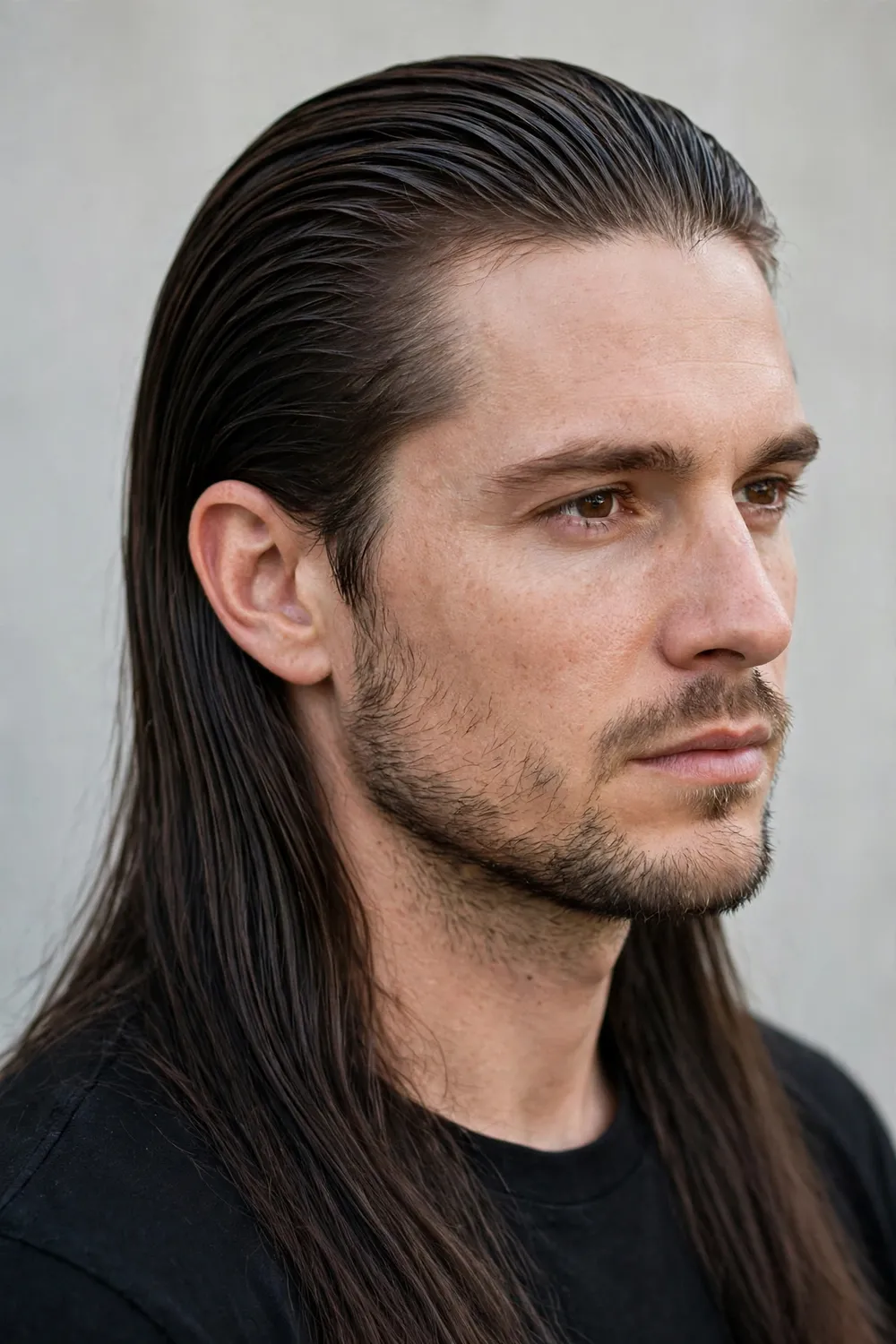
The dramatic one: a long top — six inches or more — swept all the way back, framed by faded or undercut sides so the length looks intentional rather than grown-out. It suits thick, straight to wavy hair, and it helps if you actually enjoy styling, because long hair needs a blow-dry to sit back properly instead of falling in your face. Ask your barber to keep every bit of length on top and take the sides to a fade or undercut. Work pomade or a smoothing cream through damp hair, then blow-dry backwards. With faded sides, book a tidy every two to three weeks; the top itself only needs the ends trimmed every couple of months.
29. Long Hair Combed Back
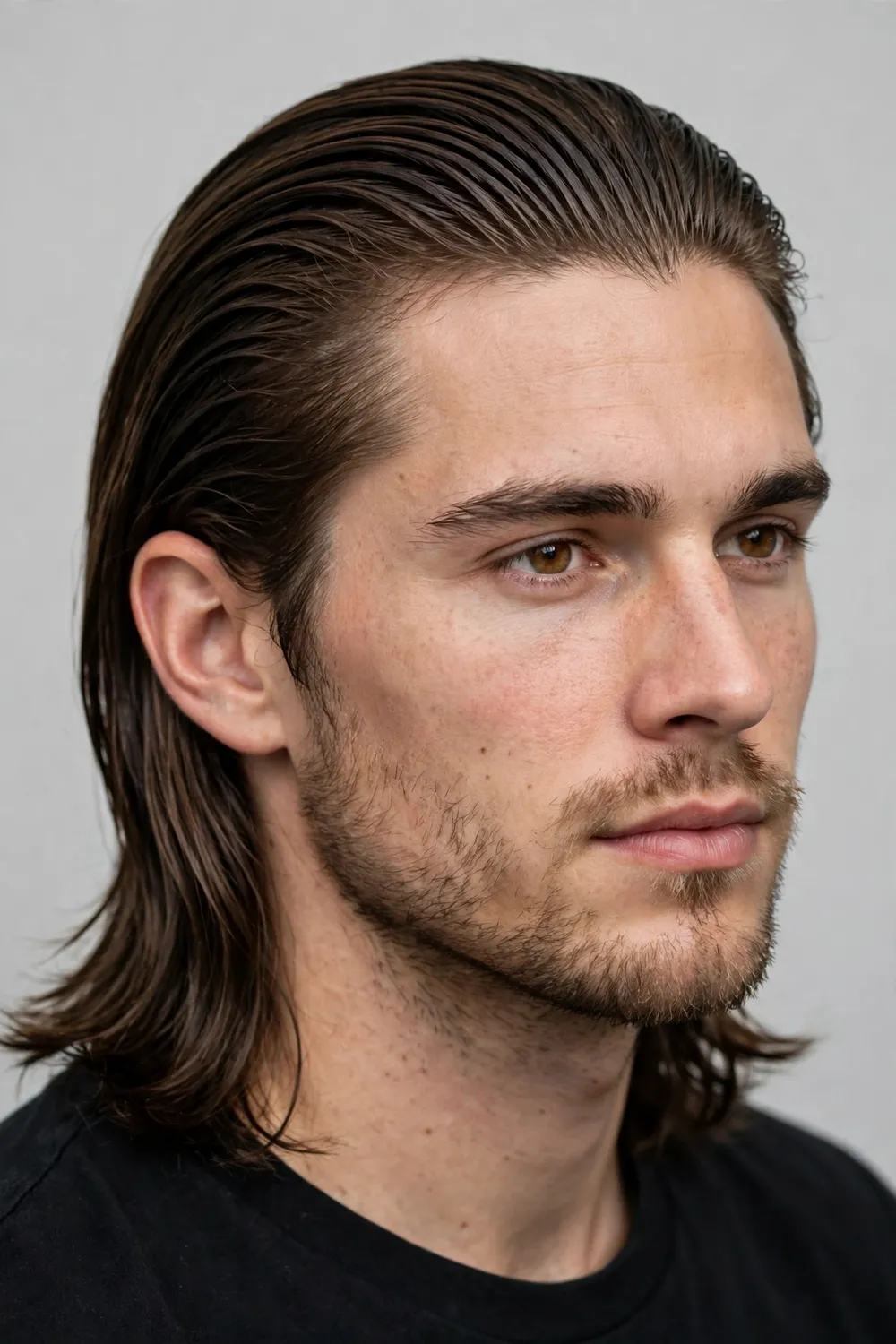
No fade, no undercut, no clipper work at all — just long hair combed straight back and tucked behind the ears. It suits men growing their hair out or anyone who wants a relaxed, natural look, and it works best on wavy or manageable straight hair. Ask your barber to only clean up the ends and keep the shape; you don’t want layers cut short. A light cream is all you need, mostly to tame frizz rather than hold anything. Maintenance is the lowest of any long version: no fade to upkeep, just a wash routine that suits your hair and an ends trim every six to eight weeks.
30. Long Brush Back with Low Fade

Here the long top is blow-dried back and slightly up, so you get lift at the roots and movement through the lengths instead of hair plastered flat to the head. A low fade keeps the edges tidy without stealing the relaxed feel. It suits thick, long hair that has some natural body. Ask for a low fade and at least six inches kept on top. Styling is the honest catch: you’ll need a pre-styler on damp hair and three or four minutes with a dryer, brushing backwards as you go, then a light pomade to finish. The fade wants a tidy about every three weeks.
31. Long, Messy Slick Back
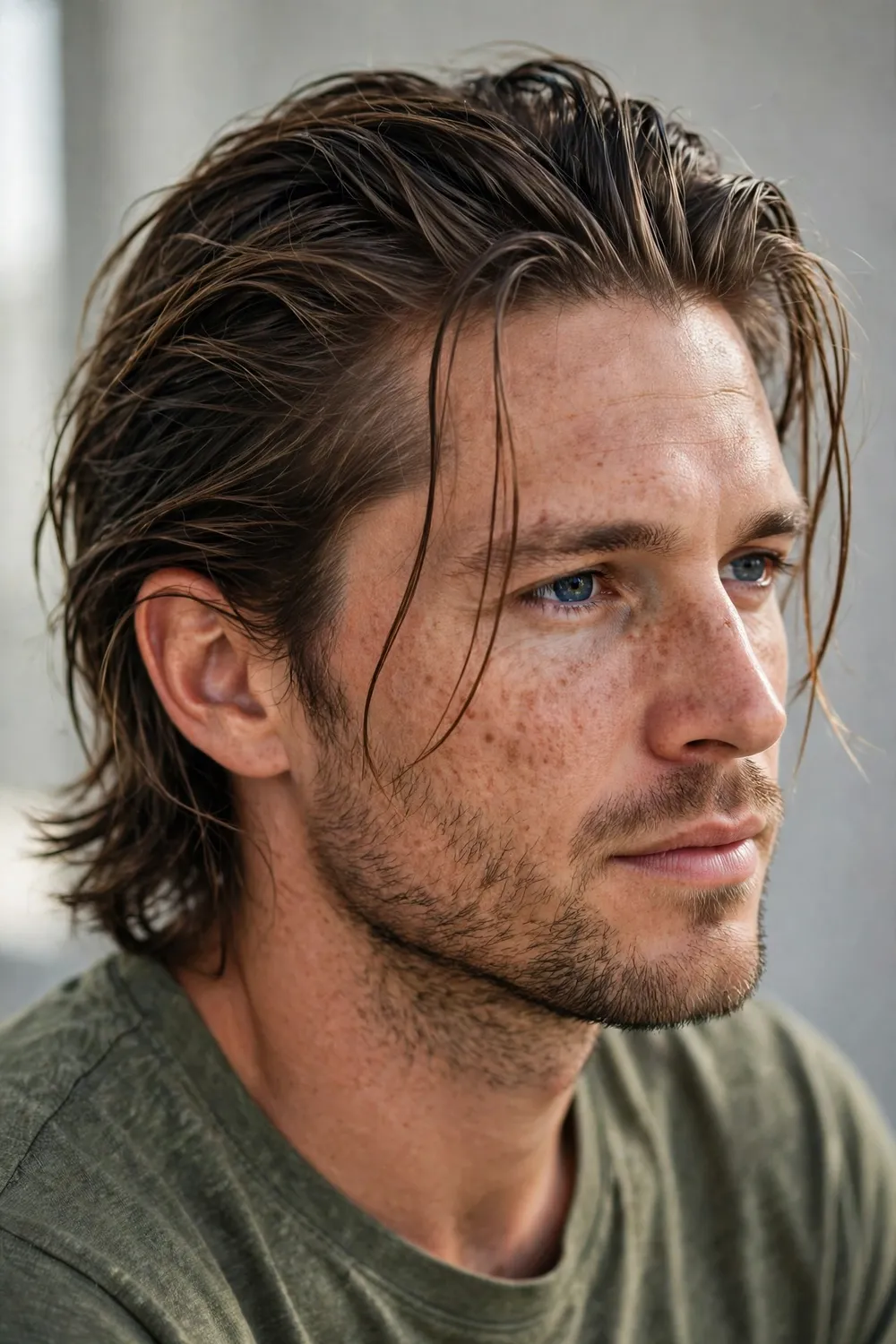
Think of this as the slick back with the polish deliberately taken off: long hair pushed back with a texturising cream, pieces separating, ends doing their own thing. It suits wavy and thick hair and relaxed dress codes — if you like the undone end of the spectrum, our messy hairstyles for men guide is worth a look too. Ask your barber to keep the length and just add light texture to the ends. Scrunch a matte cream through with your fingers rather than combing; neatness defeats the purpose. It’s forgiving day to day and grows out well, so maintenance is mostly a trim every five or six weeks.
32. Slick Back Flow

The flow is medium-long hair swept back but left free to move, fall and be touched — nothing stiff, nothing shiny. It’s the natural home of wavy hair, because the wave gives the style its shape without much product. It suits men who want length without the slicked, formal feel of the classic versions. Ask your barber to keep four to six inches on top with minimal thinning, and soft tapered sides. A light cream or a touch of sea salt spray is enough. Maintenance is easy: it looks better slightly grown-in, so a tidy every five to six weeks keeps it in shape.
33. Slick Back Man Bun

For men with real length — you need roughly seven inches or more on top to tie it comfortably — the top is slicked back smooth and gathered into a bun at the back of the head. It keeps hair off your face, which makes it practical as well as stylish. It suits straight and wavy long hair; curly hair can do it too, with more texture in the slicked part, which is fine. Ask for faded or undercut sides if you want it sharper, or keep the sides long for a fuller bun. Use a cream before tying and a soft elastic, and don’t pull it painfully tight daily — varying the position is kinder to your hairline.
34. Slick Back Top Knot

The top knot takes just the top section — slicked back and tied into a small knot high on the crown — while the sides are faded or undercut short. It’s sharper and more deliberate than a full man bun, and it suits men with straight or wavy hair and the confidence for a fashion-forward cut. You need about five to six inches on top before it will tie without straining. Ask your barber for a skin fade or disconnected undercut on the sides and all the length kept up top. Slick the top section back with pomade before tying. Be honest with yourself about upkeep: the faded sides need attention every two weeks to stay crisp.
Texture & Hybrid Styles
35. Textured Brush Back

If the word “slick” puts you off because it sounds flat and greasy, this is your version: hair brushed back with clay so it stays matte, piecey and full of movement. It suits thick hair especially well, and most face shapes, with three to five inches on top. Ask your barber to point-cut some texture into the top rather than leaving it one blunt length — that’s what stops it lying like a helmet. Work a pea-sized amount of matte clay through dry or nearly dry hair with your fingers, pushing everything back loosely. It needs little daily effort, and a trim every three to four weeks keeps the texture fresh.
36. Curly Slick Back
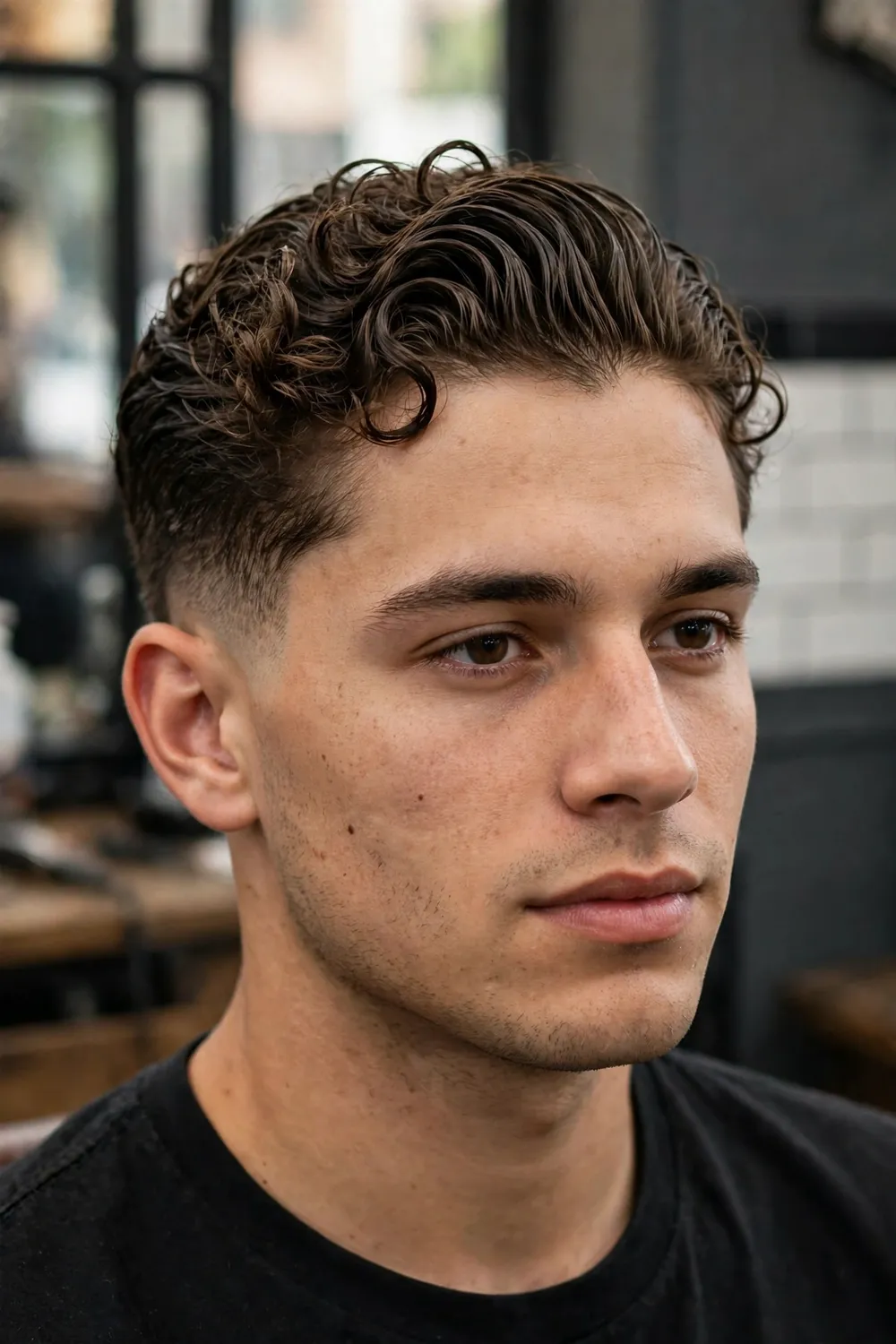
Yes, curly hair can slick back — you just work with the curl pattern instead of ironing it flat. The curls are pushed back off the face with cream and a little light gel, the spiral texture staying visible on top, which honestly looks better than a forced-flat finish. It suits type 2C to type 3 curls with at least four inches on top; for more curl-first ideas, our curly hairstyles for men guide covers the full range. Ask your barber not to thin the top aggressively, as that invites frizz. Apply product to damp hair, push back with fingers or a wide-tooth comb — never brush it dry — and air-dry or diffuse. Refresh on day two with water and a dab of cream.
37. Wavy Combed Back

The easiest of the texture versions, because the waves do the styling for you. Hair is combed back loosely on damp hair and the natural S-pattern sets into soft ridges as it dries. It suits type 2 wavy hair of medium length, and it has a relaxed, classic feel that works in most settings. Ask for four to five inches on top with a soft taper or a low fade at the sides. A light cream or low-shine pomade is all you need, raked through with fingers or a wide comb. Maintenance is minimal — this style genuinely improves with a bit of natural movement, so you’re just keeping the sides tidy every three to four weeks.
38. Slick Back Pompadour
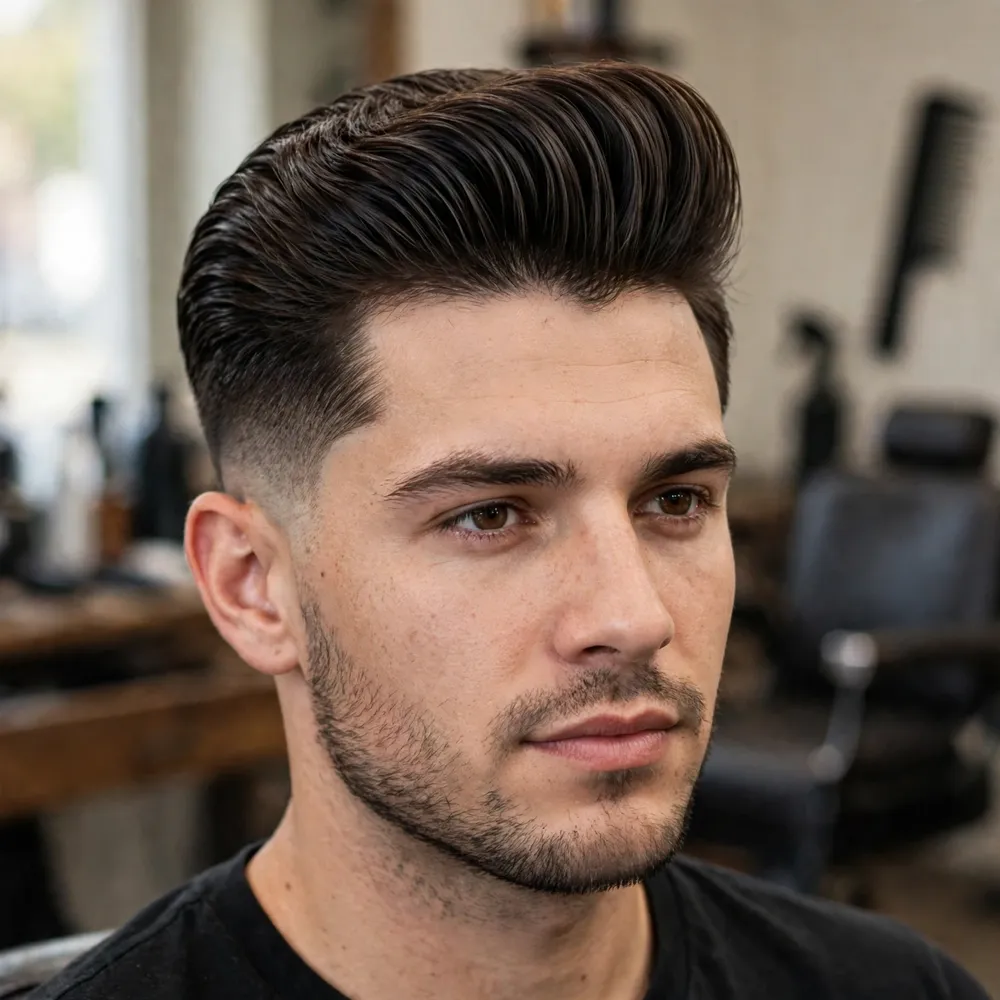
A hybrid: the front is built up into pompadour volume, then everything sweeps back into a slick finish. You get height and polish in one style. It suits straight and wavy hair, and the extra height is kind to round faces, because it lengthens the overall shape. The front needs the most length — four to six inches — and faded sides make the volume read even bigger. Ask your barber to keep the front longest and graduate it shorter towards the crown. This one asks the most daily effort of any hybrid here: blow-dry the front up and back, then set it with pomade. In return, it holds its shape far better than air-dried versions.
39. Slick Back Quiff

The quiff hybrid is the softer, more casual cousin of the pompadour: a textured lift at the front that blends back into a loose slick. It suits most face shapes and hair types, which is why barbers recommend it so often as a first “styled” cut. Keep three to five inches on top with texture cut in, and take the sides to a taper or mid fade. Ask your barber for a textured quiff that brushes back rather than standing straight up. Style with matte clay or fibre, lifting the front with your fingers and pushing the rest back. It’s more forgiving than the pompadour — if it drops a little by evening, it just looks relaxed.
40. Slick Back Mullet

Retro, and not for the shy: the top is slicked neatly back, the sides are faded, and the length stays at the back. The contrast between the polished top and the party at the rear is exactly the point. It suits straight and wavy hair and men whose style leans bold. Ask your barber to fade the temples and sides, keep the top long enough to slick, and leave clear length through the back — then agree on how long, because “a bit of length” means different things to different people. Pomade or cream keeps the top in place. The back grows quickly, so plan a tidy every three to four weeks to stop it turning scruffy.
Slick Back with a Beard
41. Slick Back with Beard

The classic pairing: a polished, slicked top balanced by a full beard. The two work together because the beard adds weight and structure at the bottom of the face that the swept-back hair leaves clean at the top. It suits men who can grow a reasonably full beard, and any version of the slick back works — classic, faded or undercut. Ask your barber to shape the beard’s cheek and neck lines in the same appointment, so the sharpness of the beard matches the sharpness of the haircut; a crisp haircut over a scruffy beard looks half-finished. Use pomade up top and a little beard oil below. The beard needs a weekly tidy at home and a professional shape-up every few weeks.
42. Slick Back with Short Sides and Beard
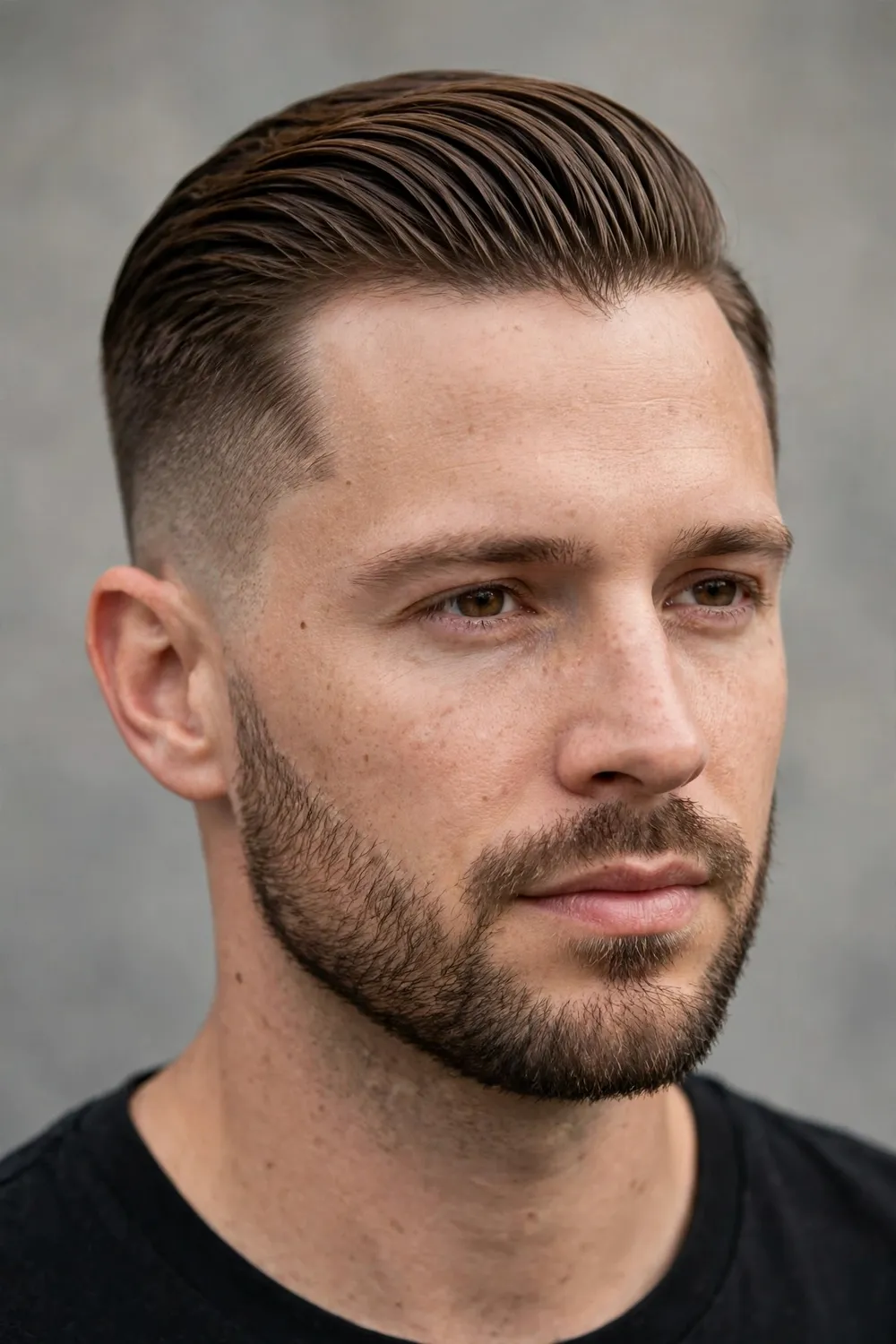
Taking the sides very short — a low clipper guard or a short fade — makes both the slicked top and the beard look sharper by contrast. It’s a good formula for thick hair and dense beards, where keeping everything long can look heavy. Ask for the sides at a guard one or two (or a short fade), the top left at four to five inches, and the beard shaped but full. A medium-hold pomade gives the top enough presence to hold its own against the beard. The trade-off is maintenance: short sides show growth quickly, so expect a barber visit every two to three weeks, plus your own beard line-ups in between.
43. Short Slick Back with Mid Skin Fade and Beard
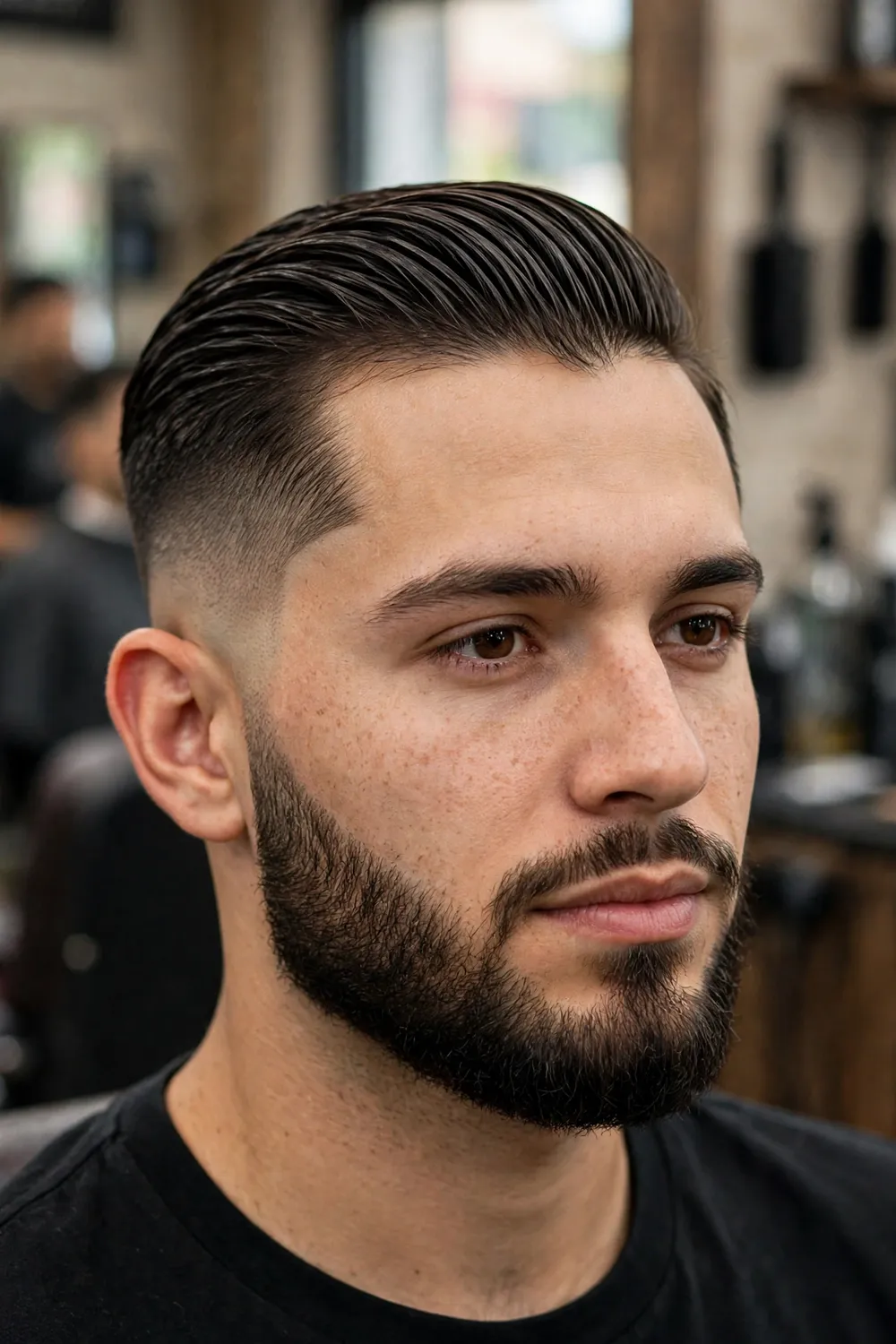
The full sharp package in one cut: a short slicked top (three to four inches is enough), a mid skin fade, and a beard shaped to connect with it. It suits straight and wavy hair and men who like every line crisp. Ask your barber for a mid skin fade, the beard blended in at the sideburns rather than cut off in a hard step, and the beard’s edges lined up cleanly. A matte or low-shine pomade suits this version better than a wet finish. Let’s be honest about the upkeep, though — this is the highest-maintenance combination in the beard group. A skin fade needs refreshing about every two weeks or it loses the whole effect.
44. Slick Back with Beard Fade
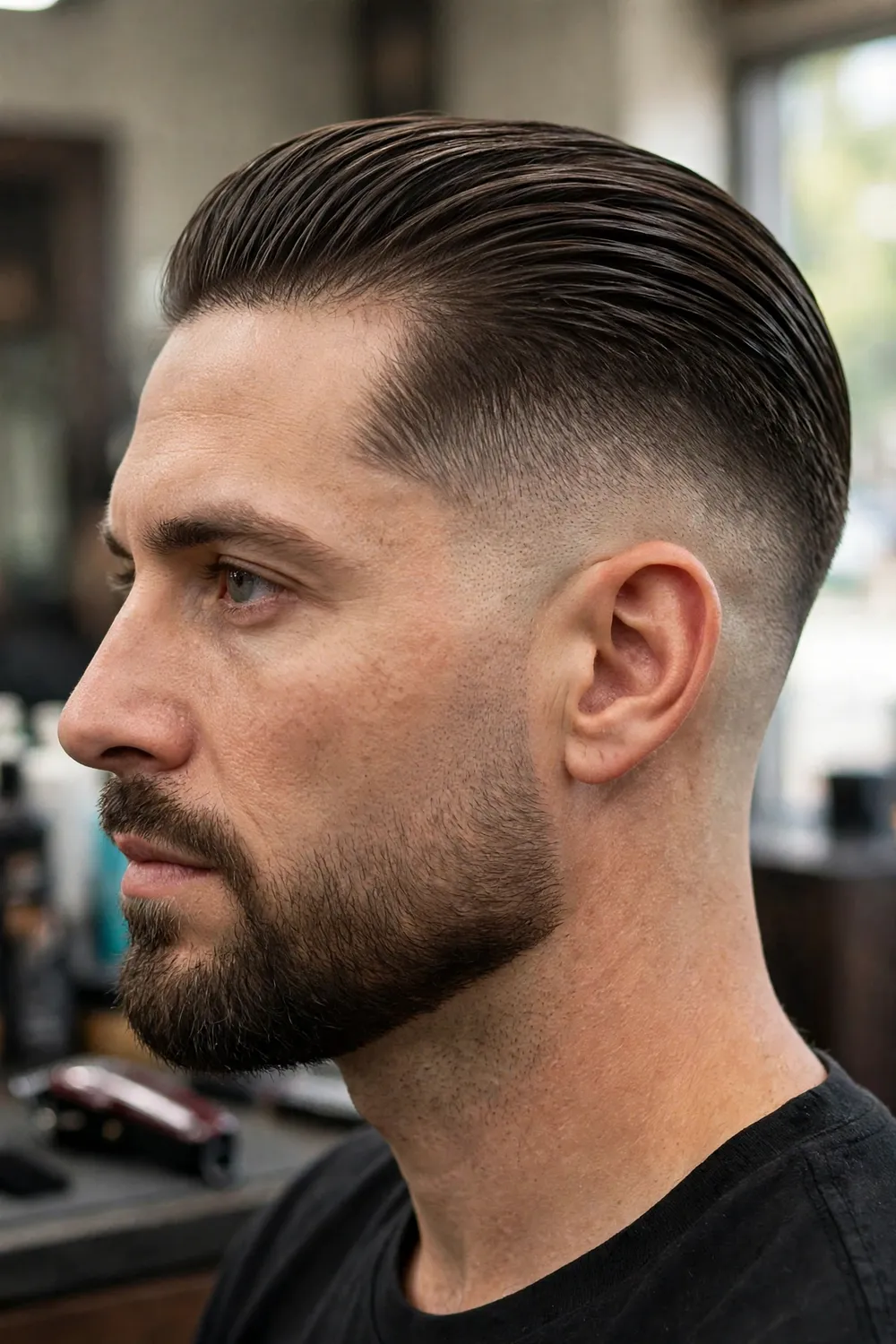
Instead of the beard starting abruptly at the sideburn, the barber fades the sideburns and the top of the beard so they dissolve into the hair fade — one seamless gradient from skin, to beard, to slicked top. It suits men whose beard is denser lower on the cheeks and jaw than up by the sideburns, because the fade works with that growth pattern. Ask your barber to blend the beard into the fade and keep the length through the chin so the beard still has shape. Pomade up top, a little beard balm for control below. The blend is the first thing to grow out, so two weeks is about the limit before it needs redoing.
Slick Back by Hair Type & Concern
45. Slick Back for a Receding Hairline

Honesty first: a slick back doesn’t hide a receding hairline — it exposes it, because everything is combed away from the forehead. Plenty of men wear it anyway and look great, because the style reads confident rather than camouflaged. What you can do is soften the effect: keep medium length on top, keep the sides short so the contrast at the temples is lower, and use a matte product, never a wet-look gel — shine on a thinning hairline draws the eye straight to it. Ask your barber for a taper or low fade and no thinning on top. Avoid pulling the hair back under hard tension daily; if showing your hairline bothers you, the side-swept version at #49 is gentler.
46. Slick Back for Thin or Fine Hair
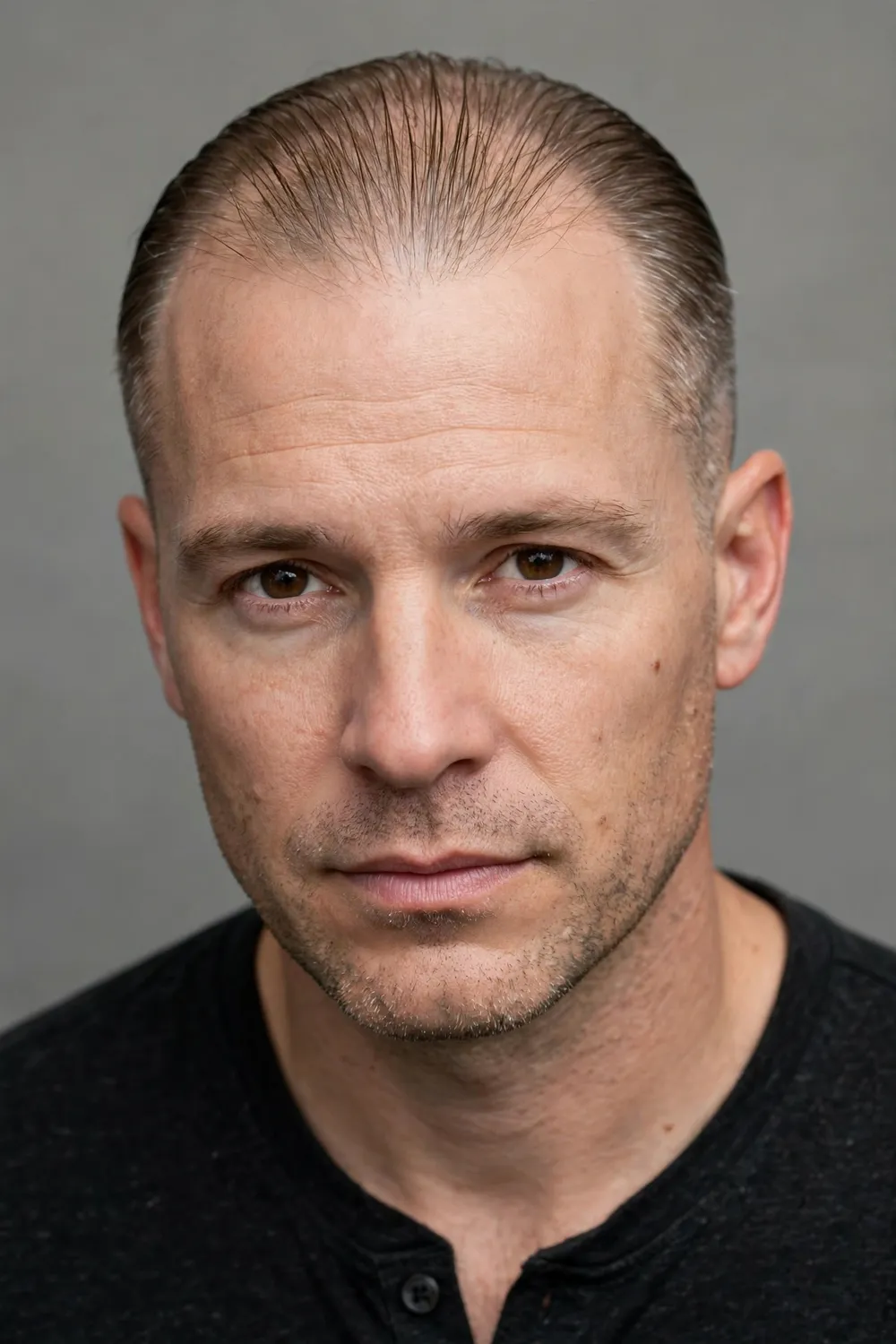
Fine hair can slick back well, but the details matter more than the cut itself. Keep the top on the shorter side — three to four inches — because longer fine hair separates and shows scalp when it’s combed back. Ask your barber for a blunt cut on top and to skip the thinning shears entirely; you need every hair you’ve got. Blow-dry the hair backwards first: the lift you build while drying is what makes it look fuller. Then use a lightweight matte clay, and use less than you think — heavy or wet products clump fine strands together and make hair look thinner, not thicker. A low fade or taper keeps the sides neat every three weeks or so.
47. Slick Back for Asian Hair
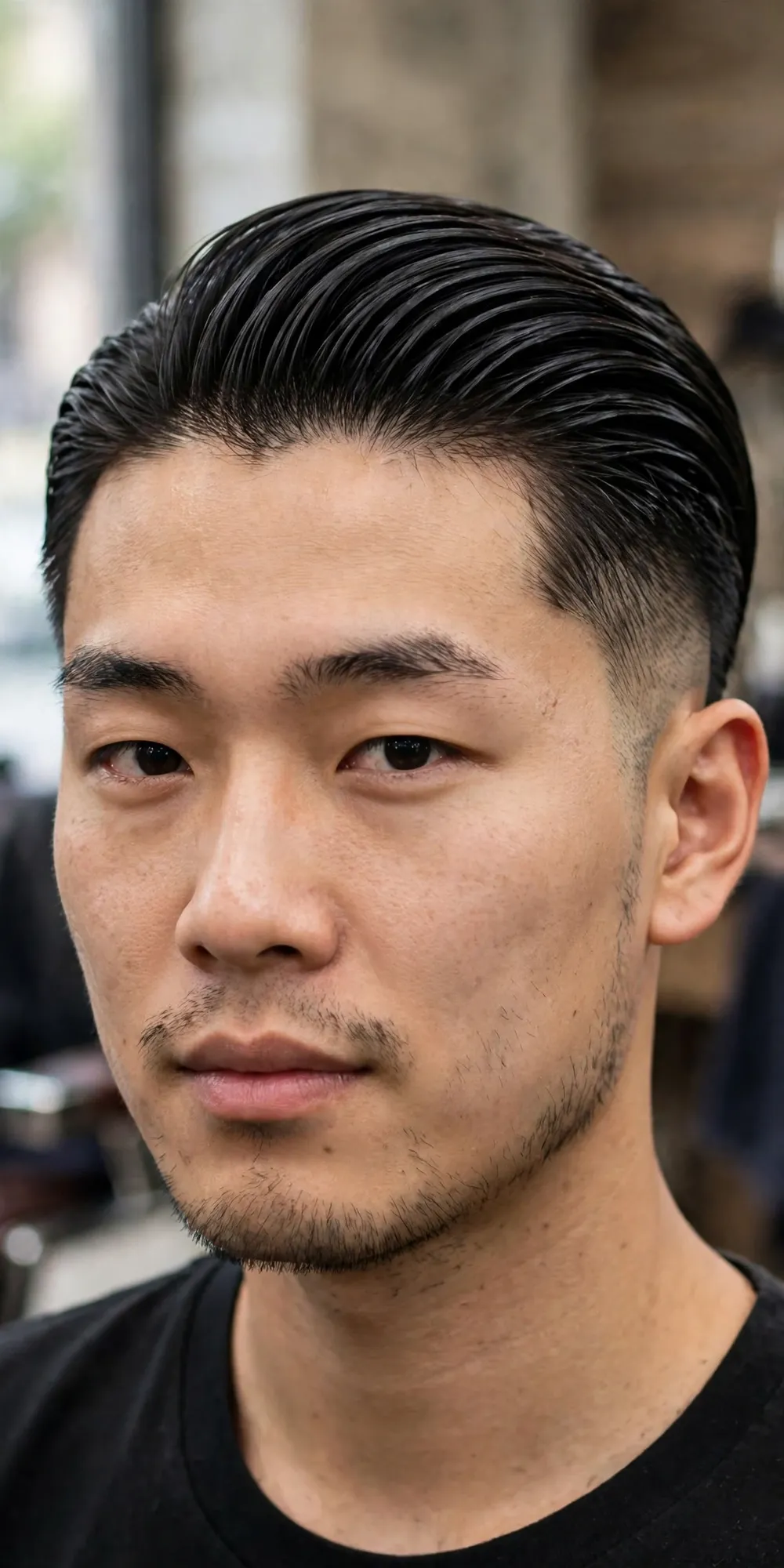
If your hair grows straight out and sticks up at the sides, you already know the challenge: thick, straight strands resist lying back until they have enough length and weight. The fix is patience plus training. Grow the top to at least four inches — five is better — so its own weight helps it lie down. For the first few weeks, blow-dry it backwards every morning and use a strong-hold fibre or pomade; you’re teaching it a new direction, and it does learn. Ask your barber for a taper or fade on the sides to remove the sticking-out bulk, and to keep all the length on top. Once trained, daily styling takes two minutes, with a tidy every three weeks.
48. Slick Back for Grey Hair

Silver hair slicked back is one of the most distinguished looks a man can wear — it’s basically the classic slick back with better natural colour. It suits older men with straight or wavy hair, and it works at almost any top length. One practical note: grey hair is often coarser and drier than it used to be, so a conditioner in your routine and a light cream or low-shine pomade will keep it smooth instead of wiry. Avoid heavy wet gels, which can look harsh against grey. Ask your barber for a classic taper or a low fade depending on how sharp you want it. Maintenance is low — a tidy every three to four weeks is enough.
49. Side-Swept Slick Back
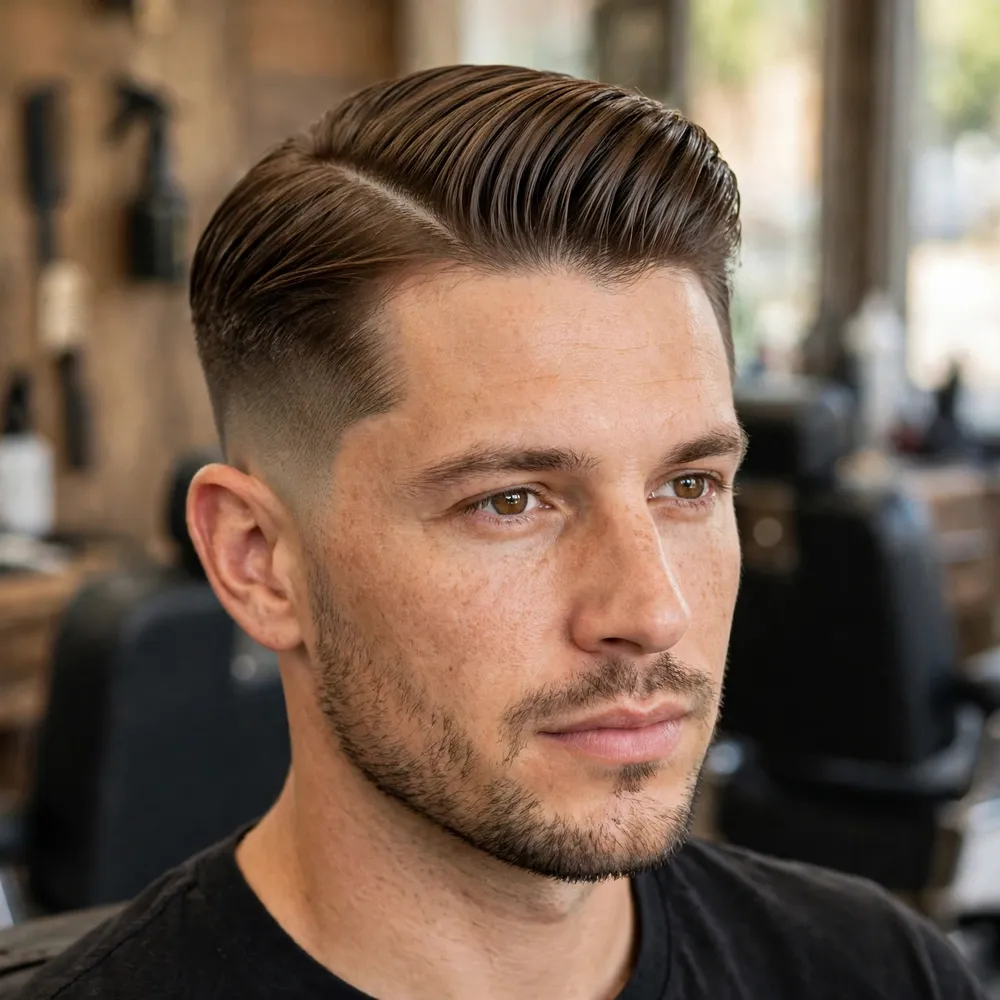
Instead of combing straight back, the hair is swept back at a diagonal, following a natural side direction. That angle softens a strong or uneven hairline — a smart pick if idea #45’s straight-back exposure puts you off — and it flatters most face shapes. It also works with your hair’s natural growth instead of against it, so men with a stubborn front cowlick often find this version stays put when the straight slick back won’t. Ask your barber to keep four to five inches on top with a taper or fade at the sides, and say which diagonal you sweep to. A medium-hold pomade with a natural finish is right. Maintenance: sides every three weeks, thirty seconds of combing each morning.
How to Slick Back Your Hair (Step by Step)
Whichever version above you pick, the styling routine is basically the same. Get these six steps right and the style takes about five minutes:
- Start on towel-dried, damp hair. Not dripping wet, not bone dry — damp is the sweet spot where product spreads evenly and hair still complies.
- Blow-dry backwards first. Before any finishing product, dry the hair while brushing or pushing it straight back. This trains the direction; skipping it is the main reason slick backs fall apart by lunch.
- Apply pre-styler or your main product evenly. Rub it between your palms, then work it through from back to front and root to tip, so the underneath isn’t left dry and springy.
- Comb it back. Use a wide-tooth comb first to set the direction, then a finer comb if you want a sleek finish — or just your fingers for the textured versions (#6, #35, #39).
- Lift the front slightly if you want volume. Push the front section up a fraction before it sets, rather than combing it flat against your scalp.
- Finish and leave it alone. A blast of cool air from the dryer sets it; a light spray is optional. Once it’s set, stop touching it — every re-comb breaks the hold you’ve built.
One troubleshooting note: if your slick back splits open at a cowlick or falls flat by midday, the cause is usually hair that was too wet or too dry when you styled it, or a product that’s too heavy (or too light) for your hair type. FAQ #7 below walks through the fixes.
What to Ask Your Barber for a Slick Back
Most disappointing slick backs are a communication problem, not a cutting problem. Say these things and you’ll get the cut you pictured:
- Protect the top length. The number one mistake is letting the barber take the top too short — once it’s under about three inches, it won’t lie back. Say clearly: “Keep the top long, just clean up the ends.”
- Name your sides. Pick one and say it plainly: a fade (short, blended, sharp — choose low, mid or high), a taper (shorter, softer, more traditional), or an undercut (disconnected and bold). Each gives the same top a completely different character.
- Bring a photo of the exact idea. Show the picture of the idea number from this list that you want. “Slick back” alone means ten different cuts to ten different barbers.
- Say how you style it. Tell the barber whether you’ll wear it glossy or matte, combed or finger-styled. A good barber cuts differently for a sleek pomade finish than for a loose matte one, and they’ll also tell you honestly if your hair type will fight the version you’ve chosen.
Best Products for a Slick Back
You don’t need a shelf of products — one that matches your hair and your preferred finish is enough. Here’s the honest breakdown:
| Product | Finish | Hold | Best for |
|---|---|---|---|
| Pomade | Classic shine, can look wet | Medium to strong | Classic and modern slick backs on straight or wavy hair |
| Clay | Matte, dry, textured | Medium to strong | Thick hair, textured versions — and thin hair, because matte makes it look fuller |
| Gel | Wet look, very glossy | Strongest | Wet-look styles only; can flake and look crunchy, so use it sparingly |
| Cream / Fibre | Natural, low or no shine | Light to medium | Loose, long and flow styles where movement matters more than hold |
The rule of thumb worth remembering: shine products can make thin or fine hair look thinner, because the strands clump and the scalp shows through. Matte products do the opposite — they separate the strands slightly and create the look of more thickness. If in doubt, start matte.
Slick Back Mistakes to Avoid
- Styling on soaking-wet or bone-dry hair. Too wet and the product dilutes and the style collapses; too dry and the hair springs back to its natural direction. Damp, towel-dried hair is where every version works best.
- Using a full palm of heavy gel. More product is not more hold — past a point it just flakes, looks greasy by afternoon, and weighs the hair flat. A fingertip-sized amount, worked in properly, beats a handful every time.
- Combing against your natural growth. If your hair grows forward or swirls at a cowlick, dragging it straight back under tension means it will split open the moment the product tires. Work with the growth, or choose the side-swept version (#49) which is built for exactly this.
- Letting faded sides grow out past three weeks. A slick back with a grown-out, fuzzy fade stops looking sharp and starts looking overdue. Fades need two to three weeks; tapers can stretch to four.
- Wearing it pulled skin-tight every single day. Constant hard tension when combing is tough on a hairline over time. Vary the tightness, take looser days, and don’t sleep in heavy product — wash it out.
- Choosing a wet-look finish on thinning hair. Shine plus slicked-flat strands is the combination that shows the most scalp. Matte and a little root lift will always serve thinning hair better — see #45 and #46.
Slick Back FAQs
What haircut should I ask my barber for if I want a slick back?
Ask for length kept on top — roughly three to six inches — with your choice of sides: a fade, a taper or an undercut. Bring a photo of the exact style you want, because “slick back” on its own can mean several different cuts. And tell your barber whether you’ll style it shiny or matte, so they cut for that finish.
How do I slick back my hair, step by step?
Start with damp, towel-dried hair. Blow-dry it backwards to set the direction, work your product through evenly, then comb (or finger-comb, for textured versions) straight back. Lift the front slightly if you want volume, then leave it alone to set. The full six-step routine is in the section above.
How long does my hair need to be to slick it back?
About three inches on top is the minimum for hair to lie back and stay there. Four to six inches is the comfortable range — enough weight to hold the direction without fighting you. Much longer than that still works, but you’ll rely more on blow-drying and product to keep it out of your face.
Pomade, clay or gel — which product is best for a slick back?
It depends on the finish you want. Pomade is the classic choice for a smooth, shiny slick back. Clay is better for a matte, textured look — and the safer choice for thin hair, since it adds the appearance of thickness. Gel gives the wettest look and the strongest hold but can flake, so it’s best kept for wet-look styles. For loose and long versions, a light cream beats all three.
Can I slick back curly or wavy hair?
Yes — wavy hair is actually the easiest, since the waves settle into the brushed-back shape naturally. Curly hair works too, as long as you style it on damp hair with cream and light gel and let the curl pattern stay visible on top instead of trying to flatten it. Ideas #36 and #37 above are built specifically for curly and wavy hair.
Does slicking your hair back damage it or cause hair loss?
A normal slick back is not a tight hairstyle, and wearing one won’t make your hair fall out. The honest caution is about habits, not the style itself: combing with hard tension day after day, and sleeping in heavy product, are worth avoiding. The American Academy of Dermatology notes that hairstyles which constantly pull on the hair can lead to a type of hair loss over time — a slick back styled gently doesn’t fall into that category, but it’s a good reason not to drag your hair back painfully tight every day. If you’re noticing real thinning, that’s a question for a dermatologist, not a barber or a blog post.
Why does my slick back fall flat or split down the middle by midday?
Three usual causes. First, you styled it too wet or too dry — damp is the window where it holds. Second, the product doesn’t match your hair: fine hair collapses under heavy pomade, and thick hair overwhelms light cream. Third, you’re fighting your growth pattern — a cowlick at the front will split a straight-back style no matter what you use. Blow-drying backwards before adding product fixes a surprising amount of this; if the split persists, the side-swept version (#49) works with your growth instead of against it.
Final Word
Strip it back and a slick back is really just three things: enough length on top, the right product for your hair type, and two minutes of combing in the right direction. The version that will work for you is the one that matches your hair honestly — its texture, its thickness, its growth pattern — not just the photo you liked most. Pick that one, give it two or three weeks of training if your hair is stubborn, and it becomes one of the easiest smart styles you can own. For more cuts and styling guides, browse more men’s haircut guides on our blog.