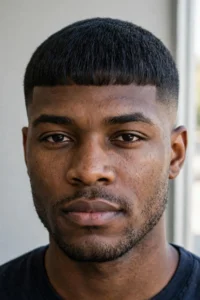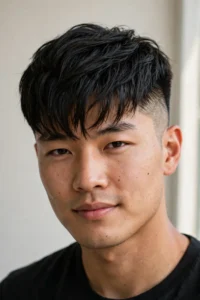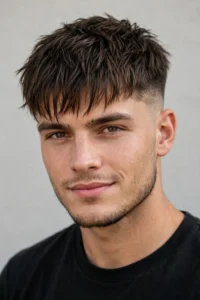


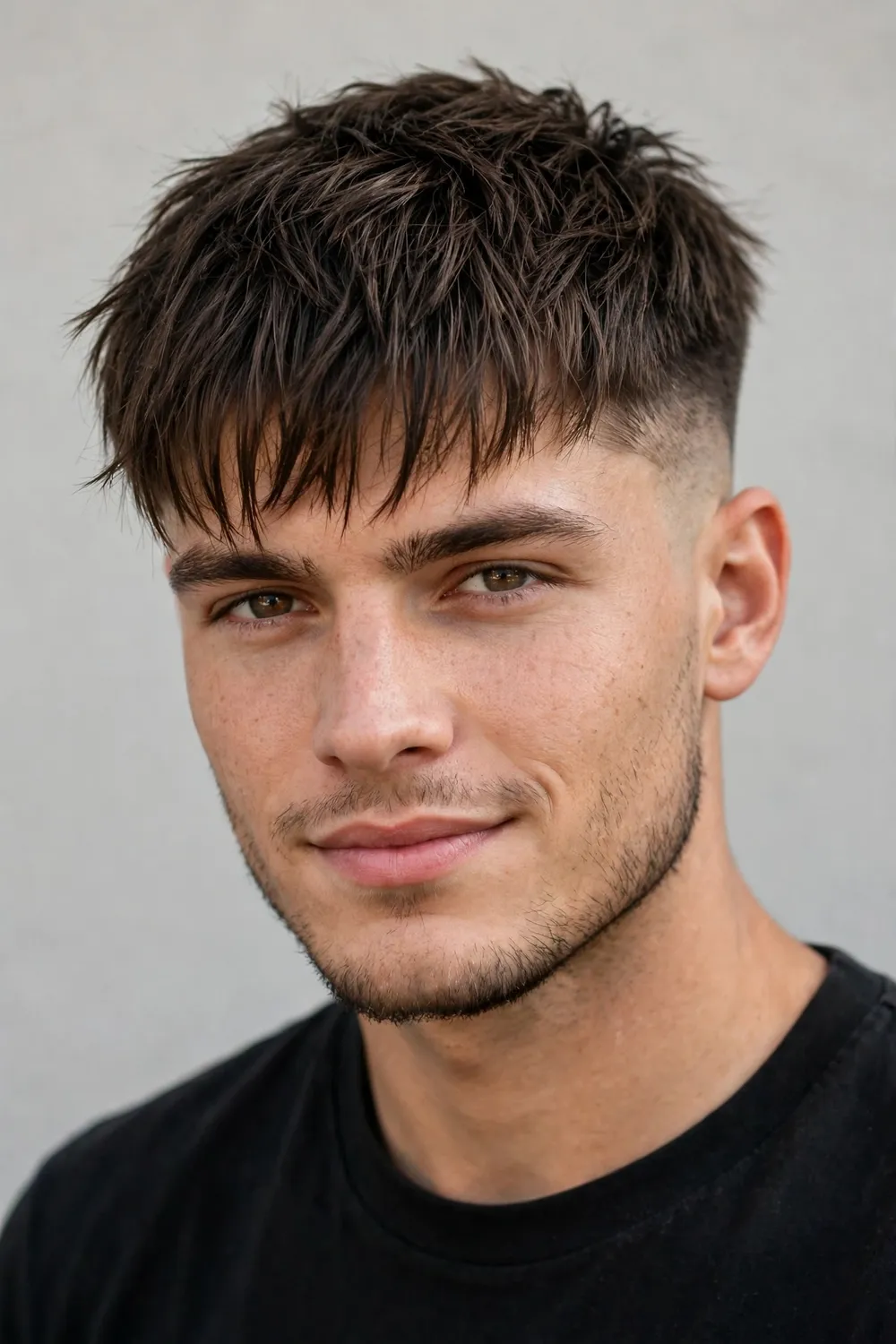
A fringe haircut is simply a men’s cut where the front hair is left long enough to fall over the forehead — and it’s quietly the defining feature behind almost every modern style you see today. If you only try three, make them the Textured Crop for everyday wear, the Side-Swept for something sharper, and the Curtain for the most face-framing look of the three.
1. Classic Straight Fringe
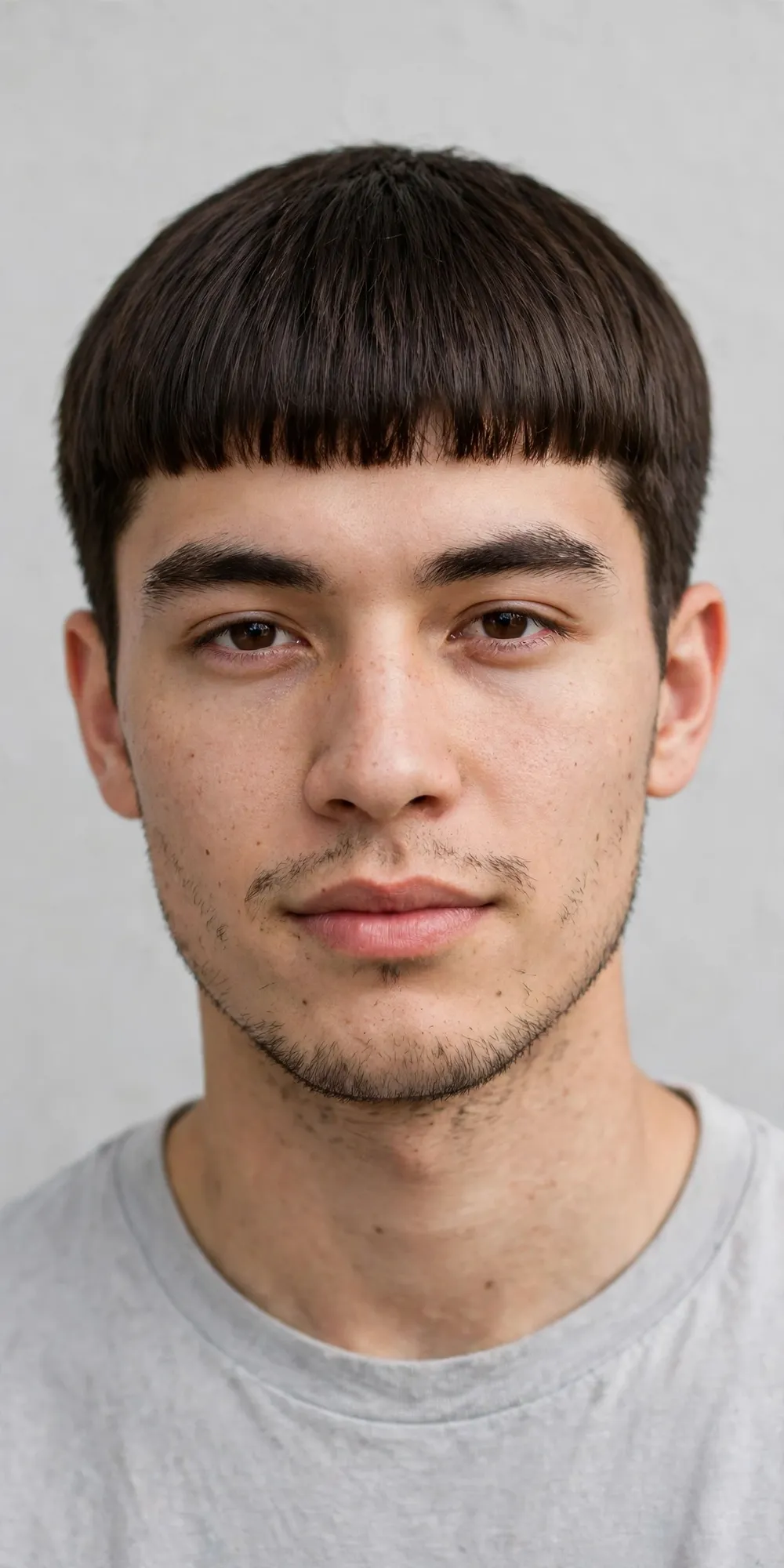
The classic straight fringe is the one everything else is measured against: hair cut in an even line across the forehead, usually sitting right at brow level, with no layering games and no diagonal tricks. It suits straight to slightly wavy hair best, and works on oval, square and oblong faces — round faces should ask for it a touch shorter so it doesn’t close the face down. Ask your barber for “a straight-across fringe at brow length, blunt cut, sides scissor-cut or a low taper.” Style it by blow-drying straight down with a vent brush, then a pea-sized amount of light pomade for a clean, natural finish. Honest maintenance: it needs a trim every three to four weeks, because once the line grows past your brows it stops looking classic and starts looking accidental.
2. Side-Swept Fringe

The side-swept fringe angles the front hair diagonally across the forehead, and it’s the safest fringe in this whole list — professional enough for an office, relaxed enough for a weekend. It flatters nearly every face shape, but it’s a genuine gift for round faces, because the diagonal line breaks up the width and adds the illusion of length. Ask your barber for “a side-swept fringe, cut on the diagonal, longer on one side, with a mid taper on the sides.” Blow-dry it toward your chosen side with a round brush, finish with a matte paste, and it’ll hold its shape all day. Maintenance is light — a tidy-up every four weeks — but you’ll need a quick morning routine, since the sweep collapses flat if you just let it air-dry.
3. Textured Crop Fringe
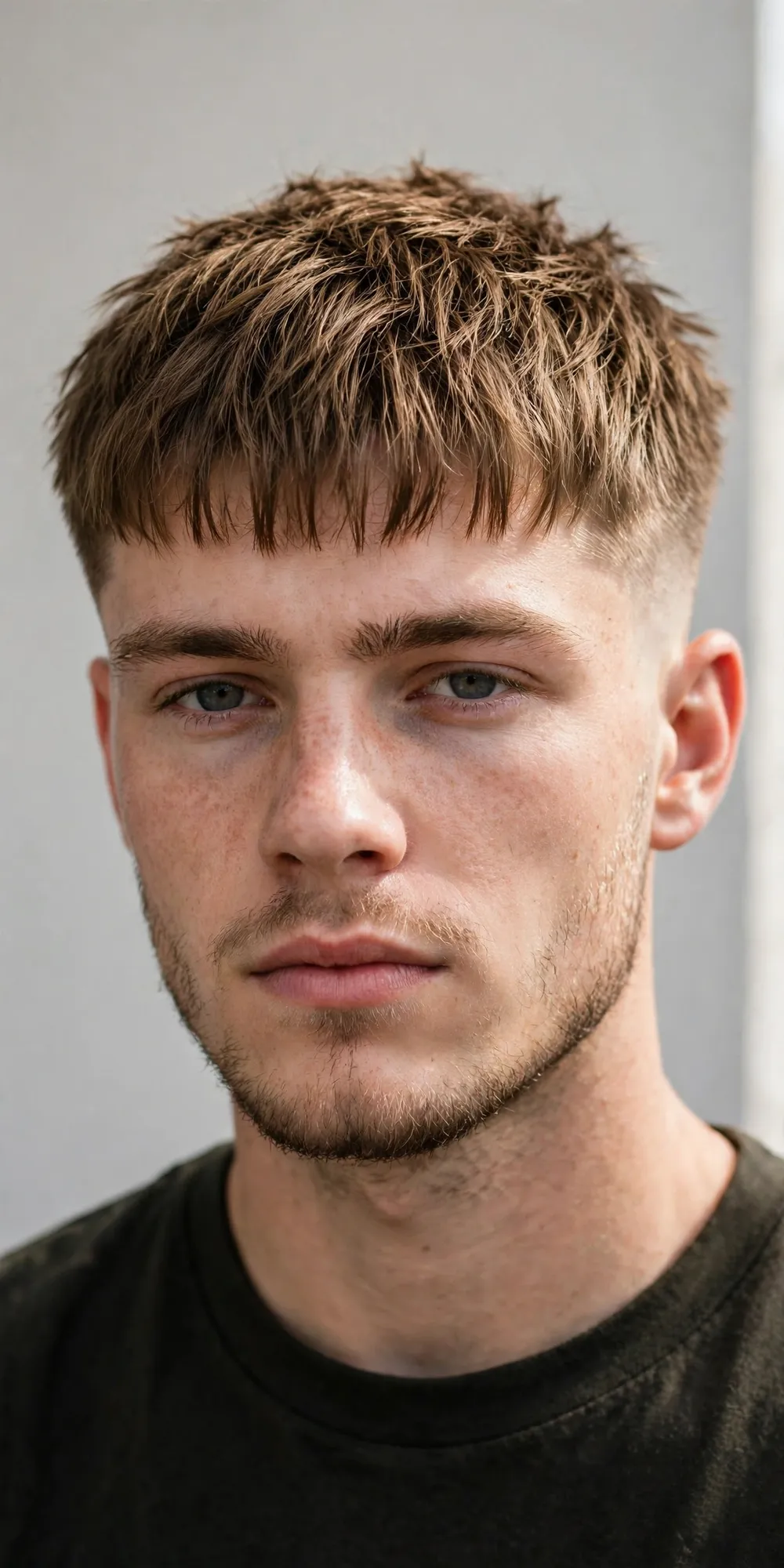
If one fringe defined 2026, it’s this one. The textured crop takes a short fringe and chops into it with point-cutting, creating visible separation and movement instead of a solid wall of hair. It suits thick hair beautifully, since the texture removes bulk, and it works on oval, square and heart-shaped faces. Fine-haired guys can wear it too, but ask for less thinning so it doesn’t go wispy. Tell your barber: “a textured crop, fringe point-cut for separation, mid skin fade on the sides.” Styling takes about a minute — sea salt spray, rough-dry with your fingers, a pinch of matte clay. Maintenance is genuinely easy: trims every four weeks, and it actually looks better slightly grown out.
4. Messy Fringe

The messy fringe looks like you didn’t try — and that’s the whole point, though the irony is that the cut itself is deliberate. Uneven lengths are cut through the front so the hair falls in different directions, giving you a lived-in, effortless finish that never looks stiff. Round faces should keep the sides tighter to avoid extra width. Ask your barber for “a messy fringe, choppy point-cut, uneven lengths through the front, textured sides.” Style it with nothing more than sea salt spray and your fingers — seriously, a comb will undo the whole look. Maintenance is about as low as fringes get: it hides growth well, so you can stretch trims to five weeks, though the sides will need tidying sooner.
5. Caesar Fringe
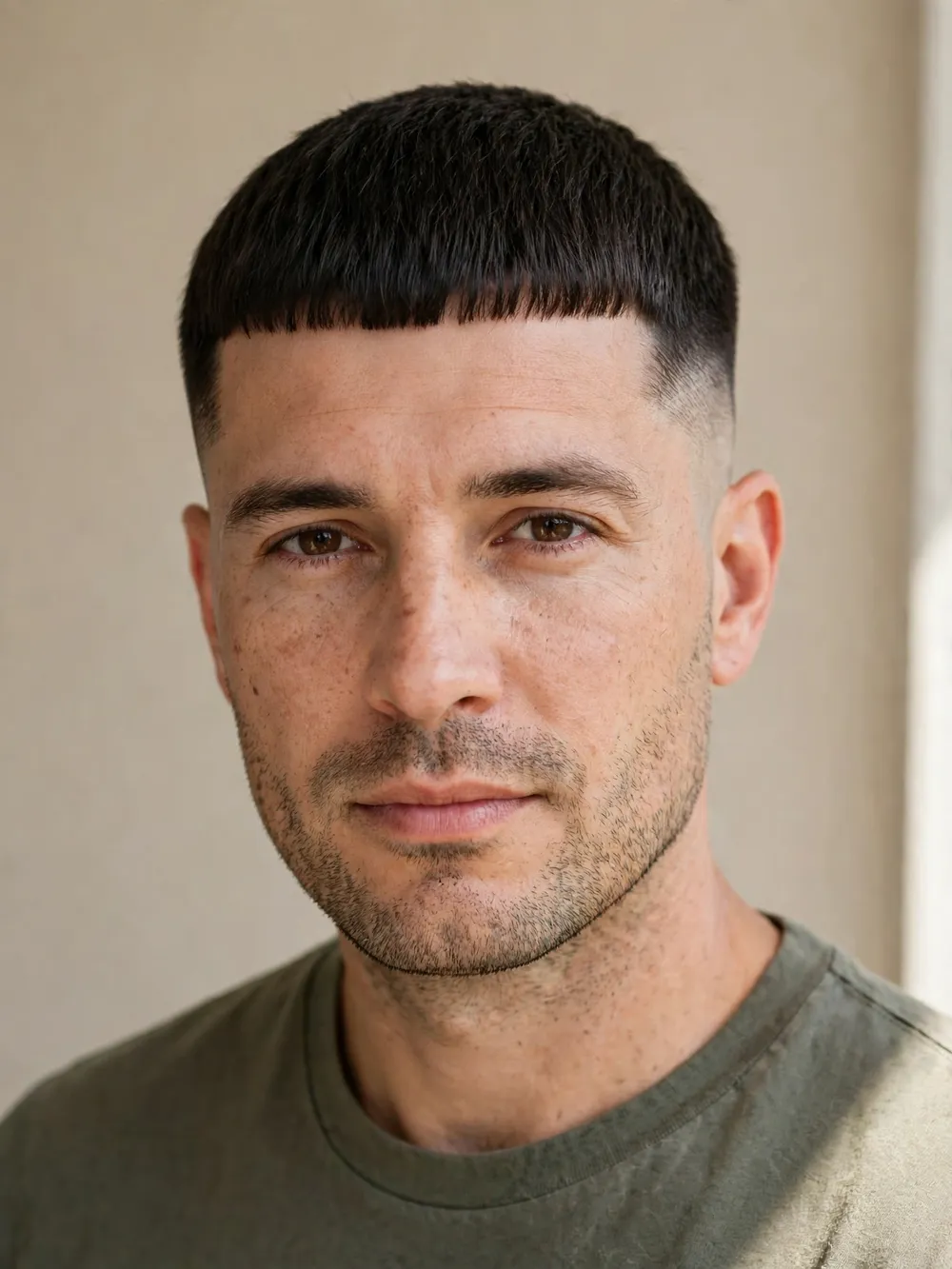
Named after the Roman emperor and barely changed in two thousand years, the Caesar is a short, even fringe with a clean hairline — no layers, no texture games, just a straight, short cut that sits close to the forehead. It suits oval, square and oblong faces and works best on straight hair, though fine hair holds the shape well too. Ask your barber for “a Caesar — short fringe, straight across, tight taper on the sides, clean hairline.” Styling is optional: a dab of matte paste if you want, nothing if you don’t. Maintenance is a trim every three weeks to keep the line crisp, but there’s no daily styling to worry about, which is the Caesar’s real selling point.
6. French Crop Fringe
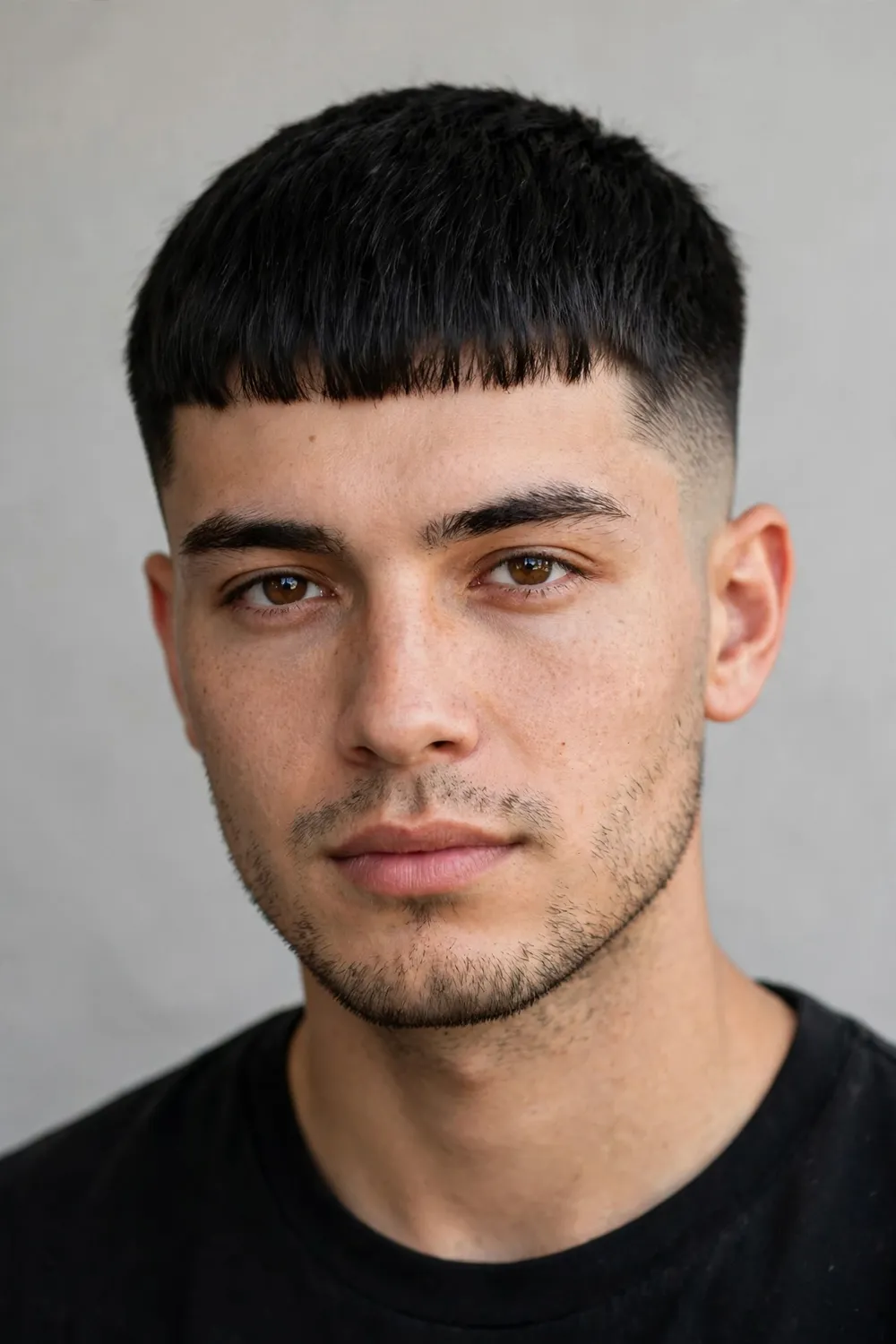
The French crop is the Caesar’s sharper, more modern cousin: a short forward fringe with a blunt edge, paired with faded sides that give the whole cut a clean, architectural shape. It suits straight and wavy hair, and it’s a particularly good choice for oval and square faces; guys with round faces should ask for a slightly higher fade to add height. Tell your barber: “a French crop, blunt fringe just above the brows, mid or high fade on the sides.” Style it forward with a small amount of matte clay — no blow-drying required. Maintenance is simple: a trim every three to four weeks keeps the blunt edge and the fade sharp, and on lazy mornings you can genuinely skip styling altogether.
7. Blunt Fringe
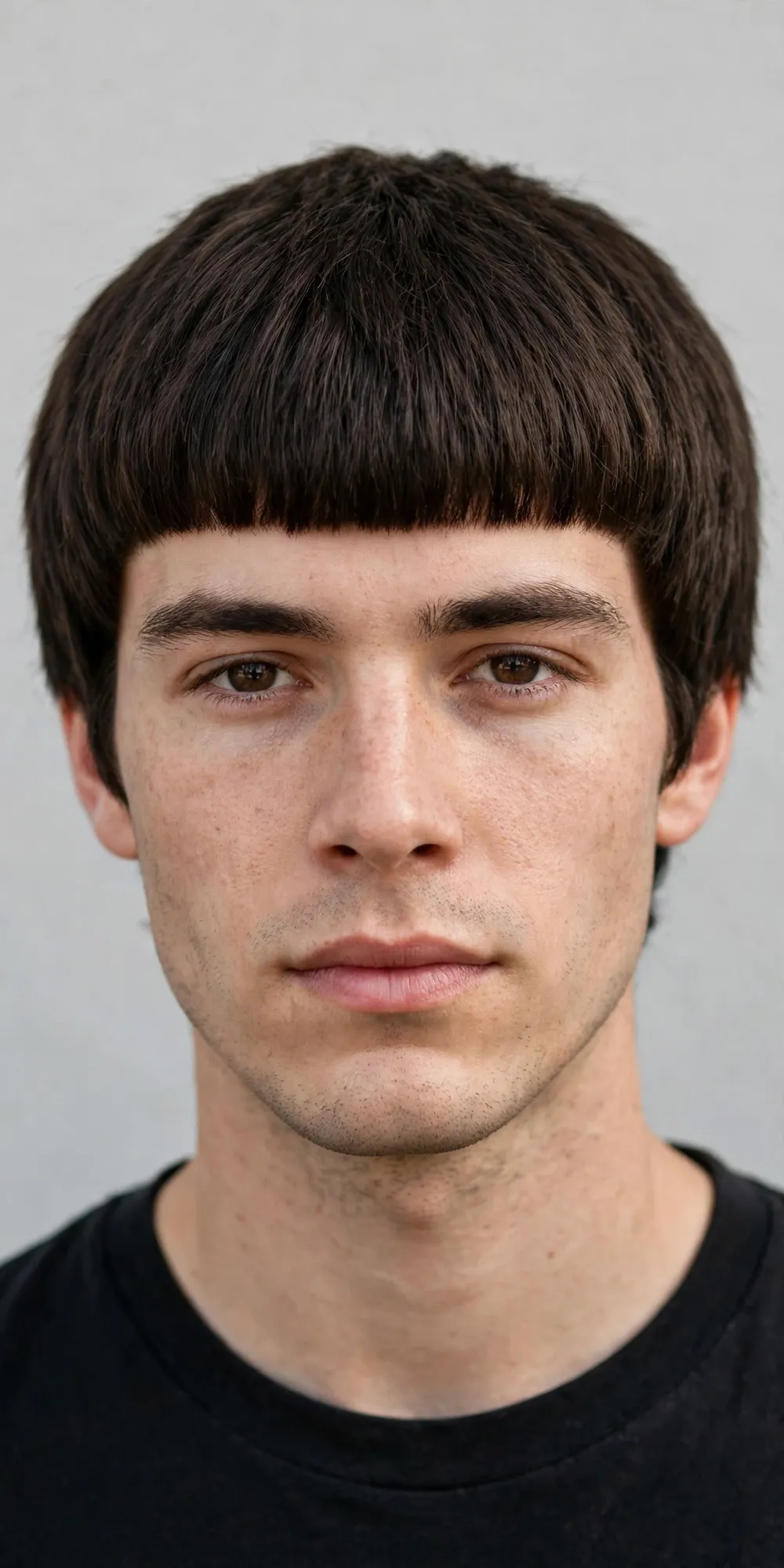
A blunt fringe is a statement: heavy hair cut in one clean, straight line across the forehead at brow level, with no thinning and no softening. It’s bold and graphic, and it works best on thick, straight hair that can hold the weight — fine hair tends to separate and lose the line. Ask your barber for “a blunt fringe, straight across at brow level, no texturising, sides kept longer and scissor-cut.” Style it by blow-drying straight down with a flat brush and finishing with a light pomade for a smooth, polished edge. Honest maintenance: this is a high-commitment fringe — the line shows growth fast, so expect a trim every three weeks, and it needs that morning blow-dry to look right.
8. Short Crop Fringe
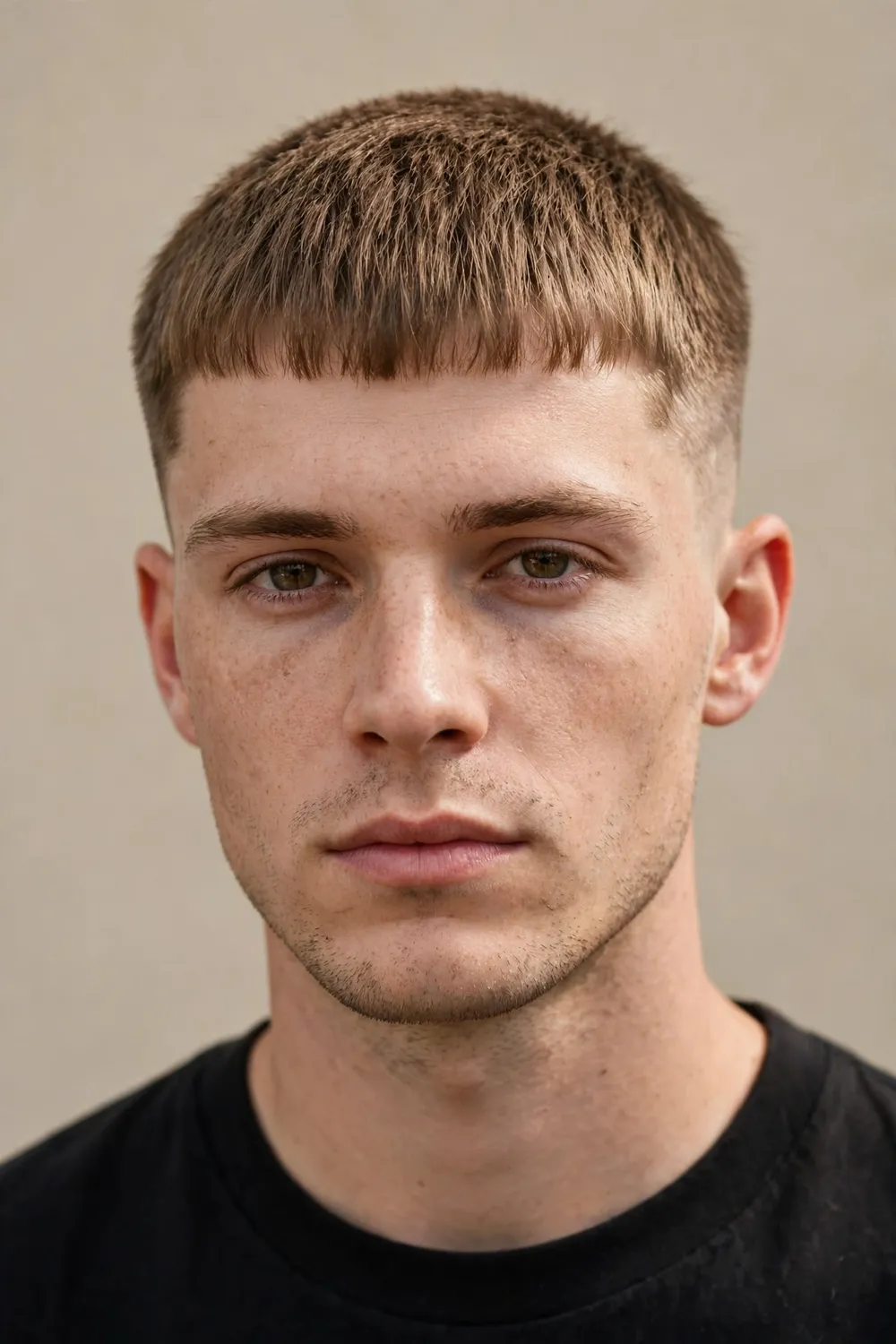
The short crop fringe is the shortest fringe worth having: the front hair is cut to just past the hairline, barely a fringe at all, but that little bit of length forward is what separates it from a plain buzz. It’s clean, quick and almost impossible to mess up, which makes it ideal for guys who want the fringe look without any styling routine. Ask your barber for “a short crop fringe, just past the hairline, with a taper or low fade on the sides.” Styling takes seconds — a tiny amount of matte paste pushed forward, or nothing at all. Maintenance is a trim every three weeks to keep it from creeping into a longer crop, but day to day, this is the easiest fringe you’ll ever own.
9. Angular Fringe
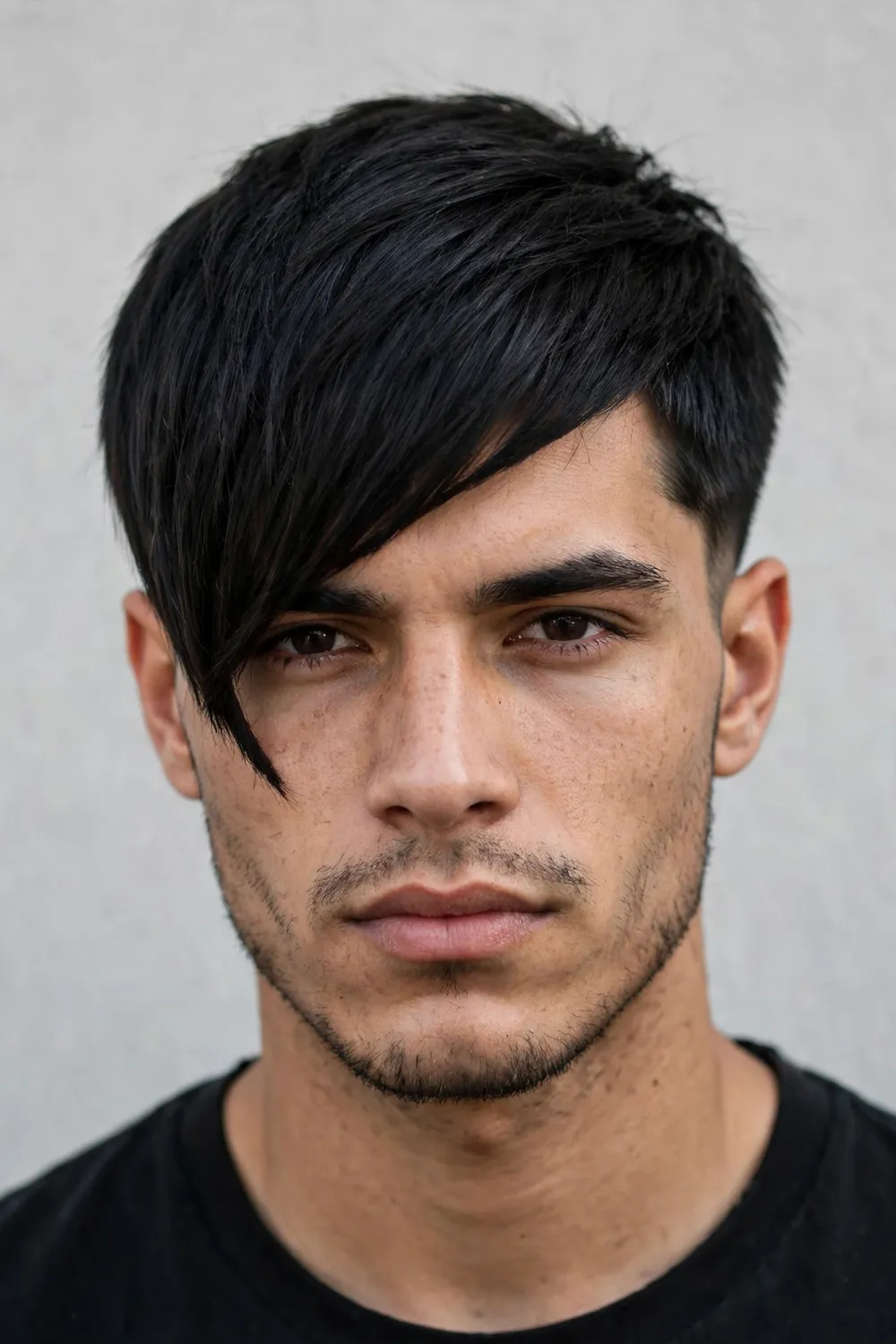
The angular fringe is cut on a sharp diagonal, with one side noticeably longer than the other, creating a strong geometric edge across the forehead. It’s a confident, slightly edgy look that pairs brilliantly with strong jawlines and square faces — the diagonal actually complements angular features instead of fighting them. Straight hair shows the angle best; wavy hair softens it into something more relaxed. Tell your barber: “an angular fringe, cut on a sharp diagonal, longer on the left side” — pick your side in advance. Style it by blow-drying along the angle with a vent brush and a little matte paste. Maintenance is moderate: the angle needs a trim every three to four weeks to stay sharp, and it does need that two-minute morning style.
10. Choppy Fringe

The choppy fringe sits somewhere between the textured crop and the messy fringe: uneven, piece-y ends with plenty of texture, but with enough structure that it reads as a deliberate style rather than bedhead. It’s the fringe for guys who want movement without committing to the full messy look. Fine hair can work if the barber keeps the chopping light. Ask your barber for “a choppy fringe, point-cut ends, lots of separation through the front, textured sides.” Styling is a minute’s work: sea salt spray, finger-dry, a touch of texture paste to define the pieces. Maintenance is forgiving — it grows out gracefully, so four to five weeks between trims is realistic, and a bad hair day just looks like part of the style.
11. Wispy Fringe
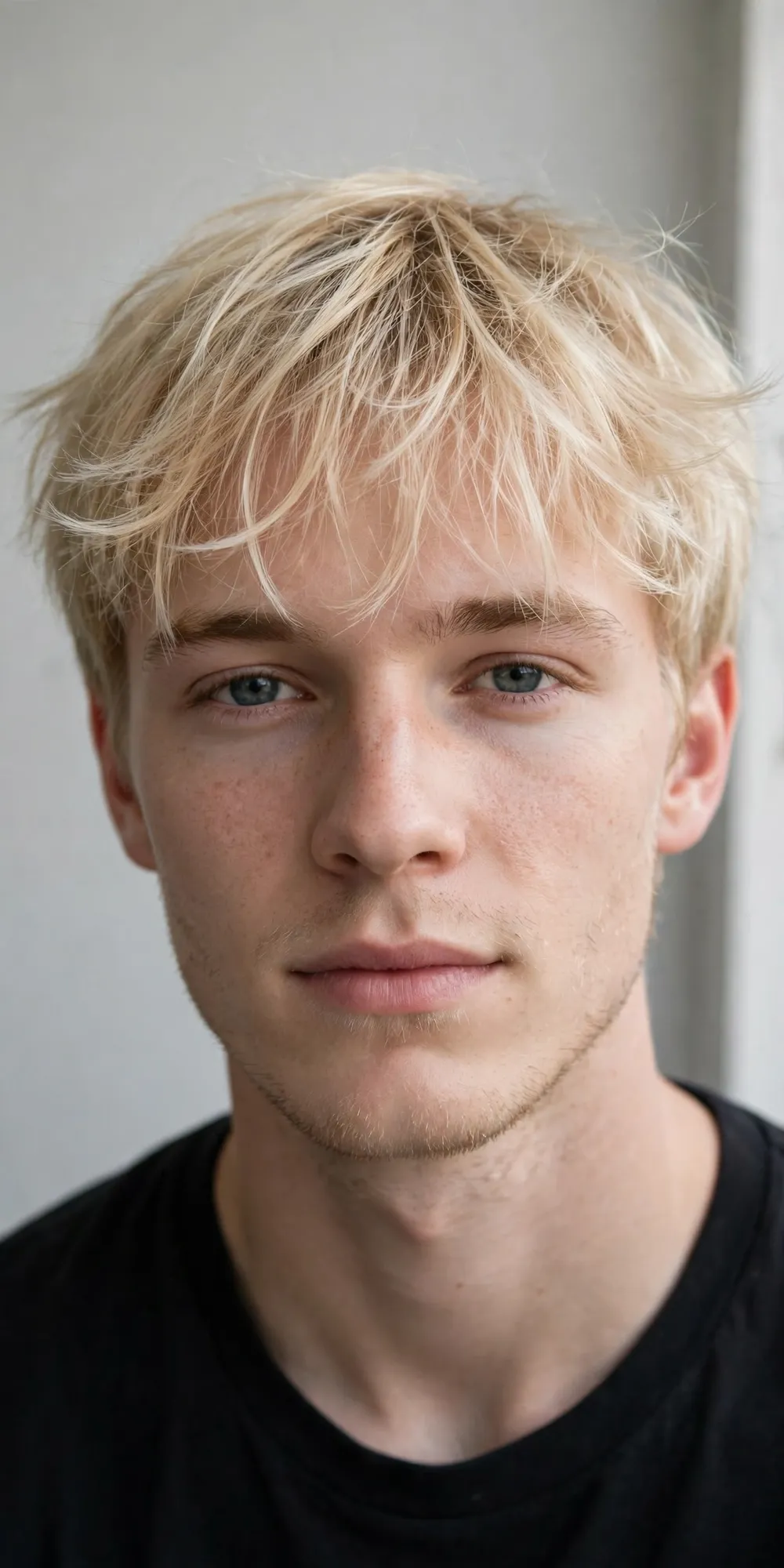
A wispy fringe is all lightness: thin, feathered ends that fall softly over the forehead without ever looking heavy or solid. It’s the gentlest fringe in this list, and it’s a great choice for guys with fine hair, since it works with the hair’s natural texture instead of fighting it. Ask your barber for “a wispy fringe, feathered ends, lightly thinned, kept soft at the edges.” Style it with a light styling cream — heavy products will weigh it down and kill the airiness — and let it fall naturally. Honest maintenance: it’s easy day to day, but the wispy ends lose their shape as they grow, so a trim every three to four weeks keeps it looking intentional rather than just overgrown.
12. Asymmetrical Fringe
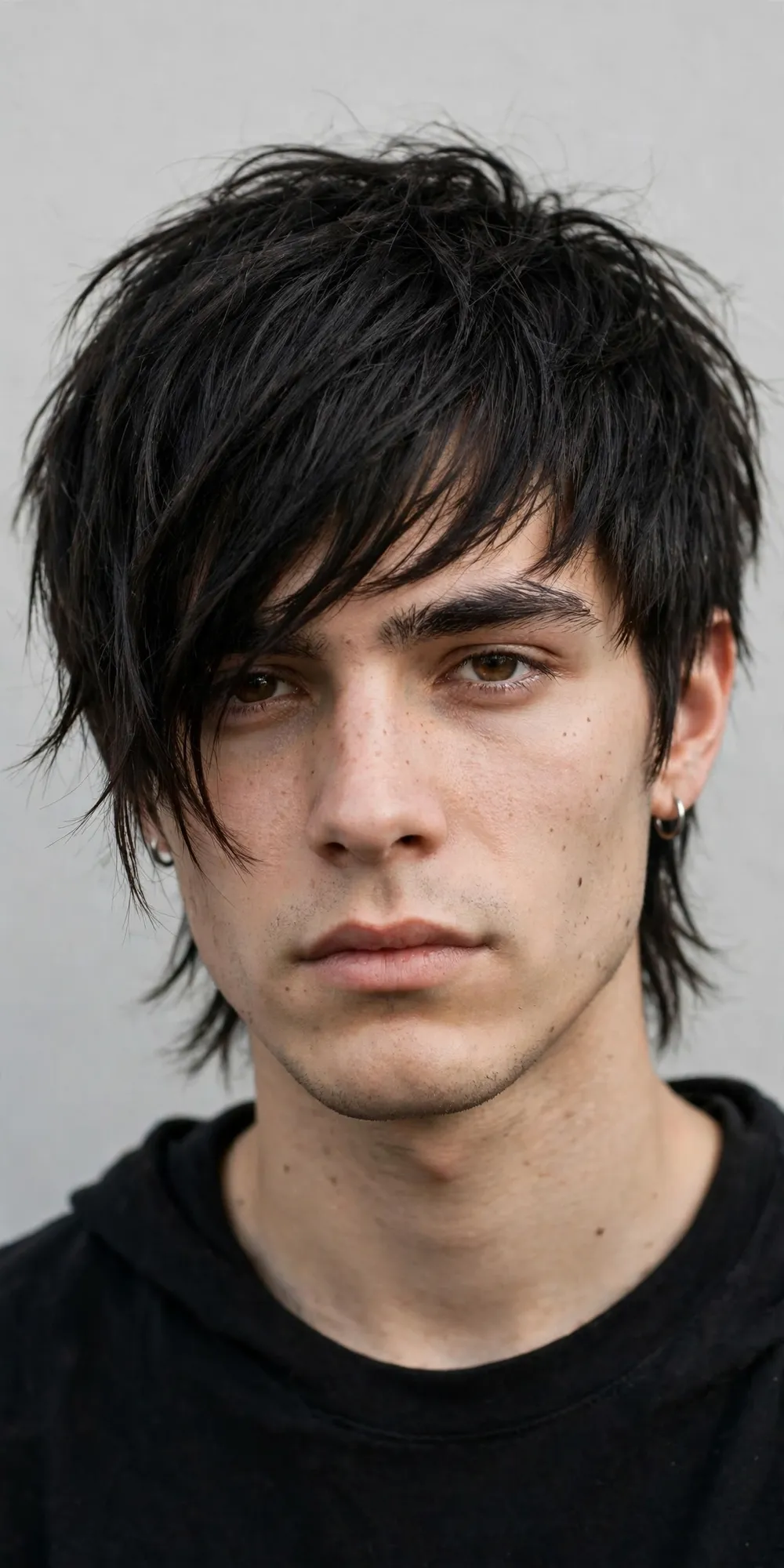
The asymmetrical fringe deliberately breaks the rules: one side is cut clearly longer than the other, giving you an off-balance, fashion-forward look with real attitude. It suits oval and oblong faces particularly well, and it works on straight hair, where the length difference reads clearly, or wavy hair, where it softens into something more organic. Ask your barber for “an asymmetrical fringe, left side noticeably longer, cut with a clean edge.” Style it by blow-drying the longer side forward and across, finishing with matte paste. Maintenance is a touch higher than average: the asymmetry needs a trim every three weeks to stay deliberate, and if you let it grow out evenly, the whole point of the cut disappears.
13. Curtain Fringe
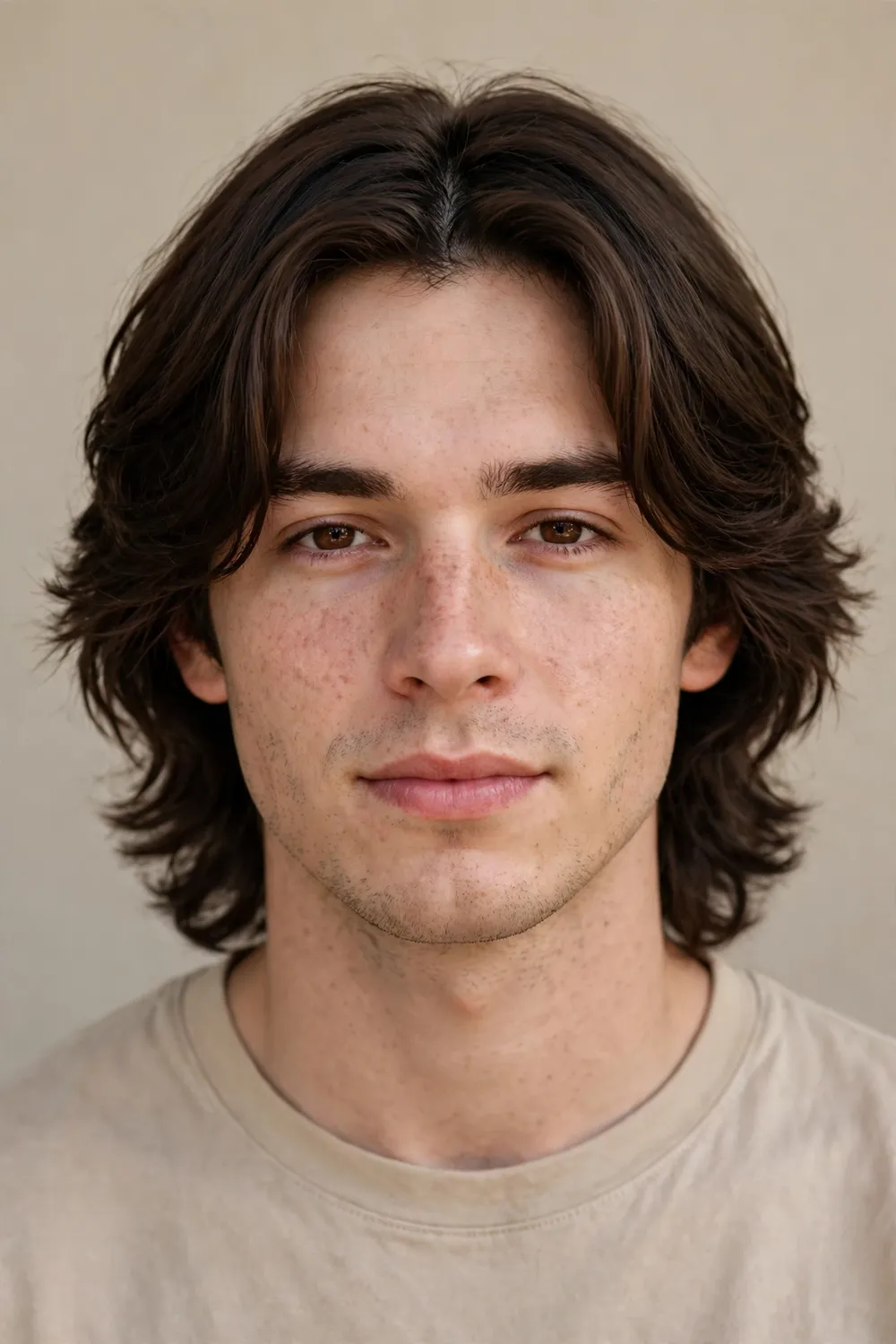
The curtain fringe is parted in the centre and falls to both sides of the face, framing it symmetrically like — well, curtains. It suits oval, square and oblong faces beautifully, and it’s a strong option for round faces too, since the vertical lines slim the face. You need medium-length hair on top, straight or wavy, to make it work — it’s not a short cut. Tell your barber: “a curtain fringe, centre part, longer at the front, layers to frame the face, sides kept longer.” Style it by blow-drying each side away from the part with a round brush, then a light cream. Maintenance is moderate: trims every four to five weeks, and it needs a couple of minutes each morning to set the part.
14. Micro Fringe
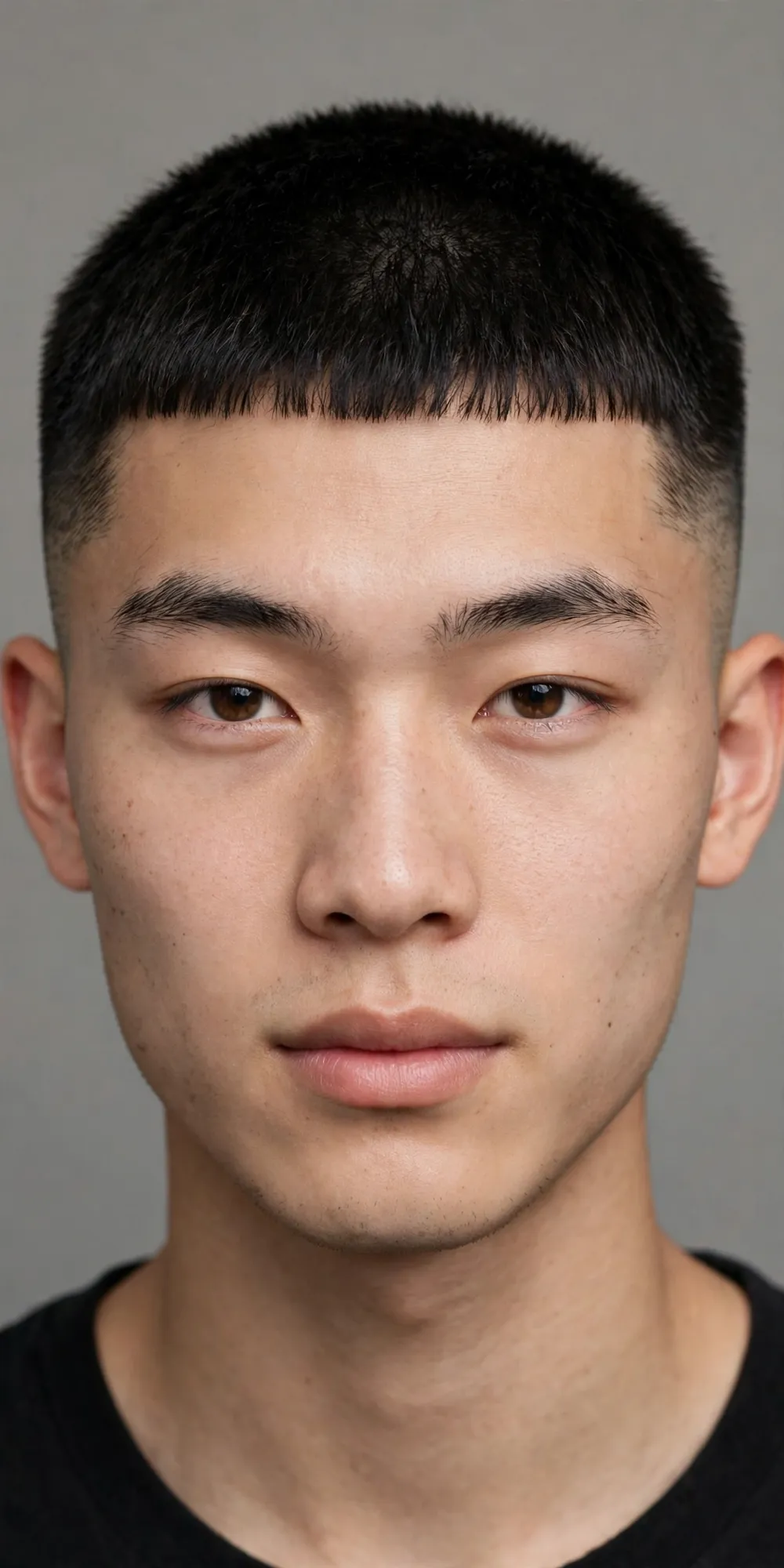
The micro fringe sits high on the forehead — well above the brows — and it’s the boldest fringe on this list. It works best on oval and square faces with strong features, and on straight hair that can hold a clean, short line. It’s also surprisingly practical — there’s almost nothing to style. Ask your barber for “a micro fringe, cut high on the forehead, straight across, with a clean taper on the sides.” Styling is optional: a dab of matte paste if you want texture, nothing if you don’t. Maintenance is minimal day to day, but the length is so precise that you’ll want a trim every two to three weeks — a few millimetres of growth changes the whole look.
15. Long Swept Fringe

The long swept fringe is drama done properly: the front hair is left long — well past the brows — and swept across the forehead in a soft, flowing line. It flatters oval and oblong faces especially, since the length adds balance, and it can soften a strong jawline nicely. Ask your barber for “a long swept fringe, kept past the brows, layered lightly so it moves, sides scissor-cut and longer.” Style it by blow-drying across the forehead with a round brush and finishing with a light pomade for hold without stiffness. Honest maintenance: this is one of the higher-maintenance fringes — it needs a few minutes every morning, and in wind or humidity it’ll need a quick fix, so keep a small amount of product in your pocket.
16. Fringe with Mid Fade
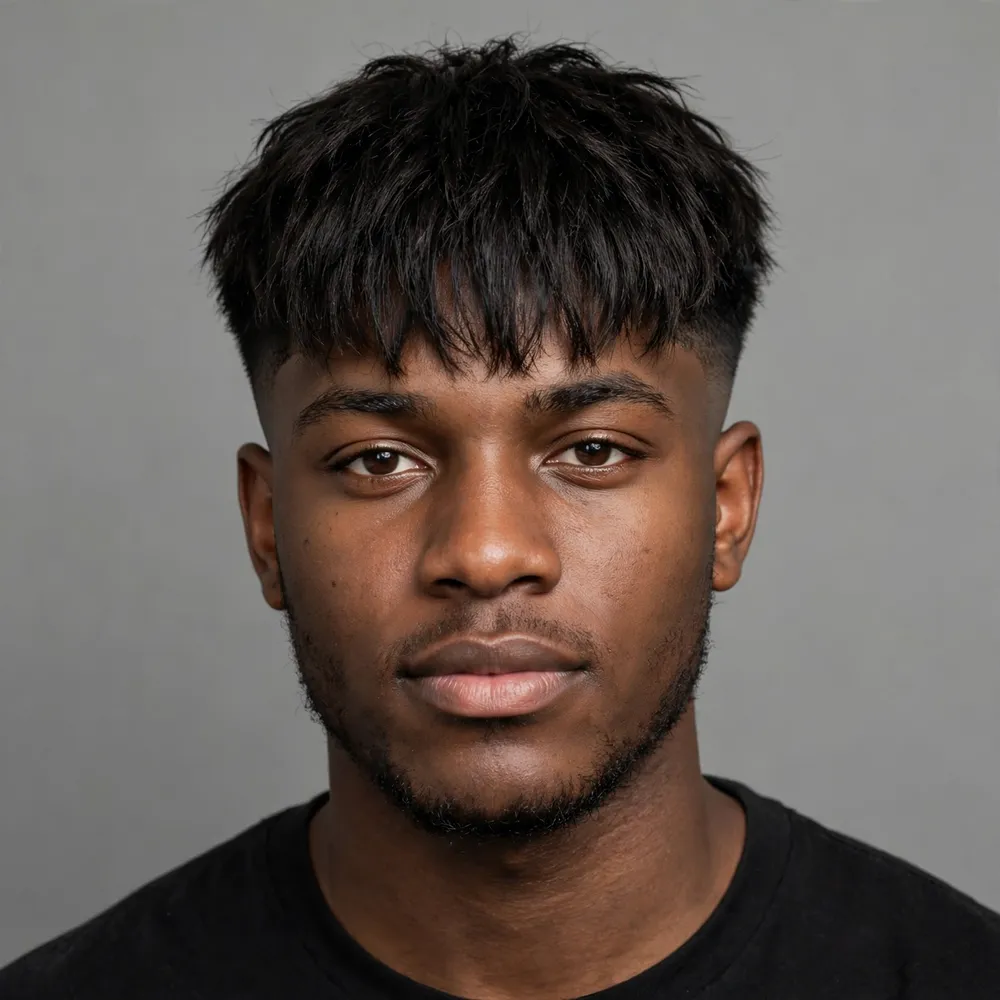
Pairing a fringe with a mid fade is the balanced choice: the fade starts halfway up the sides, giving you clean, sharp edges without the severity of a high fade. It suits every face shape, and it’s a particularly good option for guys who want a fade but find high fades too aggressive for work. Ask your barber for “a fringe on top” — specify which one — “with a mid fade on the sides and back, blended cleanly.” Styling depends on the fringe you choose, but the fade itself needs nothing. Maintenance is the trade-off: fades grow out visibly, so you’ll want a tidy-up every two to three weeks to keep the gradient crisp, even if the fringe itself could go longer.
17. Fringe with Taper Fade
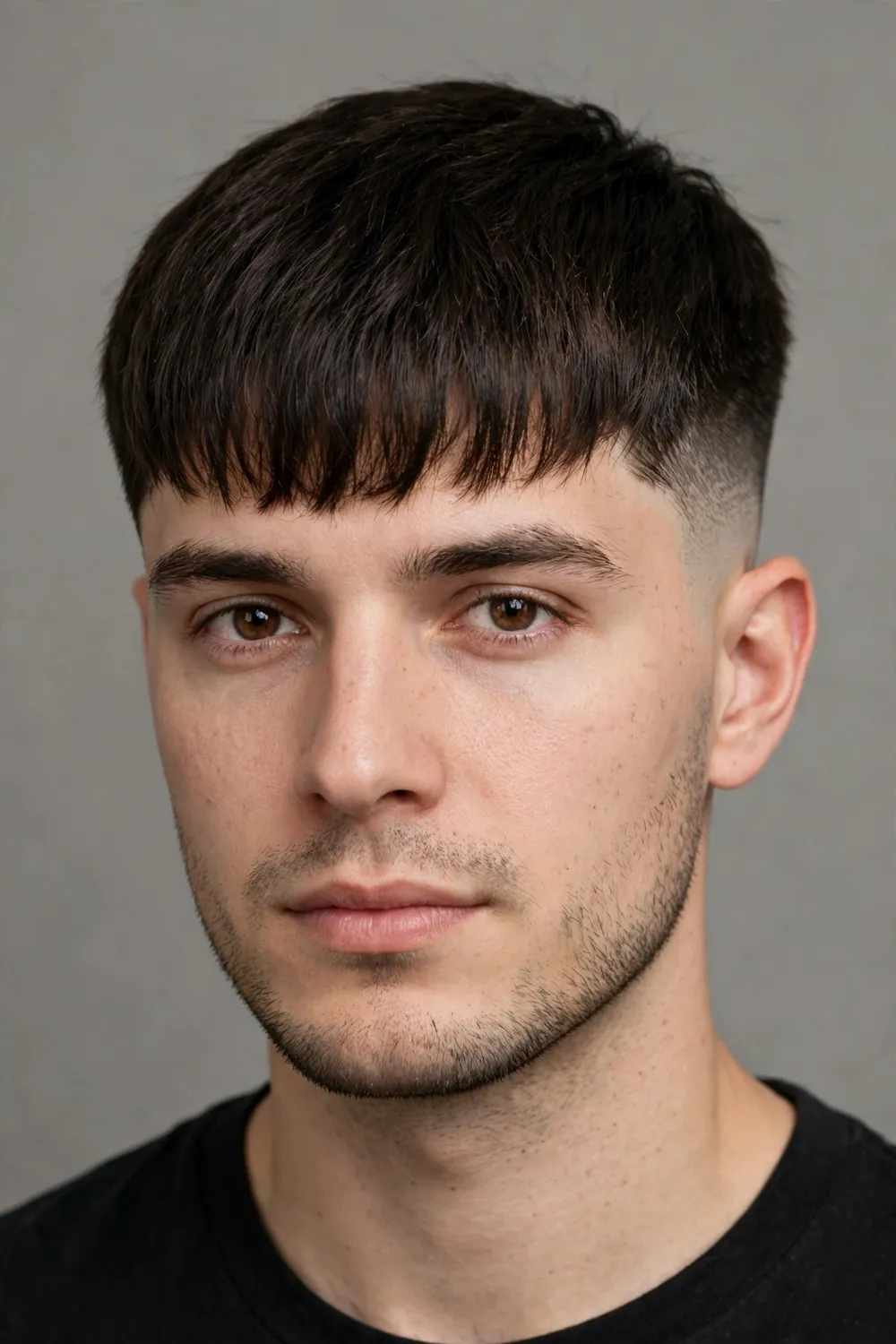
The taper fade is the quietest fade of the lot — a gradual shortening from the top down to the sideburns, with no skin showing — and paired with a fringe, it’s the cleanest, most versatile combination in this entire list. It suits every face shape and every hair type, which is why barbers recommend it as the default when a guy isn’t sure what he wants. Tell your barber: “a fringe on top with a taper fade — gradual, no skin, neat around the ears and neckline.” Styling is whatever your fringe needs; the taper itself asks nothing of you. Maintenance is gentle for a fade: the gradient hides growth better than a skin fade, so three to four weeks between visits is realistic, and the whole cut ages gracefully.
18. Fringe with Undercut
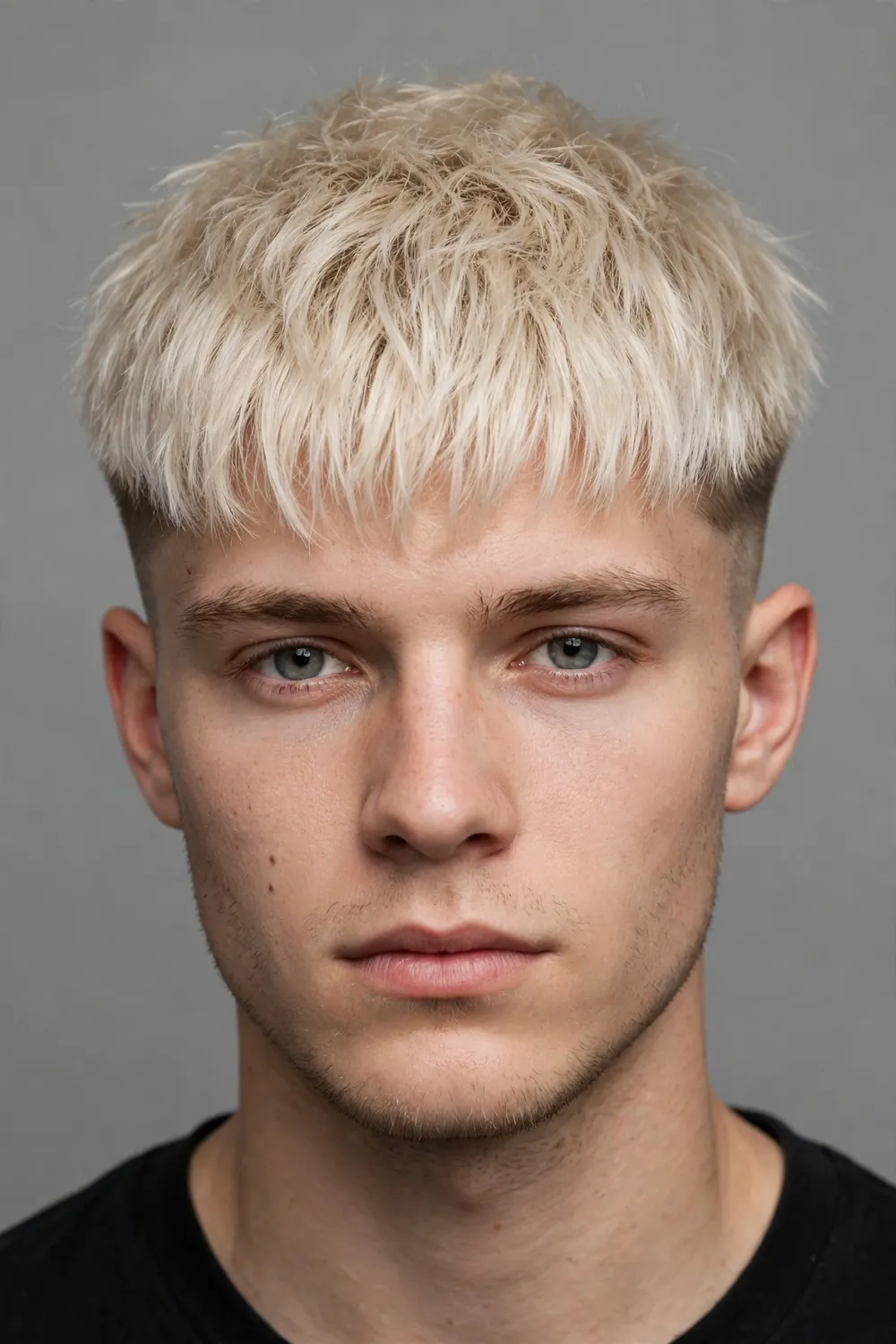
The undercut takes the fringe-and-fade idea to its extreme: the sides and back are cut to one short, uniform length with no blending at all, while the fringe on top stays long and full. The result is maximum contrast — a sharp, disconnected shape that looks bold from every angle. Ask your barber for “a fringe on top with a disconnected undercut — short all over the sides, no fade, sharp line where it meets the top.” Style the fringe forward with matte clay, and keep the sides neat with nothing more than a daily comb-through. Maintenance is a trade-off: the undercut grows out unevenly, so expect a tidy-up every two to three weeks to keep that hard line intact.
19. Fringe with Low Fade
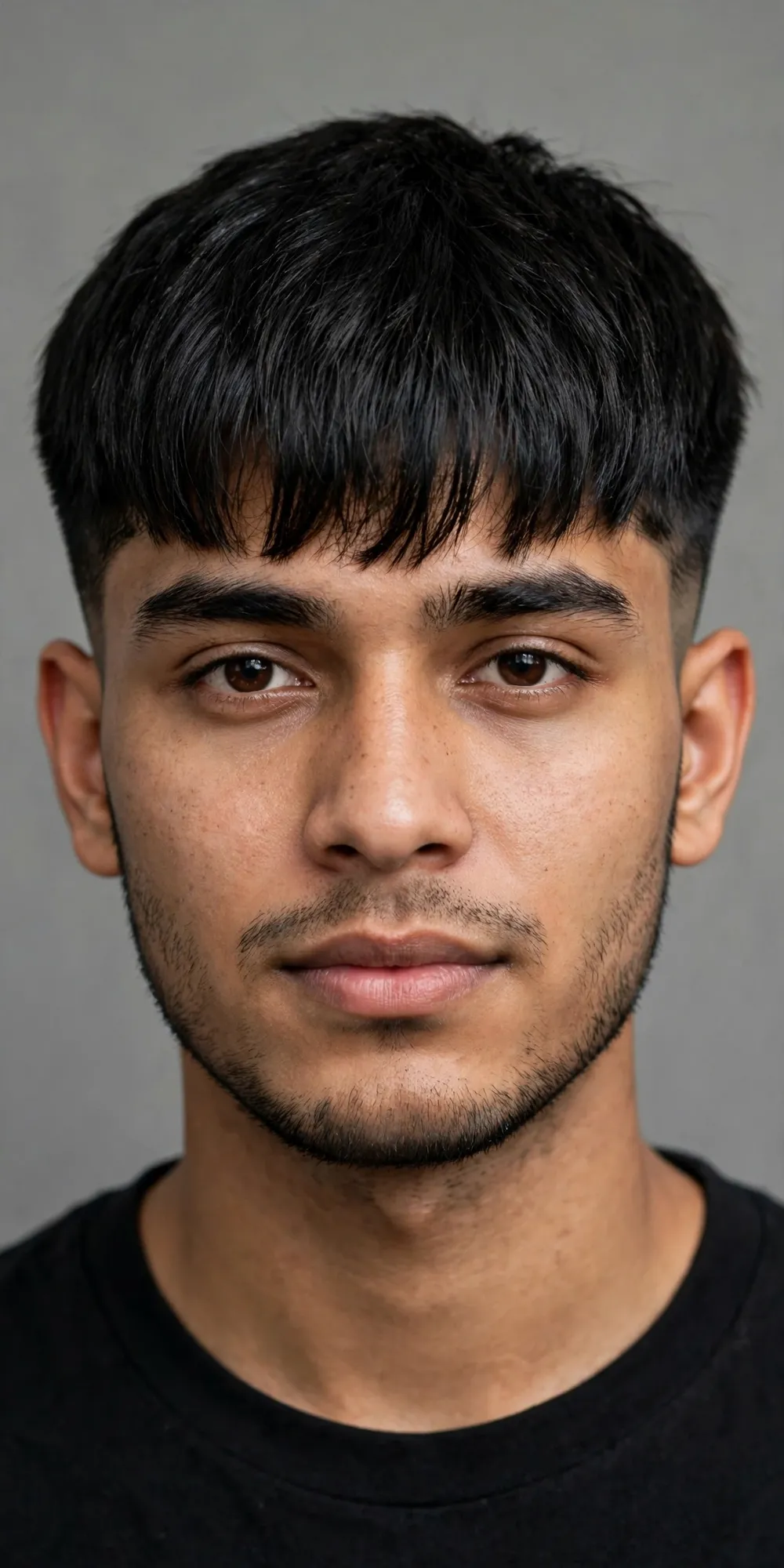
The low fade is the subtlest fade you can pair with a fringe: the gradient sits just above the ear and the neckline, leaving most of the sides full and natural. It’s the right choice if you like the clean feeling of a fade but want to keep as much hair as possible, or if your workplace frowns on anything too sharp. Ask your barber for “a fringe on top with a low fade, starting just above the ear.” Styling follows your fringe of choice. Maintenance is the easiest of all the fades — the low gradient hides growth well, so you can comfortably go four weeks between trims without it looking scruffy.
20. Curly Fringe

The curly fringe lets your natural curls do the styling: the front hair is left long enough for the curls to fall forward over the forehead, creating a fringe that’s all texture and movement. It suits oval, square and heart-shaped faces — the key is cutting it dry, so the barber can see where each curl actually lands. Ask your barber for “a curly fringe, cut dry, curls left forward, sides tapered to balance the volume.” Style it with curl cream on damp hair and let it air-dry — a diffuser if you’re in a hurry. Maintenance is honest: it needs a trim every four weeks to stop the curls getting heavy, and you’ll want to avoid brushing it dry, which turns curls into frizz.
21. Wavy Fringe

If your hair has a natural bend, don’t fight it — a wavy fringe lets the wave do the styling. The fringe is left at brow length and falls forward, and the wave gives it movement straight hair can’t fake. It suits oval and heart-shaped faces best, and works on medium to thick hair with a natural wave; pin-straight hair will fight you every morning. Ask your barber for brow length, point-cut ends, and sides slightly longer than a fade. A pea-sized amount of sea salt spray on damp hair, scrunched forward and left to air dry, is the whole routine. On humid days the wave can go bigger than planned, so trim every four weeks to keep the length in check.
22. Fringe for Thick Hair
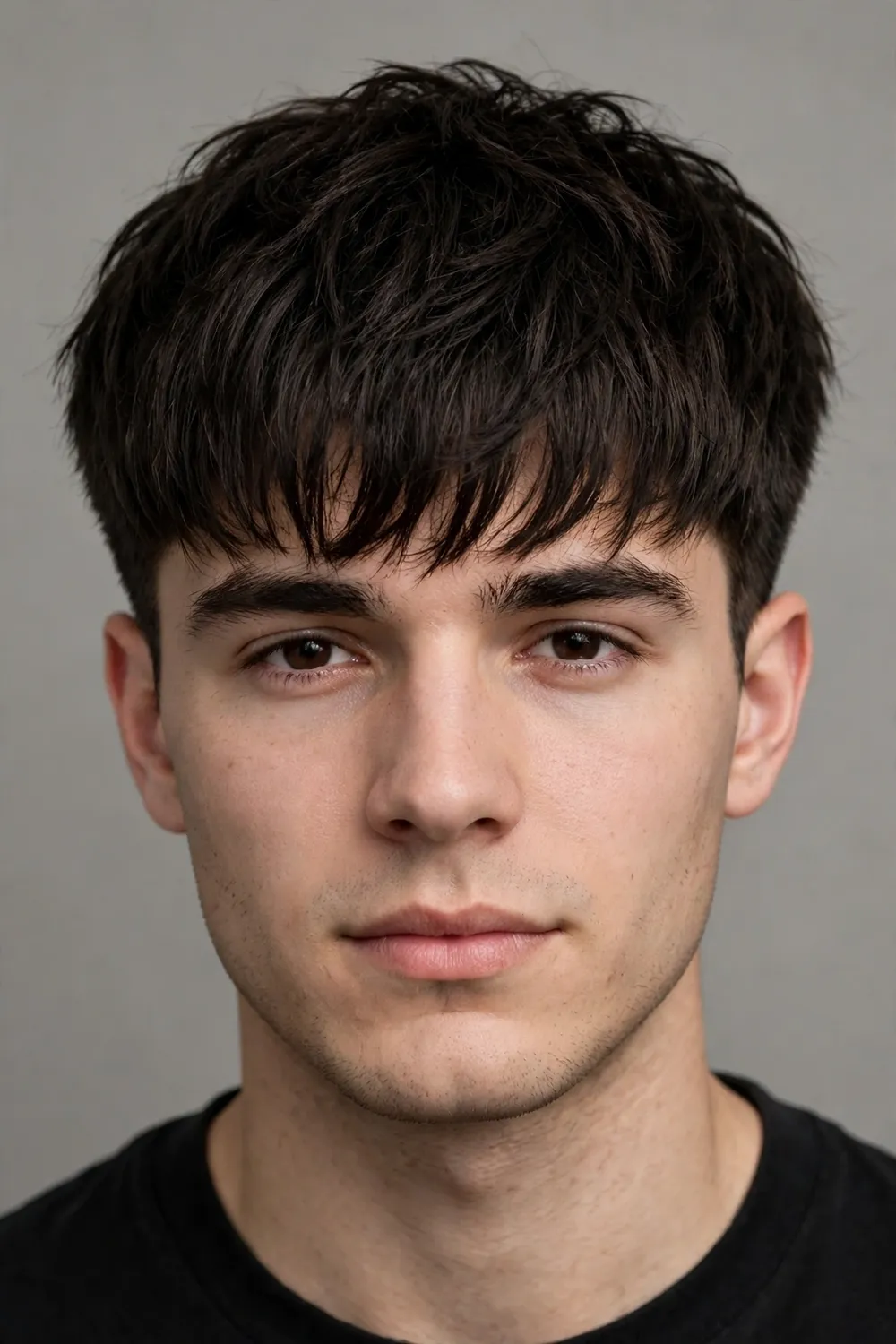
Thick hair and fringes can be a bad combination if the fringe is cut like a curtain — heavy, solid, and sitting on your forehead like a shelf. The fix is thinning, and lots of it. Your barber should thin the bulk with shears and cut layers in, so it moves instead of holding one rigid shape. This suits square and oval faces, and any man whose hairdresser has ever called his hair “a lot”. Ask for the fringe thinned from underneath, layered through the top, and kept at brow length. A matte clay worked through dry hair gives hold without shine and stops the fringe from puffing up. Thick hair grows fast, so you’ll need a thinning pass every four to five weeks, or the shelf comes back.
23. Fringe for Fine Hair
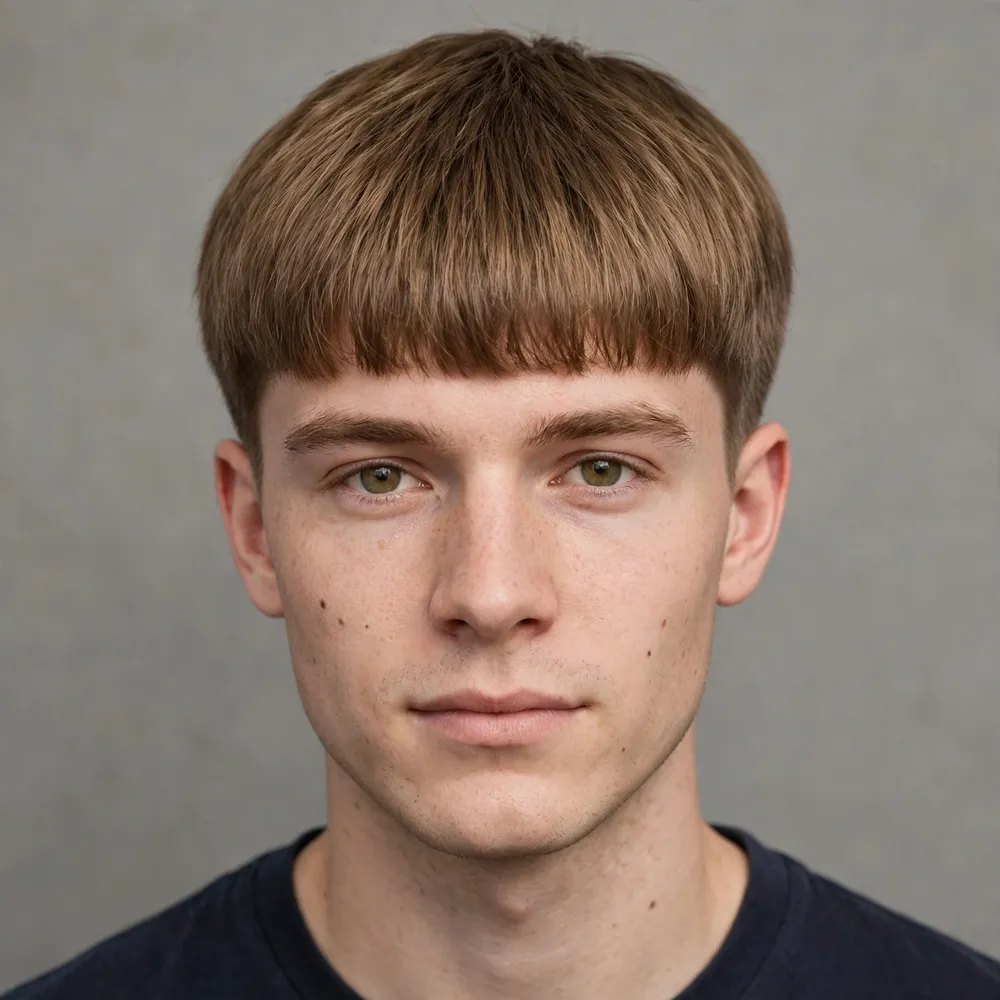
Fine hair needs the opposite treatment to thick hair — here, weight is your friend. A blunt edge across the forehead makes fine hair look thicker than it is, because the solid line creates the illusion of density. Tell your barber not to thin it at all: just a clean blunt cut at brow level with a little point-cutting on the ends. It suits round and oval faces and fine, straight hair; fine curly hair will fight the blunt line and frizz at the ends. A pinch of volumising powder or a little light paste gives lift — heavy waxes and oils will flatten it in an hour. Wash it regularly — fine hair shows grease fast — and trim every three to four weeks.
24. Layered Fringe
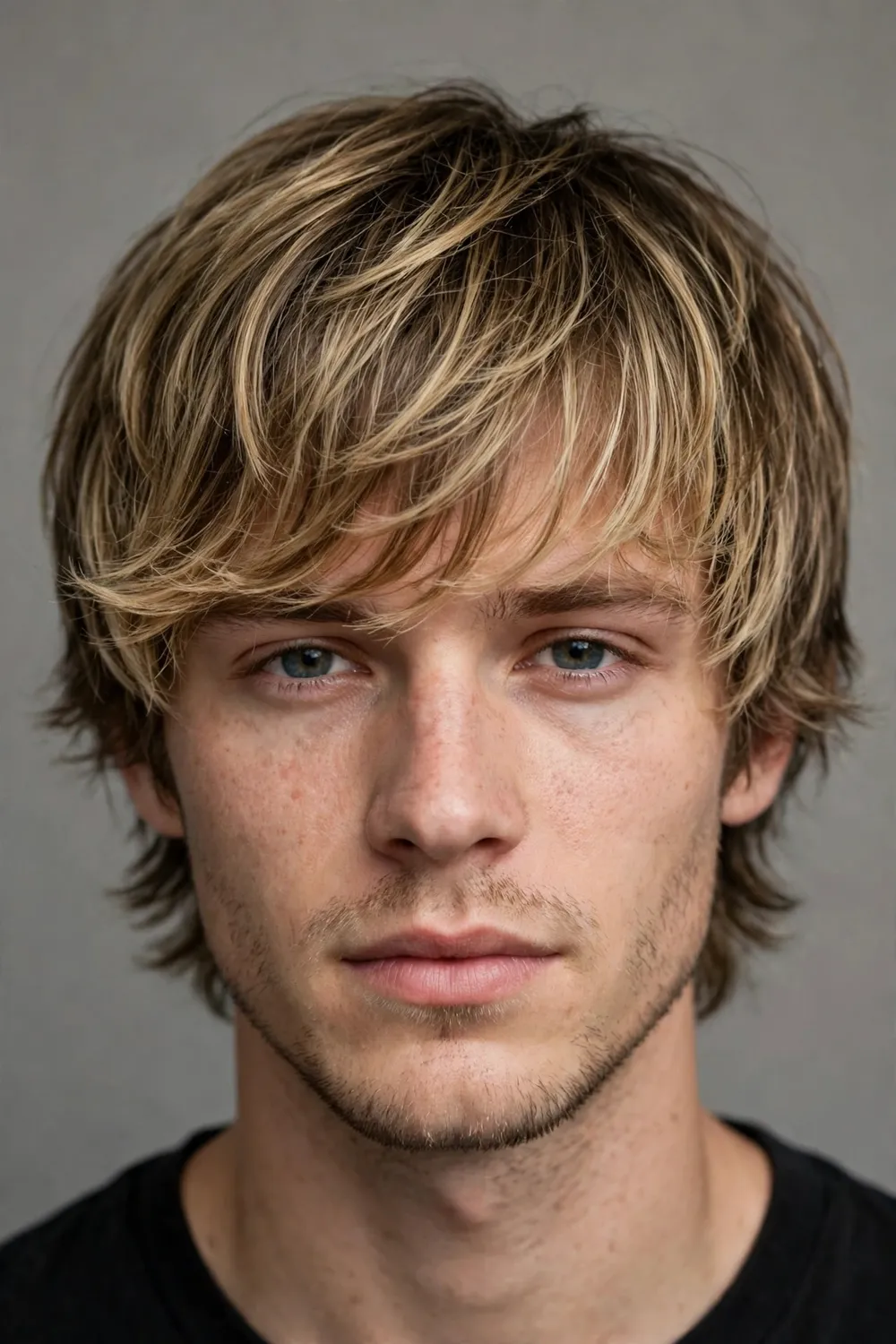
Instead of one length, your barber cuts layers through it — shorter at the crown, longer at the front — for the most movement of any fringe here. It suits long and oval faces, because the layers break up the face’s length, and works on medium to thick hair; very fine hair can look stringy if the layers are cut too aggressively. Ask for layers running short at the back to longer at the front, with point-cut ends. A little texture paste, worked through with your fingers and pushed forward, is all it needs. Our guide to Textured Haircuts for Men covers building texture into the rest of the cut. The downside: layered fringes grow out unevenly, so trim every three weeks.
25. Tousled Fringe

The tousled fringe is the two-minute fringe. It looks like you woke up, ran your fingers through your hair, and walked out — except it was cut that way on purpose. The fringe is point-cut to uneven lengths, and the styling is deliberately rough: no comb, no parting, just fingers and product. It suits almost every face shape, and works best on medium hair with some natural texture; very straight hair can look like you didn’t bother, so ask for extra point-cutting. Ask for an uneven, point-cut fringe at brow length with textured ends. Rub a fingertip of matte clay between your palms, push the fringe forward, and pinch a few pieces apart. It looks better slightly grown out, so trims can stretch to five weeks. Over-style it and you’ve lost the point.
26. Fringe with Quiff
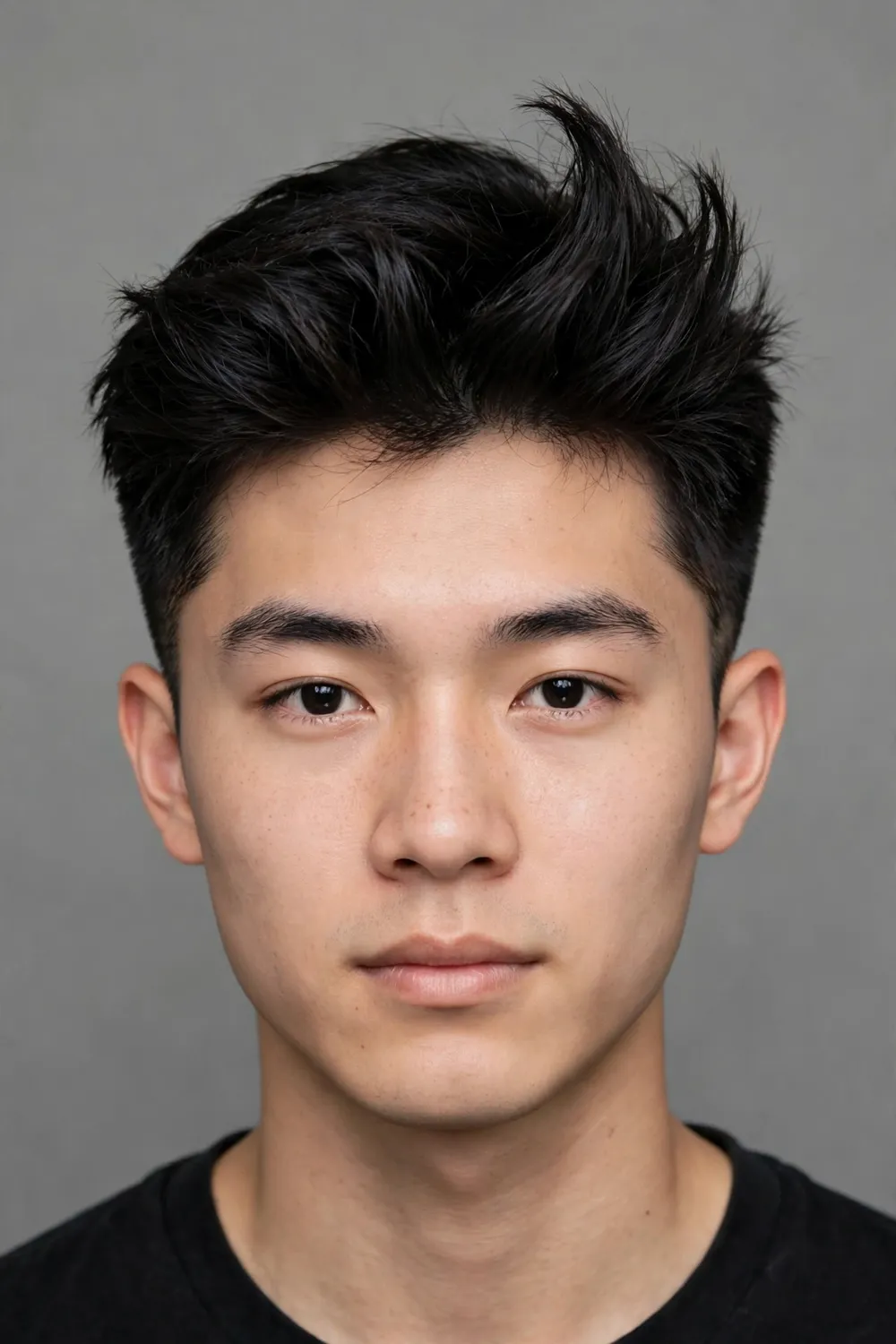
A fringe with a quiff gives you height at the front and a forward edge that frames your face. The front lifts up and back while the rest falls forward, so you get volume instead of a flat curtain across your forehead. It suits round faces, because the height lengthens the face, and needs medium to thick hair strong enough to hold a lift — fine hair collapses by lunchtime. Ask your barber to keep the front long, take the sides short with a taper or low fade, and leave enough length to push up. Styling takes five minutes and a blow dryer: dry the front up with your fingers, then work a matte clay through and push it up and to one side. On lazy mornings you’ll push it forward like a regular fringe, which still works.
27. Disconnected Fringe
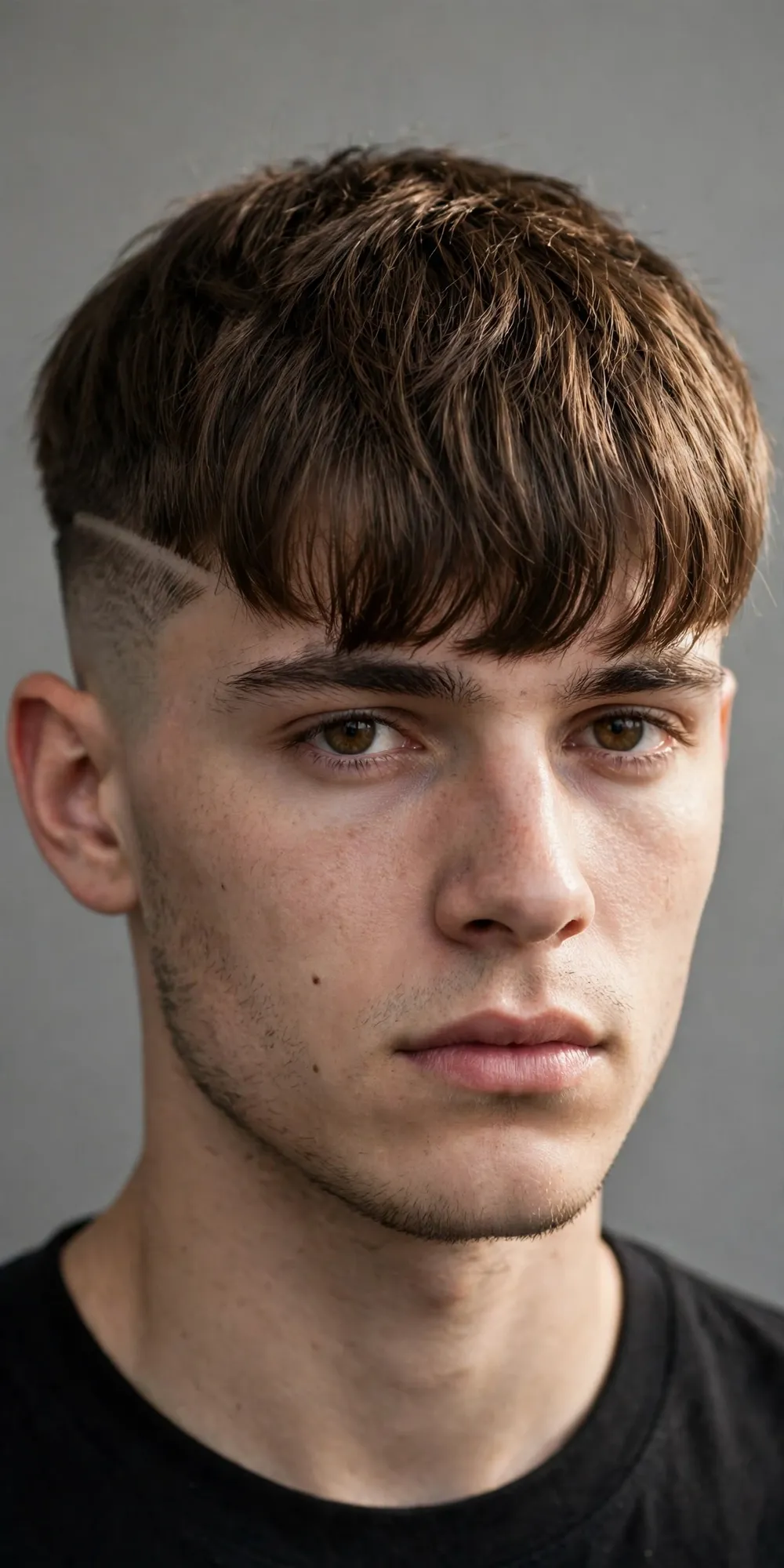
The disconnected fringe is a statement cut, and it doesn’t pretend otherwise. There’s a hard line where the long fringe meets the short sides — no blending, no fade, just sharp, deliberate contrast. It suits oval and square faces and straight hair; wavy or curly hair softens the disconnect and the effect is lost. Ask for a hard part, a heavy fringe kept long at the front, and sides clipped short with no taper into the top. A light pomade gives shine, matte clay a drier finish — either way, keep the fringe pushed forward so the line stays visible. The catch is upkeep: the contrast only works while the sides are short, so you’ll need a touch-up every two to three weeks. While it’s fresh, nothing else on this list looks as sharp.
28. Bowl Cut Fringe
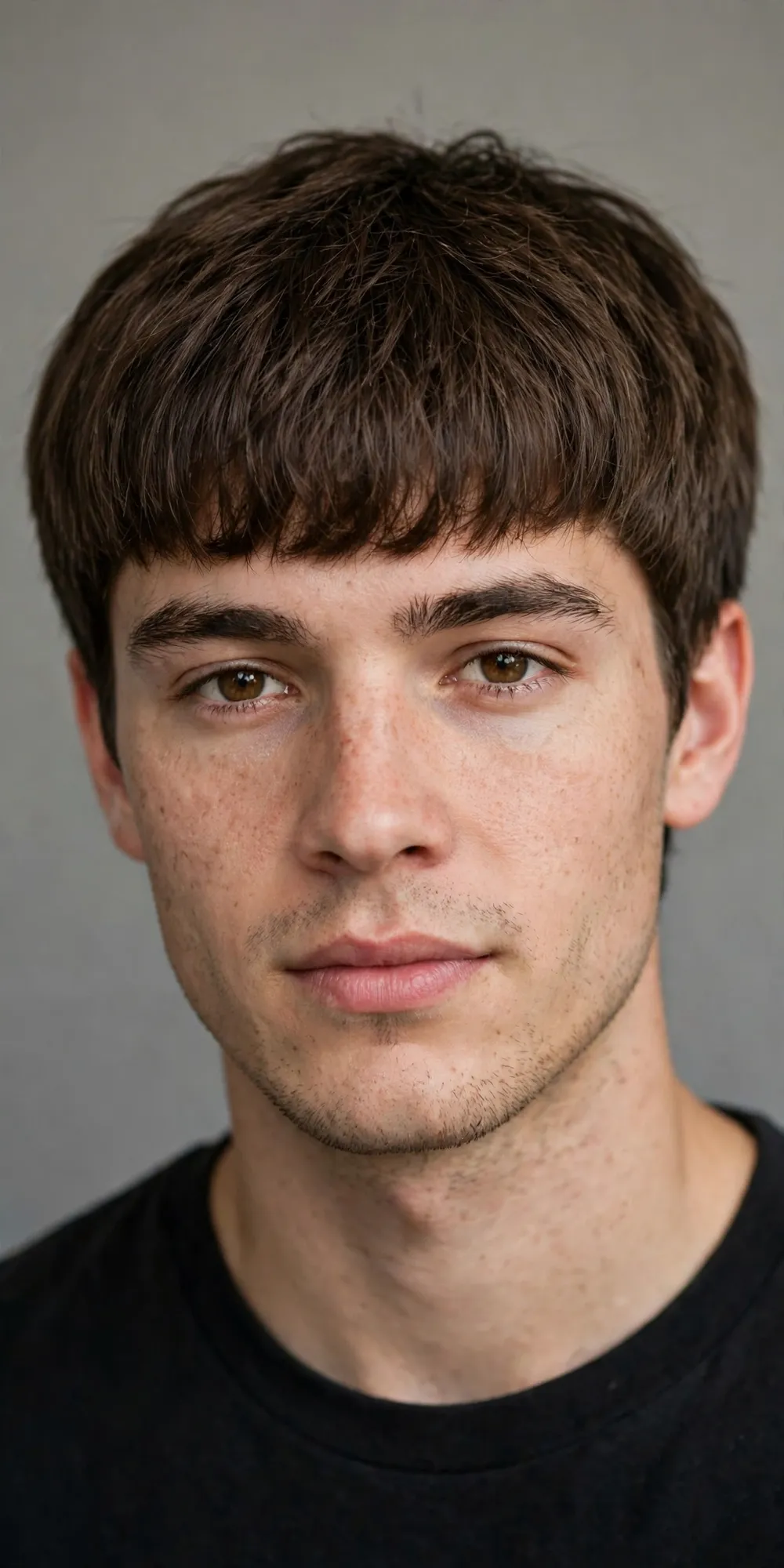
Forget the bowl cut you had as a kid — the modern version is rounded, textured, and a long way from the nineties disaster. The fringe runs in a soft curve around the head, slightly longer at the front, with textured ends so it moves instead of sitting like a helmet. It suits oval and heart-shaped faces, and works on straight to slightly wavy hair with medium density. Ask for a rounded fringe with textured, point-cut ends, and be clear you want the modern version. A little texture paste, worked through with your fingers, keeps the shape without stiffness. It grows out awkwardly, losing its round shape within a month, so trim every three to four weeks. Bold, but done well it turns heads for the right reasons.
29. Broccoli Fringe
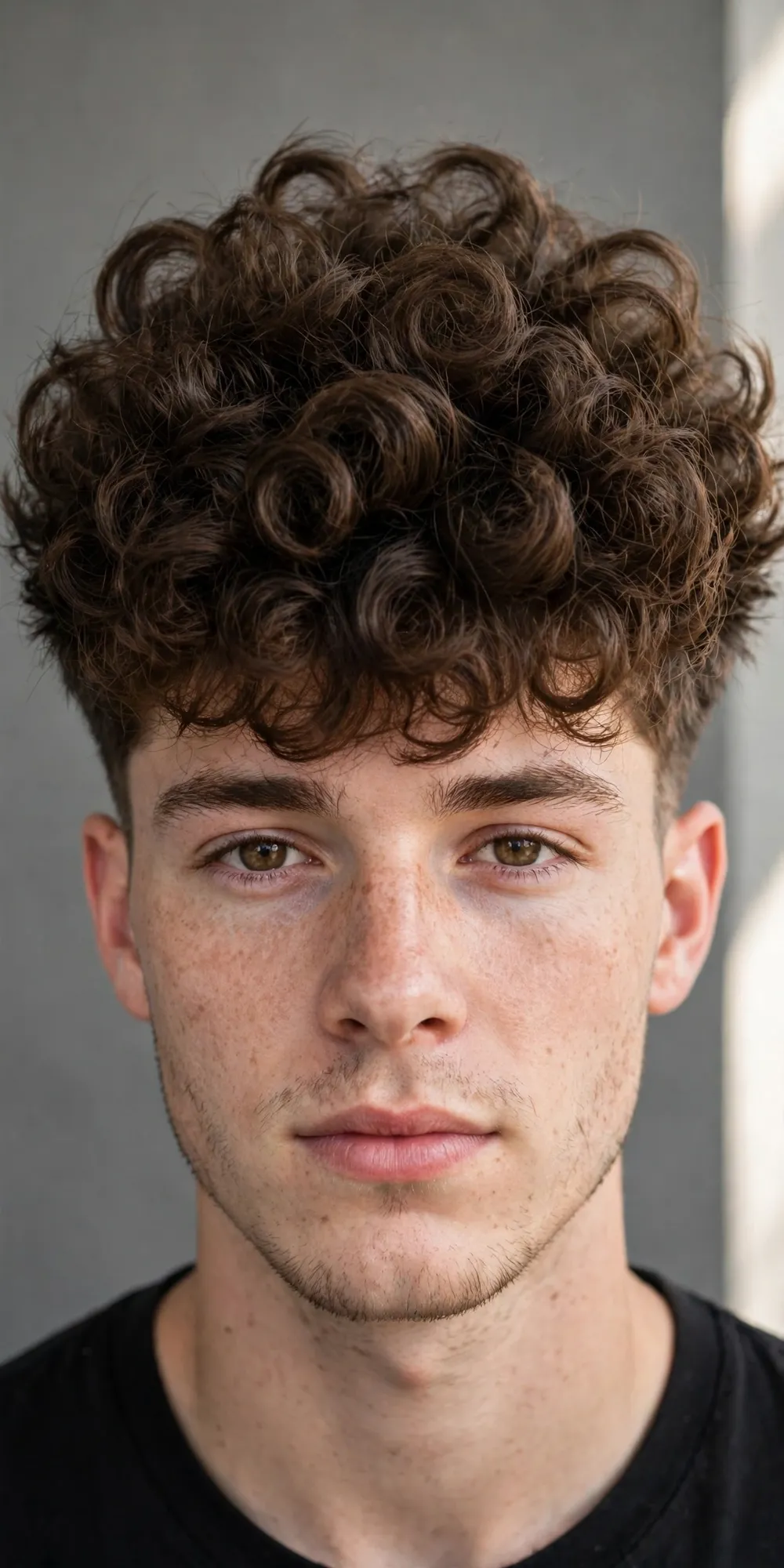
The broccoli fringe is the most viral haircut of the last few years. It’s curly, textured hair piled high on the forehead — the fringe pushed forward and up, with faded or tapered sides underneath. It suits younger guys and oval or heart-shaped faces, and naturally curly or wavy hair; straight hair needs a perm, a commitment worth thinking about first. Ask for a textured, curly fringe with plenty of height, a mid or low taper, and point-cut ends so the curls separate instead of clumping. Curl cream on damp hair, scrunched in and left to air dry, is the styling routine. A perm needs redoing every couple of months, and the fade needs a touch-up every three weeks.
30. Feathered Fringe
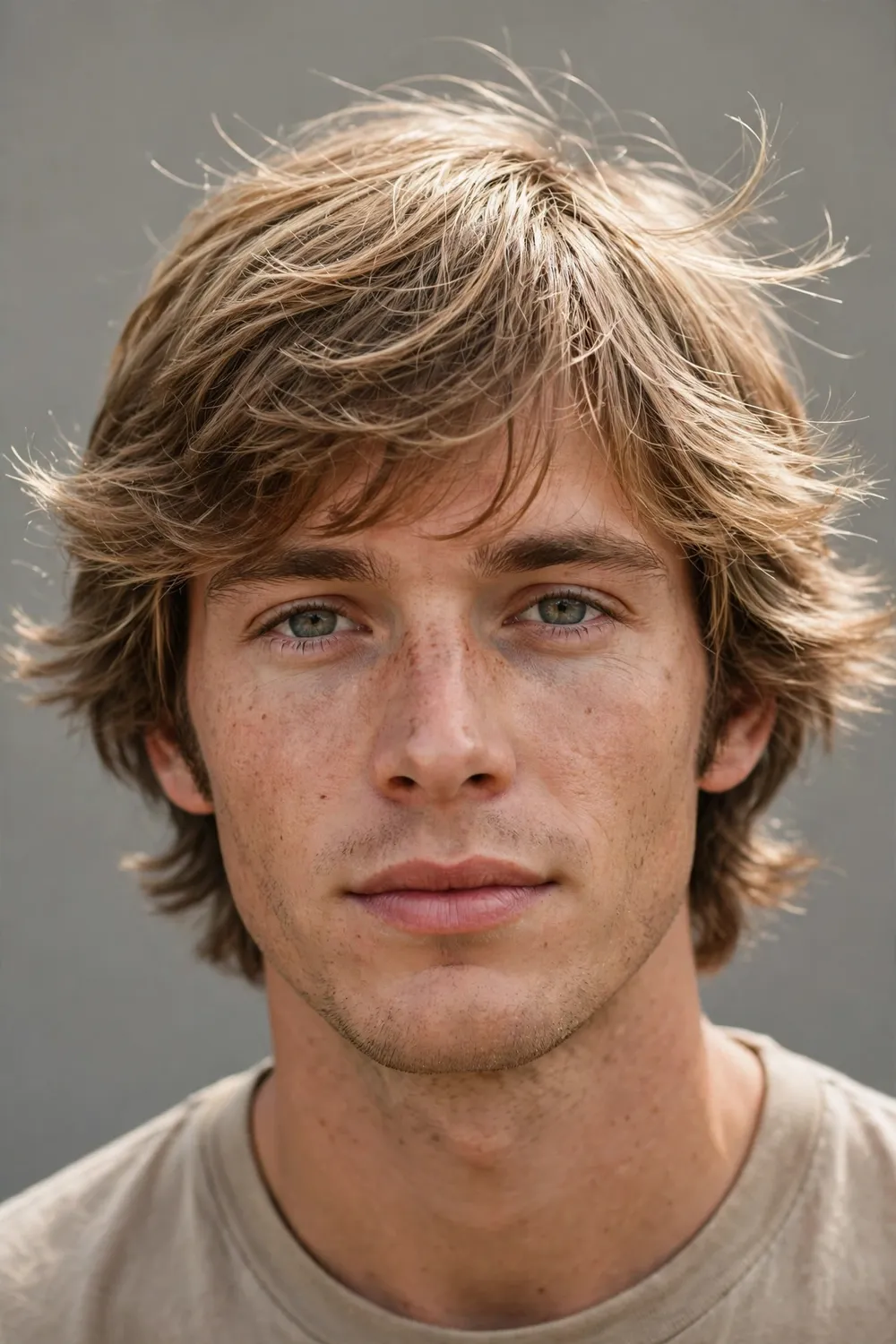
The feathered fringe brings back seventies softness: light, airy ends that flick outwards, giving the front of the cut movement. It suits long and oval faces, because the flicked ends add width where a long face needs it, and fine to medium hair; very thick hair needs thinning first or the feathering gets buried. Ask your barber to feather the ends outwards with a razor or thinning shears, keeping the length at brow level. A light pomade or a quick blow dry with a round brush gets the flick — and the dryer is worth it, because air drying flattens the feathering out. Trim every four weeks, and go easy on product: too much and the feathering clumps into solid pieces.
31. Edgar Fringe
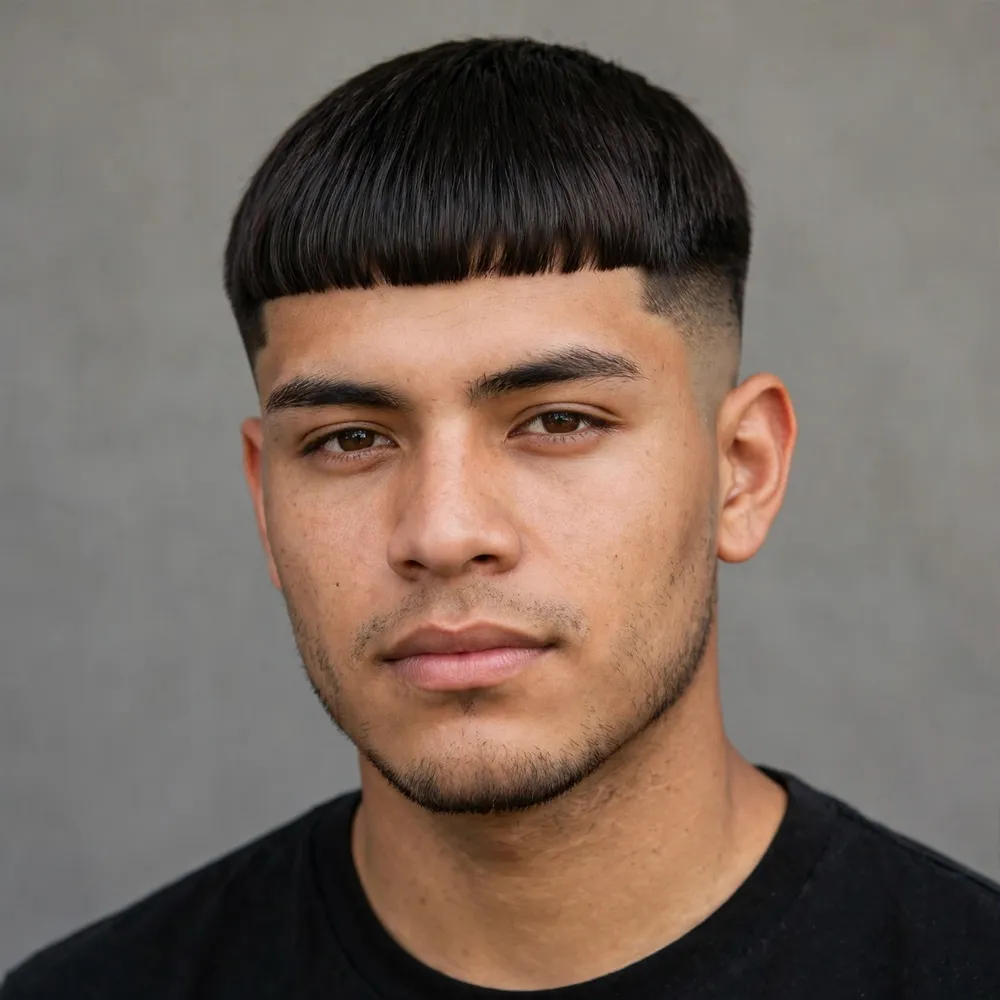
The Edgar is the sharpest fringe on this list. A straight, blunt fringe cut clean across the forehead, a high skin fade, and a crisp lineup — the whole cut is hard edges and clean lines. It suits oval and square faces with strong features, and straight, thick hair that holds a blunt line; wavy hair softens the edge and the Edgar loses its punch. Ask for a straight blunt fringe at brow level, a high skin fade, and a sharp lineup around the hairline and temples. It takes the blunt edge of the French Crop further. The real cost is upkeep: the lineup needs redoing every one to two weeks, and the fade grows out fast. If you’re not ready for regular barber visits, pick something more forgiving.
32. Fringe with High Fade
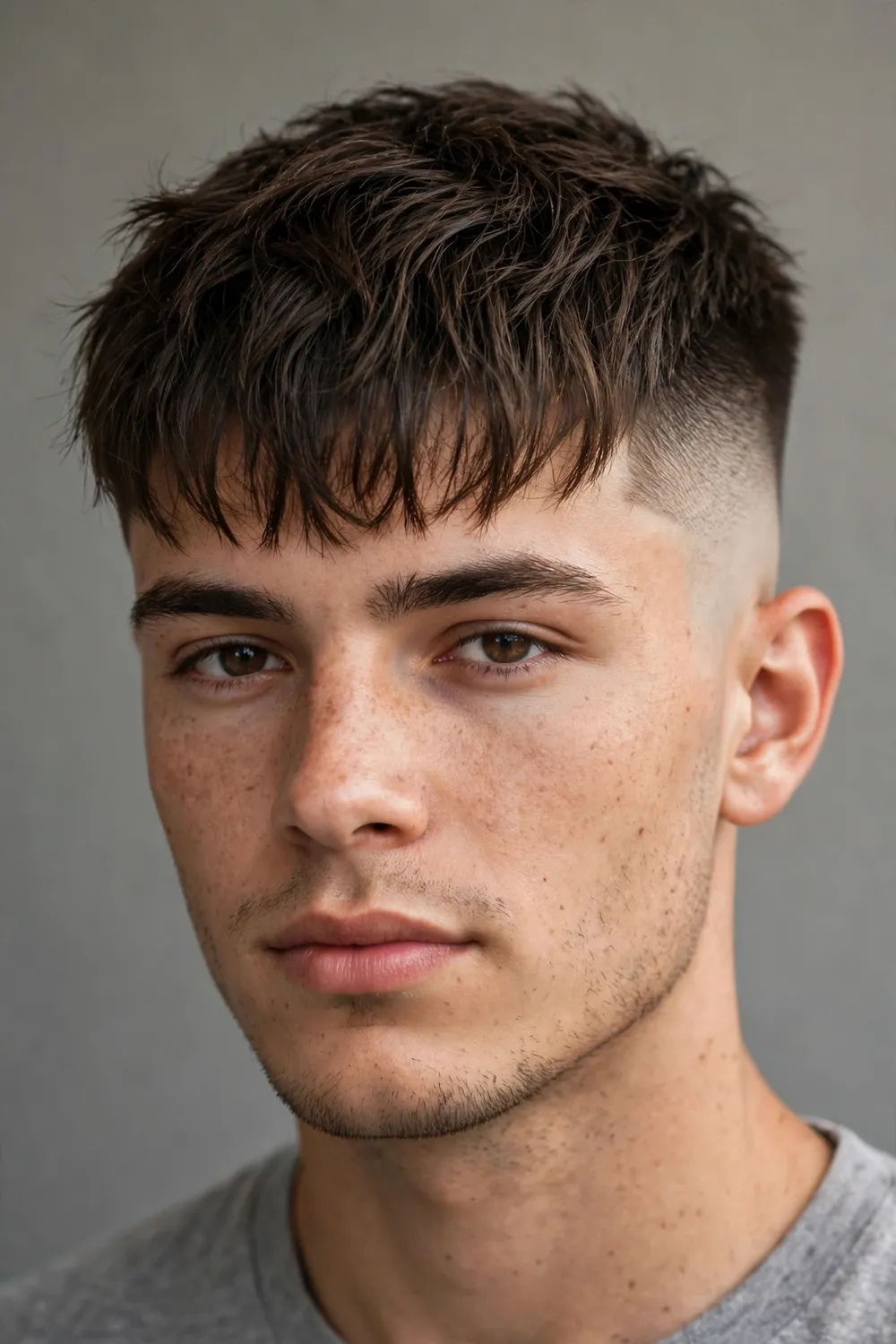
A high fade under a fringe is the sharpest fade pairing, and it works because the contrast does half the work. The fade starts high, close to the crown, so the sides are almost bare while the fringe stays long and full — that difference makes the cut look intentional. It suits oval and square faces and most hair types. Ask for a high fade on the sides and back, with the fringe long enough to sweep forward or to one side — and say “high” clearly, because a mid fade is a very different cut. Matte clay gives the fringe hold without shine and keeps the top textured against the clean sides. The fade needs a touch-up every two to three weeks, or the cut goes soft.
33. Fringe with Skin Fade
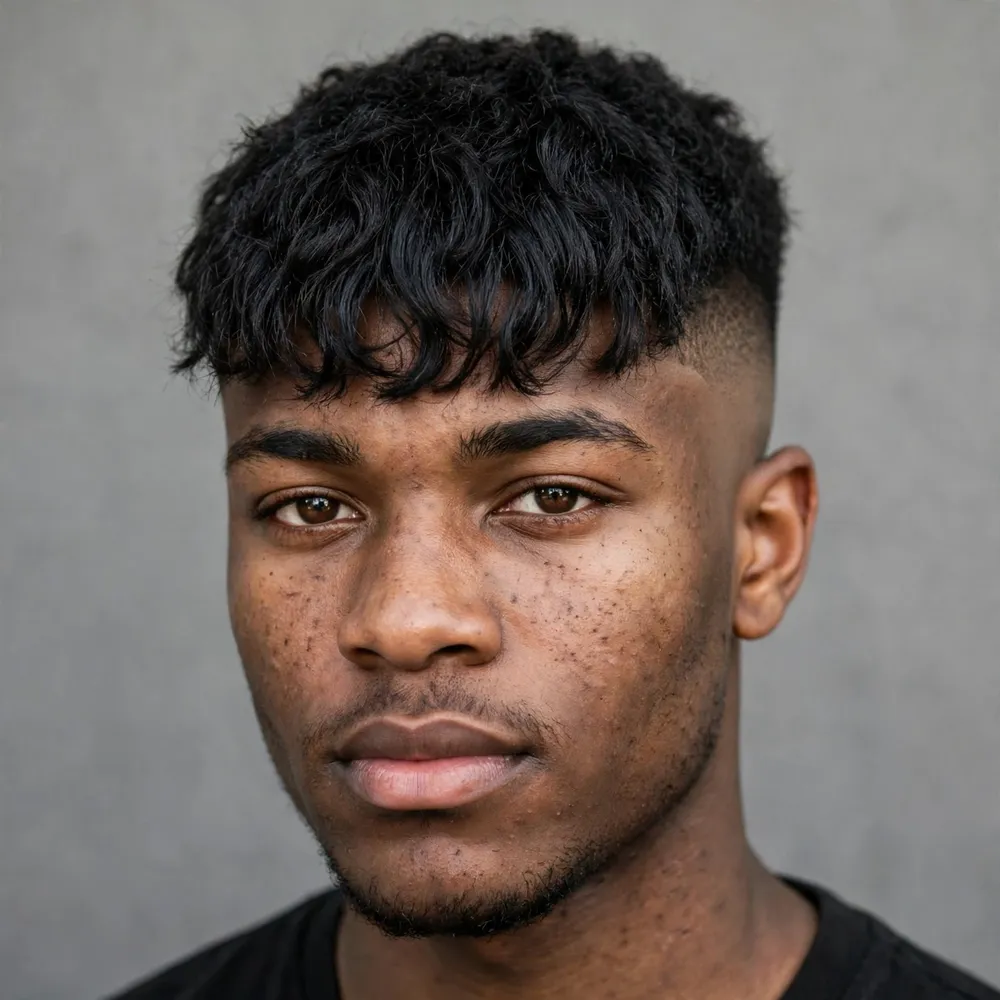
The skin fade takes the high fade further — the sides are shaved to the skin, so the contrast with the full fringe on top is as strong as it gets. It’s the highest-contrast fringe combination there is, and looks best on oval faces with straight hair. Ask for a bald skin fade on the sides and back, with the fringe left forward at brow length and the top textured, so it doesn’t look like a flat cap on a shaved head. Matte clay is the right product: texture and hold, with no shine competing with the clean fade. A skin fade is the highest-maintenance fade here — stubble shows within days and the fade loses its edge in under two weeks, so expect a barber visit every fortnight. Nothing else frames a fringe quite like it.
34. Fringe with Beard

A fringe and a beard is one of the oldest pairings in men’s grooming: the fringe frames the top of your face, the beard the bottom. It’s a rugged combination for square and oval faces, best with medium to thick hair and a beard a few weeks grown. Ask your barber to keep the fringe forward at brow length and shape the beard to match: clean cheek lines, a defined neckline, and a length balanced against the fringe. Style the fringe with matte clay, the beard with a few drops of beard oil combed through. Maintenance is double — a trim every four weeks for the fringe, shaping every week or two for the beard — but for men who can grow a decent beard, this is one of the most flattering combinations there is.
35. Fringe for Receding Hairline
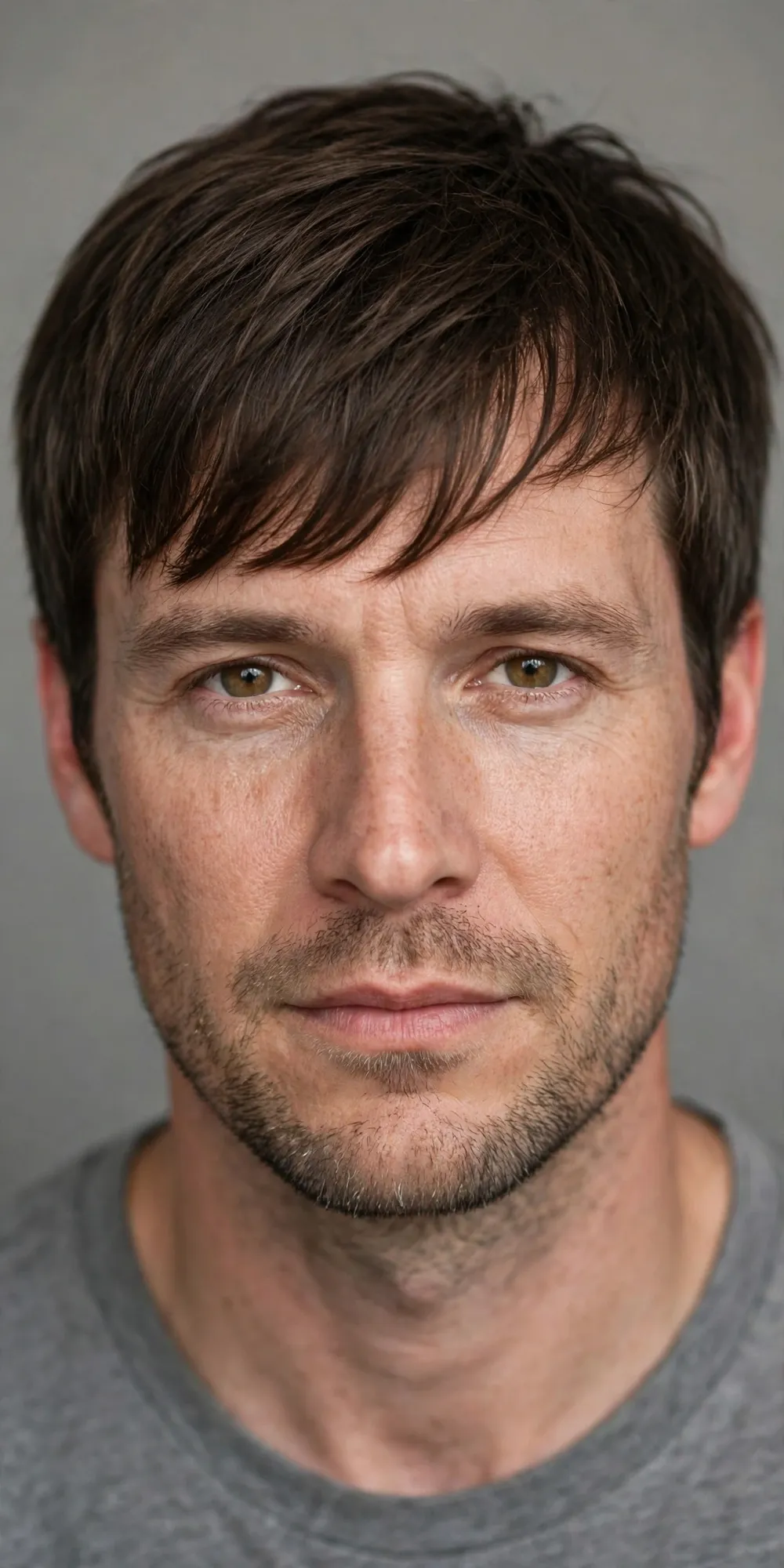
A fringe is the most natural-looking answer to a receding hairline. Instead of sweeping hair across a bald patch, you keep the fringe longer and let it fall forward, so it covers the hairline like a style choice rather than a cover-up. It suits any face shape and straight to wavy hair with enough front density — if the front is very thin, a shorter textured fringe works better. Ask your barber to keep the fringe long, sweep it forward, and avoid thinning the front — thinning makes a receding hairline more visible, not less. A light paste gives hold without weighing it down; heavy products are worth avoiding. Our guide to Hairstyles for Hiding a Receding Hairline covers the full range. Trim every three weeks to keep the coverage even.
36. Wet-Look Fringe
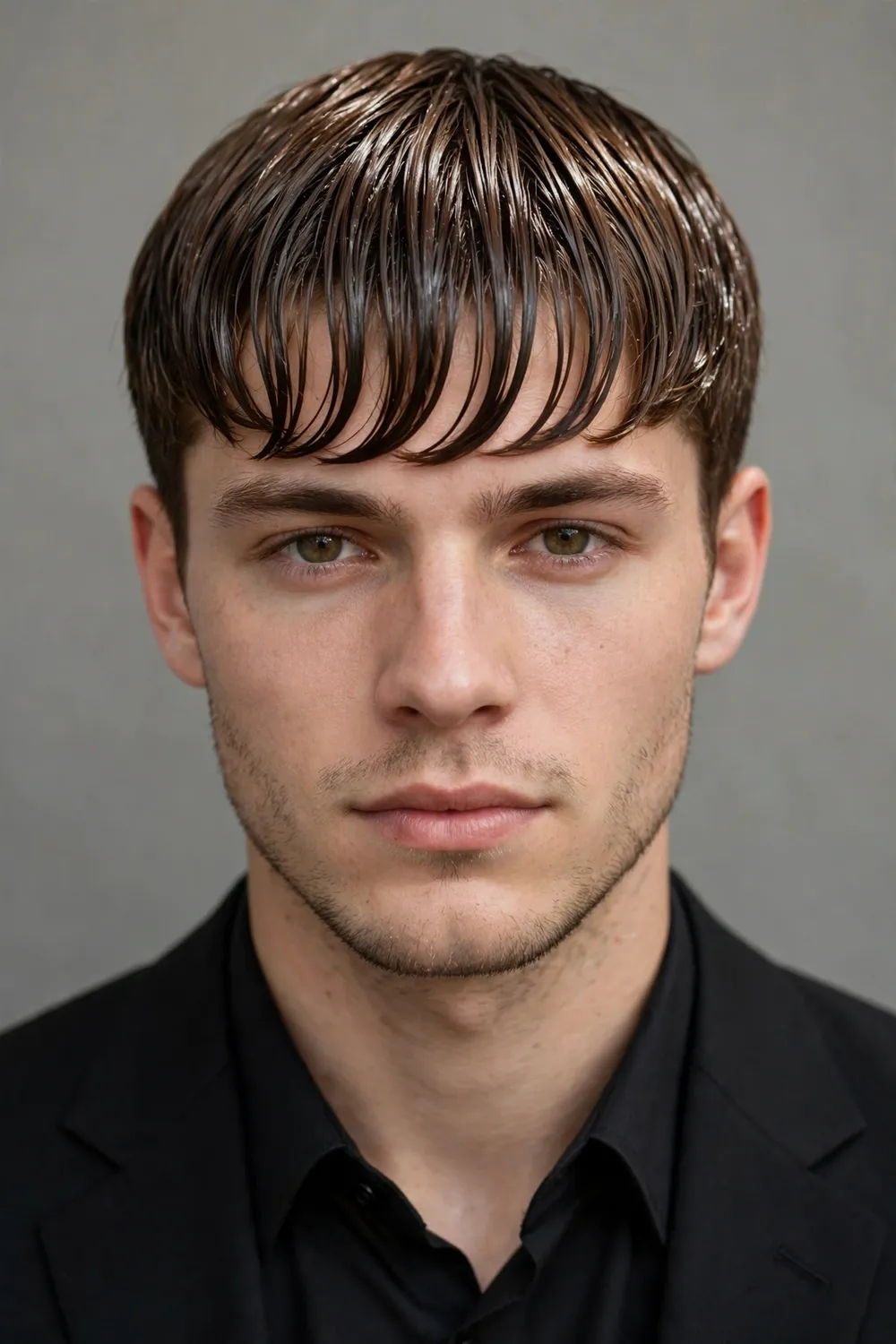
The wet-look fringe is the evening version of a fringe — sleek, glossy, polished, right at a wedding and out of place at the gym. The fringe is combed forward and set with a glossy product for a smooth, deliberate finish. It suits oval and square faces and straight hair; curly or wavy hair fights the sleek finish and you’ll spend the evening re-combing it. Ask for a fringe cut to brow length with a clean, even edge, and sides kept neat with a taper. Style it with a wet-look gel or high-shine pomade, combed forward while damp, and leave it alone — touching it breaks the finish. It can look greasy in daylight, and the product needs washing out properly at the end of the day or it builds up. Save it for occasions.
37. Fringe with Middle Part

The middle-part fringe is the curtain fringe’s shorter cousin — centre-parted, falling to both sides, with less length and less drama. Parted in the middle, it falls to either side of the face, framing it symmetrically. It suits oval faces and straight to wavy hair with medium density; very thick hair can make the part look bulky, so ask for some thinning. Ask for a centre part with the fringe falling both ways at brow length, and point-cut ends so the two sides don’t sit in solid blocks. A light styling cream is enough. If you want the fringe swept to one side, a Side Swept Fringe gives the same length with a more directional finish. Trim every four weeks to keep the part sitting where it should.
38. Fringe for Older Men

A fringe works just as well at sixty as at twenty — it just needs cutting differently. The older man’s fringe is softer and shorter: a tidy, textured fringe that flatters greying hair, with neat sides and a deliberate look rather than a leftover from younger days. It suits mature faces of any shape and greying hair of any type. Ask for a short, soft fringe with textured ends, kept above the brows, and sides tapered rather than faded hard — a skin fade under a fringe at sixty looks like a midlife crisis. A light styling cream gives control without stiffness, and adds a healthy sheen to drier grey hair. Maintenance is easy: a trim every four to five weeks, and the softer cut grows out gracefully.
39. Fringe for Teenage Guys
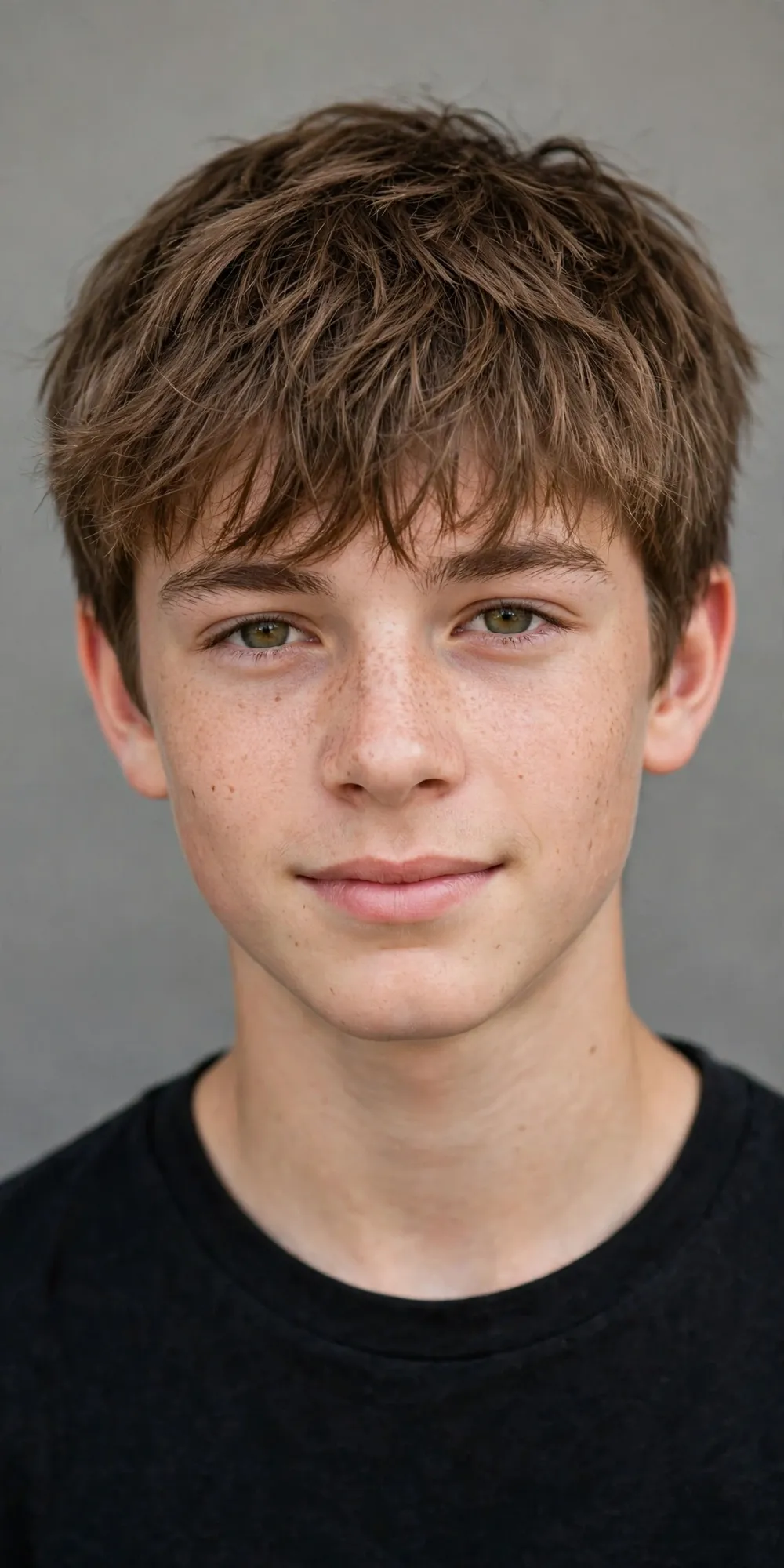
The textured fringe is the haircut most teenage guys are asking for right now — trendy, photogenic, and two minutes to style before school. It’s cut with plenty of texture and left long enough to fall forward, usually with a taper or low fade so it stays clean without looking like a grown-up’s cut. It suits most face shapes and straight, wavy or curly hair — almost every teen can wear some version of it. Ask for a textured fringe with point-cut ends and faded sides, kept at the brows so it doesn’t fall into the eyes during class. A bit of sea salt spray on damp hair, scrunched forward, is the whole styling routine. Our guide to Haircuts for Teenage Guys has more teen-friendly cuts. Keep it above the eyes, or the teachers will notice before the compliments do.
How Do You Choose the Right Fringe?
The fringe has been around in one form or another for centuries — the history of it is older than most people realise, and the Wikipedia entry on Bangs (hair) is a good rabbit hole if you’re curious. But choosing one for yourself comes down to two things: your face shape and your hair type. Get those right and almost any fringe on this list will work; get them wrong and you’ll be fighting your hair every morning.
| Face shape | Best fringes | Avoid |
|---|---|---|
| Oval | Almost any fringe — curtain, textured crop, side-swept | Nothing in particular; you have the easiest face to cut for |
| Round | Angular, quiff, high fade, textured crop — anything with height or asymmetry | Heavy blunt fringes that sit straight across and widen the face |
| Square | Side-swept, wavy, layered — softer fringes that take the edge off a strong jaw | Very sharp, geometric fringes that make the jaw look harder |
| Long | Blunt, wispy, feathered — fringes that cover forehead and shorten the face | Quiffs and anything that adds height on top |
| Heart | Curtain, middle part, side-swept — fringes that balance a wider forehead | Very short micro fringes that expose the forehead |
| Hair type | What works | Watch out for |
|---|---|---|
| Straight | Blunt, French crop, Edgar, angular — clean lines hold well | Fringes that rely on natural texture, like the messy fringe |
| Wavy | Wavy, tousled, curtain, layered — the wave does the styling | Blunt cuts, which can look uneven as the wave kicks in |
| Curly | Curly fringe, broccoli, textured crop — let the curl lead | Short blunt fringes, which shrink up as curls dry |
| Thick | Layered, thinned, textured — anything that removes bulk | Heavy blunt fringes that sit like a shelf |
| Fine | Blunt edge, short crop, wispy — keep the weight in | Heavy thinning, which makes fine hair look thinner still |
If you’re torn between two options, show your barber a photo of the one you like and tell him your face shape and hair type. A good barber will adjust the cut to suit you rather than copying the photo exactly, and that’s the version you actually want.
What Products Does a Fringe Need?
A fringe doesn’t need a shelf full of products — it needs the right one, used sparingly. Four products cover every fringe on this list.
Matte clay is the workhorse. It gives strong hold with no shine, which is what most fringes need — the fringe should look like hair, not like plastic. Use a fingertip’s worth, warm it between your palms, and push it through dry hair. It’s the right choice for textured crops, messy fringes, Edgar cuts and anything with a fade underneath.
Texture paste is clay’s lighter cousin. It gives medium hold and a bit more flexibility, so it’s better for layered and feathered fringes where you want movement rather than a fixed shape. Work it through damp hair and let it dry naturally for a softer finish.
Sea salt spray is for fringes that rely on texture rather than hold — wavy, tousled, broccoli and teenage fringes. Spray it onto damp hair, scrunch the fringe forward, and let it air dry. It adds grip and separation without weighing anything down, and it’s the closest thing to a two-minute styling routine that exists.
Light pomade is for the polished fringes: wet-look, side-swept, and anything where you want a bit of shine. A small amount combed through damp hair gives a smooth, controlled finish. The warning with pomade is always the same — too much, and the fringe looks greasy by lunchtime. Start with less than you think you need; you can always add more, but you can’t take it back without washing your hair.
One thing worth saying plainly: no product fixes a bad cut. If your fringe won’t sit right no matter what you use, the problem is the cut, not the jar. Tell your barber what’s happening and let him adjust it.
5 Mistakes to Avoid With a Fringe
1. Cutting it yourself between barber visits. It looks easy — just a quick snip across the front — and it almost never is. Home trims go crooked, too short, or both, and your barber then has to fix a fringe that’s shorter than the cut was supposed to be. Wait for the appointment.
2. Using too much product. A fringe sits on your forehead, so every bit of extra product ends up on your skin as well as your hair. Heavy waxes and too much pomade make a fringe look greasy within hours and can break out the skin underneath. A fingertip is enough; if the fringe still won’t hold, the cut needs adjusting, not more product.
3. Choosing a fringe that fights your hair type. A blunt fringe on curly hair, a textured fringe on pin-straight hair, a heavy fringe on fine hair — all of these mean a daily battle with a blow dryer and a prayer. Pick the fringe that suits the hair you actually have, not the hair you wish you had.
4. Letting it grow too long between trims. A fringe has a sweet spot of about three to five weeks, depending on the cut. Past that, it falls into your eyes, loses its shape, and starts looking like you forgot about it rather than chose it. Book the next trim when you leave the barber, not when the fringe is already in your eyes.
5. Washing it too much — or too little. A fringe gets greasy faster than the rest of your hair because it sits against your forehead all day. Washing just the fringe in the sink on non-wash days keeps it fresh without drying out the rest of your hair, and over-washing the whole head strips the oils that give a fringe its natural movement. Find the middle ground that works for your skin.
Frequently Asked Questions
What is a fringe haircut for men?
A fringe haircut is any men’s cut where the front hair is left long enough to fall over the forehead, rather than being pushed back or cut short. The fringe — sometimes called bangs — is the defining feature of the cut, and everything else (the fade, the taper, the length on top) is built around it. It’s the base of most modern men’s styles, from the French crop to the textured crop, and it can be cut straight, swept to the side, textured, or left messy depending on the look you want.
How long does hair need to be for a fringe?
You need roughly 5 to 7 centimetres (2 to 3 inches) of length at the front to get a proper fringe — enough for the hair to fall forward over the forehead rather than standing up. Shorter than that and you’re looking at a crop rather than a fringe. If your hair is shorter right now, growing it out takes around two to three months from a buzz cut, and your barber can shape it as it grows so you don’t go through an awkward stage.
Which fringe suits a round face?
The best fringes for a round face are the ones that add height or angles: an angular fringe, a fringe with a quiff, a textured crop, or a fringe with a high fade. All of these lengthen the face visually and break up its roundness. Avoid heavy blunt fringes that sit straight across the forehead, because they add width exactly where a round face doesn’t need it — and keep the sides short, since volume on the sides makes a round face look rounder.
Is a fringe hard to maintain?
It depends on the fringe. A Caesar or a short crop fringe is genuinely low maintenance — wash it, push it forward, done. A textured crop or a messy fringe needs a couple of minutes with product each morning. The high-maintenance ones are the sharp cuts: Edgars, skin fades and disconnected fringes need a barber visit every two weeks to stay sharp. Most fringes need a trim every three to five weeks, which is the real maintenance cost — the daily styling is usually under five minutes.
Can a fringe work on curly hair?
Yes, and some of the best fringes are curly ones. Natural curls give a fringe texture and volume that straight hair can’t match, and cuts like the curly fringe and the broccoli fringe are built around curls rather than fighting them. The key is length: a curly fringe needs to be cut longer than it looks when wet, because curls shrink as they dry, and cutting it to the right length while dry is the mistake that leaves a fringe sitting halfway up the forehead. Find a barber who’s comfortable cutting curly hair, and let the curls do the styling.
How do I ask my barber for a fringe haircut?
Be specific about three things: the length, the shape, and the sides. Say how long you want the fringe — “brow length” is the clearest reference — then describe the shape: straight across, swept to one side, textured, or messy. Then say what you want on the sides: a fade, a taper, or left longer. Better still, show a photo of the exact fringe you want, and tell your barber your hair type and how much time you’re willing to spend styling it each morning. A good barber will adjust the photo to suit your face rather than copying it blindly.
How often should I get a fringe trimmed?
Most fringes need a trim every three to five weeks to hold their shape. Short, sharp fringes — Edgars, micro fringes, skin fades — need attention every two weeks, because even a little growth blurs the clean lines. Softer fringes like the tousled or the layered fringe can stretch to five or six weeks, and they often look better slightly grown out. The practical move is to book your next appointment before you leave the barber, so the trim happens before the fringe is falling into your eyes.
Final Word
A fringe is the simplest way to change how your hair looks without changing how long it is — the same head of hair, cut forward instead of back, reads as a completely different style. The thirty-nine cuts in this guide cover every face shape, hair type and comfort level, from a two-minute tousled fringe to a sharp Edgar that needs a fortnightly barber visit, and the right one is the one that suits the hair you actually have and the mornings you’re willing to have. Show your barber a photo, tell him your hair type, and let him adjust the cut to your face — that’s how a good fringe happens. And if you’re still working out which style fits where, the Hair Groom blog has the full range of men’s cuts, from fades to textured crops, to help you find your next one.