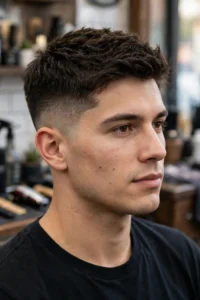



A side swept fringe is a fringe brushed diagonally across the forehead instead of straight down — and when it’s cut well, it’s the easiest way to make a plain haircut look deliberate. If you only remember three from this list, go with the Classic for a timeless look, the Textured for something you can style in two minutes, or the Low Fade when you want that sweep to actually stand out. Thirty cuts below, all with real barber asks and honest maintenance notes.
What Is a Side Swept Fringe?
A side swept fringe is hair at the front of the head cut long enough to push across the forehead at an angle — usually to one side, following your natural part. It sits somewhere between a full fringe and a side part: the hair still covers part of the forehead, but it’s swept diagonally, so your face stays open and the style looks relaxed rather than heavy. A fringe is simply the front section of hair that falls over the forehead, and sweeping it to the side is one of the oldest ways to wear it.
People mix this cut up with two others all the time, so it’s worth getting clear. A comb-over pulls the hair from a hard side part flat across the crown, and it usually relies on covering a thinning area — the hair lies flat and the part is the feature. A side swept fringe has no hard part; the hair is cut forward and to the side, and it has movement and texture. The French Crop Haircuts for Men is the shorter, blunter cousin: the fringe is cut straight across the forehead and sits high, more of a statement line than a sweep. If you like the idea of a fringe but want something softer and longer than a crop, this is the version to ask for.
You need roughly 3–4 inches of length at the front to make this work. Any shorter and the hair won’t hold the angle — it’ll just stick up or fall straight down. Thinner hair can get away with the lower end of that range because it doesn’t fight gravity, while thick or wavy hair needs the full 4 inches so there’s enough weight to drape across the forehead. Growing it out from a short cut takes about six to eight weeks, so if your barber says it’s not long enough yet, believe them and book the next trim instead of forcing it.
30 Best Side Swept Fringe Haircuts for Men
1. Classic Side Swept Fringe

This is the one your granddad probably wore, and it still works because it doesn’t try to do too much. The front runs about 3–4 inches, angled gently across the forehead, with tapered sides that blend instead of fading hard. It suits oval and square faces best, and straight to slightly wavy hair behaves itself here without much effort. Tell your barber: “Classic side swept fringe, tapered sides, keep the front long enough to sweep — no fade.” A pea-sized amount of light-hold matte clay gives it shape without shine, and a quick comb-through in the morning is genuinely all it needs. Get a trim every 3–4 weeks before the sweep starts dropping into your eyes.
2. Textured Side Swept Fringe

Choppy, point-cut pieces replace the clean diagonal line, so the fringe looks broken up and effortless rather than combed flat. It works best on straight to wavy hair with medium density — thin hair can look stringy if the texture goes too far. Ask for “textured top, point-cut the fringe, short clean sides, and keep it messy on purpose.” Work a little sea salt spray or matte paste through with your fingers — a comb kills the texture. If you want more texture inspiration, our guide to Textured Haircuts for Men breaks down the techniques barbers actually use. Maintenance is low, but you do need to touch the product in daily — it’s not a wake-up-and-go cut.
3. Messy Side Swept Fringe

The messy version takes the same diagonal front and lets it fall where it wants, with layers underneath so nothing sits flat. It’s a good match for wavy hair and for anyone whose hair has a natural cowlick — the mess actually hides it. Ask your barber for “a messy side sweep, layered through the top, no hard lines, and keep the sides short but not faded.” Style it with your fingers and a dab of matte clay on damp hair, then leave it alone; overworking it is the only real mistake. Honestly, this is one of the lowest-effort cuts on this list — a trim every 4 weeks is plenty, and bedhead genuinely counts as styling.
4. Side Swept Fringe with Low Fade
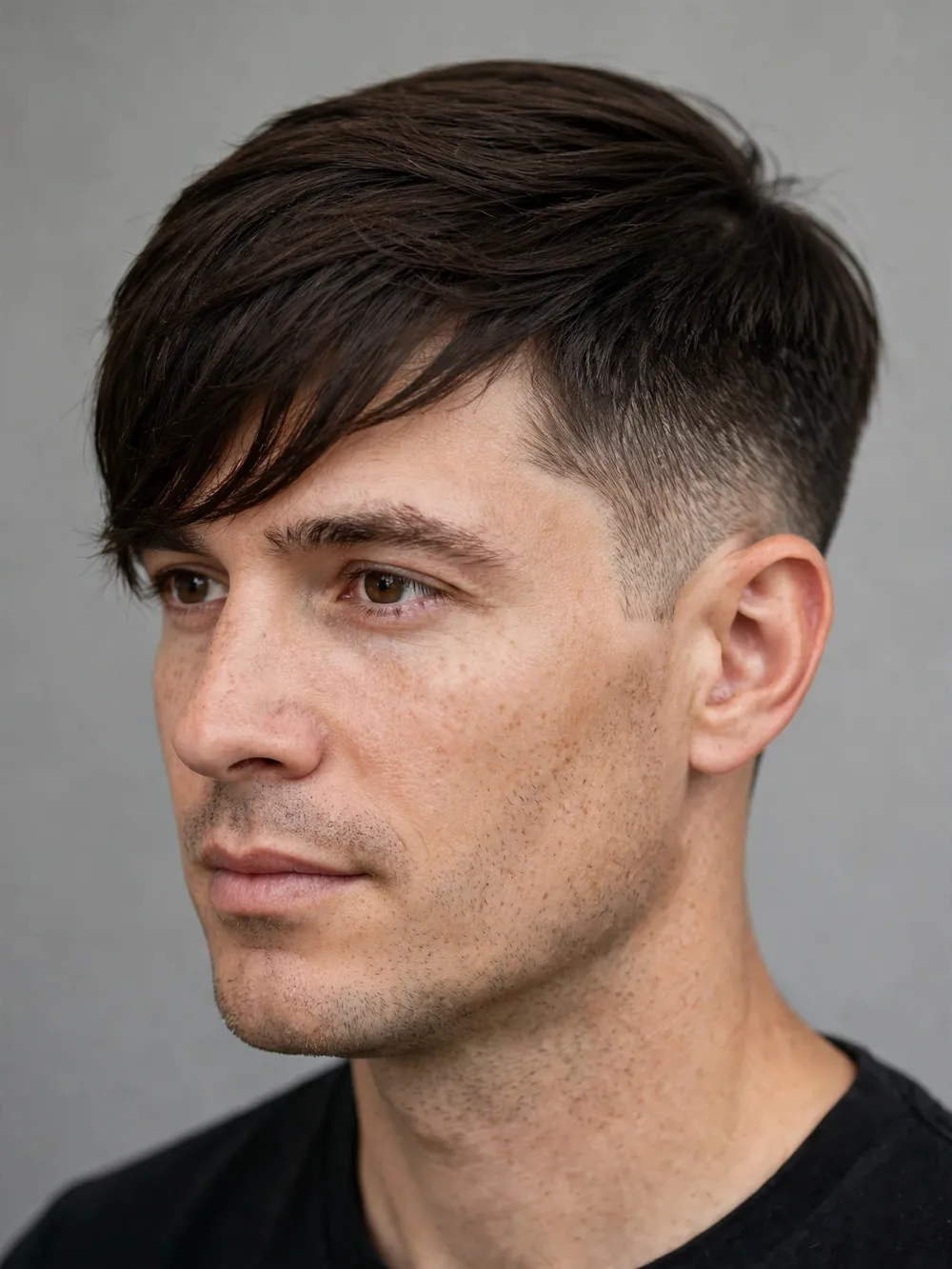
The low fade starts just above the ears, so the sides stay neat while the longer front does all the talking. This suits most face shapes, and it’s a strong choice if your hair is thick, since the fade takes weight out of the sides while the top keeps its length. Say: “Low fade on the sides, keep the front 3–4 inches and sweep it across.” A light pomade or matte clay keeps the front in place; skip heavy gel or the fringe will look wet and stiff. The fade grows out faster than a taper, so expect a tidy-up every 2–3 weeks. Our pick for anyone who wants a modern edge without committing to a high fade.
5. Side Swept Fringe with Mid Fade

A mid fade climbs to the temples, which creates a sharper contrast between the clean sides and the diagonal front. Square and oval faces handle it best, and it works well on straight or wavy hair with medium thickness. Ask for “mid fade, blend it clean, and leave the front long enough to sweep past my eyebrow.” Styling takes two minutes: blow-dry the fringe across your forehead on low heat, then a fingertip of matte paste to hold it. You’ll need the fade touched up every 2–3 weeks or the blend starts looking muddy. It’s a touch more upkeep than the low fade, but the payoff is a cut that photographs really well.
6. Side Swept Fringe with Taper

A taper keeps the ears and neckline tidy while leaving more hair on the sides than any fade — so the whole cut grows out gracefully and never looks harsh. This is the version to pick if you wear your hair longer on the sides, or if your workplace frowns on fades. Tell your barber: “Taper on the sides and back, nothing skin-tight, and a side swept fringe up front.” A light cream or matte clay is enough for the finish; the style is naturally soft, so avoid strong-hold products that make it look glued. Trims every 4 weeks keep it neat, and between cuts the taper hides regrowth better than any fade on this list.
7. Wavy Side Swept Fringe

Natural waves do half the work here — they drape across the forehead with built-in volume, so the fringe looks full without any teasing or blow-drying. If your hair already waves, this is honestly the easiest way to wear a fringe; straight hair can fake it with a light perm, but that’s a bigger commitment. Ask your barber to “cut the front to follow the wave, don’t thin it too much, and keep the sides shorter so the wave stands out.” A sea salt spray on damp hair, scrunched in and left to dry, gives the best finish. Maintenance is a trim every 4 weeks to keep the ends from getting straggly, and a weekly deep condition if your waves tend to dry out.
8. Short Side Swept Fringe

The front sits high on the forehead at around 2–3 inches, so this is the sportiest, lowest-maintenance take on the style. Straight hair shows the angle best, and it works on most face shapes, though square faces get the most from it. Ask for “a short side sweep, front around 2 inches, tapered sides, keep it clean.” A tiny amount of matte paste is optional; many guys wear this with nothing at all. Trims every 3–4 weeks keep the shape, but because it’s short, it grows out neatly rather than turning into a mess. If the longer fringes on this list feel like too much commitment, this is your entry point.
9. Curly Side Swept Fringe

Curls swept diagonally across the forehead give this cut a relaxed, natural energy that straight hair can’t copy. The key detail is length: curls shrink as they dry, so your barber needs to cut it longer than it looks wet — ask for “at least 4 inches at the front when dry” or you’ll end up with a fringe that bounces above your hairline. Tell your barber: “Cut it dry if you can, sweep the curls across, and don’t thin it too aggressively.” A curl cream on damp hair defines the shape without crunch. Expect a trim every 4–5 weeks, and don’t be surprised if the fringe sits differently on humid days — that’s the trade-off, and it’s worth it.
10. Medium Side Swept Fringe

Mid-length all over, with a front that reaches the eyebrows and a fuller, more relaxed silhouette than the shorter cuts. It’s the middle ground that suits almost everyone — oval, square and oblong faces especially — and it works with straight, wavy or curly hair. Ask for “medium length, front to the brow, swept across, sides blended but not faded.” A blow-dryer on low heat helps the sweep hold, and a light cream gives a soft finish without stiffness. The honest downside is restyling: it can fall flat by the afternoon if you skip product, so keep a small tub of clay in your bag. Trims every 4 weeks keep the shape from getting heavy and shapeless.
11. Blonde Side Swept Fringe

Lighter colour makes the diagonal sweep impossible to miss — every strand reads, and the angle of the fringe becomes the whole look. This works best on straight or slightly wavy hair, and it’s a strong choice for guys with fair skin or warm undertones, where blonde looks natural rather than forced. The cut itself is straightforward: “classic side sweep, front 3–4 inches, tapered sides.” The colour is where the work is — you’ll need bleach or highlights, then purple shampoo once or twice a week to stop it going brassy. Roots show in 4–6 weeks, so budget for regular touch-ups or ask your barber for a darker root blend that grows out more gracefully. It’s high-maintenance, but the payoff is a fringe that genuinely pops in photos.
12. Layered Side Swept Fringe
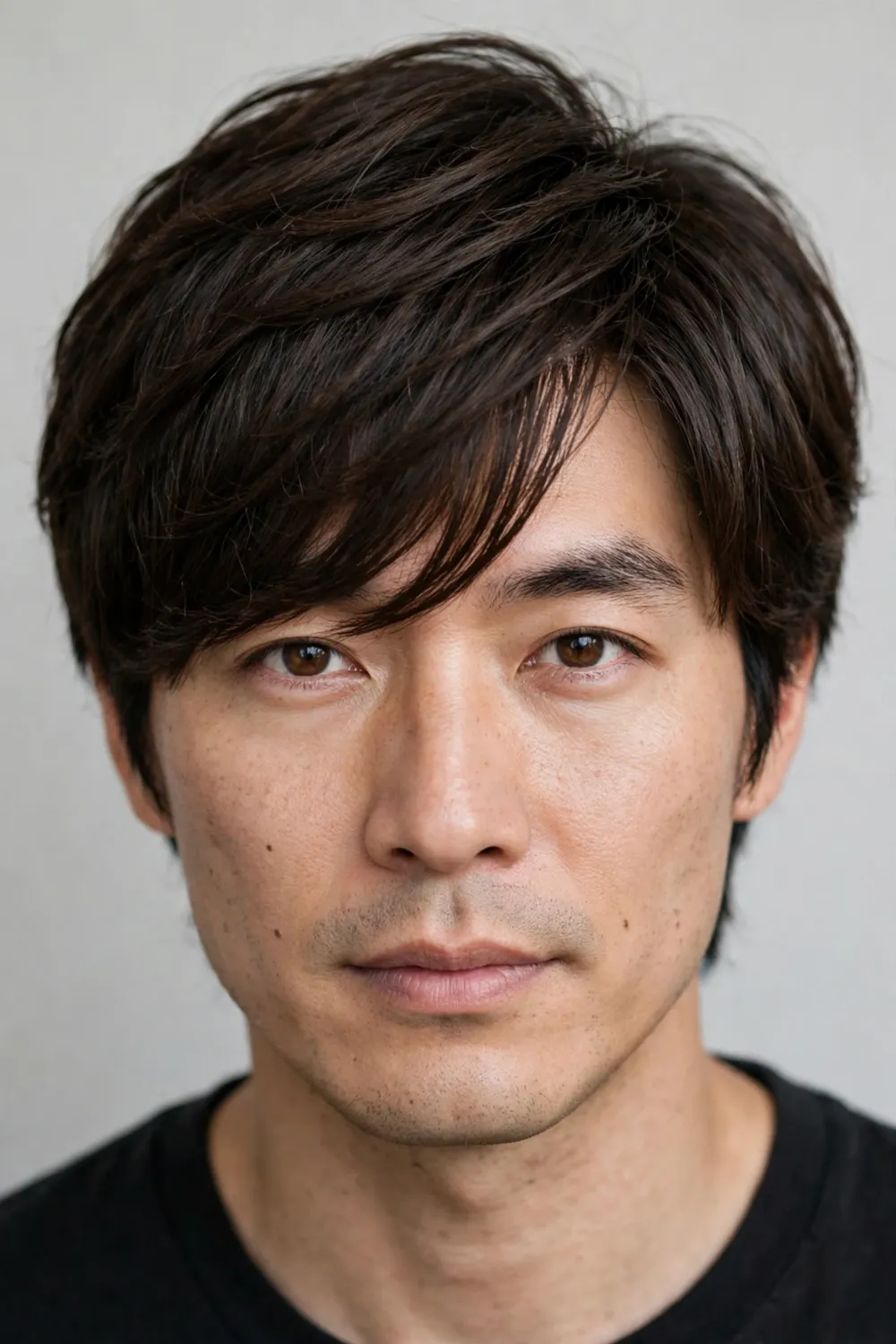
Layers of different lengths through the top take bulk out of thick hair, so the fringe bends across the forehead instead of pushing forward like a wall. If your hair is thick and every fringe you’ve tried has stuck out, this is the fix. Tell your barber: “Layer the top, thin the weight out of the front, and sweep it across — I want movement, not bulk.” A light cream or sea salt spray is all the product you need; heavy pomade will flatten the layers you’re paying for. Trims every 3–4 weeks keep the layers defined, because once they grow out the bulk comes straight back. Worth every visit, though — this is the cut that makes thick hair behave.
13. Straight Side Swept Fringe

Straight hair shows the diagonal line at its sharpest, so this version is all about a clean, clear angle across the forehead. It suits oval and square faces, and it’s ideal if your hair is naturally straight and fine to medium in thickness — the fringe lies flat and the sweep reads crisply. Ask for “a sharp diagonal sweep, front 3–4 inches, clean tapered sides, no texture.” A light-hold pomade or a dab of styling cream gives a smooth finish with a hint of shine; avoid matte products, which can make straight hair look dull and dry. The trade-off is that it shows every imperfection — a bad cut or a cowlick has nowhere to hide, so pick a barber you trust. Trims every 3 weeks keep the line sharp.
14. Side Swept Fringe with Undercut

The undercut disconnects the sides completely — short, buzzed, and separated from the top by a hard line — while the full angled front sweeps across the forehead. It’s the boldest contrast on this list, and it works best on straight or slightly wavy hair with enough density up top to carry the length. Say: “Disconnected undercut on the sides, keep the front long, sweep it across, and don’t blend the sides into the top.” A strong-hold matte clay keeps the fringe in place against all that contrast, and a blow-dry helps it hold its shape. The undercut grows out fast and the hard line softens within two weeks, so book touch-ups every 2 weeks or the contrast fades into a blur.
15. Korean Side Swept Fringe

Soft layers, airy volume and feathered ends — the Korean take on the fringe is lighter and more delicate than the Western versions, and it often comes with a light perm for lift at the roots. Ask your barber for “a Korean-style side sweep, soft layers, feathered ends, and a light root perm if my hair needs volume.” Styling is simple: blow-dry the fringe forward and across with a round brush, then finish with a light wax. The perm lasts 6–8 weeks, so maintenance is a trim every 4 weeks plus a perm refresh every couple of months. If you want a fringe that looks soft rather than sharp, this is the one.
16. Wispy Side Swept Fringe

A wispy fringe is all about lightness. Instead of a solid wall of hair, the front is thinned and feathered so individual pieces drift across the forehead, with a little skin showing through. That softness suits oval and heart faces, and it’s a lifesaver for fine or thin hair, where a heavy fringe would just fall flat. Ask your barber to point-cut the ends, thin the very tips, and keep the front around three inches. A pea-sized dab of light styling cream on damp hair is enough; anything heavier clumps the strands and kills the airiness. It grows out gracefully, so trims can stretch to four or five weeks, but in wind or humidity it can look messy fast, so keep a pocket comb handy.
17. Side Swept Fringe with Beard
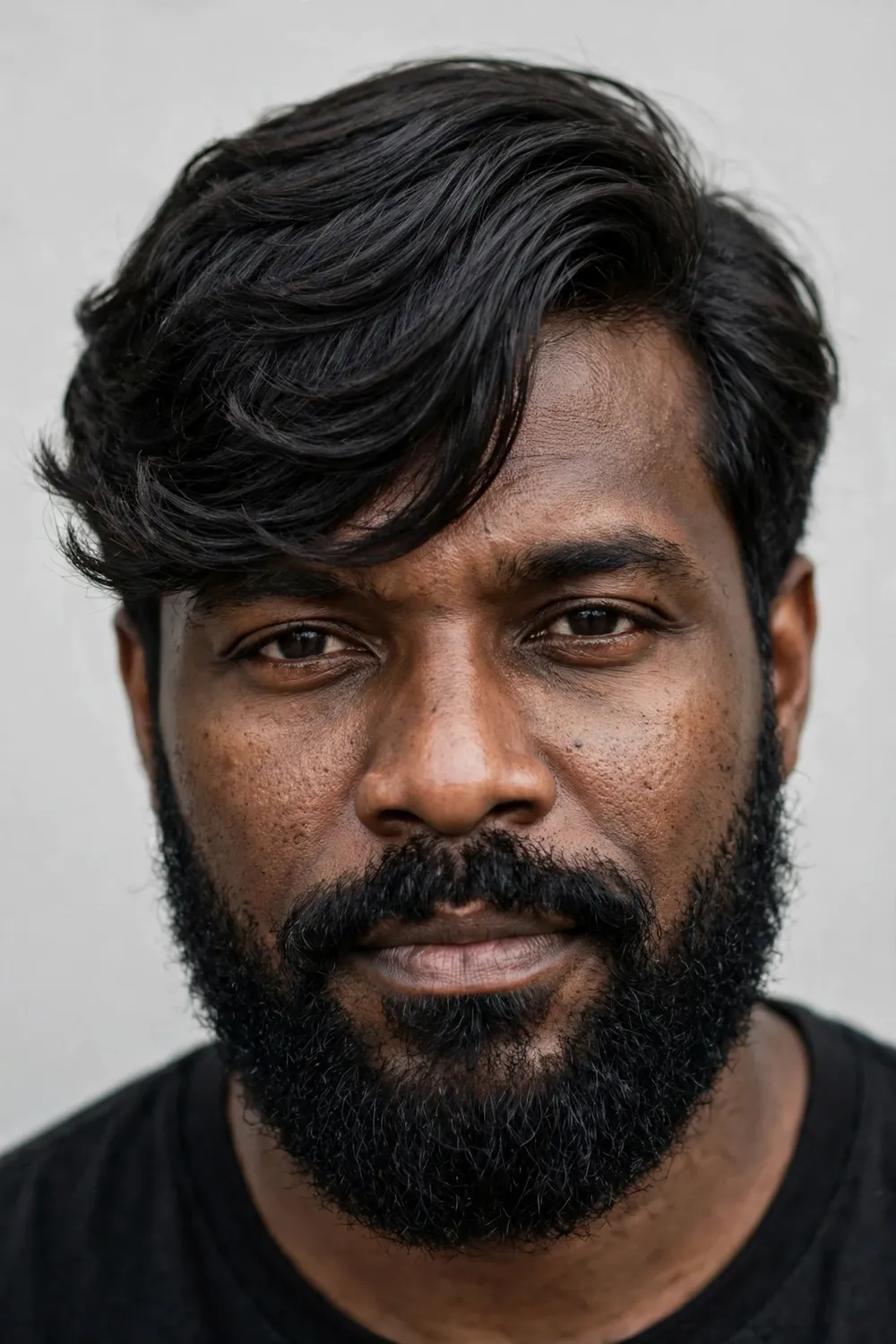
This pairing works because the two halves balance each other. The fringe keeps things soft and youthful up top, while a structured beard adds weight and maturity below, so the whole look reads intentional rather than boyish. It flatters oval and oblong faces especially, since the beard fills out a longer jaw, and it suits straight to slightly wavy hair best. Tell your barber you want a three-to-four-inch fringe with a clean taper, and a beard shaped so the cheek line stays sharp. A matte clay holds the sweep, and beard oil twice a week keeps the beard from looking scruffy. The honest catch: the beard needs trimming weekly and the fringe every three to four weeks, so you’re signing up for two routines, not one.
18. Asymmetrical Side Swept Fringe

If you want a fringe that actually gets noticed, this is the one. One side of the front is cut noticeably longer than the other, so the diagonal is exaggerated and the whole haircut leans to one side in a deliberate, almost editorial way. It suits square and oval faces — the uneven line softens a strong jaw — and works best on straight or slightly wavy hair, because curls fight the asymmetry. Be specific: the longer side should reach the brow, the shorter side sit about an inch and a half up, and the part clearly off-centre. You’ll need a blow-dryer and round brush to set the angle, plus a light pomade — and a trim every three weeks, with a few minutes of styling each morning.
19. Side Swept Crop

This is the fringe for guys who hate long hair but still want character: a short, textured top, the front angling across the forehead, tight sides — a crop with a sense of direction. It suits round and square faces — the forward sweep adds length without bulk — and works on straight, wavy or slightly curly hair. Ask your barber for a textured crop with the fringe left about two inches at its longest point, point-cut so it doesn’t sit in a straight line, and a mid taper or low fade on the sides. Styling takes a minute: a fingertip of matte paste through towel-dried hair, pushed forward and to the side. A trim every three weeks keeps it sharp, and on lazy days you can just leave it.
20. Long Side Swept Fringe

This is the dramatic one. The fringe runs to the brow or lower, draping across most of the forehead in a heavy, sweeping curtain that completely changes the shape of your face. It’s ideal for a big forehead or an oblong face, since all that hair shortens the forehead visually, and it needs straight or gently wavy hair — tight curls spring it up and ruin the drape. Ask your barber for four to five inches up front, slide- or point-cut so the ends stay soft, with sides long enough to blend. A sea salt spray on damp hair gives it movement, and a light cream keeps it in place without stiffness. The honest trade-off: it falls into your eyes, especially by week three, and trims every three weeks are non-negotiable.
21. Choppy Side Swept Fringe

Choppy means uneven on purpose: the ends are cut at different lengths, so the fringe has jagged, piece-y texture instead of a smooth line. It suits oval and square faces, and it’s brilliant for thick hair — all that chopping removes weight and stops the fringe sitting like a helmet. Tell your barber you want a choppy fringe, longest pieces around three and a half inches, shortest a good inch shorter, plus a taper or low fade. A matte clay or texturising powder gives the pieces separation — work it through with your fingers, not a comb, or you’ll flatten the texture. Maintenance is forgiving — it looks good slightly grown out — but get a tidy-up around week four once the ends look ragged.
22. Professional Side Swept Fringe

This is the fringe for a job interview, a client meeting, or a wedding. The front is short and smooth, sweeping across at a neat, controlled angle, with a conservative taper — nothing disconnected, nothing dramatic, just clean. It suits every face shape, but it’s especially safe for round faces, where the diagonal adds structure. Ask your barber for a side swept fringe of about two and a half inches, scissor-cut with a soft finish, and a classic taper on the sides and back. A little light-hold pomade or grooming cream gives it a tidy sheen; comb it into place while damp and it’ll stay put all day. Trims every three to four weeks keep it looking deliberate. It’s not the most exciting cut here — but that’s exactly the point.
23. Spiky Side Swept Fringe
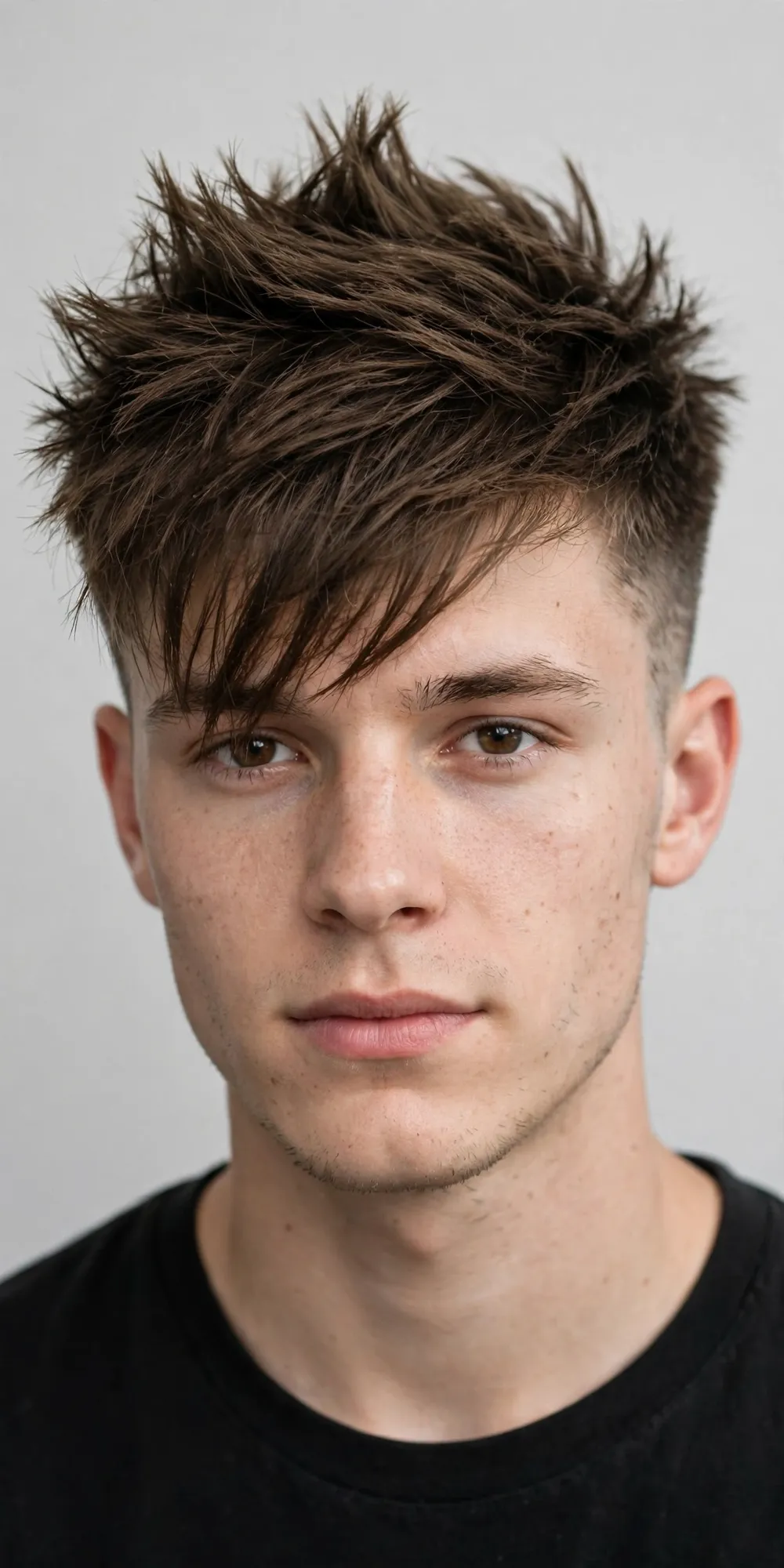
This mixes two ideas that shouldn’t work together: a lifted, textured crown and a fringe angling down across the forehead. The height gives the cut energy, while the sweep keeps it from looking like a 2000s throwback. It suits oval and heart faces and needs straight or slightly wavy hair with natural volume — flat, fine hair won’t hold the lift. Ask your barber for texture through the crown, the front left three to four inches, swept aside, and short tapered sides. You’ll need strong-hold matte clay or fibre: work it through towel-dried hair, push the crown up and forward, then angle the fringe across. It’s a daily styling job, and a trim every three weeks keeps the spikes from turning into a mop. If a lifted front is more your thing, a Quiff Haircut is bolder.
24. Side Swept Fringe with High Fade
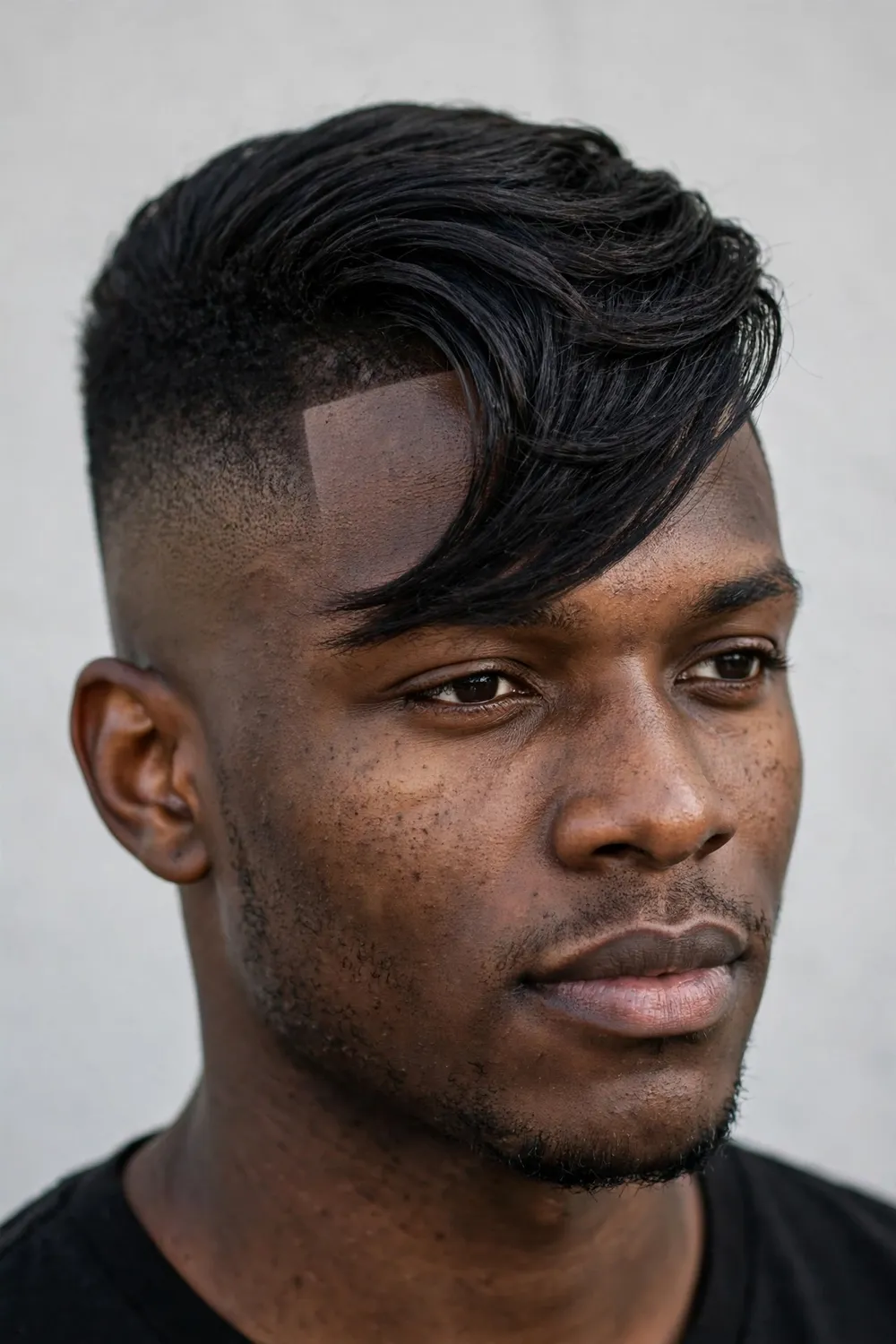
A high fade takes the contrast up a notch: the fade climbs to the crown, the sides are almost bare, and the long fringe does all the work — sharp, modern, impossible to miss. It suits square and oval faces, where the strong outline sharpens the jaw, and works on straight or wavy hair. Tell your barber you want a high fade — skin or zero at the bottom, blending to the crown — with the fringe kept three to four inches and swept firmly aside. A matte pomade gives the sweep hold without shine, and a quick blow-dry in the sweep direction sets it. A high fade loses crispness fast, so you’ll want a tidy-up every two weeks, and a fringe trim every three to four. It’s high-effort, high-reward, and it photographs brilliantly.
25. Side Swept Fringe with Drop Fade
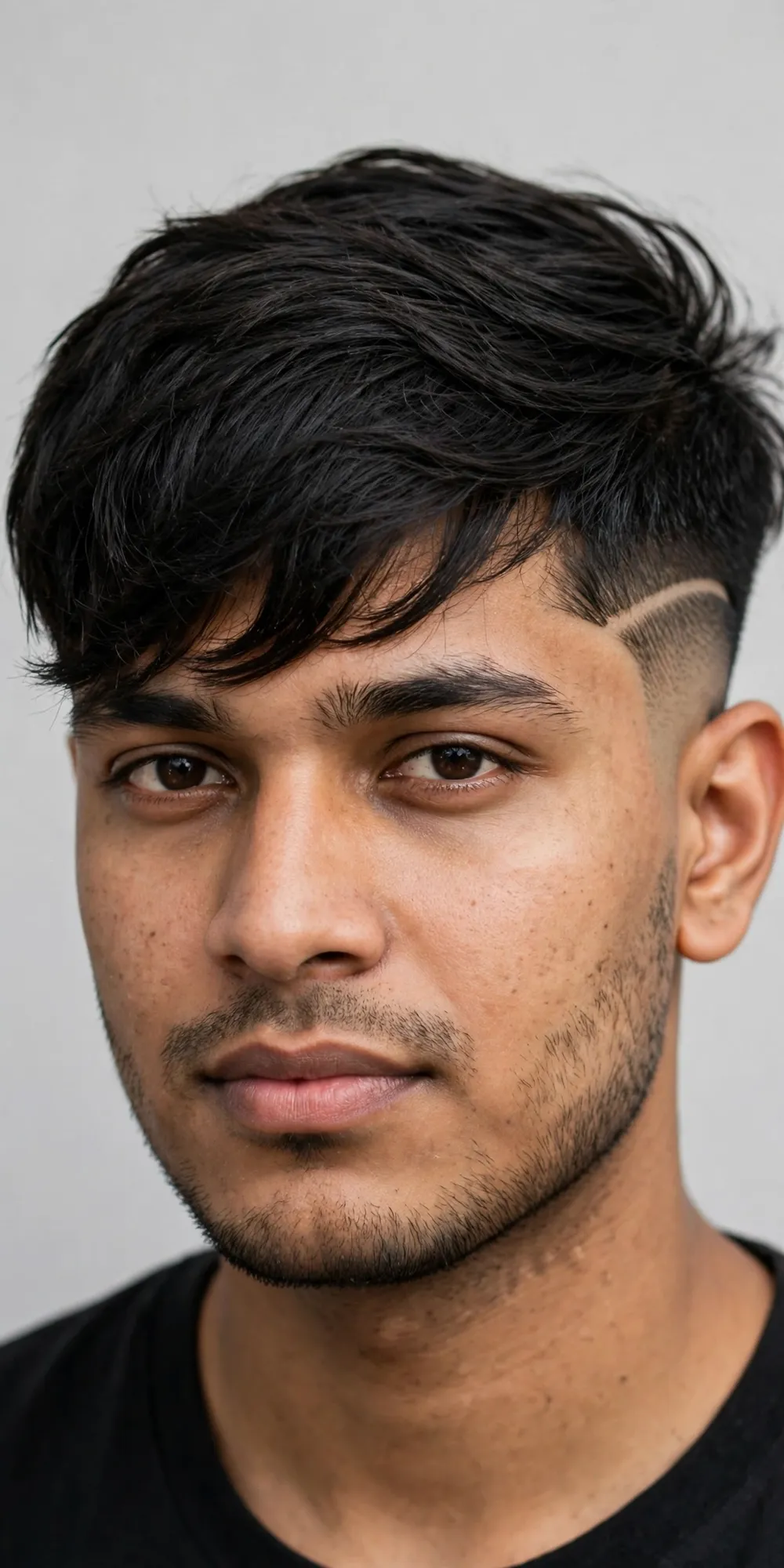
A drop fade is the detail most people miss and then can’t stop noticing: instead of running straight around the head, it dips behind the ear and frames the sweep beautifully. It suits oval and round faces — the dip adds shape where a straight fade can look flat — and works on most hair types. Ask specifically for a drop fade — not a regular mid fade — with the lowest point just behind the ear, and keep the fringe around three inches, swept across. Styling is the same as any fringe: a little matte clay on damp hair, blow-dried in the sweep direction. The fade needs a clean-up every two to three weeks, and if your barber isn’t confident with drop fades, don’t push it.
26. Side Swept Fringe with Skin Fade
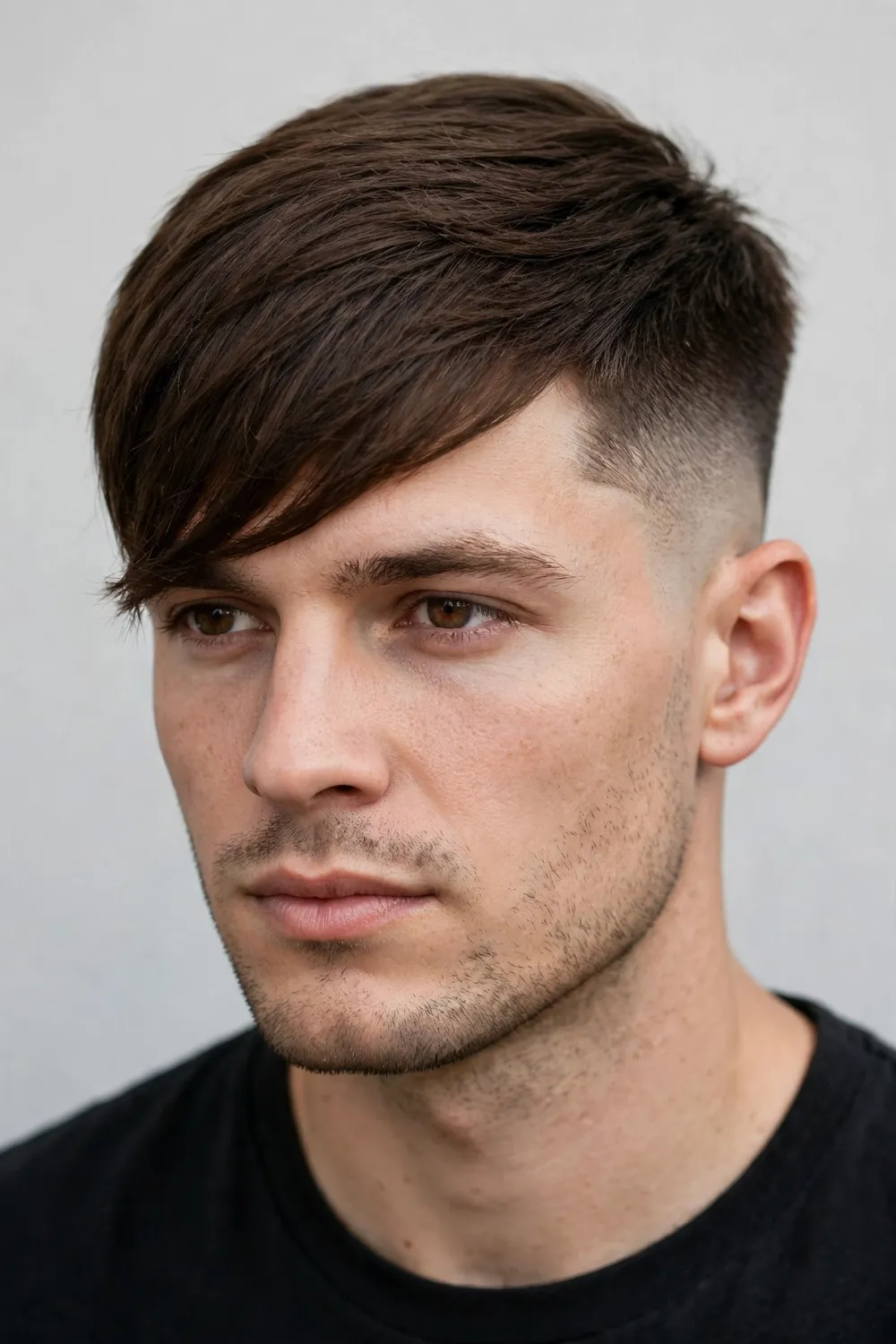
Skin fade plus fringe is the boldest combination here: the sides go right down to skin, so the fringe becomes the entire haircut. It suits square and oval faces with strong bone structure, and straight or wavy hair shows the angle best. Be clear: a skin fade (foil shaver at the bottom), blended up over about an inch, with the fringe left three and a half to four inches and swept across. A light pomade or clay holds the sweep; anything too shiny will clash with the matte, skin-tight sides. Here’s the honest part: a skin fade grows out in days, not weeks, so expect a barber visit every ten days to two weeks to keep it sharp. It’s the highest-maintenance cut here, but it turns the most heads.
27. Side Swept Fringe with Two Block
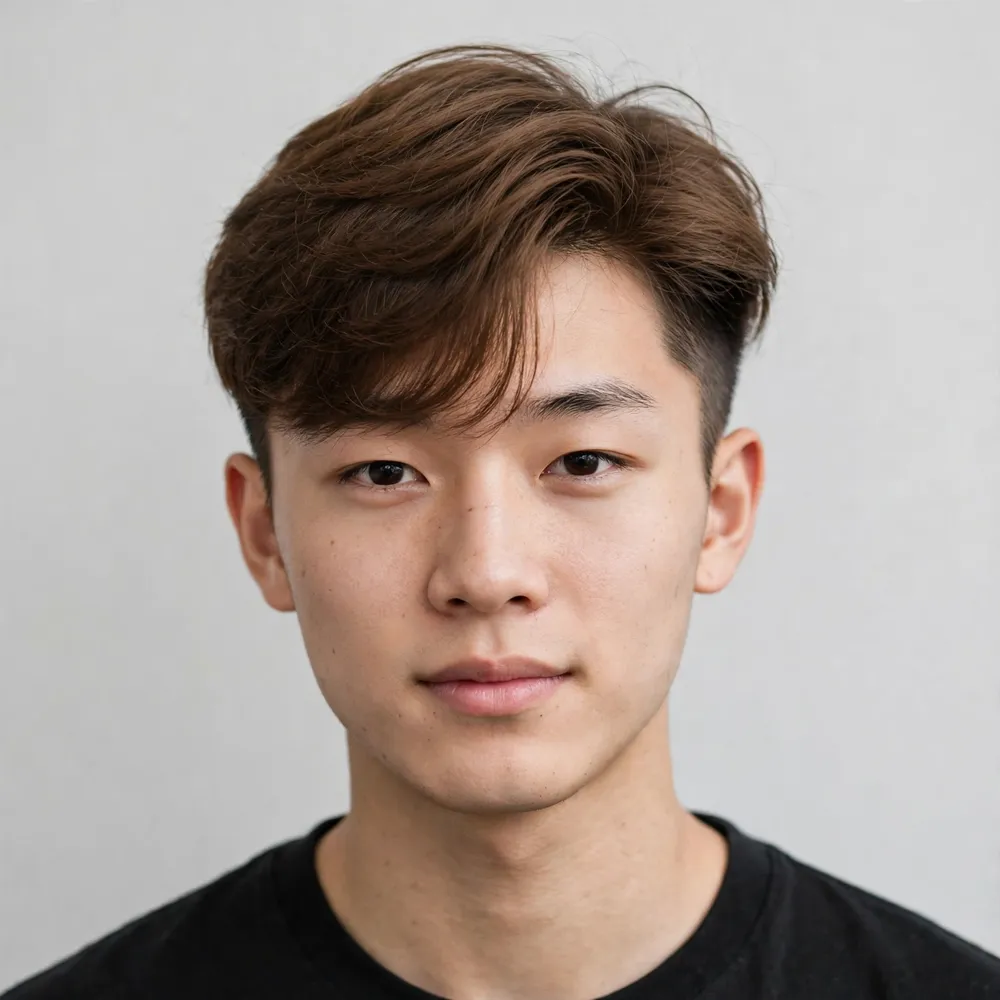
The two block is a Korean cut — short sides, longer disconnected top — and pairing it with a side swept fringe gives that soft, airy K-drama look an edge. The longer top sweeps forward and across, while the short sides keep it light. It suits oval and heart faces and straight or slightly wavy hair; thick, coarse hair works too if the top is thinned. Ask your barber for a two block with the sides clipped short and the top left four inches or more, fringe swept aside, ends feathered. A light styling cream or sea salt spray keeps the sweep soft — heavy products weigh it down and kill the airiness. A light perm helps if very straight hair won’t hold the sweep. Trims every four weeks keep the shape.
28. Side Swept Fringe for a Receding Hairline

A receding hairline doesn’t mean giving up on a fringe — it means choosing the right one. This version is shorter and more textured than a classic sweep, so it covers the temples, and the diagonal hides recession better than a straight-across fringe. It suits any face shape, but it’s most useful once your temples start pulling back. Tell your barber exactly what’s going on — they’ll keep the fringe around two and a half to three inches, textured rather than heavy, swept across the deeper temple. A matte paste works best; avoid anything wet-look, because shine exposes scalp, and keep the sides tapered. Trim every three weeks, and don’t grow the fringe longer to compensate — shorter and textured covers more than long and thin ever will.
29. Side Swept Fringe for Thick Hair

Thick hair and fringes can clash — too much weight and the fringe pushes forward like a shelf instead of sweeping. The fix is weight removal: point-cutting and thinning through the front so the hair bends. This suits oval and square faces and dense hair that makes a normal fringe sit too heavy. Ask your barber to thin the fringe with point-cutting or thinning shears, keep the front around three to four inches, and taper the sides so bulk doesn’t build up around the ears. A light cream or sea salt spray is all you need — heavy waxes just add weight back. Blow-drying the fringe in the sweep direction for thirty seconds makes a real difference — thick hair holds the shape you dry into it. Trims every three to four weeks keep the weight from creeping back.
30. Side Swept Fringe for Fine Hair

Fine hair needs the opposite trick: instead of removing weight, create the illusion of it. A texturised diagonal sweep does exactly that — the angle and layering make fine hair look denser, because your eye reads the overlapping pieces as fullness. It suits oval and oblong faces, and it’s the best fringe option for fine hair that’s still fairly dense at the front. Ask your barber for a textured fringe of about three inches, short choppy layers, a clean taper — and specifically ask them not to thin it further, the mistake most barbers make. A volumising mousse or a pinch of texturising powder at the roots gives the sweep lift and grip. Blow-dry it in the sweep direction and it’ll hold; air-dried, fine hair falls flat. Trim every three to four weeks.
How to Ask Your Barber for a Side Swept Fringe
The difference between a great fringe and a disappointing one is usually the conversation before the scissors come out. Start with the length: tell your barber how long you want the front — three inches is the sweet spot for most guys, four if you want a longer drape, two and a half if you want it office-safe. Then pick your sweep direction and say it out loud. Most people sweep to their stronger side, but your natural part matters more than habit, so ask the barber to check which way your hair falls on its own. Next, name the sides: a taper if you want it neat and slow-growing, a low fade for subtle contrast, or a high or skin fade if you want it bold — if you’re unsure, our Low Fade Haircuts for Men guide walks through the fade heights. Then talk texture and finish: point-cut and choppy for a relaxed look, scissor-cut and smooth for a polished one, matte or shiny product. And bring a photo. Not three photos — one, of a cut that’s close to your hair type. Show it, point at the fringe, and say “like this, but a little shorter on the sides” or whatever your tweak is. That one sentence saves more misunderstandings than any amount of describing.
How to Style a Side Swept Fringe in 5 Minutes
You don’t need a salon routine — five minutes and the right order will do it. Start with damp hair, not soaking wet: towel-dry until it’s about 70% dry, then work a pea-sized amount of product through it — matte clay for hold, light cream for a softer finish, pomade if you want shine. Next, blow-dry in the direction of the sweep. Hold the dryer above the fringe and push the hair across with your fingers or a vent brush, keeping the airflow moving in the same direction the fringe should sit. Thirty to sixty seconds is usually enough; the heat sets the shape so the fringe doesn’t flop back by midday. Then finish with your fingers, not a comb — separate a few pieces at the ends for texture, and tuck the longest piece behind your ear if it’s nearing your eyes. Quick fixes: if the fringe is falling flat, a pinch of texturising powder at the roots revives it instantly; if it’s too puffy, a drop of water and a quick comb smooths it down; and if it’s a windy day, accept the mess — a fringe that moves a little looks better than one glued in place.
Which Side Swept Fringe Suits Your Face Shape?
The right sweep isn’t about fashion, it’s about geometry — the fringe should balance your face, not fight it. Here’s the quick picker:
| Face shape | Best sweep |
|---|---|
| Oval | Any sweep works — classic, textured or faded, your call |
| Square | Soft, textured sweep to soften a strong jaw |
| Round | Longer, angled sweep with volume on top to add length |
| Oblong | Longer fringe that covers more forehead and shortens the face |
| Heart | Wispy or side-swept fringe with soft layers to balance a wide forehead |
If you’re between two shapes, go with the longer sweep — it suits more faces than a short one, and it’s easier to shorten later than to grow out. And remember that hair type matters as much as face shape: wavy hair adds natural volume that flatters round faces, while straight hair shows the angle best on square faces. When in doubt, ask your barber to cut it slightly longer than you think you want; you can always take more off at the next visit, but you can’t stick it back on.
5 Mistakes That Ruin a Side Swept Fringe
- Cutting it too short. A fringe that’s too short can’t sweep — it just sticks up or falls straight down. Keep at least two and a half inches up front, and let your barber take it shorter gradually.
- Using too much product. A heavy handful of wax or gel glues the fringe into a solid slab and shows your scalp. Start with a pea-sized amount; you can always add more, but you can’t take it out without washing.
- Sweeping against your natural part. Fighting the way your hair grows means fighting it every morning. Work with your natural part and the fringe will sit where you want it with half the effort.
- Skipping trims. A fringe grows fast, and by week five it’s in your eyes and out of shape. Book a trim every three to four weeks — a two-week tidy-up for high and skin fades — and the cut keeps looking intentional.
- Blow-drying it the wrong way. Drying the fringe straight down or against the sweep trains it to sit wrong all day. Always dry in the direction of the sweep, even if it’s only for thirty seconds.
Frequently Asked Questions
What face shape suits a side swept fringe?
Almost every face shape suits a side swept fringe, which is a big reason it’s stayed popular for so long. Oval faces can wear any version, square faces benefit from a softer, textured sweep that takes the edge off a strong jaw, and round faces look best with a longer, angled sweep that adds length. Oblong faces should go longer to shorten the forehead visually, and heart faces suit a wispy sweep that balances a wider forehead. If you’re unsure, a classic or textured sweep is the safest starting point.
Is a side swept fringe professional?
Yes — as long as you pick the right version. The professional side swept fringe, with a short, smooth front and a neat taper, is completely office-appropriate and wouldn’t raise an eyebrow in a law firm or a boardroom. What makes a fringe look unprofessional is usually length and mess: a long, choppy fringe falling into your eyes reads casual, not careless, but it’s not the look for a formal workplace. Keep it above the brow, keep it tidy with a light product, and it’s as professional as any other short cut.
Should I get a side swept fringe with a big forehead?
Yes, it’s one of the best cuts for a big forehead. A longer side swept fringe covers a good portion of the forehead, and because it sweeps diagonally rather than sitting straight across, it doesn’t look like you’re hiding something — it just looks like a style choice. Go for a fringe of four inches or more, swept firmly to one side, and avoid very short fringes, which expose the forehead and make it look bigger. The long side swept fringe in this list is the version built exactly for this.
How do I keep my side swept fringe out of my eyes?
Three things help, in order of how much they matter. First, the cut itself: a fringe that’s texturised and layered falls to the side instead of straight down, so ask your barber for point-cut ends. Second, styling: blow-drying the fringe in the sweep direction sets the shape, and a small amount of matte clay holds it there. Third, the quick fix — tuck the longest piece behind your ear when it starts to creep down, or push it to the side with your fingers. If it’s constantly in your eyes even after all that, it’s simply too long and needs a trim.
Does a side swept fringe work with thin hair?
Yes, and it can actually make thin hair look thicker. A texturised diagonal sweep creates overlapping layers that read as fullness, which is why the fine-hair version in this list works so well. The keys are keeping the fringe around three inches, adding short choppy layers through the top, and using a volumising mousse or texturising powder at the roots instead of heavy products. What you should avoid is a heavy, blunt fringe, which will separate, show scalp, and make thin hair look thinner. And never let a barber thin fine hair further — that’s the most common mistake.
Can I get a side swept fringe with curly hair?
Absolutely — curly hair gives a side swept fringe natural volume and movement that straight hair can’t match. The important thing is the cut: your barber should leave the fringe longer than they would for straight hair, because curls shrink as they dry, and cut it dry or with the curl pattern in mind rather than pulling it straight. A taper or low fade on the sides keeps the shape clean while the curls do the work up top. Use a curl cream or light leave-in conditioner to define the curls, and avoid brushing the fringe dry, which turns it into frizz. A trim every four weeks keeps the shape without losing the length the curls need.
What’s the difference between a side swept fringe and a comb over?
The two get confused a lot, but they’re different cuts with different jobs. A side swept fringe is cut forward and across the forehead, with the front hair sitting low on the face — the fringe is the feature. A comb over is cut and styled to the side from a side part, with the hair swept back and across the top of the head, usually with more height and a cleaner part line. The fringe is softer and more relaxed; the comb over is sharper and more formal. If you like the idea of hair swept to the side but want something younger and easier to style, the fringe is the better pick — and if you want lift and polish, a Quiff Haircut sits somewhere between the two.
Final Word
A side swept fringe has survived every trend cycle for a simple reason: it’s flexible, flattering, and it works on almost everyone. Whether you go classic, textured, faded, or long, the rules are the same — keep enough length up front, sweep with your natural part, use less product than you think you need, and don’t skip your trims. Pick one from this list, show the photo to your barber, and give it a couple of weeks to settle in before you judge it. And if you’re still deciding between styles, you’ll find plenty more ideas on our blog — the next cut you love might be one click away.