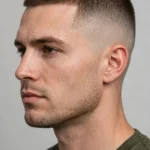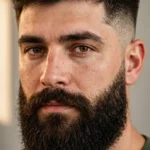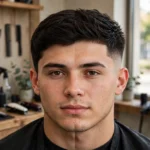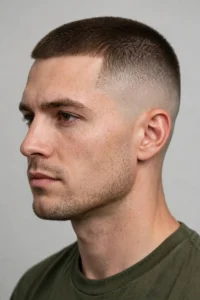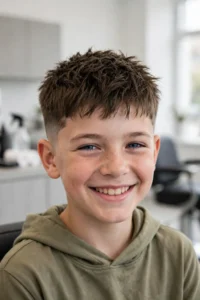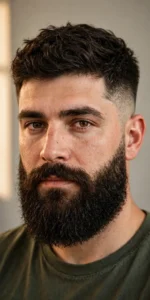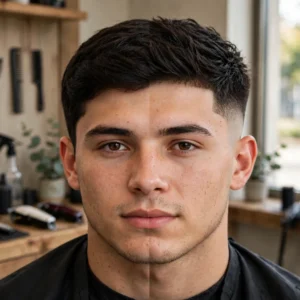


The best boys haircut fades balance a clean, grown-up shape with a morning routine a kid will actually sit still for. Our top three: the Classic Low Fade with Textured Top for a first fade, the Low Fade with Textured Crop for the easiest school mornings, and the Curly Top High Fade for curly hair. The other 36 below cover every age, hair type and fade height, with the exact words to say to the barber for each one.
Quick-Pick Table: All 39 Boys Haircut Fades at a Glance
| # | Style | Fade level | Top length | Best age | Effort |
|---|---|---|---|---|---|
| 1 | Classic Low Fade with Textured Top | Low | Medium | 5–12 | Low |
| 2 | Classic Mid Fade with Side Part | Mid | Medium | 7–14 | Medium |
| 3 | Classic High Fade | High | Medium–long | 9–16 | Medium |
| 4 | Classic Taper Fade | Taper | Short–medium | 4–12 | Low |
| 5 | Classic Short Fade | Low–mid | Very short | 5–14 | Very low |
| 6 | Low Fade with Textured Crop | Low | Short | 6–13 | Low |
| 7 | Low Taper Fade with Brushed Forward Top | Low taper | Medium | 6–12 | Low |
| 8 | Mid Fade Crop | Mid | Short | 6–14 | Low |
| 9 | Mid Skin Fade with Side Part | Mid skin | Medium | 8–15 | Medium |
| 10 | Low Fade Quiff | Low | Medium–long | 8–15 | Medium |
| 11 | High Skin Fade with Crop Top | High skin | Short | 8–16 | Low |
| 12 | Skin Fade with Quiff | Skin | Medium–long | 10–16 | Medium |
| 13 | Buzz Cut with Skin Fade | Skin | Very short | 5–16 | Very low |
| 14 | High Fade with Textured Fringe | High | Medium | 7–14 | Low |
| 15 | Zero Fade with Design | Zero skin | Short | 7–14 | Medium |
| 16 | Curly Top High Fade | High | Long | 6–15 | Medium |
| 17 | Wavy Fringe Mid Fade | Mid | Medium | 6–13 | Low |
| 18 | Coily Top Low Fade | Low | Long | 5–14 | Medium |
| 19 | Straight Hair Slicked Back Fade | Mid | Medium–long | 9–16 | Medium |
| 20 | Thick Hair Messy Top Fade | Mid | Long | 8–15 | Low |
| 21 | Toddler Low Fade | Low | Short | 2–4 | Very low |
| 22 | Little Boy Low Fade | Low | Short | 5–7 | Low |
| 23 | School Age Mid Fade | Mid | Short–medium | 8–10 | Low |
| 24 | Pre-Teen Drop Fade | Drop | Medium | 11–13 | Medium |
| 25 | Teen High Fade with Line Up | High | Medium | 14+ | Medium |
| 26 | Burst Fade with Spikes | Burst | Short–medium | 7–14 | Medium |
| 27 | Faux Hawk Fade | Mid | Medium | 7–14 | Medium |
| 28 | Mohawk Fade | High | Medium | 8–15 | Medium |
| 29 | Hard Part Fade | Mid | Medium | 7–14 | Medium |
| 30 | Ivy League Fade | Low | Short–medium | 8–16 | Medium |
| 31 | Drop Fade with Curly Top | Drop | Long | 8–15 | Medium |
| 32 | Low Fade with Hard Part | Low | Medium | 7–14 | Low |
| 33 | Taper Fade with Neat Comb Over | Taper | Medium | 7–14 | Low |
| 34 | Fade with Caesar Cut | Mid | Short | 5–12 | Low |
| 35 | Fade with French Crop | Mid | Short | 6–14 | Low |
| 36 | Swoop Fringe Fade | Low–mid | Medium | 7–14 | Low |
| 37 | High Fade with Pompadour | High | Long | 12–16 | High |
| 38 | Crew Cut Fade | Low–mid | Short | 5–16 | Very low |
| 39 | Spiky Top Fade | Mid | Short–medium | 6–13 | Low |
What Is a Fade?
A fade is simply hair that gets gradually shorter as it travels down the sides and back, blending smoothly into the skin or near-skin at the bottom. The blend is what makes it look sharp instead of just short, and where that blend starts decides the whole character of the cut. A low fade starts just above the ear and around the sideburns, so it stays subtle, grows out gracefully, and is the safest choice for a first fade or a strict school. A mid fade starts about halfway up the side of the head, giving a balanced, tidy look that suits most boys and most mornings. A high fade climbs close to the crown, so the contrast between the long top and the short sides is dramatic — great for older boys who want the cut to be noticed.
A taper is the gentlest cousin of the fade: the blend is softer, the sideburns and neckline keep a little length, and nothing goes down to skin. It is the best option for a wiggly little boy or a first-ever barber visit — see our baby boy haircuts guide if your son is still at the very first-cuts stage. A skin fade, also called a bald or zero fade, takes the bottom of the blend right down to bare skin, usually with a foil shaver, which looks incredibly crisp but shows regrowth within days. A drop fade follows the curve of the head and dips lower behind the ear, while a burst fade arcs around the ear in a rounded shape and leaves length at the nape — read our full burst fade guide if that curved shape appeals to you.
Before you sit your son in the chair, learn the guard numbers, because naming one removes all guesswork. A #0 guard cuts skin-close, a #1 leaves about 3mm, a #2 leaves 6mm, a #3 leaves 10mm and a #4 leaves 13mm. Every barber ask in this guide names its guards, so you can repeat the words exactly and get the same cut at any good barbershop.
The 39 Best Boys Haircut Fades
1. Classic Low Fade with Textured Top
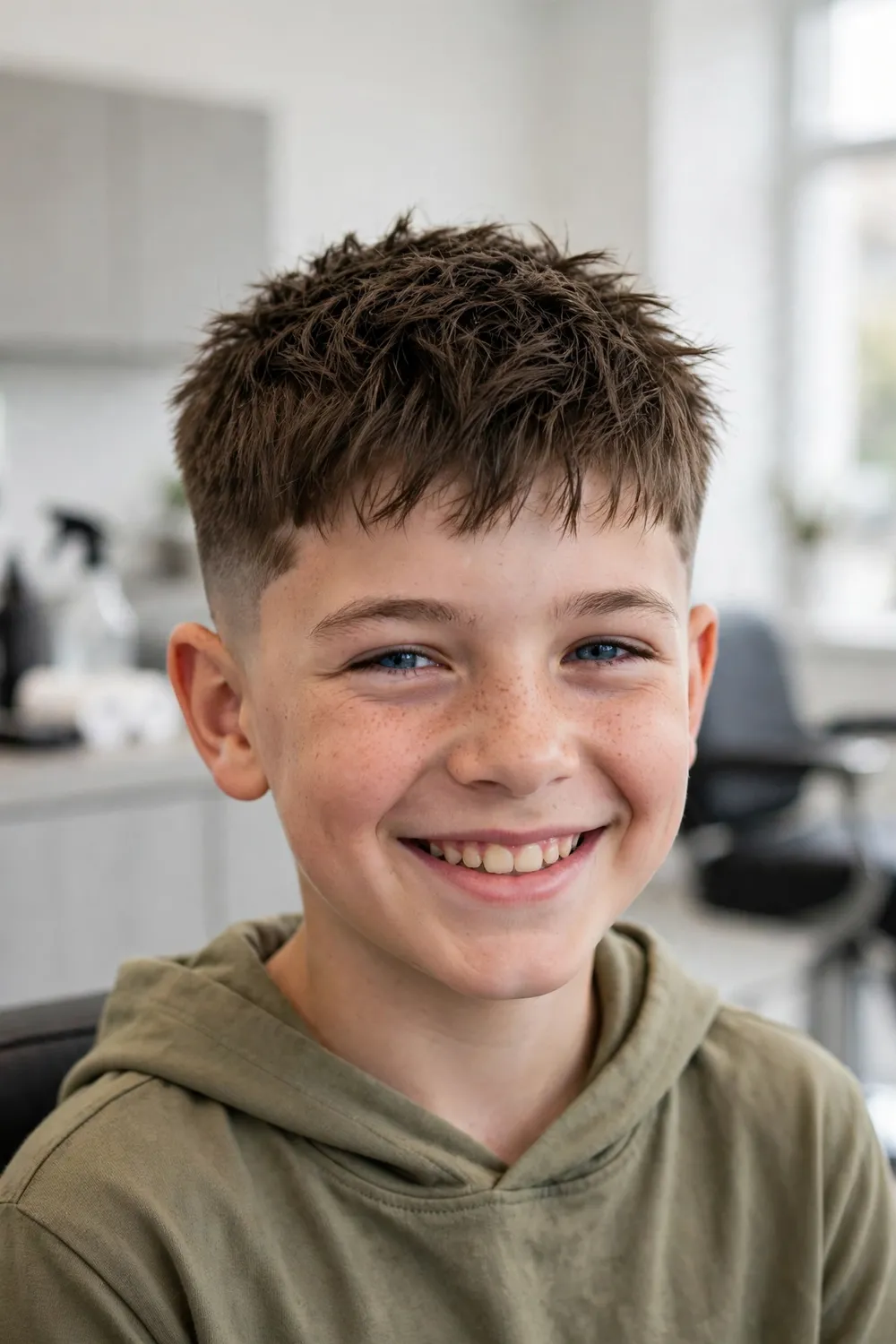
The Classic Low Fade with Textured Top is the safest first fade you can ask for. The sides stay low and neat, fading gently from a #1 at the bottom up to a #3, while the top keeps about two inches of choppy, point-cut texture. It suits boys aged five to twelve with straight or wavy hair, fine to medium in thickness. Tell the barber: “Low fade, #1 to #3 blend, leave two inches on top and point-cut the texture in.” A pea-sized dab of matte clay, rubbed between your palms and pushed through the top, gives a natural finish with no shine. Trim every three to four weeks; the low fade grows out gracefully. Dads who want to match their son can start with our low fade guide.
2. Classic Mid Fade with Side Part
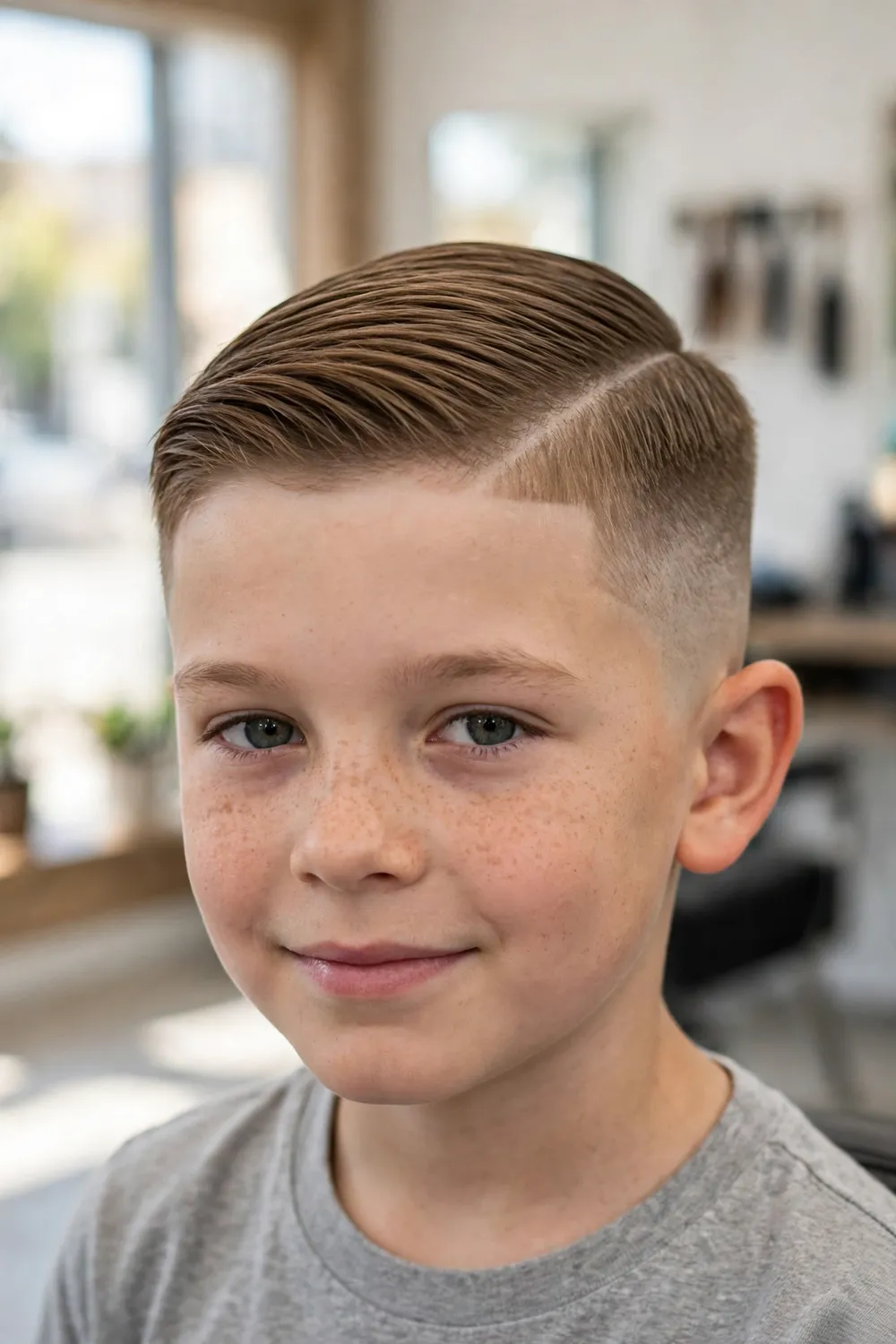
The Classic Mid Fade with Side Part is the timeless school-photo cut, the one that has never really gone out of fashion. The fade starts halfway up the side of the head, blending from a #1 into a #2, while the top stays around three inches with a clean part combed to one side. It suits boys aged seven to fourteen with straight or wavy hair of medium thickness. Tell the barber: “Mid fade, #1 up to #2, part on the left, three inches on top, tapered at the neck.” A light pomade or styling cream, combed through damp hair along the part, holds the shape without stiffness. Expect a trim every three weeks, as the part softens and the edges lose their crispness first.
3. Classic High Fade
The Classic High Fade is the boldest of the three classic fades, and it suits a boy who actually wants his haircut noticed. The blend climbs high, from a #0 at the bottom through a #2, so the sides look almost bare next to a top left long at three to four inches. It works best for boys aged nine to sixteen with thick, straight or wavy hair that can hold height. Tell the barber: “High fade, #0 to #2, keep four inches on top and square off the fringe.” Matte paste worked through towel-dried hair, dried upward, gives the top its lift. The finish is clean and confident, with real contrast between top and sides. Plan a trim every two to three weeks; a high fade shows regrowth fast.
4. Classic Taper Fade
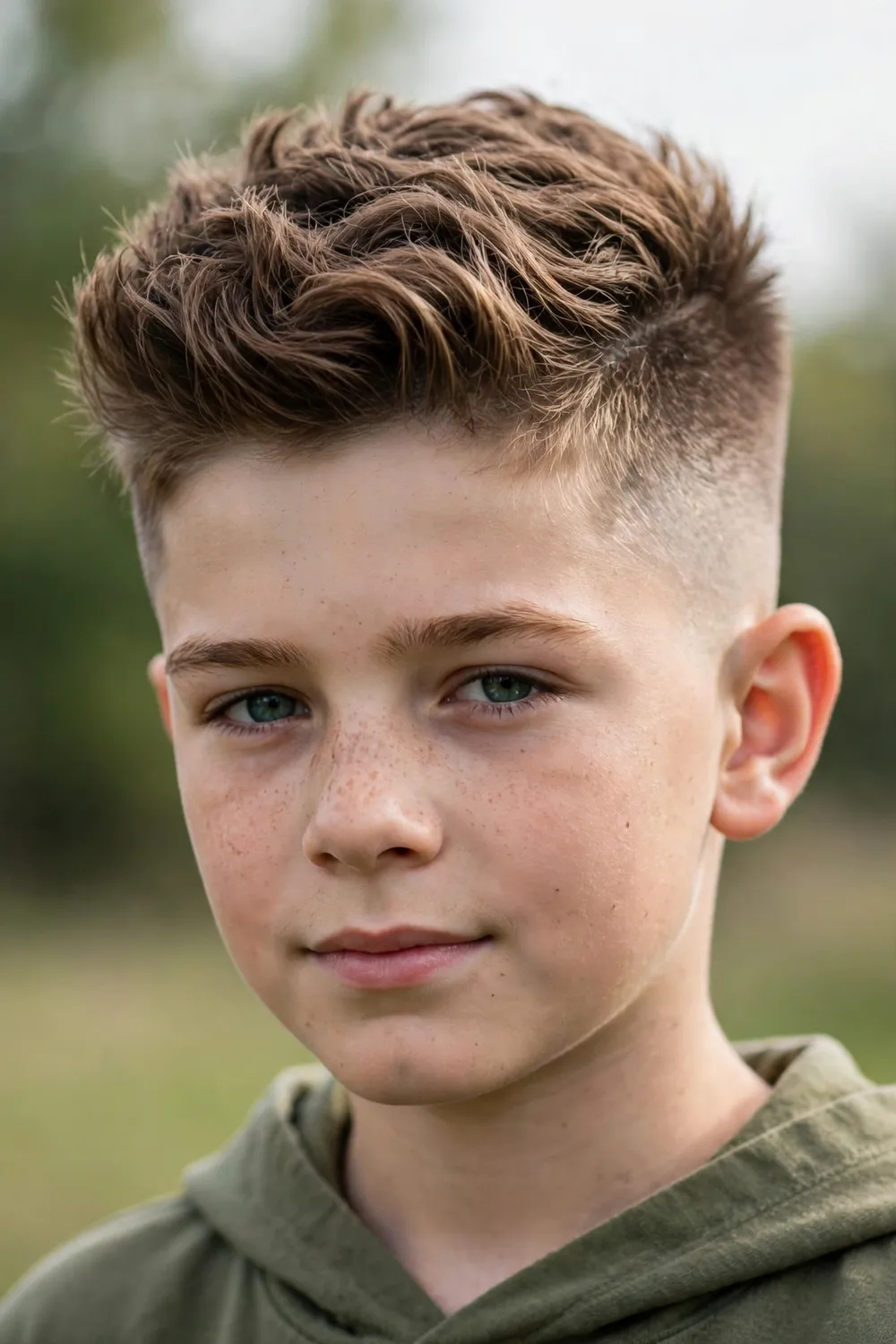
The Classic Taper Fade is the gentlest fade in this guide, and for a nervous little boy it is often the right first step into fades. Nothing goes down to skin; the sides simply graduate from a #2 into a #4, keeping a soft edge around the ears and neckline while the top stays more or less as it is, just tidied. It suits boys aged four to twelve with any hair type, straight, wavy or curly. Tell the barber: “Low taper, #2 at the sides fading to #4, keep the top as it is, just tidy the edges.” Most mornings need no product, though a dab of leave-in tames flyaways. Trims can stretch to four or five weeks; the grow-out is the easiest of any fade here.
5. Classic Short Fade
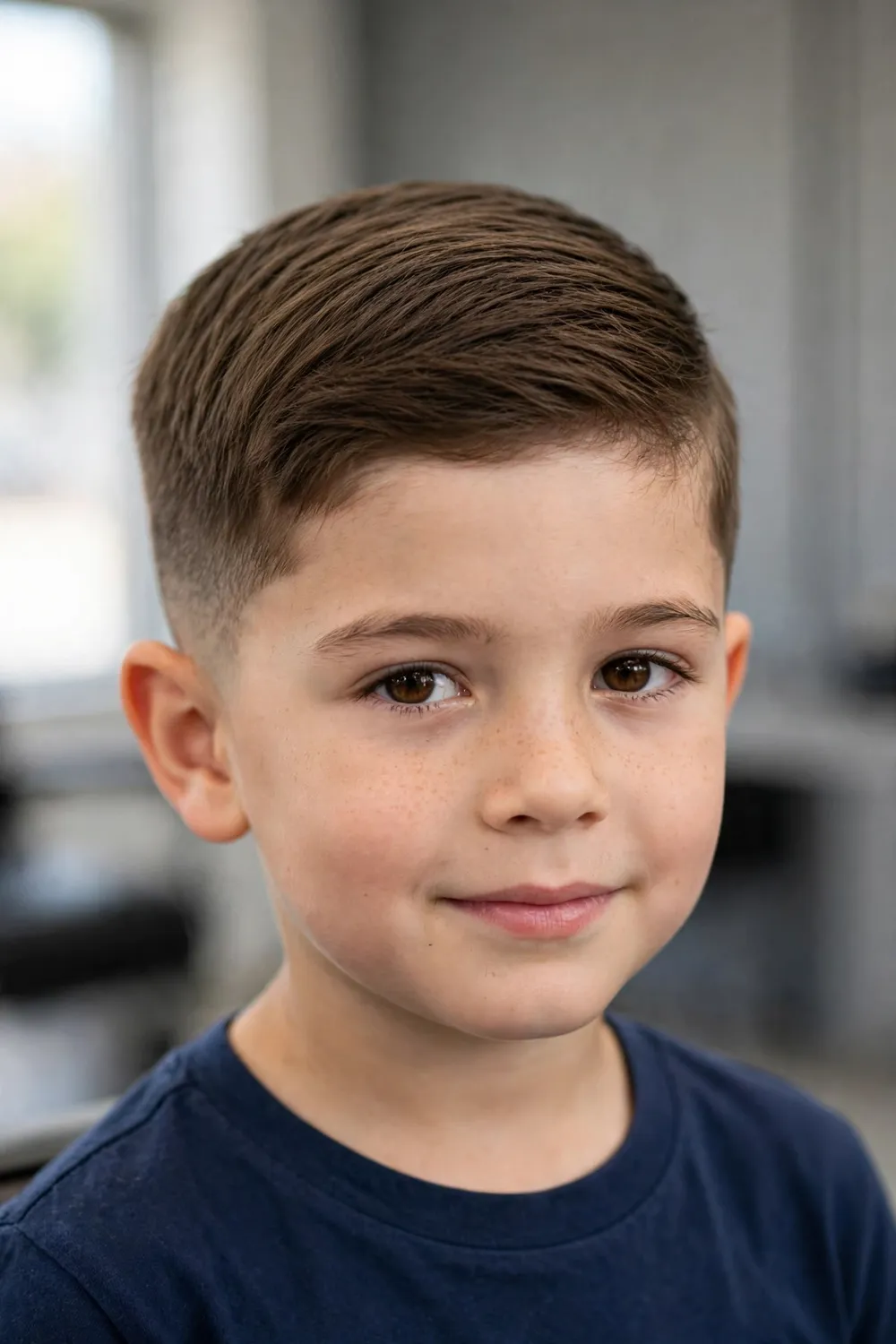
The Classic Short Fade is the answer for parents who are tired of the morning hair battle, because there is almost nothing left to style. The top is clipped to a #3, the sides fade from a #1, and the whole head reads as one short, even, sporty shape that dries in seconds. It suits boys aged five to fourteen with thick hair. Tell the barber: “Short fade, #1 on the sides to a #3 on top, blended at the temples.” No product is needed; towel-dry and go, with a little sunscreen on the scalp in strong sun. The finish is clean, cool and completely fuss-free. Book a trim every three weeks, or let it grow out through a neat buzz-cut stage.
6. Low Fade with Textured Crop
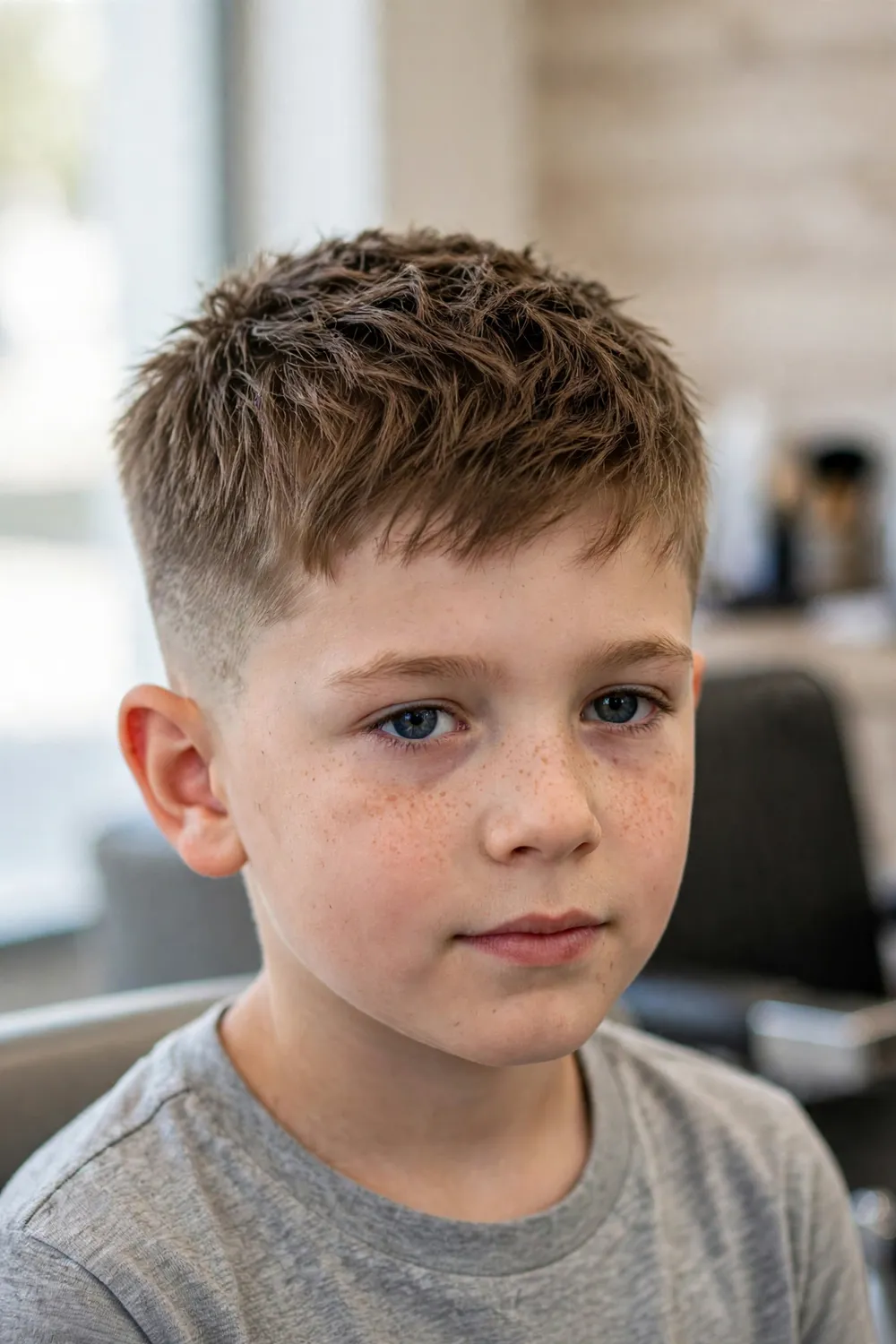
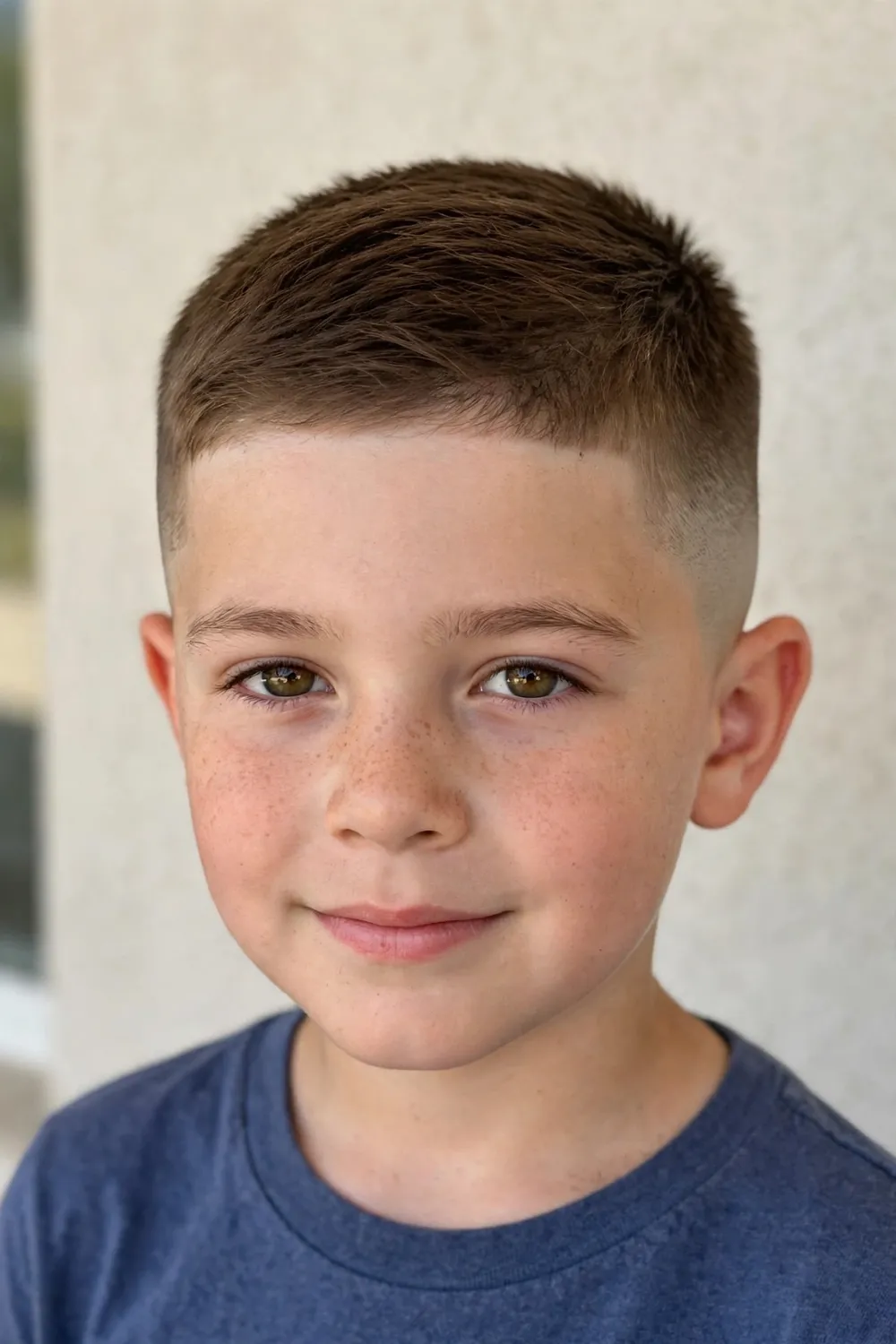
The Low Fade with Textured Crop is our pick for the easiest school mornings. The top is cropped short, about an inch and a half, and point-cut into choppy layers that fall into place on their own, while a low fade from a #1 to a #2 keeps the sides tidy. It suits boys aged six to thirteen with straight or wavy hair. Tell the barber: “Low fade, #1 to #2, crop the top to about an inch and a half, point-cut for texture.” A fingertip of matte clay pinched into the ends is all it needs; on lazy mornings even that can be skipped. The finish is casual and slightly scruffy, never stiff or shiny. Trim every three to four weeks; the crop grows out evenly.
7. Low Taper Fade with Brushed Forward Top
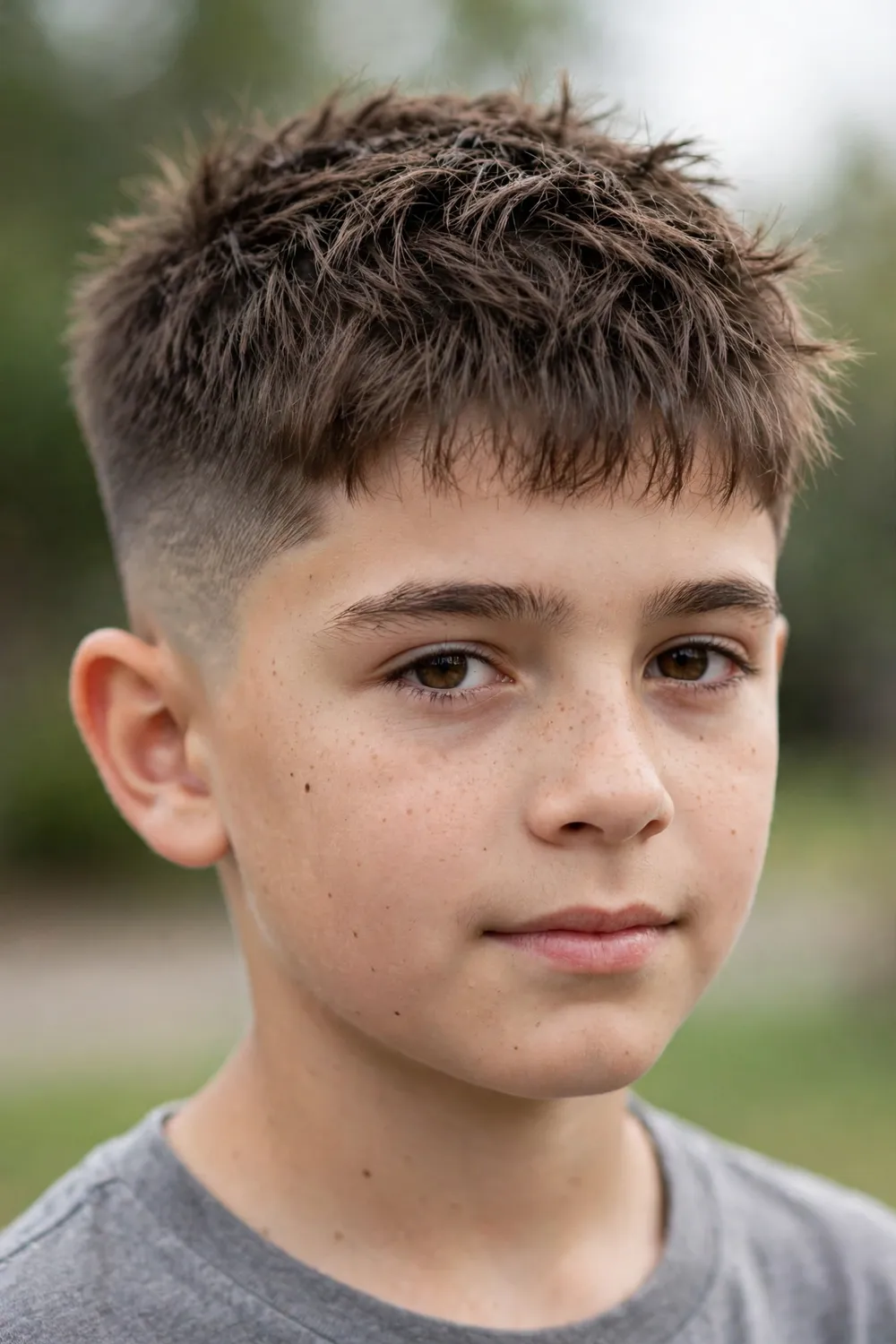
The Low Taper Fade with Brushed Forward Top gives a boy a softly grown-up look without any of the fuss of a slicked-back style. The sides taper gently from a #2 to a #4, the fringe is left long enough to brush forward at about two and a half inches, and the whole cut reads neat rather than severe. It suits boys aged six to twelve with straight hair, fine to medium. Tell the barber: “Low taper fade, #2 to #4, top left two and a half inches, brushed forward.” A light styling cream smoothed through damp hair keeps the fringe in place. The finish is soft, natural and school-safe, with no hard lines. A trim every four weeks is plenty, since the taper grows out so gently.
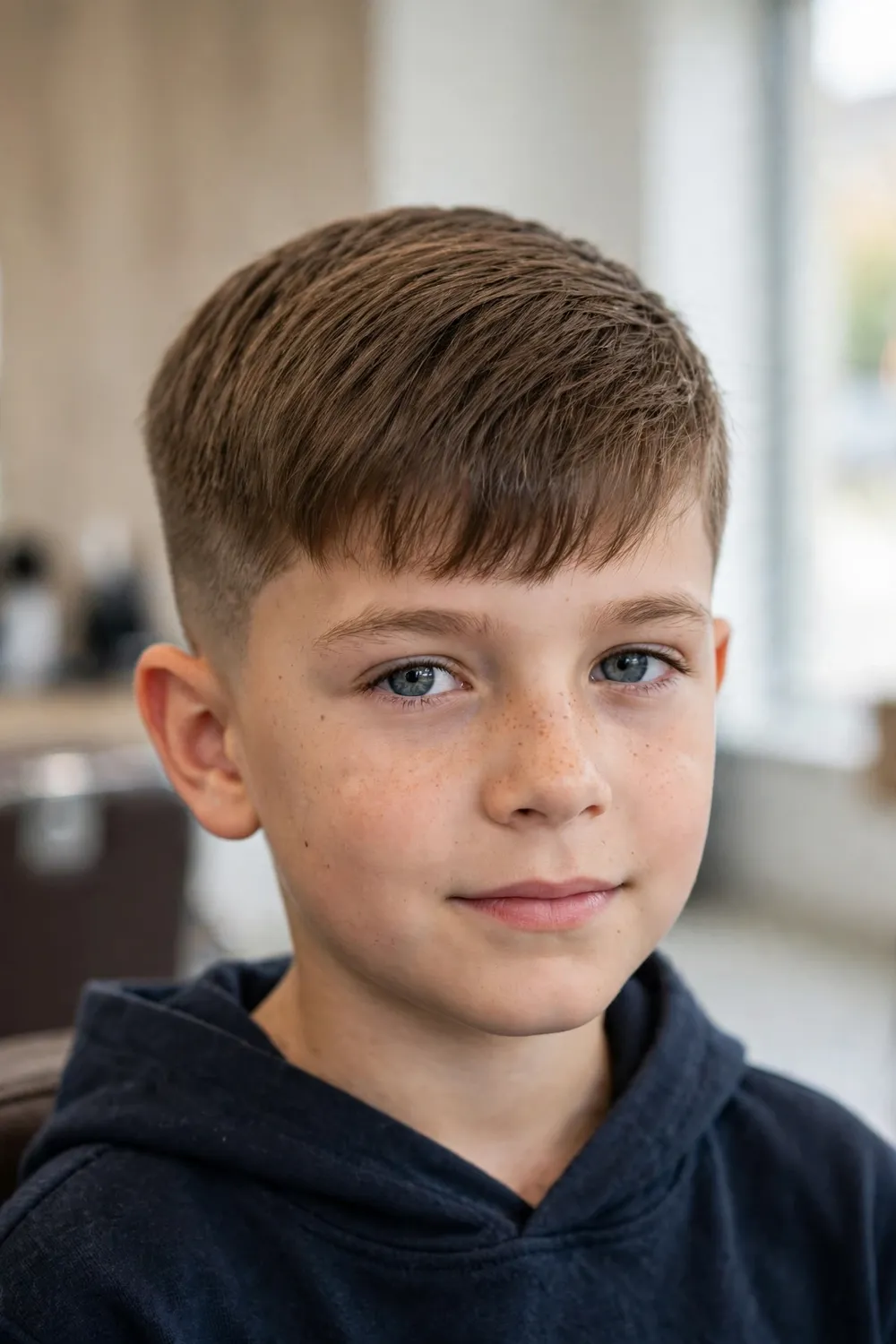
8. Mid Fade Crop
The Mid Fade Crop is the workhorse of this list: balanced, tidy and easy to live with. A mid fade from a #1 to a #2 gives the sides a clean edge, while the top is cropped to about an inch and a half with a lightly textured fringe that never falls into the eyes. It suits boys aged six to fourteen with thick or wavy hair. Tell the barber: “Mid fade, #1 to #2, crop top one and a half inches, textured fringe.” A small amount of matte paste, worked through with the fingers, adds definition without shine. The finish is neat but relaxed, and still looks good after a helmet or a swim. Book a trim every three to four weeks; the crop holds its shape until then.
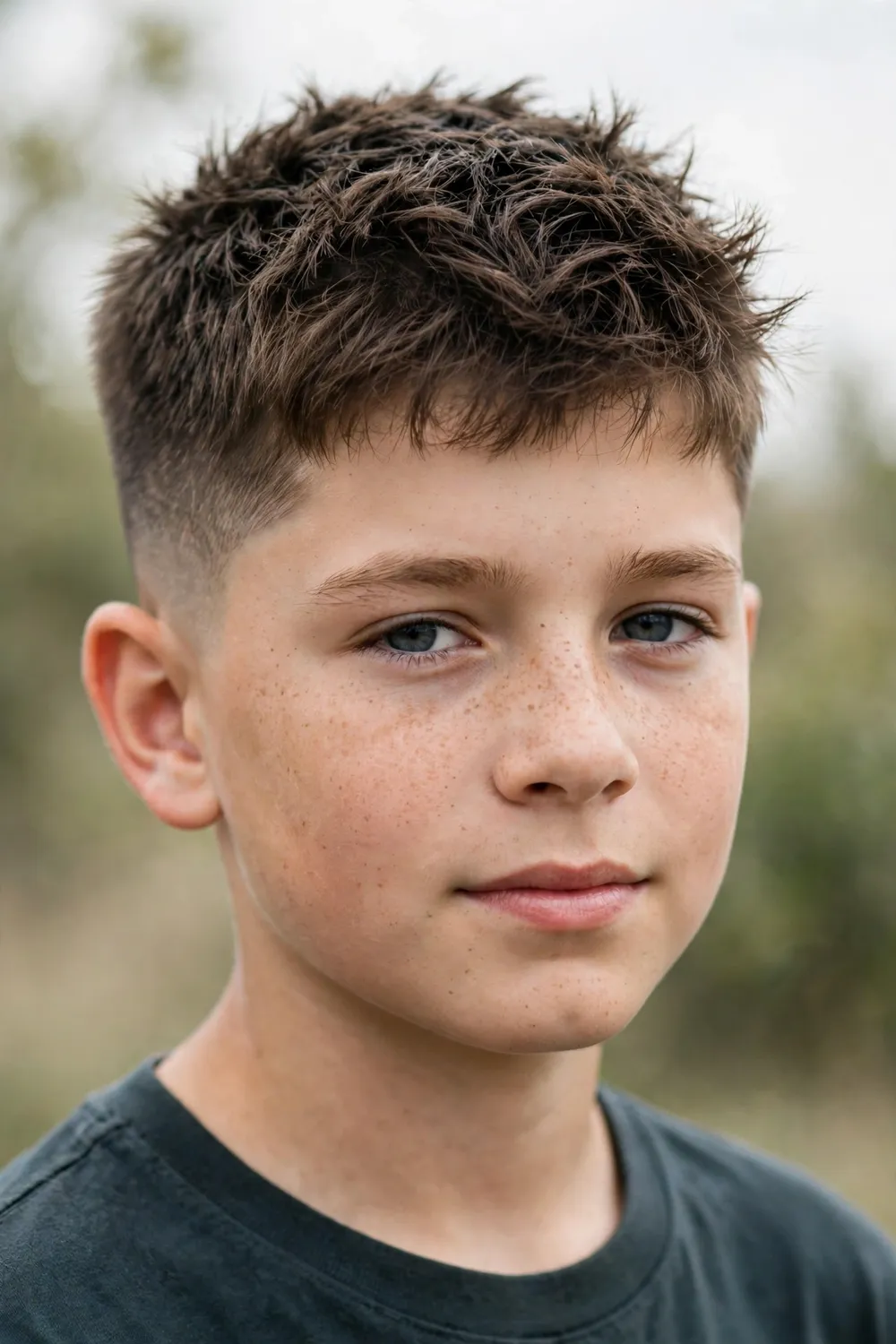
9. Mid Skin Fade with Side Part
The Mid Skin Fade with Side Part is the photo-day cut, sharp enough for a wedding and tidy enough for Monday assembly. The sides go down to skin at the bottom, blending up through a #1 to a #2, while the top keeps three inches and a crisp part combed to the side. It suits boys aged eight to fifteen with straight or wavy hair that holds a part. Tell the barber: “Mid skin fade, foil shaver at the bottom, #1 to #2 blend, side part, three inches on top.” A light pomade combed along the part gives a polished finish. Check the school dress code first, since some schools draw the line at skin fades. Trim every two to three weeks; a skin fade loses its edge quickly.
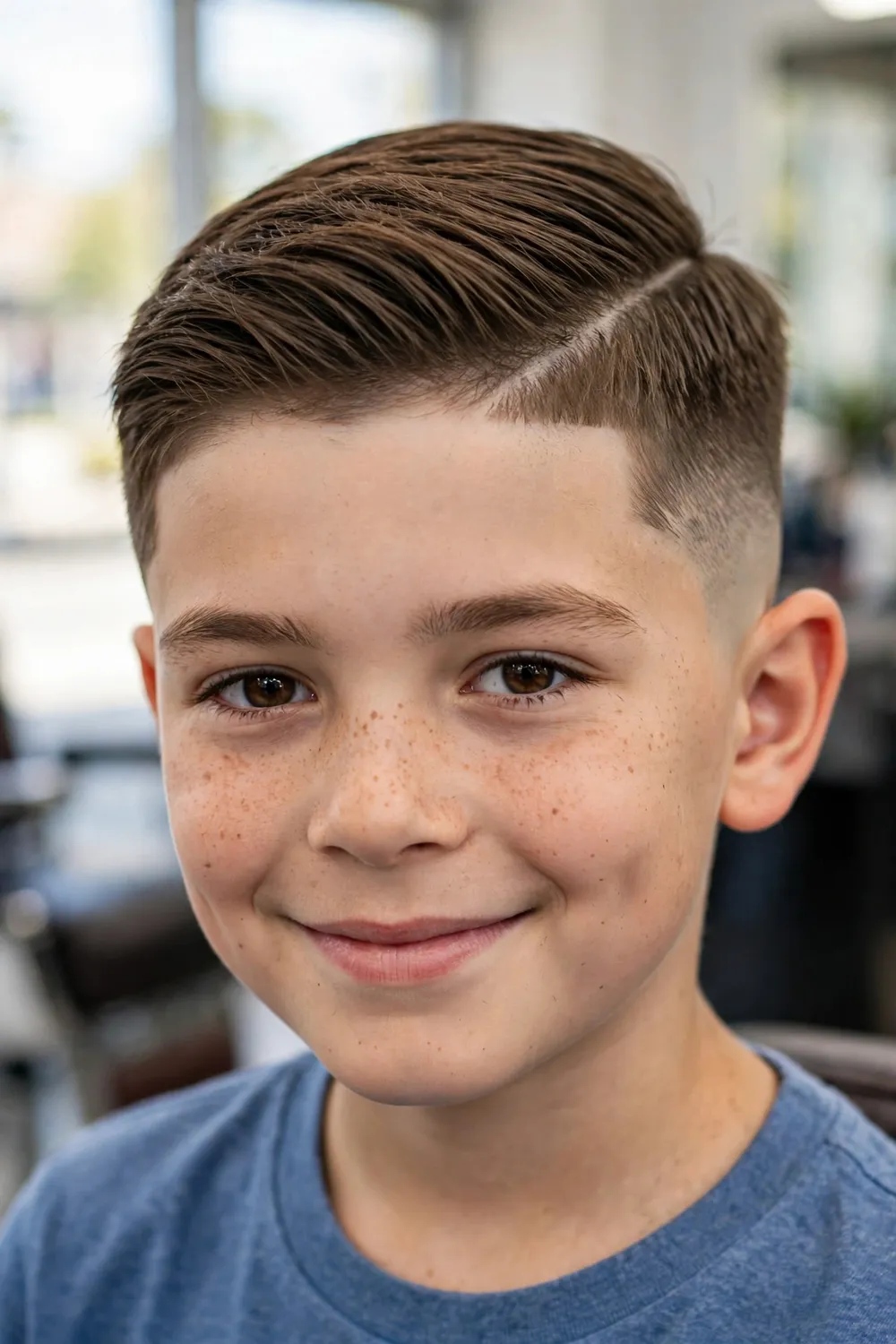
10. Low Fade Quiff
The Low Fade Quiff puts all the drama on top and keeps the sides calm and clean underneath. The fade stays low, from a #1 to a #3, while the front is left at three and a half inches and swept upward into a soft quiff that falls naturally to one side. It suits boys aged eight to fifteen with straight or wavy hair of medium to thick texture. Tell the barber: “Low fade, #1 to #3, leave three and a half inches on top, quiff swept up at the front.” Volumising mousse on damp hair, dried upward, then a little matte clay holds the lift without crunch. Stylish but wearable, not a costume. Two minutes each morning and a trim every three weeks keeps the quiff up.
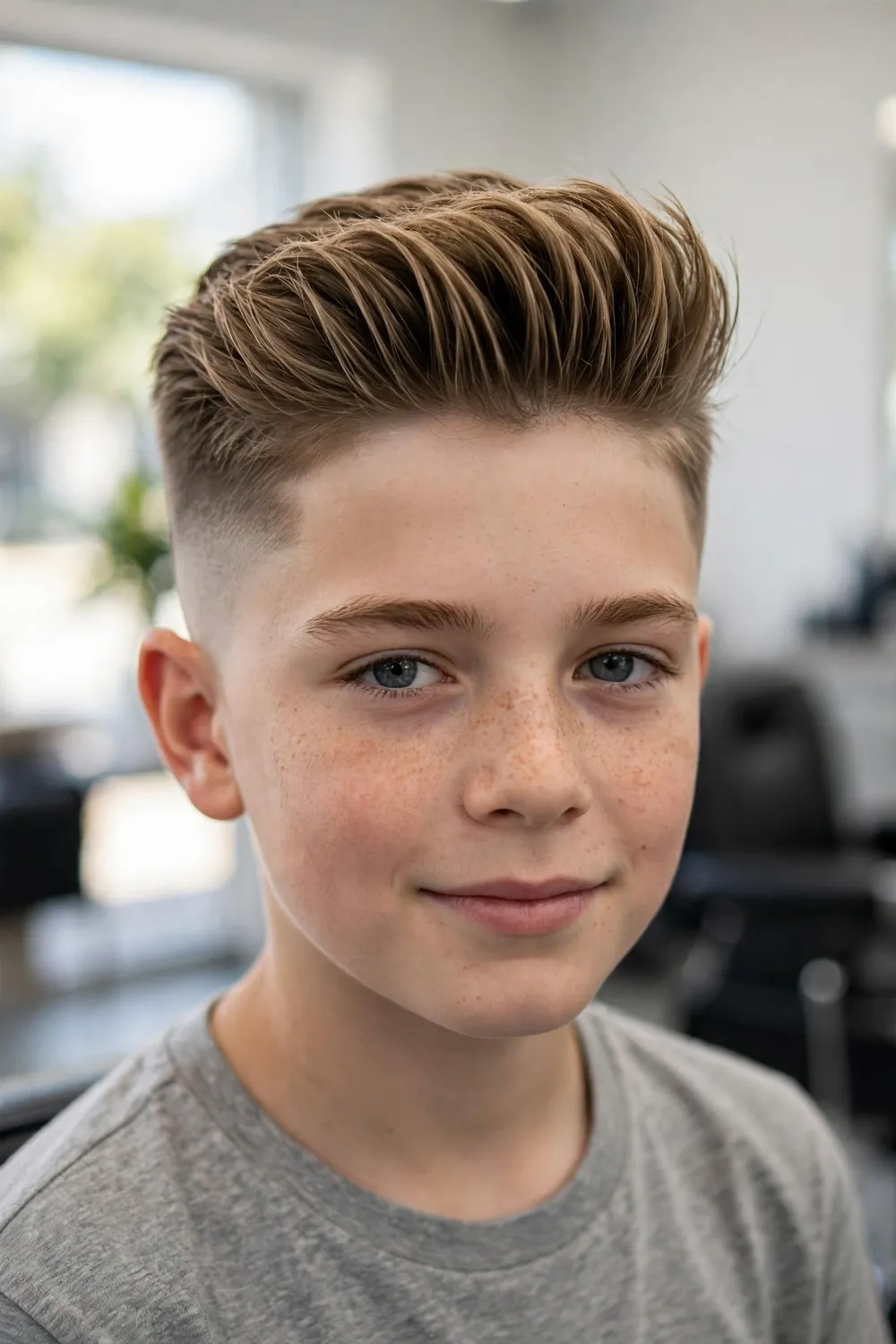
11. High Skin Fade with Crop Top
The High Skin Fade with Crop Top is built for the boy who lives in trainers and comes home muddy. The sides are faded to skin high up the head, from a #0 to a #1, while the top is cropped to a neat one inch with a straight fringe. It suits boys aged eight to sixteen with straight or wavy hair. Tell the barber: “High skin fade, #0 to #1, crop top one inch, straight fringe.” Most days need no product; on picture days a touch of light clay keeps the fringe flat. The finish is cool, clean and sporty. Book a trim every two to three weeks; the skin grows back visibly and the high line sells the style.
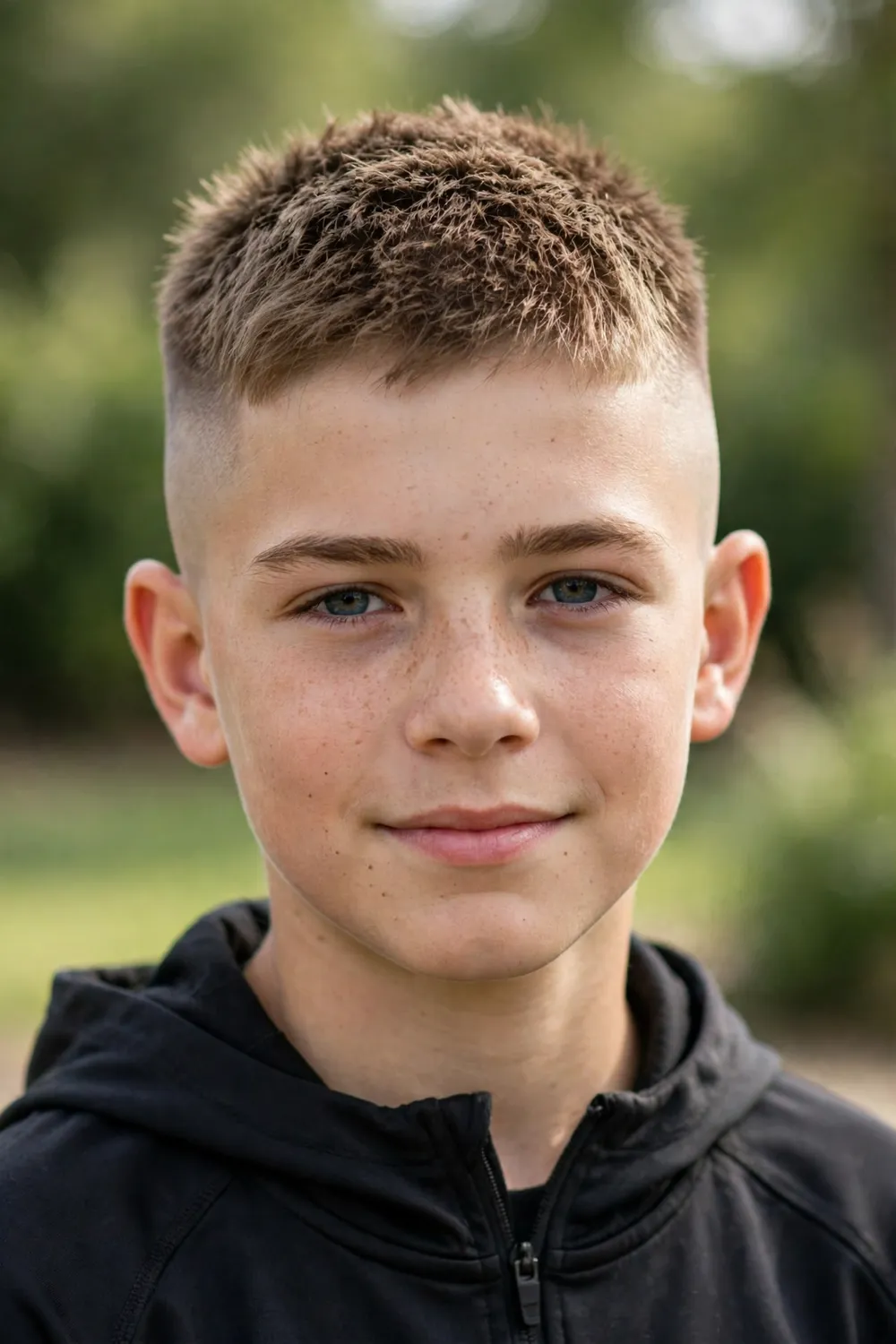
12. Skin Fade with Quiff
The Skin Fade with Quiff is the boldest pairing in this guide, and it belongs to older boys who genuinely enjoy their hair. Bare skin at the sides, fading up through a #2, meets four inches of top swept high at the front. It suits boys aged ten to sixteen with thick, straight or wavy hair that can hold volume. Tell the barber: “Skin fade, #0 up to #2, four inches on top for the quiff, sharp hairline.” Strong-hold matte clay, worked through hair dried upward at the front, keeps the quiff standing all day. Check the school rules before you book, as skin fades are the first thing a strict dress code bans. Trim every two weeks to keep the sides truly skin-close.
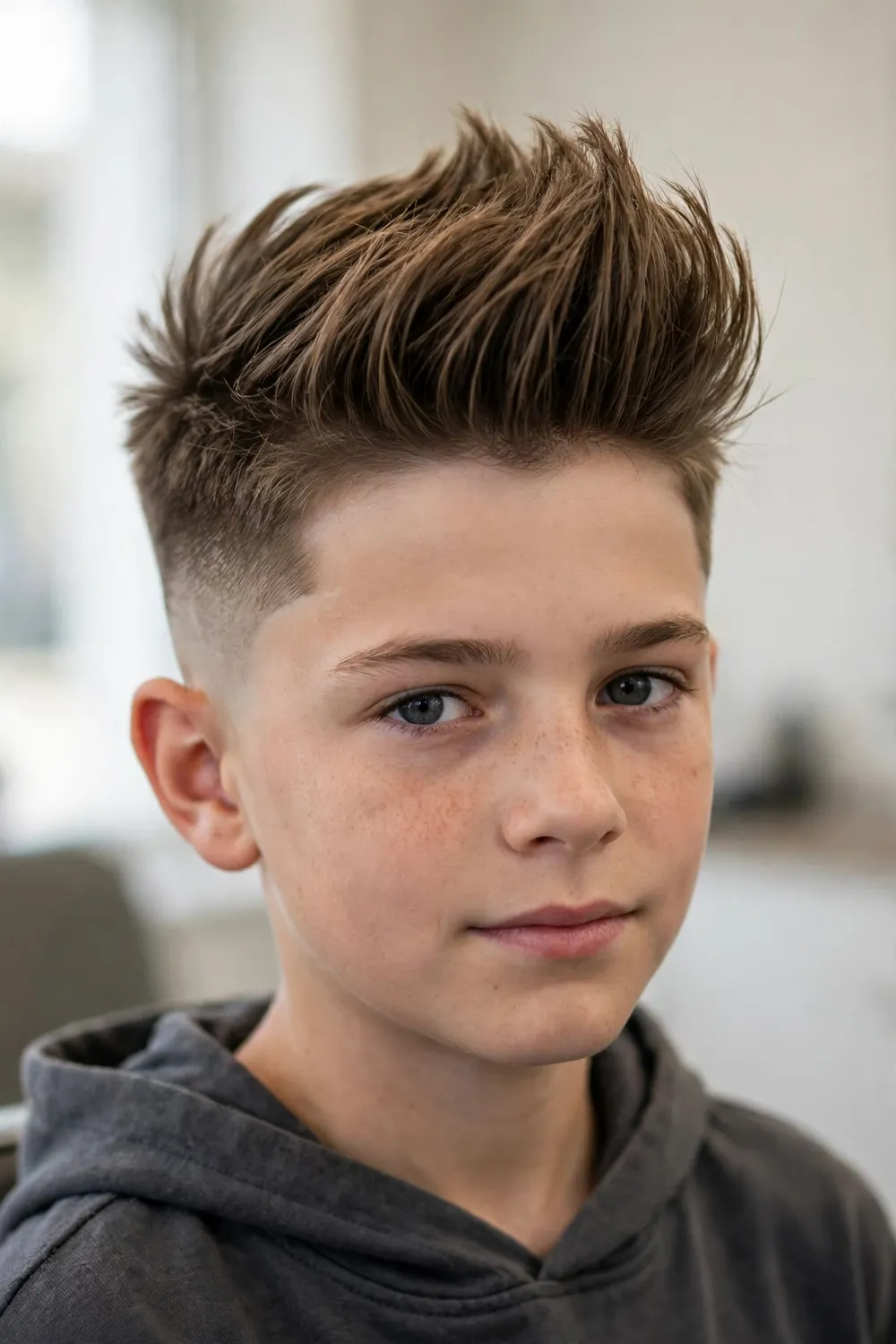
13. Buzz Cut with Skin Fade
The Buzz Cut with Skin Fade is the closest thing to a wash-and-go haircut that still looks like a real style. The top is buzzed to a #2, the sides fade down to skin, and the result is one short, even shape that needs no comb, no product and no morning negotiation. It suits boys aged five to sixteen with any hair type. Tell the barber: “Buzz #2 on top, skin fade on the sides, #0 at the bottom.” There is no product to buy and nothing to apply; towel-dry, and remember sunscreen on the scalp in strong summer sun. The finish is tidy, cool and honest. Trim every two to three weeks, or let it grow out through a neat short stage.
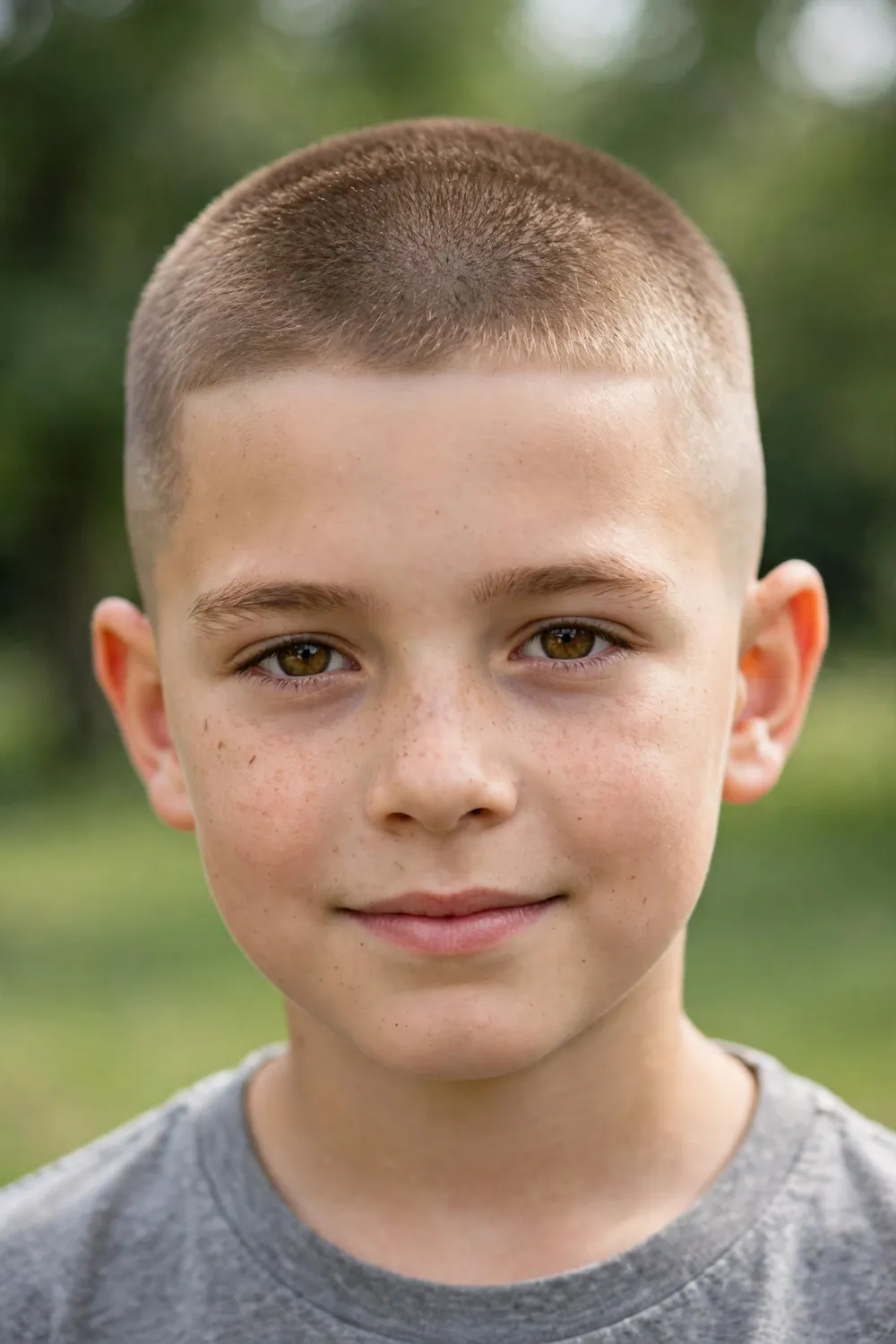
14. High Fade with Textured Fringe
The High Fade with Textured Fringe pairs a choppy, modern fringe with sides faded high. The fade runs from a #0 up to a #2, while the fringe is left at about two inches and point-cut into uneven, textured ends that fall just above the eyebrows. It suits boys aged seven to fourteen with straight or wavy hair. Tell the barber: “High fade, #0 to #2, fringe left two inches, point-cut choppy.” A fingertip of matte clay pinched into the fringe ends gives it separation and stops it clumping together. The finish is edgy but still school-friendly, since the fringe keeps its length modest. Trim every three weeks to keep the fade high and the fringe out of the eyes.
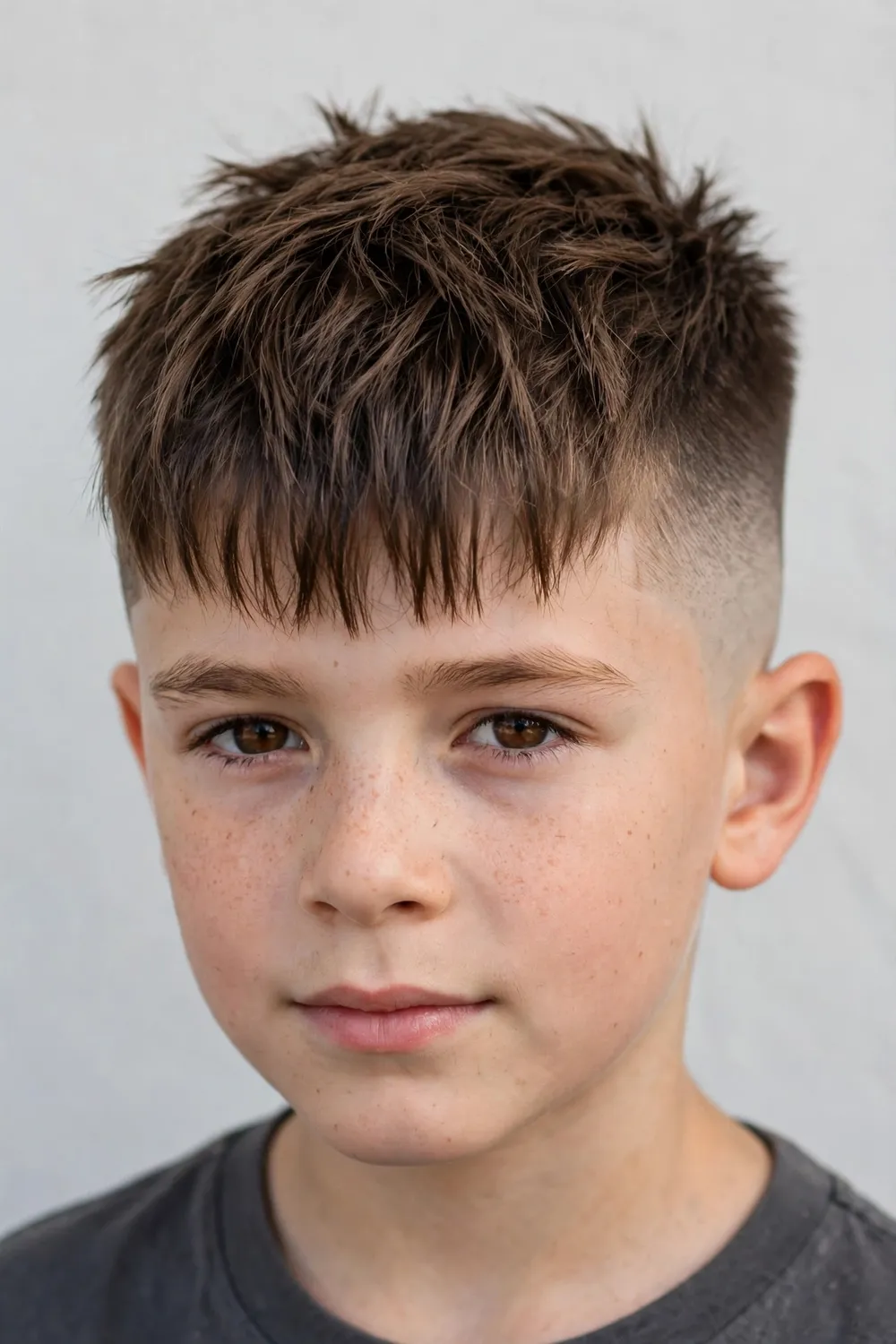
15. Zero Fade with Design
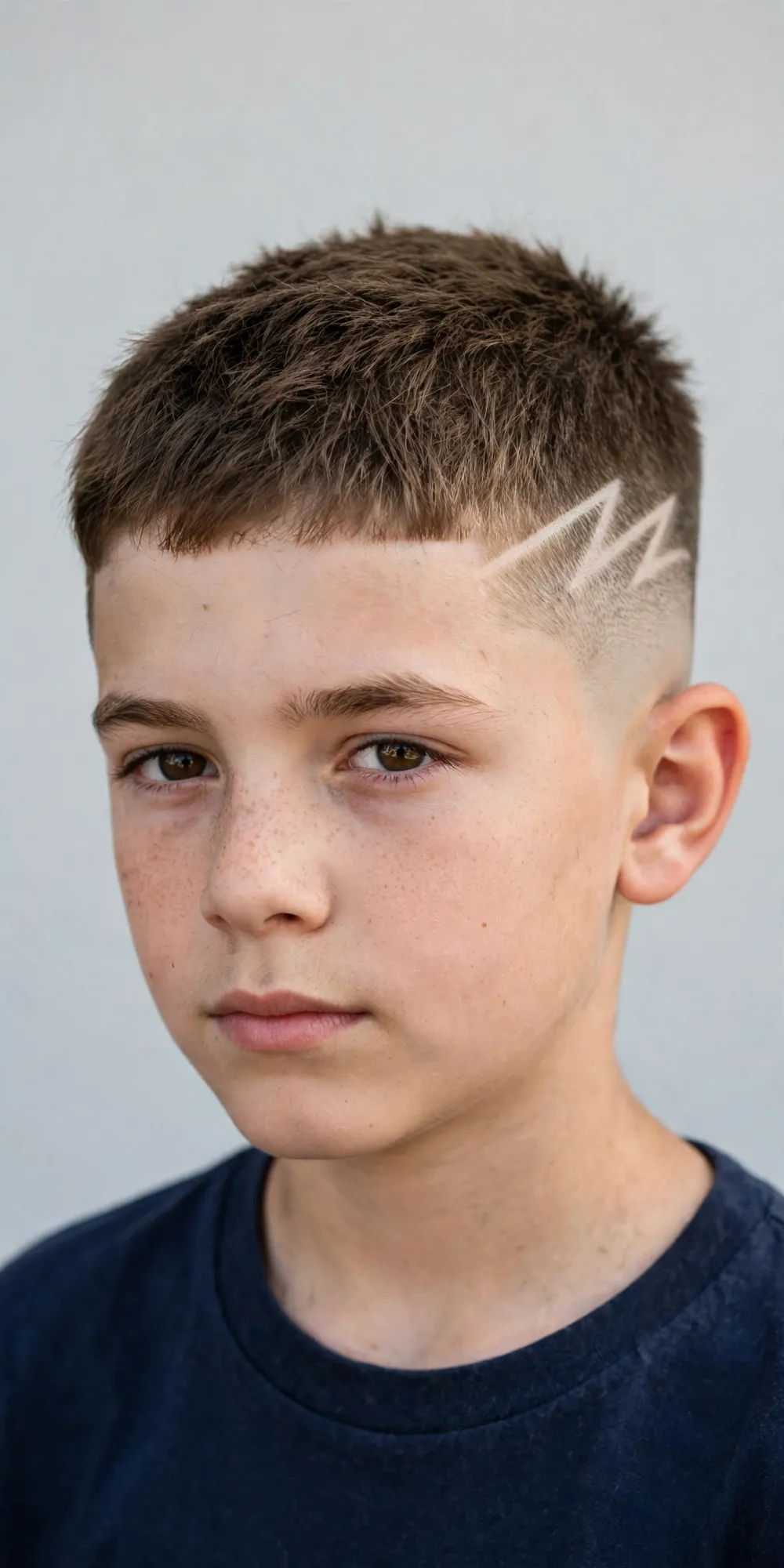
The Zero Fade with Design is the birthday-party haircut, the one other boys ask about in the playground. The sides go right down to a zero fade, skin-close at the bottom, and a lightning-bolt design is shaved in above one ear with a trimmer, turning the fade itself into the decoration. It suits confident boys aged seven to fourteen with straight or wavy hair. Tell the barber: “Zero fade, skin at the bottom, lightning-bolt design shaved above the ear.” No styling product is needed, though a drop of light oil adds shine for a photo. Always check the school dress code first, because shaved designs are banned in many schools. Book a trim every two weeks, since the design blurs quickly as the hair grows back.
16. Curly Top High Fade
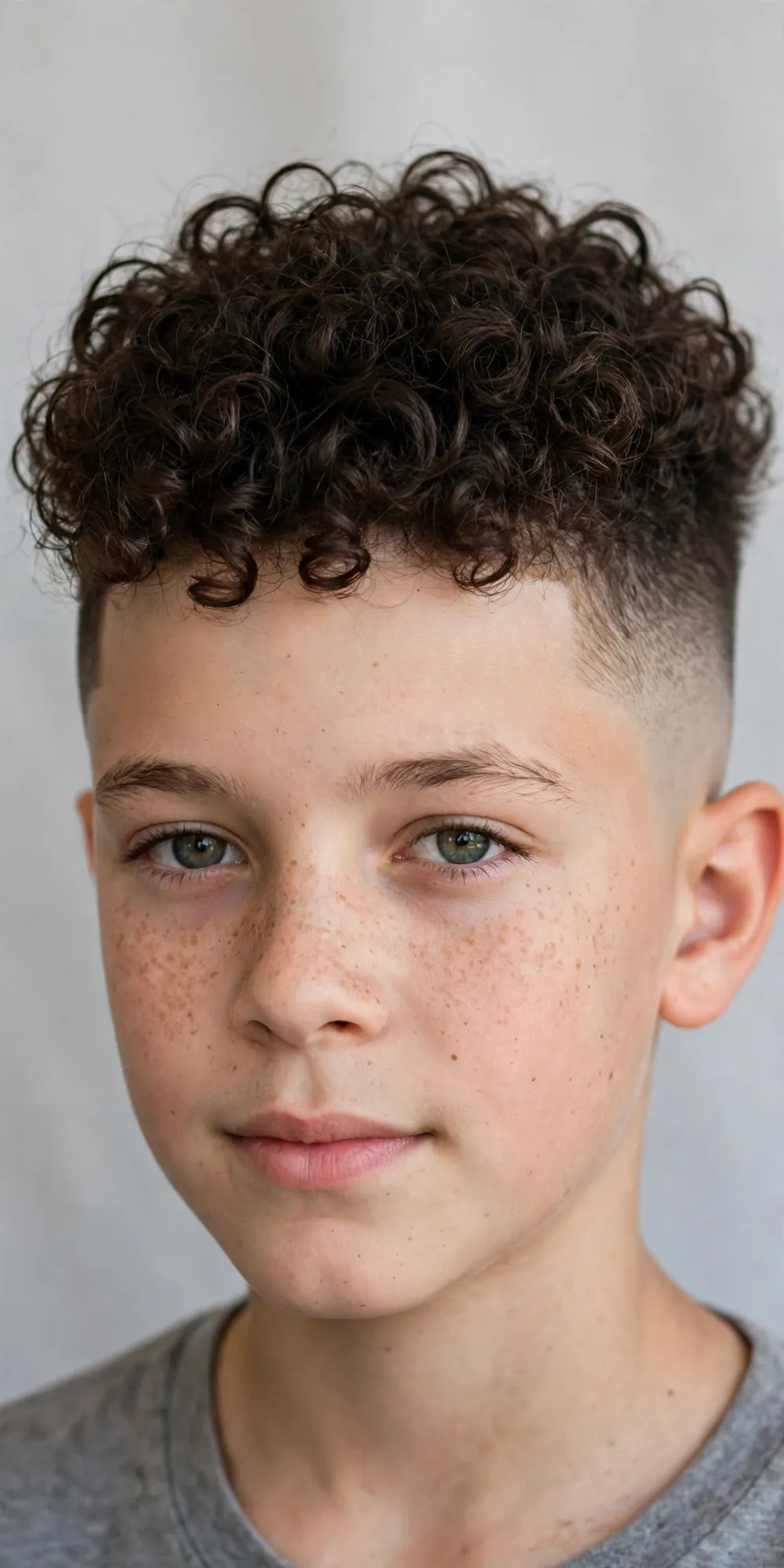
The Curly Top High Fade is our top pick for curly hair: the curls do the talking while the sides stay out of the way. The curls stay long on top, three to four inches, and the sides fade high from a #1 to a #2, so the shape stays clean as the curls grow. It suits boys aged six to fifteen with curly hair of any thickness. Tell the barber: “High fade, #1 to #2, leave the curls three to four inches on top, no thinning shears on the curls.” Curl cream scrunched into damp hair, left to air-dry, defines the curls without crunch. The finish is full and lively. Trim every three to four weeks; the fade keeps the sides tidy while the curls grow.
17. Wavy Fringe Mid Fade
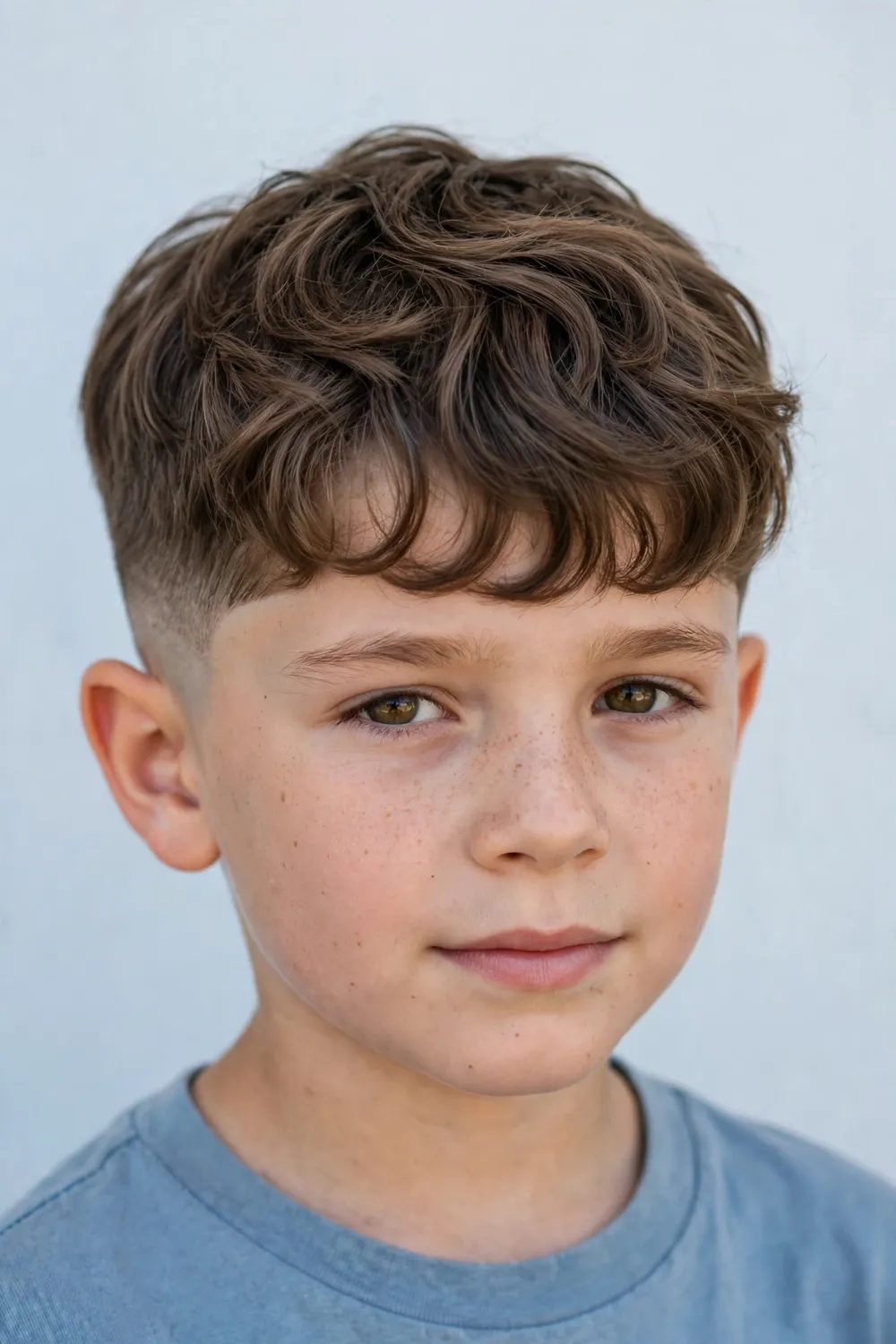
The Wavy Fringe Mid Fade works with the wave instead of fighting it, which is why it looks so effortless. Soft waves fall forward into a fringe of about two and a half inches, while a mid fade from a #1 to a #2 keeps the sides neat and the shape balanced. It suits boys aged six to thirteen with naturally wavy hair, fine to medium. Tell the barber: “Mid fade, #1 to #2, fringe left two and a half inches, texture the ends only.” Sea-salt spray or a dab of light cream, scrunched through damp hair, brings out the wave pattern. The finish is relaxed and beachy, never over-styled. A trim every three to four weeks keeps the fringe clear of the eyes and the fade looking fresh.
18. Coily Top Low Fade
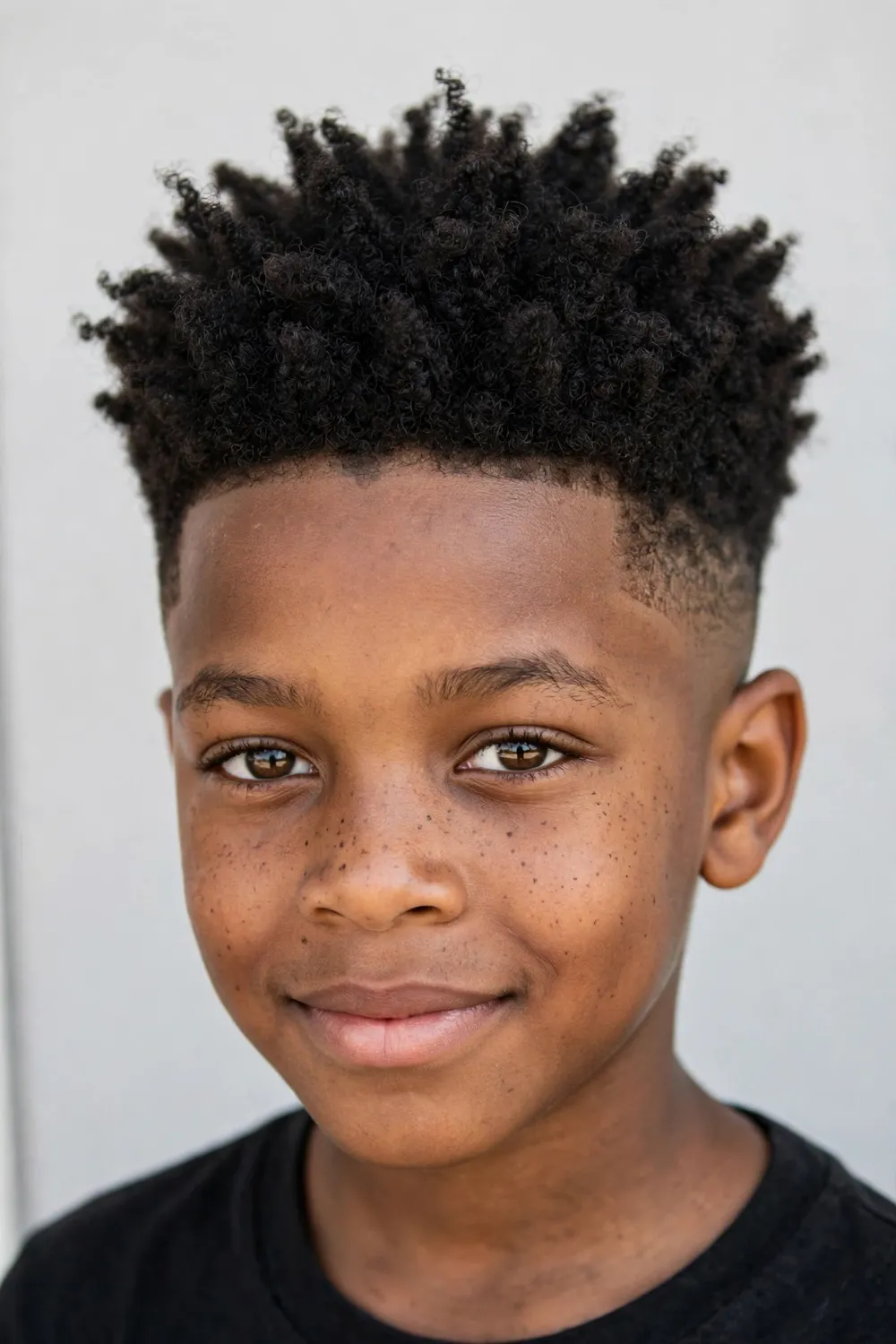
The Coily Top Low Fade keeps the coils full and proud on top while a gentle low fade tidies everything underneath. The coils stay around four inches, picked out for volume, and the sides fade low from a #1 to a #2, so the shape stays soft. It suits boys aged five to fourteen with coily or tightly curly hair. Tell the barber: “Low fade, #1 to #2, keep coils four inches on top, pick them out, no clippers on top.” A curl cream followed by a little light oil keeps the coils moisturised and defined between washes. The finish is full, soft and confident, with the low fade framing the coils. Trim every three to four weeks, and moisturise regularly to keep the coils healthy.
19. Straight Hair Slicked Back Fade
The Straight Hair Slicked Back Fade is the smartest cut in this guide, the one for a boy who likes looking polished. The top is left long at about four inches and combed straight back off the forehead, while a mid fade from a #1 to a #2 keeps the sides crisp and the whole shape sleek. It suits boys aged nine to sixteen with straight hair, medium to thick. Tell the barber: “Mid fade, #1 to #2, top four inches, slicked straight back.” Classic pomade, combed back through damp hair, gives a smooth finish with a light shine. The look is confident and grown-up, closer to a young man’s cut. Trim every three weeks; the slicked top starts to flop once the sides lose their shape.
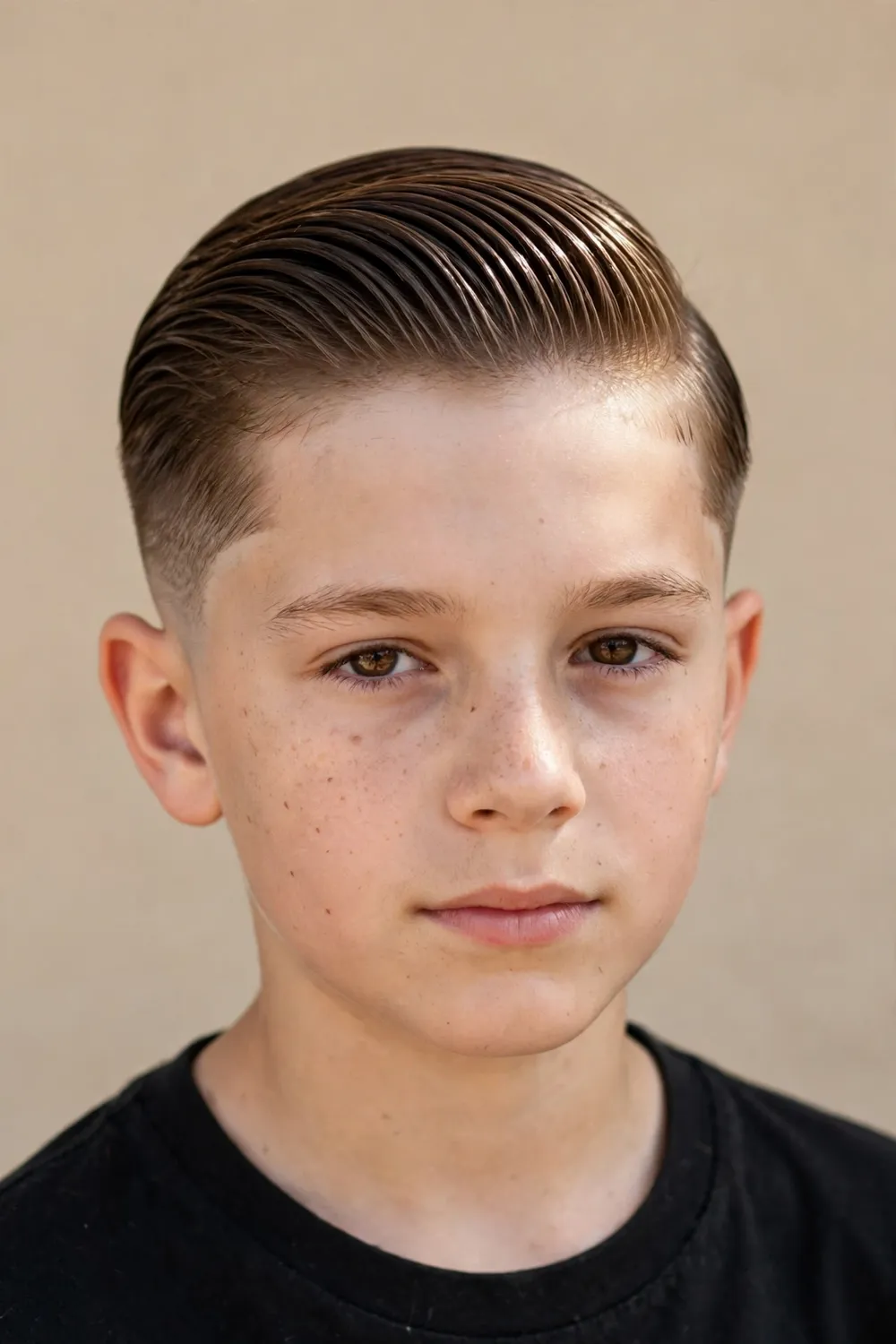
20. Thick Hair Messy Top Fade
The Thick Hair Messy Top Fade is the answer for boys whose hair refuses to lie flat, because this cut stops fighting the thickness and uses it. The top stays long at about four inches and heavily texturised, falling into a tousled shape, while a mid fade from a #1 to a #3 thins the bulk at the sides. It suits boys aged eight to fifteen with thick, wavy or straight hair. Tell the barber: “Mid fade, #1 to #3 to thin the bulk, top four inches, texturised, messy finish.” A little matte clay scrunched through with the fingers is all it takes — the messier, the better. The finish is carefree and full of character. Trim every three to four weeks; the mess hides regrowth well.
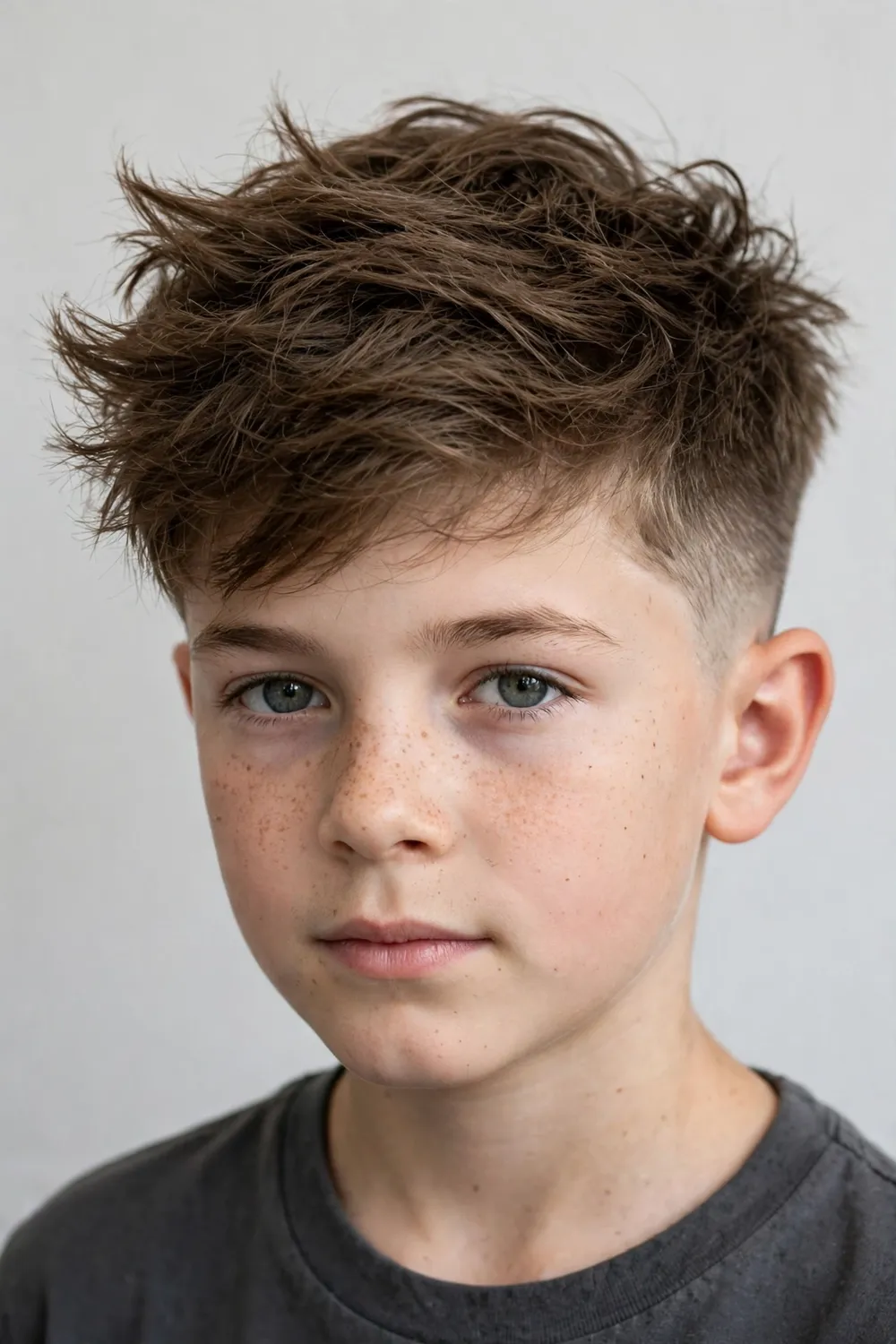
21. Toddler Low Fade
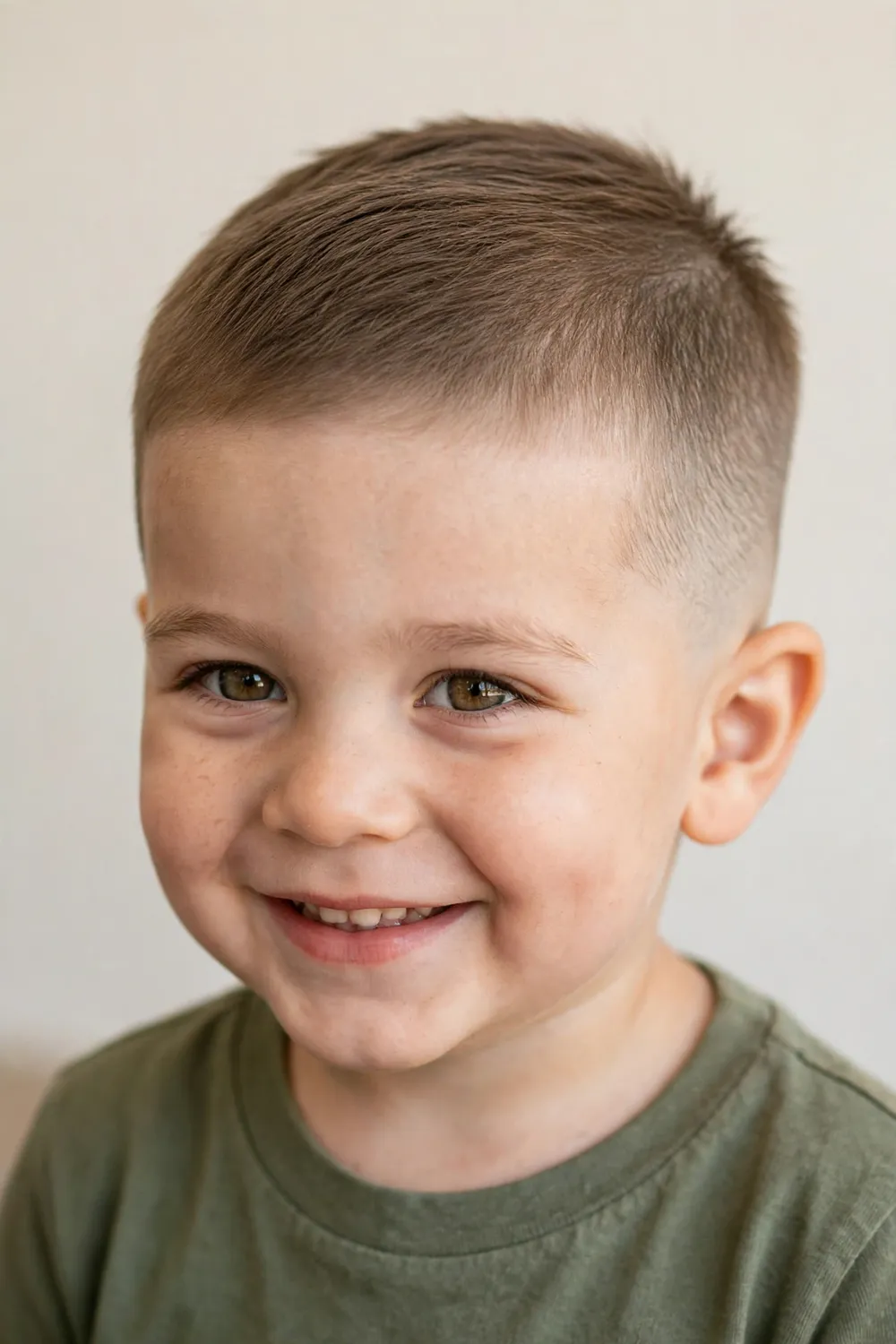
This is the gentlest fade in the list, made for one reason: little boys don’t sit still. The sides blend low and soft, close to the ears, so the whole thing reads tidy without ever looking sharp or grown-up. It suits ages 2–4 with any hair type, and it’s a lifesaver for thick hair that would otherwise stick out everywhere. Ask the barber: “A low taper fade, a number 4 on the sides blending to a 2 at the bottom, and leave about an inch on top — nothing too short.” No product needed — a little water and a quick finger-comb is plenty. If the morning gets chaotic, this cut still looks fine. Trim every 4–5 weeks, and pick a barber who works fast with small kids.
22. Little Boy Low Fade
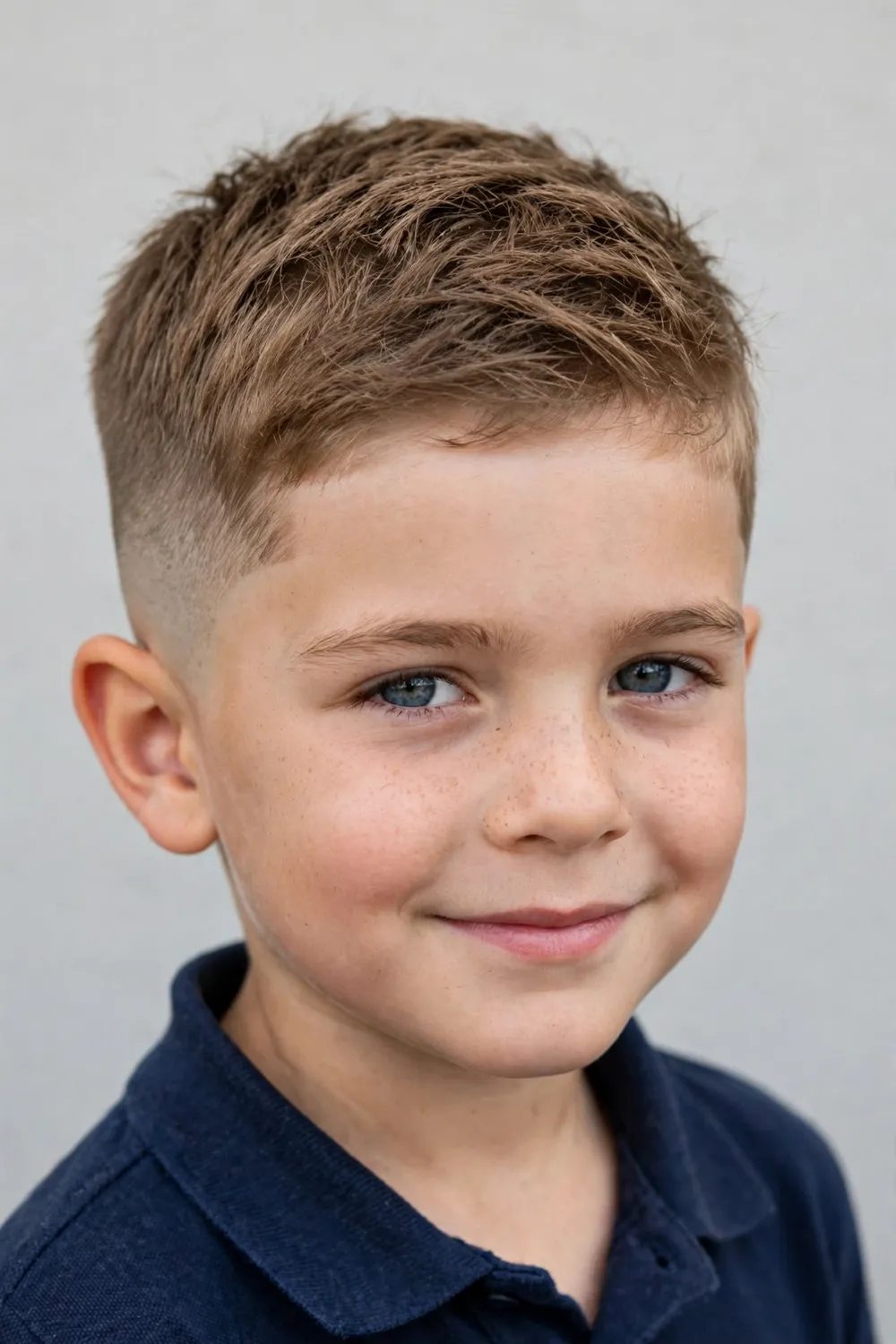
The sweet spot between the baby cuts and the older-kid styles. The low fade keeps the sides short and clean while the top stays long enough to comb, part, or just leave messy. It suits boys aged 5–7 with straight, wavy, or fine hair — especially the ones who arrive at school with their hair already doing its own thing. Ask the barber: “A low fade with a number 3 guard on the sides, blending up into a number 5, top about two inches, scissor-cut so it’s not too blunt.” A pea-sized dab of light cream gives a soft finish without any crunch. Trim every 4–5 weeks and the fade holds its shape nicely. It also passes every school dress code we’ve heard of.
23. School Age Mid Fade
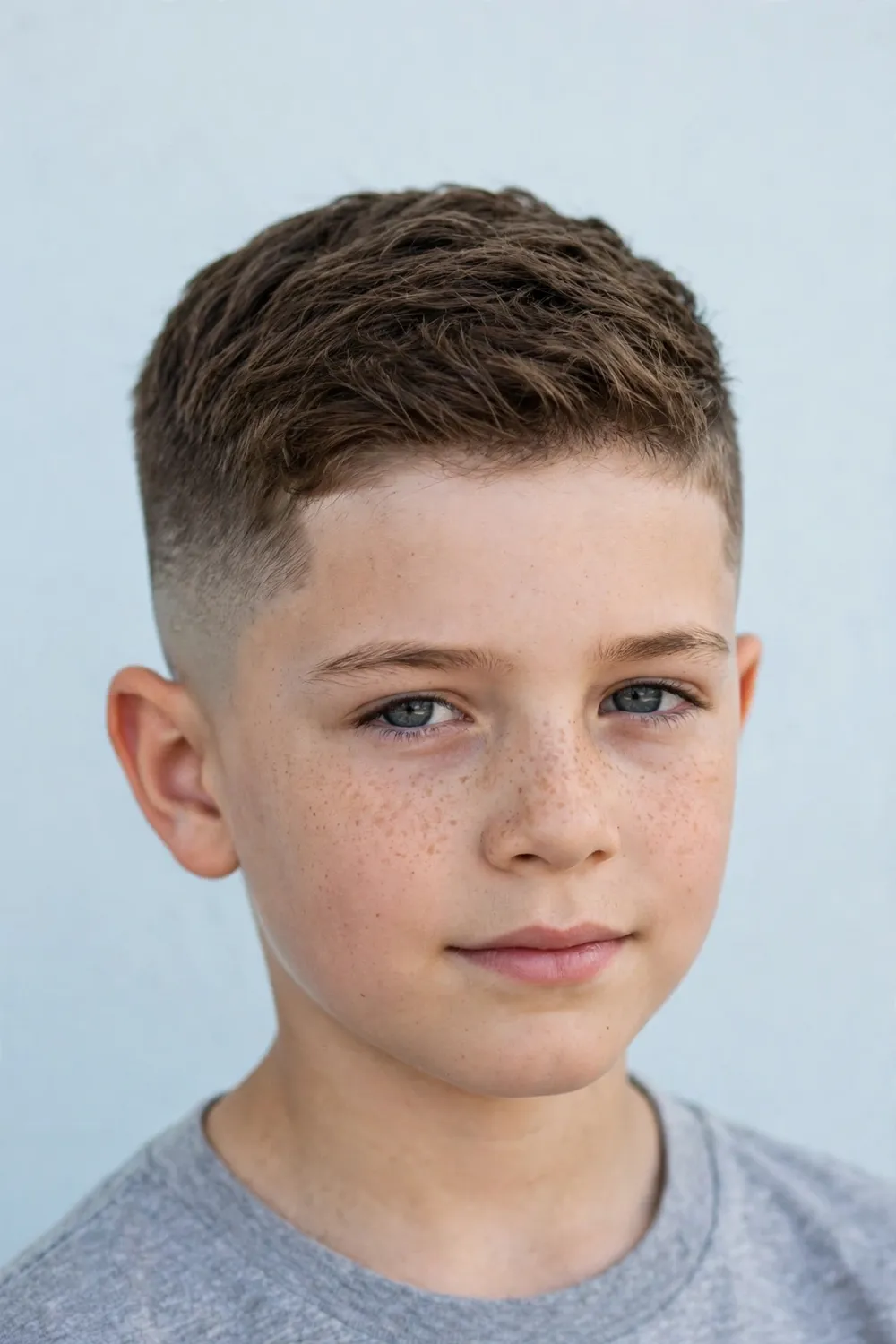
Once your son hits 8, he starts caring what his hair looks like — and this mid fade gives him something to be proud of without turning the morning into a production. The blend starts halfway up the sides, which makes it look more deliberate than a low fade but still calm enough for the classroom. It suits ages 8–10 with straight, wavy, or thick hair, and it grows out in a forgiving way, so a missed week never looks disastrous. Ask the barber: “A mid fade, a number 2 at the bottom fading to a number 4, top left two to three inches with texture.” A little matte paste, rubbed between the palms and pushed through, finishes it. Trim every 3–4 weeks to keep the blend sharp.
24. Pre-Teen Drop Fade
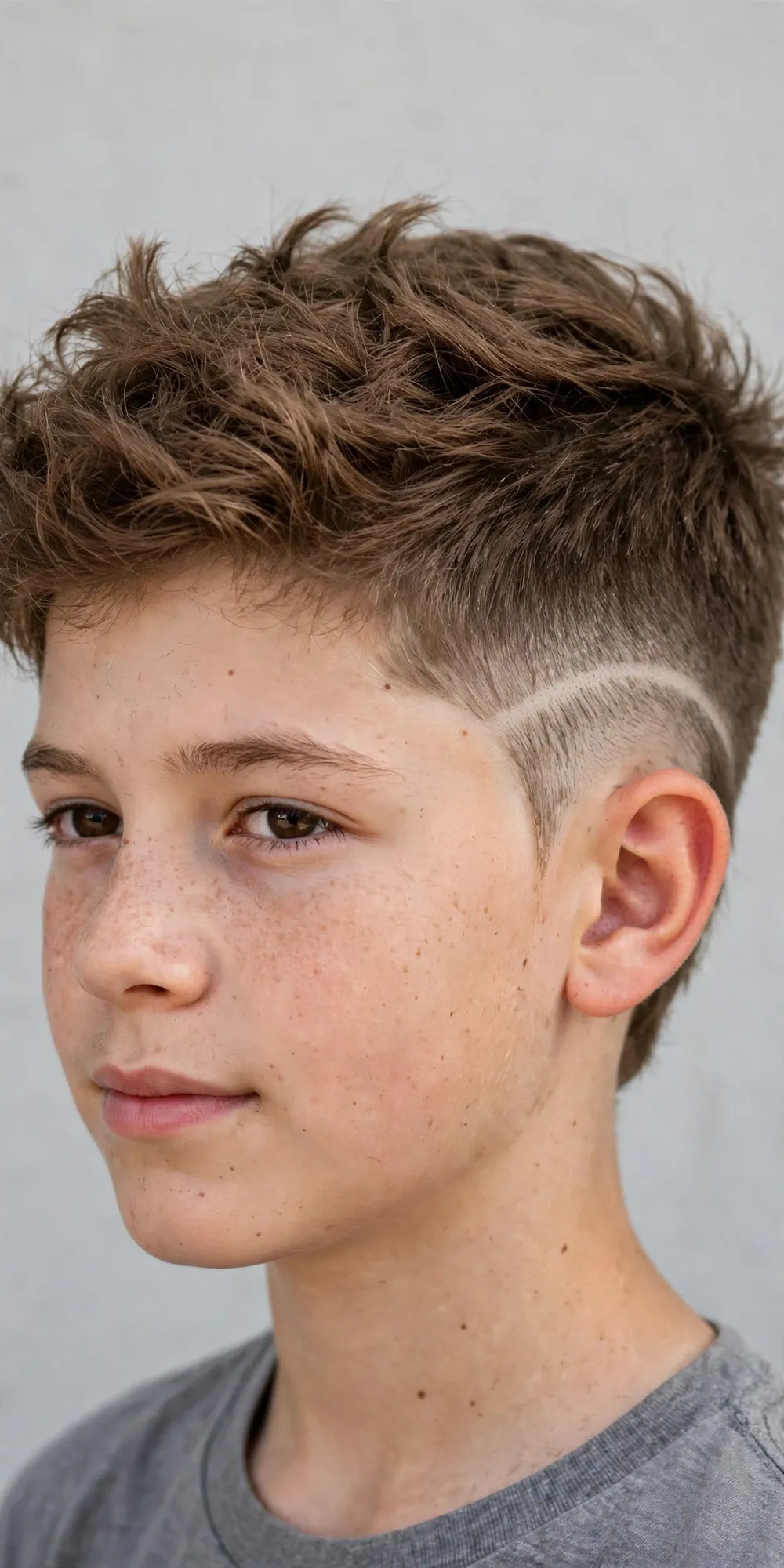
The drop fade is the one kids ask for by name once they start watching YouTube haircut videos. The fade line dips down behind the ear instead of running straight around the head, which gives the whole cut a curved, modern silhouette. It suits ages 11–13 with straight or wavy hair, and it’s a strong choice for thick hair because the drop shape takes bulk out of the back without thinning the top. Ask the barber: “A drop fade, a number 1.5 fading up to a 4, top left long enough to sweep forward.” A light styling cream or sea-salt spray adds texture without stiffness. Trim every 3 weeks — the curved line is what sells it, and it blurs fast.
25. Teen High Fade with Line Up
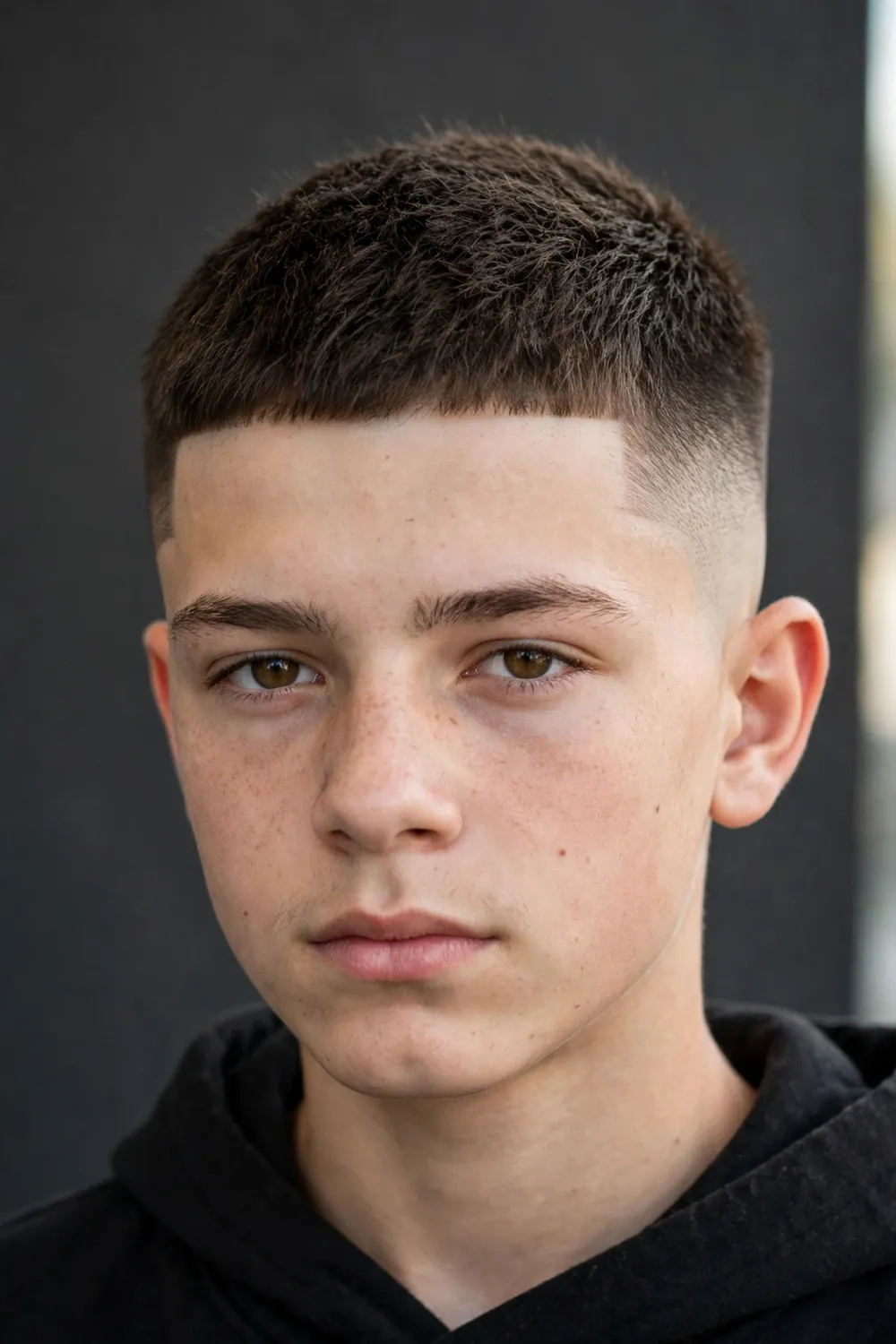
This is the sharpest cut in the list and it earns its place at the top of the teen range. The fade climbs high up the sides and back, and the line-up gives the hairline and temples a crisp, razor-defined edge. It suits ages 14+ with straight, wavy, or curly hair — anyone old enough to sit still while the barber works the razor and to keep the lines clean between visits. Ask the barber: “A high skin fade, zero at the bottom fading to a 3, with a line-up — keep it natural, don’t push the hairline back.” A matte clay gives the top hold with no shine. The trade-off is maintenance: the lines soften in days, so book every 2 weeks to keep it looking fresh.
26. Burst Fade with Spikes
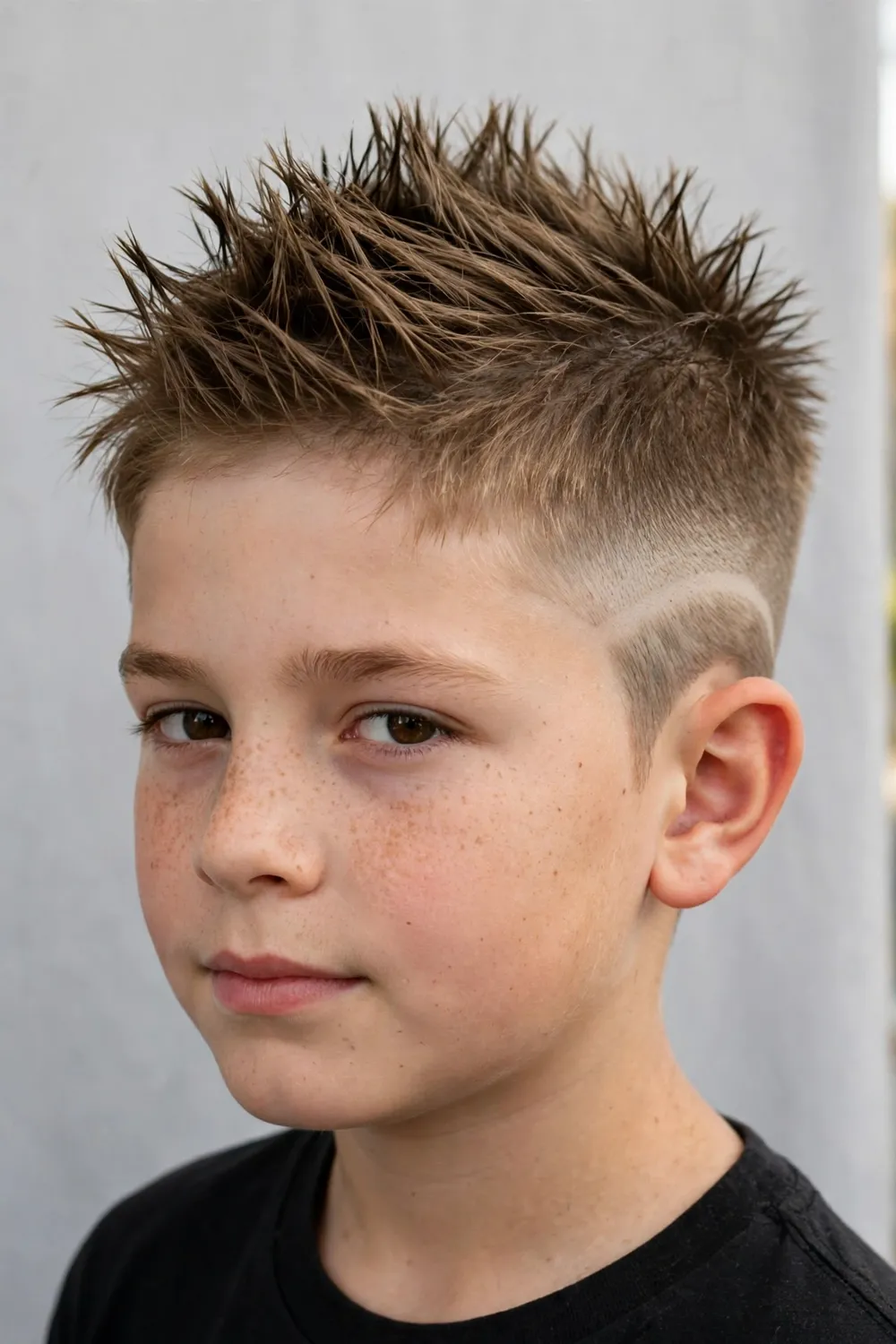
If your son plays sport and wants hair that looks as energetic as he is, this is the one. The burst fade arcs around the ear in a semicircle, leaving the back longer, while the top is cut short and spiky — a cut that practically styles itself after a shower. It suits ages 8–14 with straight or wavy hair, and it works particularly well on thick hair that has the body to hold a spike. Ask the barber: “A burst fade around the ears, a number 2 fading to a 4, top about two inches, point-cut so the spikes form naturally.” A small amount of fibre or wax, worked in with fingertips, sets the spikes. Trim every 3–4 weeks; the burst shape stays readable even as it grows.
27. Faux Hawk Fade
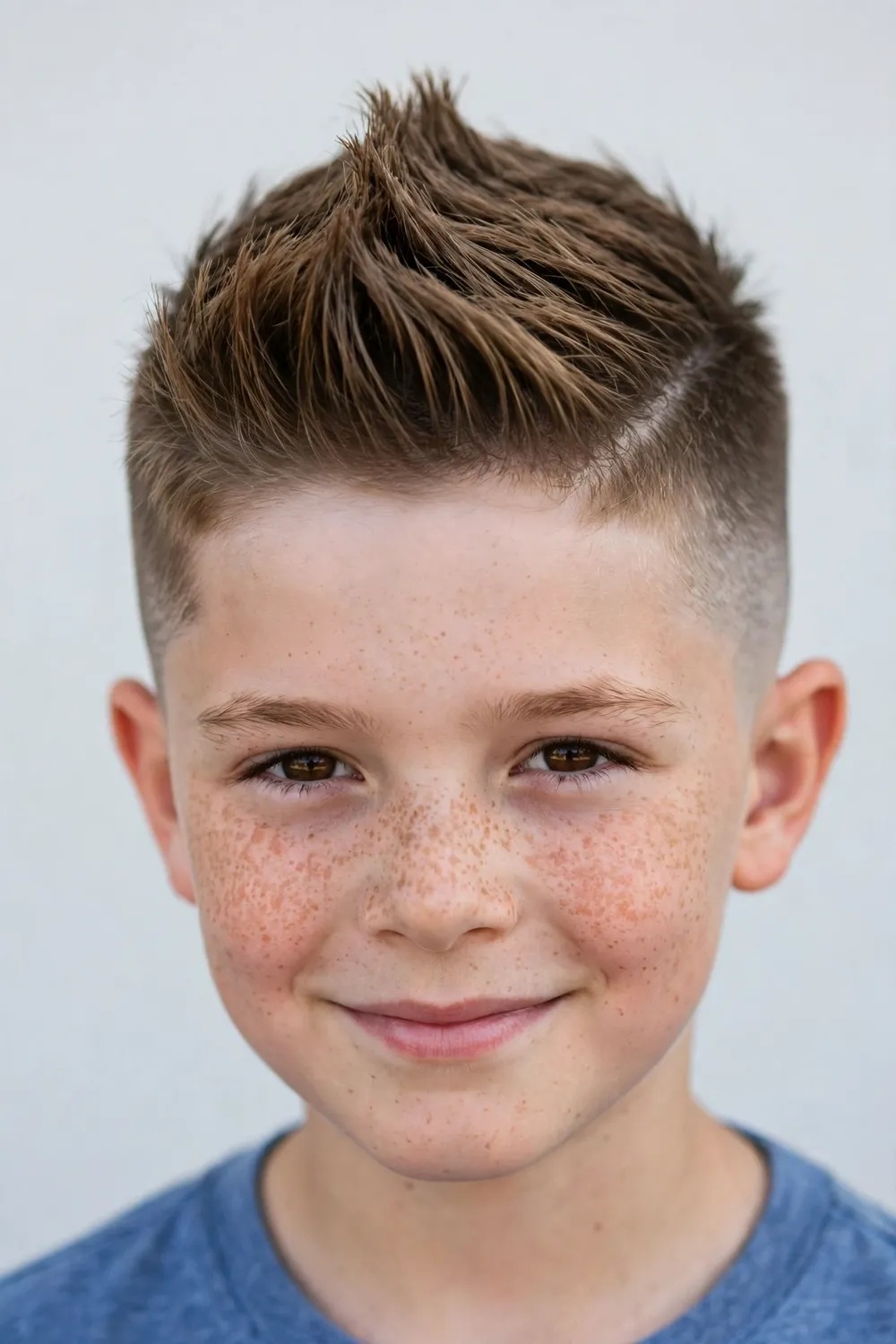
The faux hawk is the compromise every parent reaches eventually: your son gets something that feels rebellious, you get a cut that won’t draw a call from the school office. The centre strip runs front to back, pushed upward, while the faded sides keep it clean and wearable. It suits ages 6–13 with straight or wavy hair — thick hair holds the shape best, but fine hair works too with a little product. Ask the barber: “A faux hawk, a mid fade with a number 2 to a 4 on the sides, and leave the middle strip about two and a half inches.” A dab of strong-hold wax, applied to damp hair, gives the lift. Trim every 3 weeks, and use a lighter touch on the product for school days.
28. Mohawk Fade
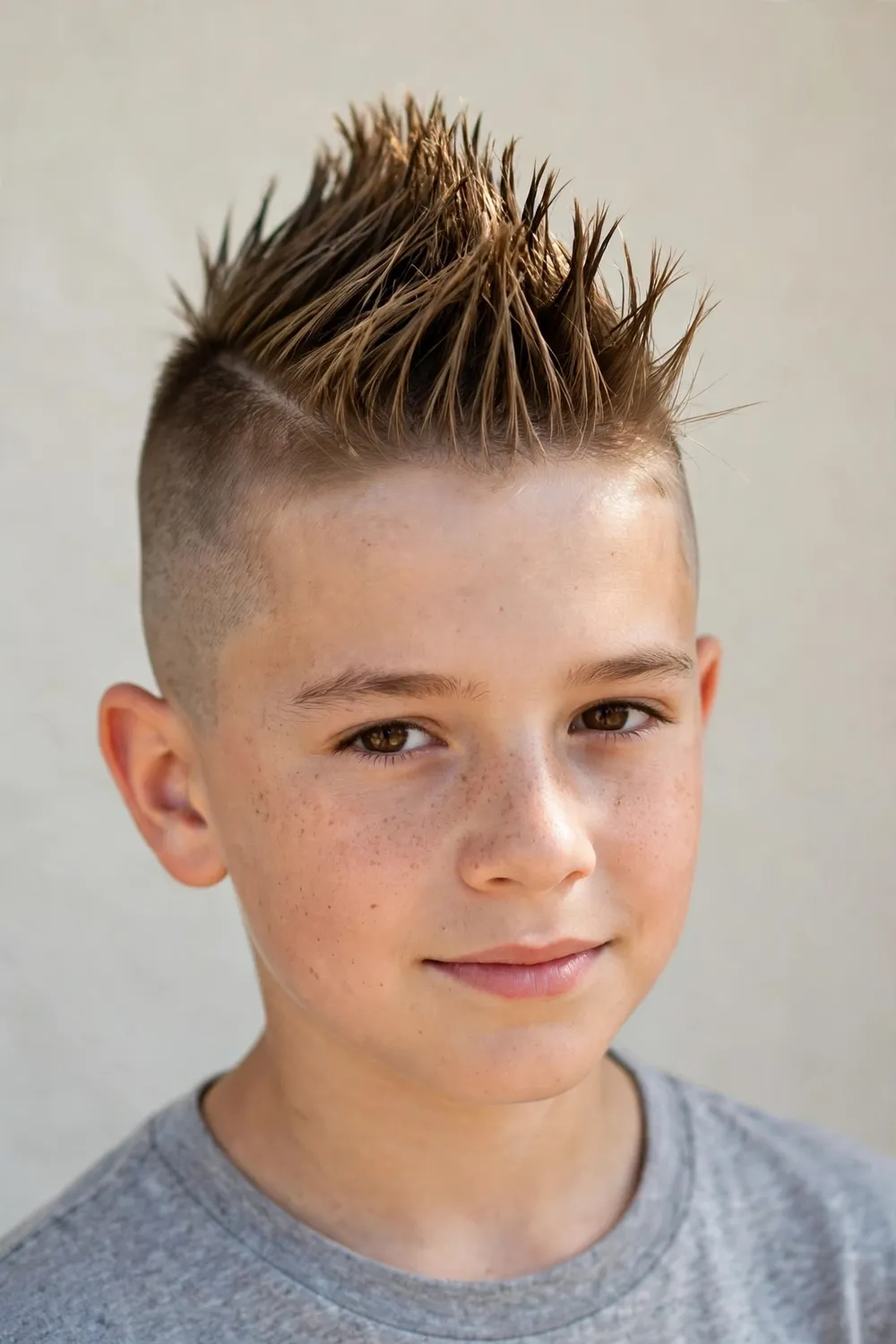
The full mohawk is a statement, no pretending otherwise — a bold strip down the middle with the sides faded tight. It’s the cut kids choose when they want to stand out, and it’s one of the easiest to maintain once it’s in, because the shape is so clear. It suits ages 7–14 with straight, wavy, or thick hair; curly hair can work too if the strip is left long enough to show the curl. Our kids mohawk haircuts guide covers bolder variations. Ask the barber: “A mohawk fade, a number 1 on the sides fading up, strip about two to three inches wide and long enough to spike.” Styling wax does the heavy lifting. Trim every 2–3 weeks, and check school rules first — some schools ban it outright.
29. Hard Part Fade
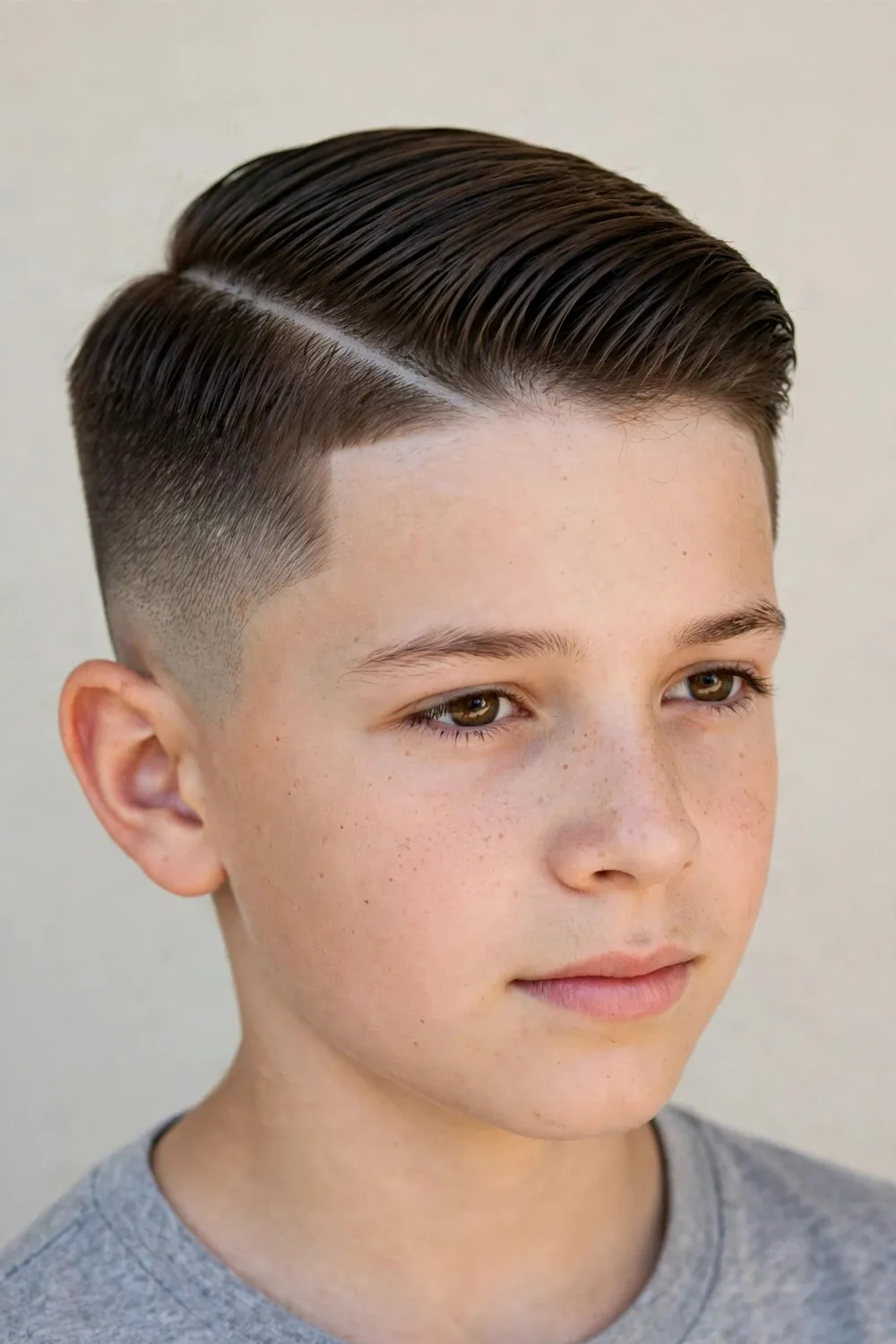
A hard part is a razor-shaved line that splits the hair exactly where you want it, turning an ordinary mid fade into something photo-shoot ready. The part line is the whole point, so it suits boys aged 8–14 who can sit still and like a polished look — great for straight or wavy hair, less useful on very curly hair, where the line gets lost. Ask the barber: “A mid fade with a hard part on the left side, a number 2 fading to a 4, top three inches combed over to the right.” A light pomade gives a clean shine without looking greasy. The catch is upkeep: the shaved line fills in within a week, so it needs re-cutting every 2–3 weeks along with the fade.
30. Ivy League Fade
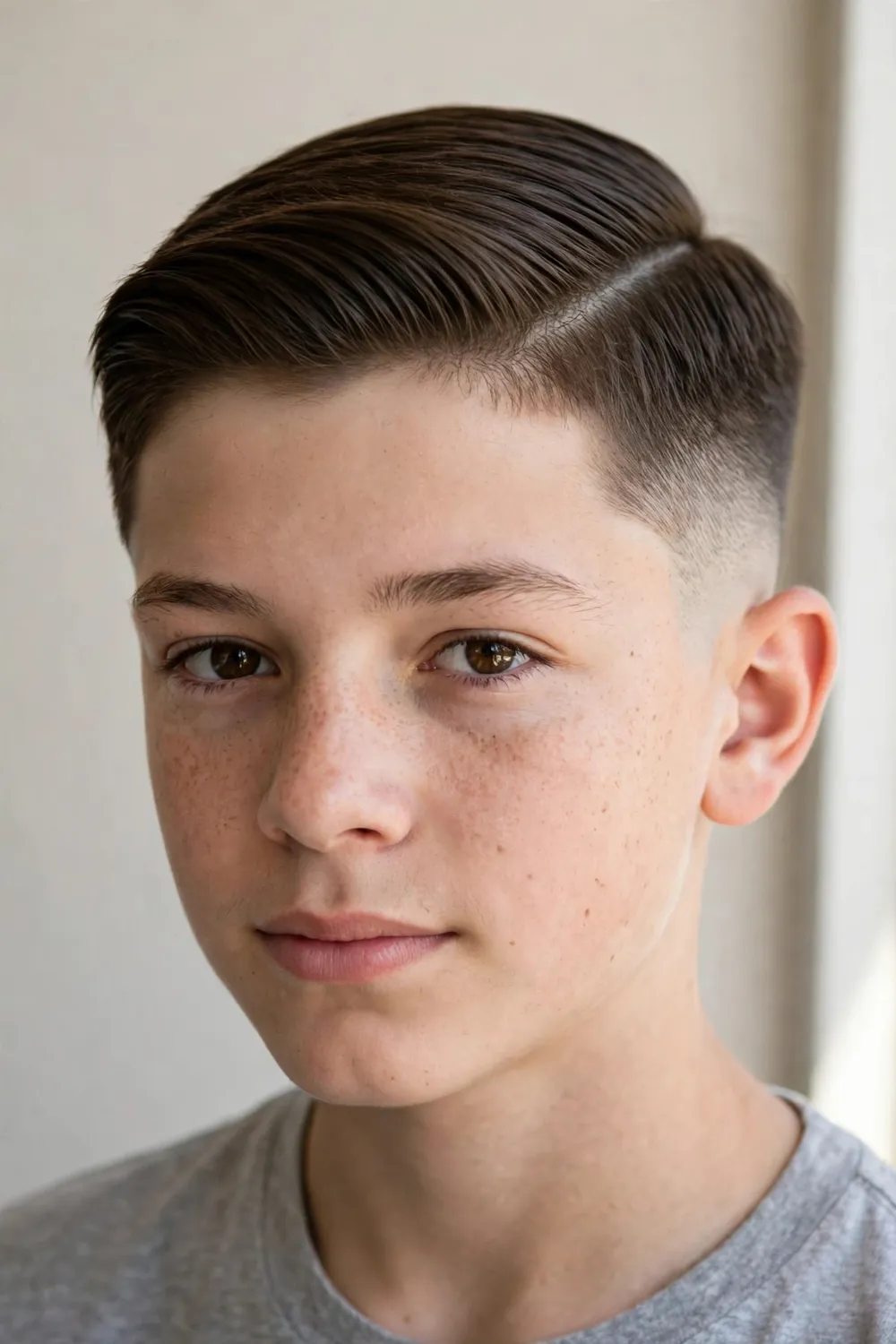
Think of this as the low fade’s smarter older brother — a classic side-parted cut with enough length on top to comb neatly, finished with a low fade that keeps the sides sharp. It’s the one to pick for family photos, weddings, and boys who like looking tidy without feeling like they’re wearing a uniform. It suits ages 8–14 with straight or wavy hair, especially fine hair, which lies flat and combs cleanly into the part. Ask the barber: “An Ivy League, a low fade with a number 3 fading to a 5, top about two and a half inches, scissor-cut with a side part on the left.” A little pomade or cream gives a soft, natural sheen. Trim every 4 weeks and the shape holds up well.
31. Drop Fade with Curly Top
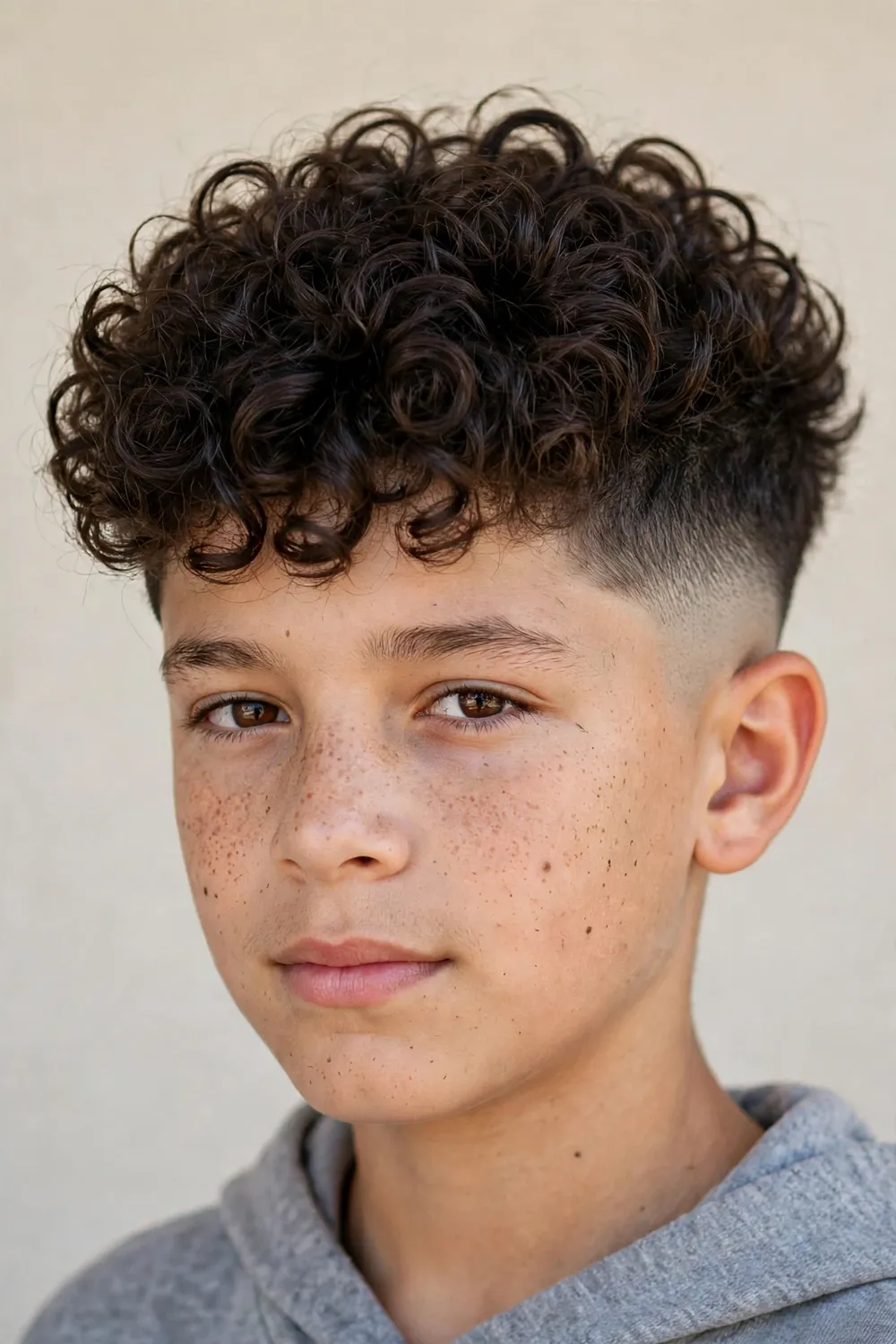
Curly hair and a drop fade are a genuinely good match. The curved fade line follows the shape of the head and takes the bulk out of the sides, while the curls stay long and full on top where they belong. It suits ages 8–14 with curly or coily hair — the kind of curl that springs up as soon as it dries. Ask the barber: “A drop fade, a number 2 fading to a 4, and leave the curls long on top — trim them dry, curl by curl, not wet.” Curl cream, scrunched in while the hair is damp, defines the curls without weighing them down. Trim every 3–4 weeks, and never let anyone thin the curls with thinning shears — that’s how the frizz starts.
32. Low Fade with Hard Part
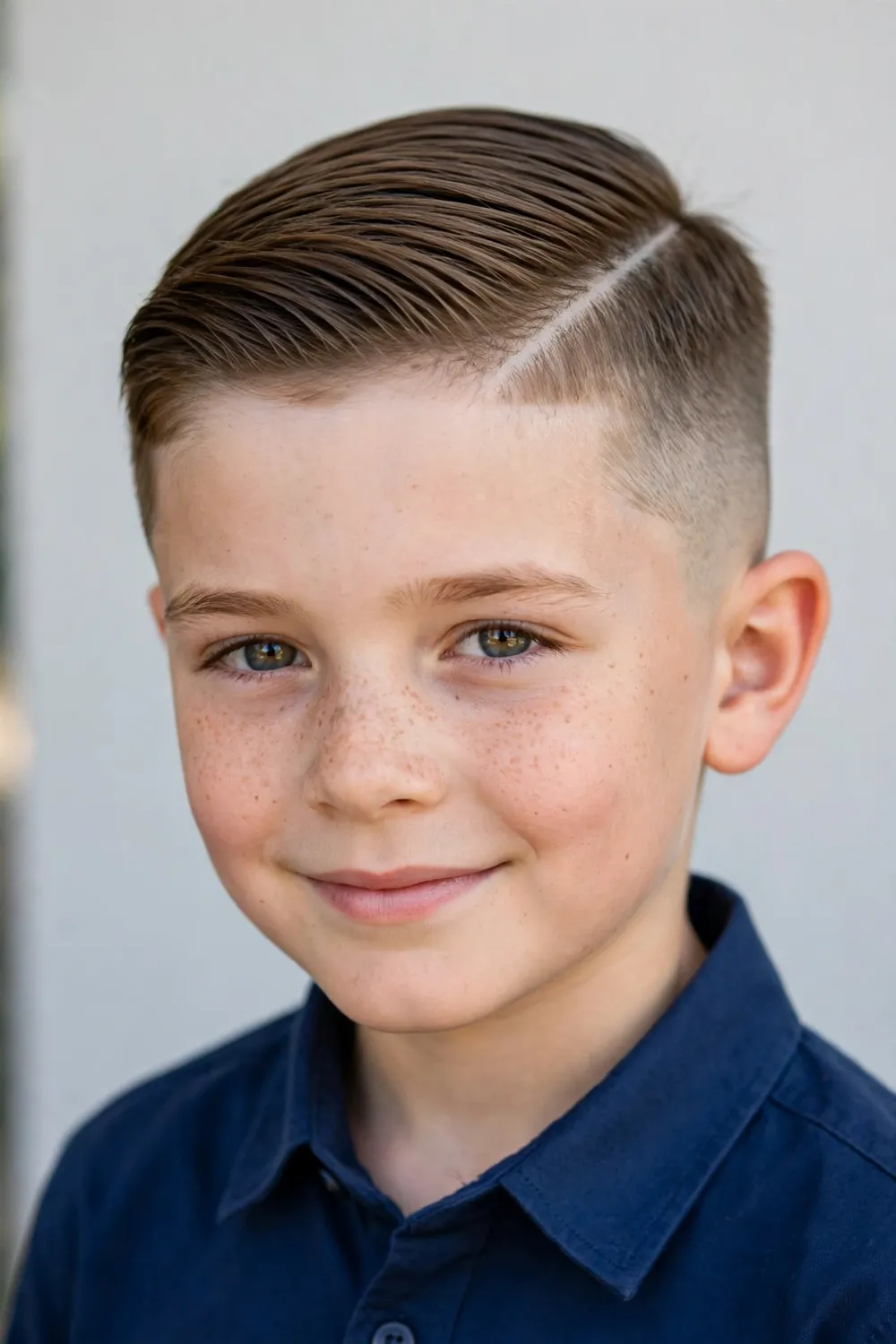
This is the hard part’s quieter cousin — the same crisp shaved line, but paired with a low fade instead of a mid, so the whole cut stays subtle enough for school and smart enough for a family event. It suits ages 7–13 with straight or wavy hair, and it’s a strong pick for picture day or a first communion. Ask the barber: “A low fade with a hard part, a number 3 fading to a 5, top about two inches combed to the side.” A small amount of water-based pomade gives a neat finish that washes out easily at night. Like any hard part, the line softens fast — plan a tidy-up every 2–3 weeks, or accept a softer part between visits.
33. Taper Fade with Neat Comb Over
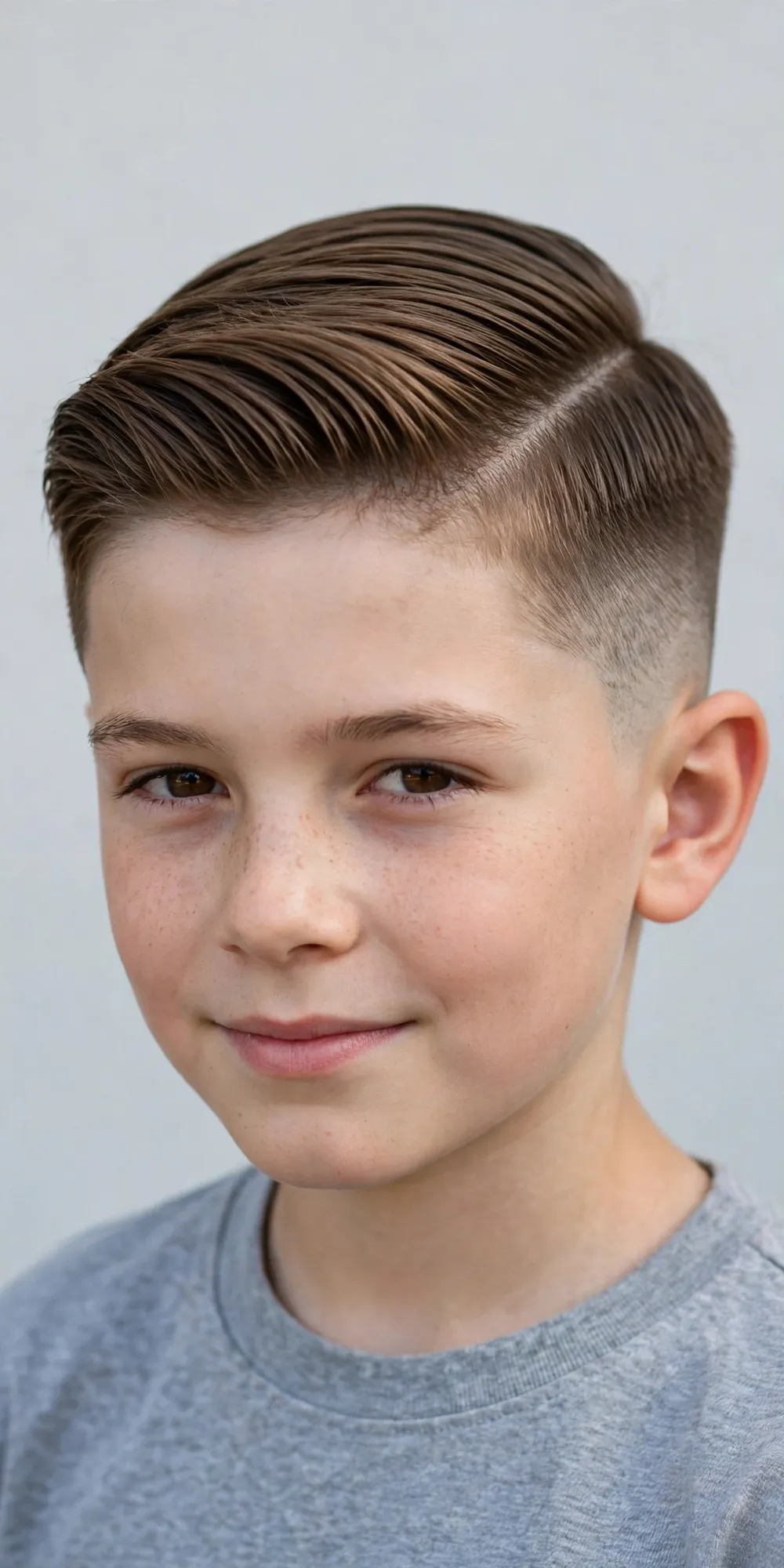
The comb over gets a bad name from the adult version, but on a boy it’s just a neat, side-swept cut that looks like he made an effort — even when he didn’t. The taper fade keeps the sides and neckline clean without the harshness of a skin fade, and the top combs over to one side with a natural part. It suits ages 6–13 with straight or fine hair, which combs flat and stays put. Ask the barber: “A taper fade, a number 4 fading to a 2 at the neckline, top two to three inches, scissor-cut and combed over to the right.” A light cream or a drop of pomade holds it in place. Trim every 4 weeks — one of the easiest fades to grow out gracefully.
34. Fade with Caesar Cut
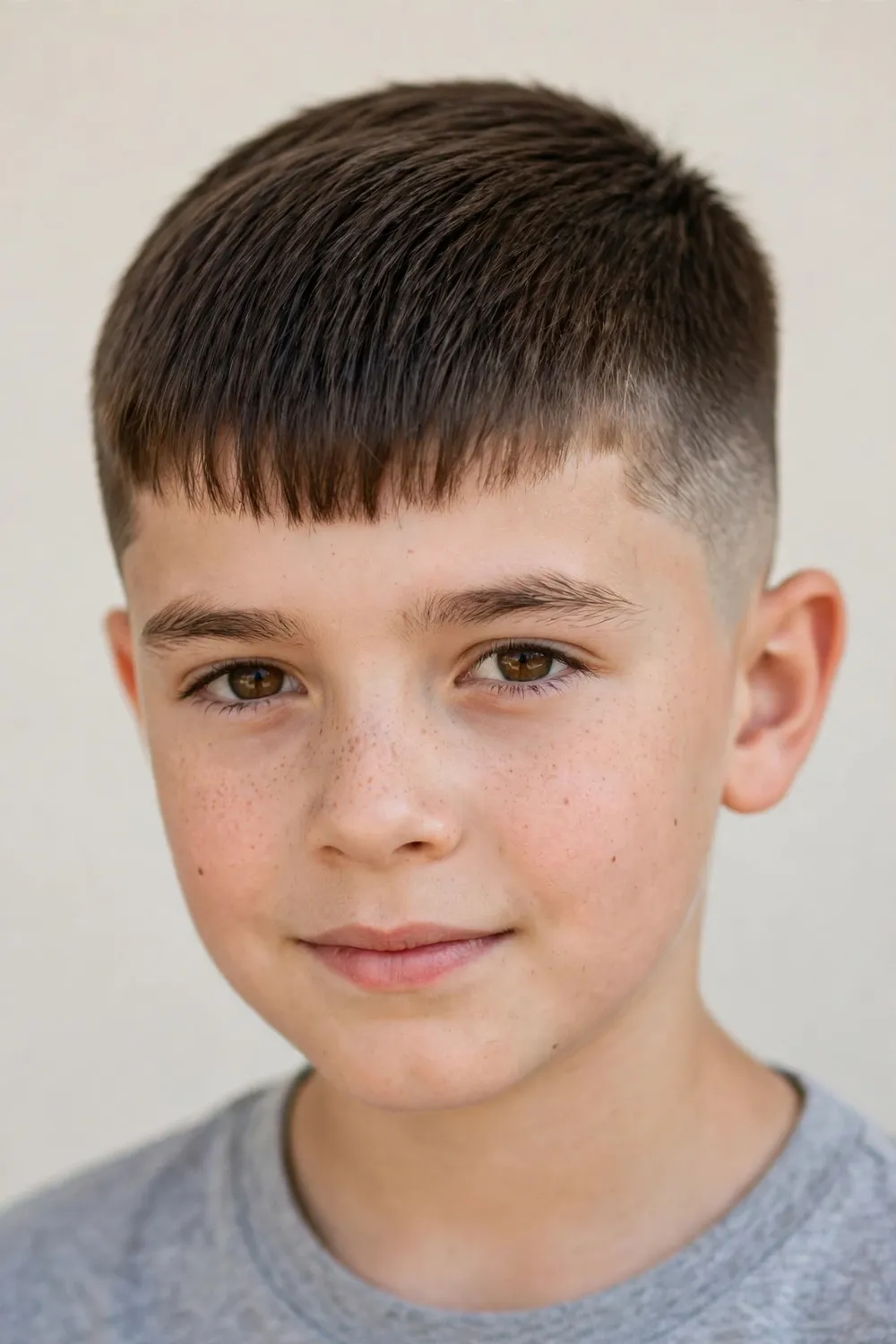
The Caesar is ancient, simple, and — for parents of busy boys — almost perfect. The hair is cut to one short, even length all over the top and brushed forward into a short fringe, with a fade on the sides that keeps it tidy. It suits ages 5–12 with straight, wavy, or thick hair, and it’s brilliant for boys who hate having their hair touched in the morning. Ask the barber: “A Caesar cut with a mid fade, a number 2 on the sides, top cut to about an inch and brushed forward.” No product at all is needed — the cut is the style. Trim every 3–4 weeks; it works just as well for a boy growing his hair out as one who wants it short.
35. Fade with French Crop
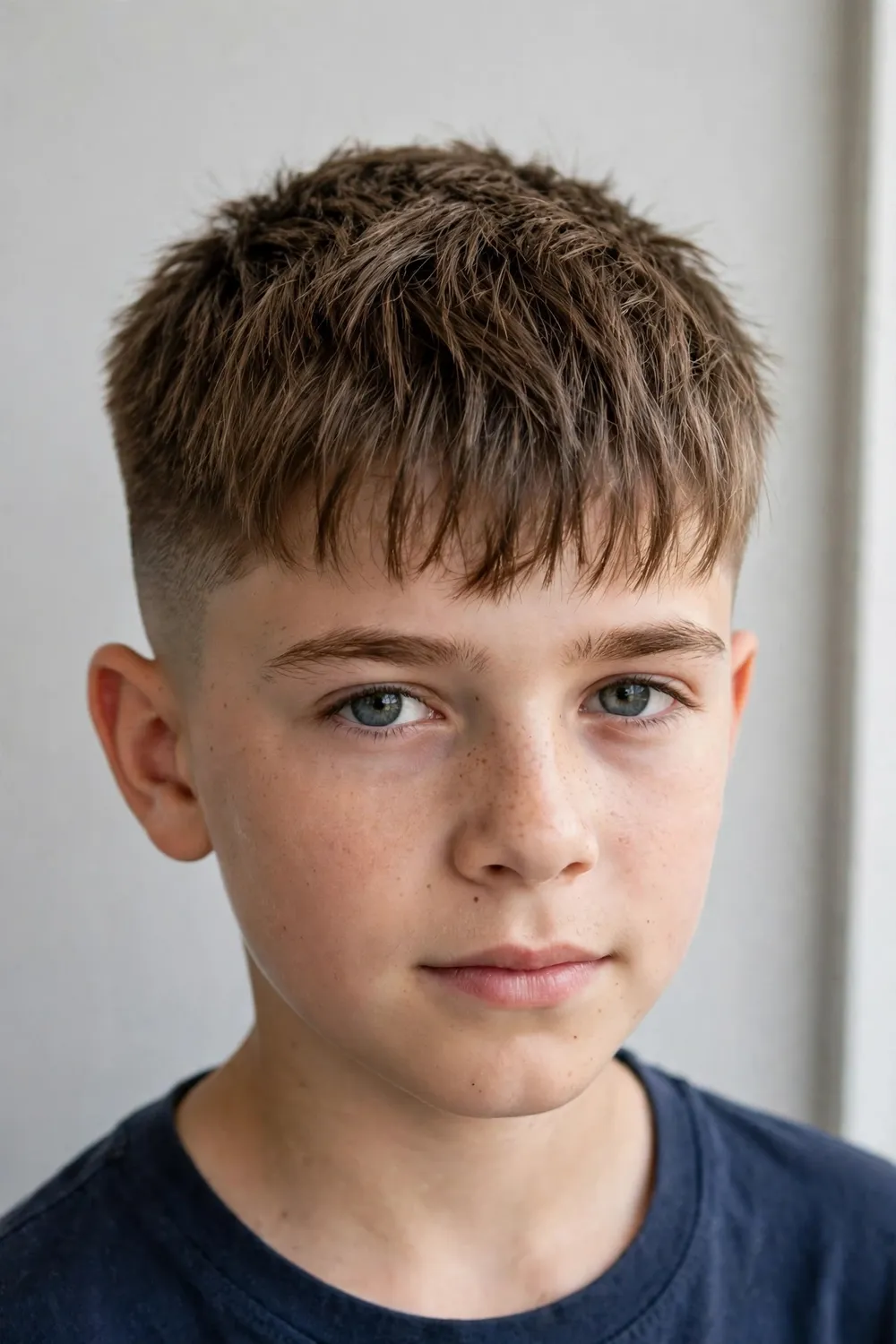
The French crop is the Caesar’s choppier, cooler little brother. Same short fringe brushed forward, but with texture cut into it — little jagged edges that give the top movement and character — plus a clean fade on the sides. It suits ages 6–14 with straight or wavy hair; thick hair takes the texture particularly well, and it hides a cowlick at the hairline better than almost any other cut. Ask the barber: “A French crop with a low fade, a number 3 on the sides, top about an inch and a half, point-cut for texture, fringe left blunt.” A tiny bit of matte paste, pushed forward with the fingers, finishes it. Trim every 3–4 weeks to keep the fringe from creeping into his eyes.
36. Swoop Fringe Fade
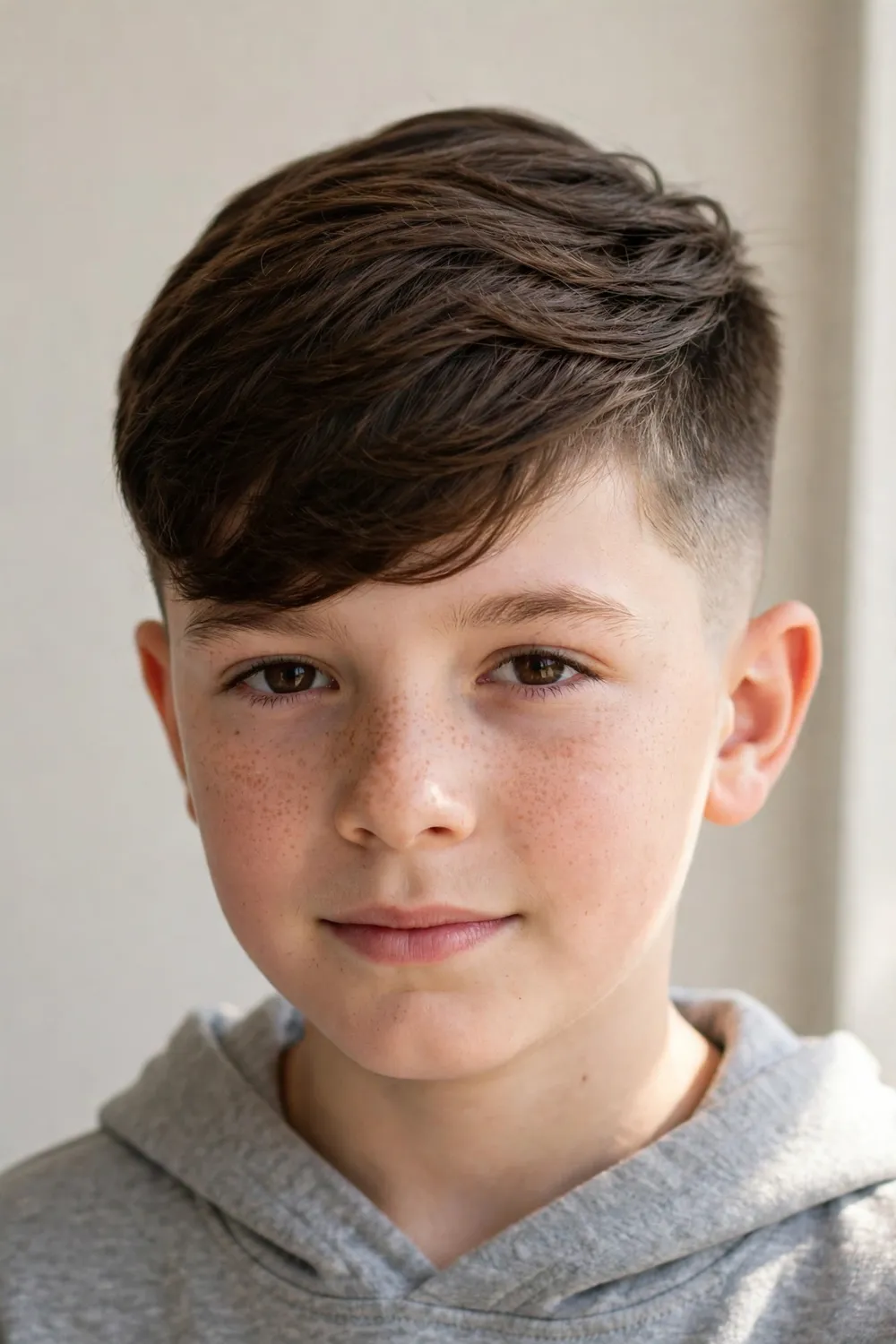
The swoop is for the boy who likes his fringe — long enough to sweep across his forehead, short enough to stay out of trouble. The fringe falls to one side in a soft arc, and the fade on the sides stops it looking shaggy. It suits ages 8–14 with straight or wavy hair, especially fine hair, which sweeps easily and never fights back. Ask the barber: “A swoop fringe with a low fade, a number 3 fading to a 5, fringe left about two and a half inches, swept to the left.” A pea-sized amount of light cream keeps the sweep in place without stiffness. Trim every 4 weeks, and expect to tidy the fringe yourself between visits — hair scissors and a steady hand are all it takes.
37. High Fade with Pompadour
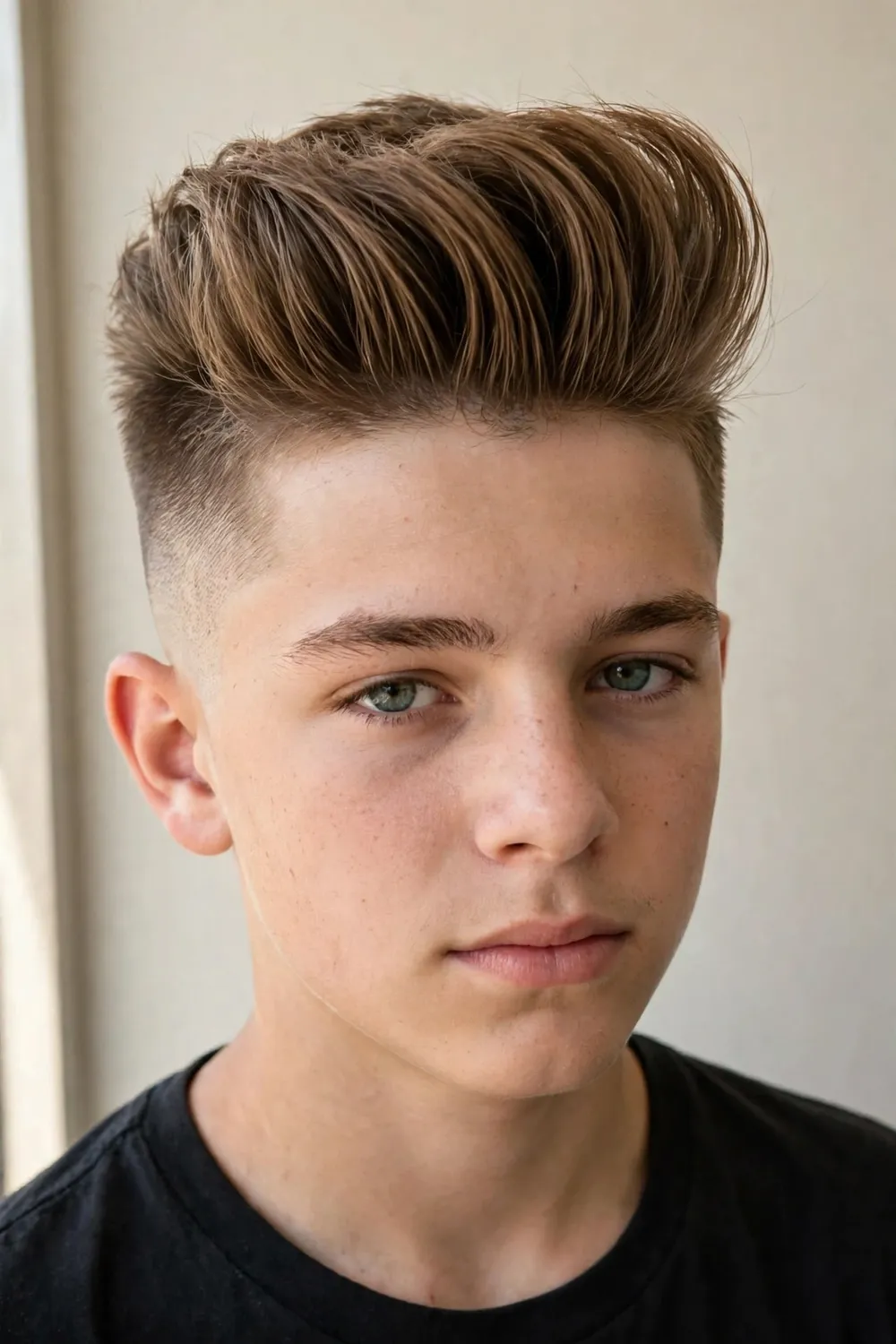
The pompadour is the tallest, boldest top in this list — hair swept up and back into a wave several inches high, balanced by a tight high fade. It’s a lot of hair and a lot of personality, suiting ages 12–16 with straight or wavy hair that has enough body to hold the height. Fine hair will struggle here — be honest about what you’re working with. Ask the barber: “A high fade with a pompadour, a number 1 fading to a 3, top left four to five inches, blow-dried up and back.” A strong-hold pomade and a quick blast with the hairdryer set it; this is not a wash-and-go cut. Trim every 2–3 weeks, and budget five minutes in the morning — this one earns its look.
38. Crew Cut Fade
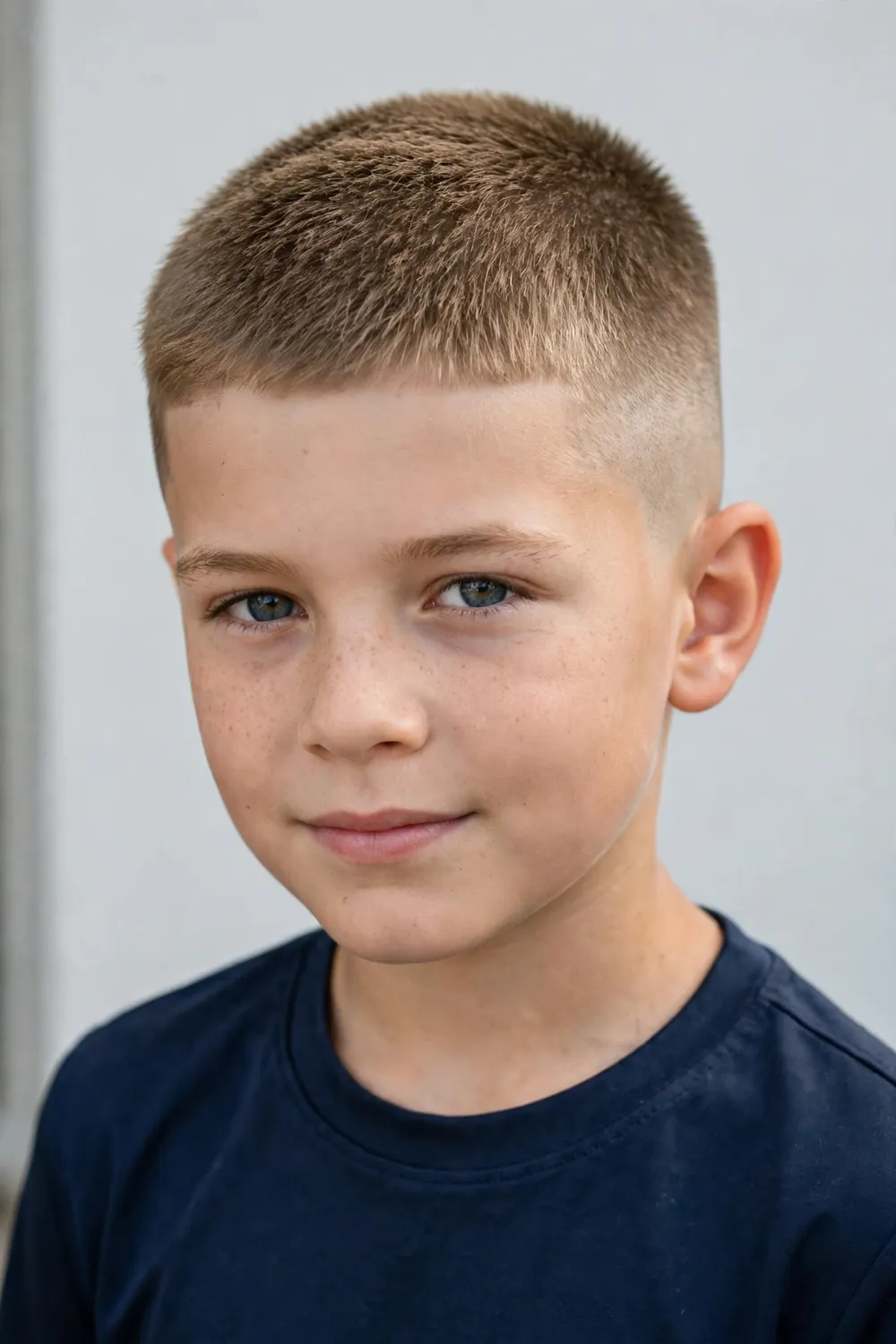
The crew cut is for boys who’d rather be outside than in front of a mirror. Short on top, slightly longer at the front, with a clean fade on the sides — sporty, neat, and almost impossible to mess up. It suits ages 4–14 with any hair type, and it’s the best choice for very thick hair that gets hot and heavy in summer. Ask the barber: “A crew cut with a mid fade, a number 2 on the sides fading to a 4, top about an inch, slightly longer at the front.” No product needed; towel-dry and go. Trim every 3–4 weeks, though the shape is forgiving — an extra week won’t hurt. If your son swims a lot, this is the easiest cut to live with.
39. Spiky Top Fade
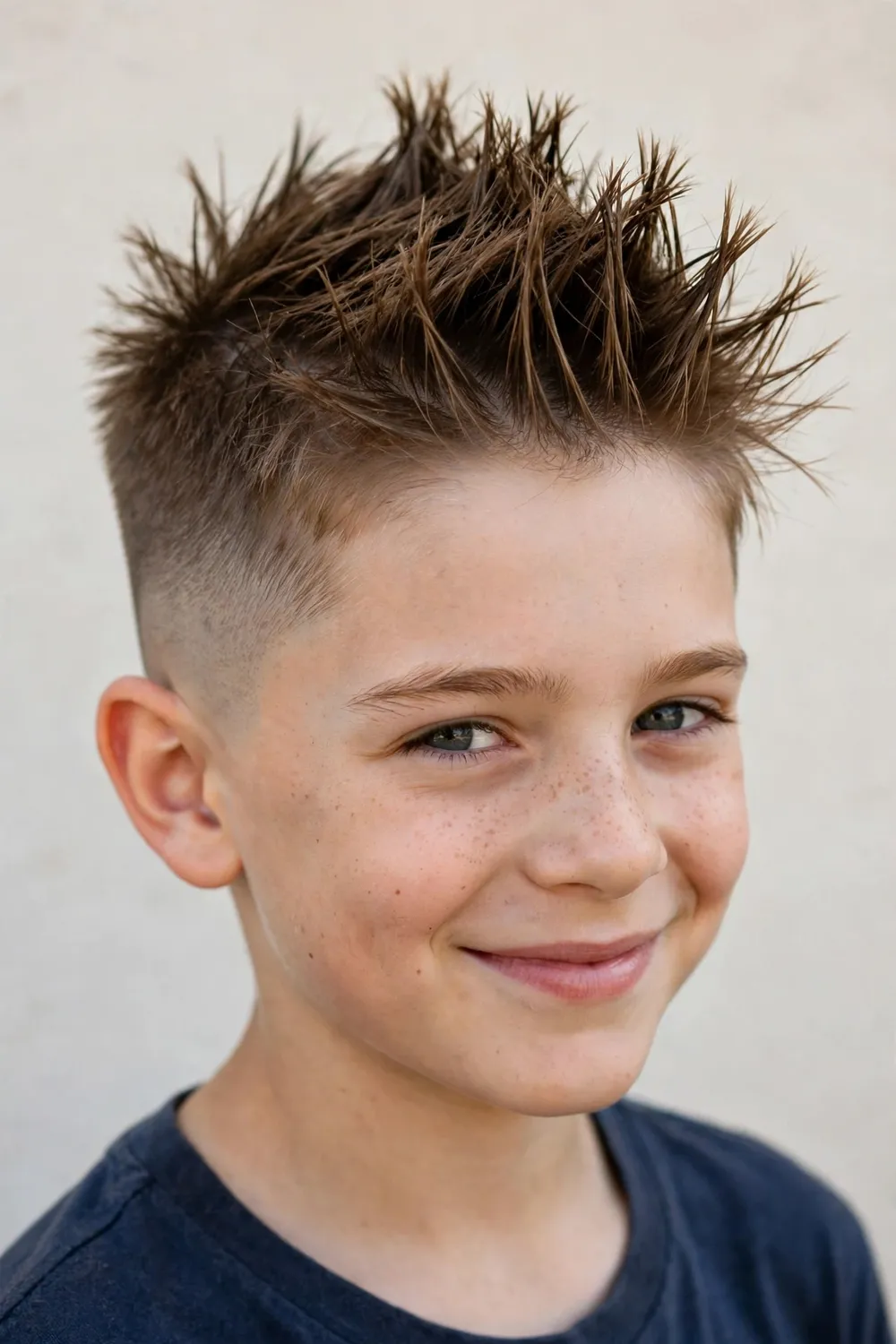
Last one, and it’s the most fun. The spiky top takes a short textured cut and pushes it upward in all directions, while the faded sides keep the whole thing from looking like a bad hair day. It suits ages 5–13 with straight or wavy hair, and it’s a great way to use thick hair that naturally wants to stand up anyway. Ask the barber: “A spiky top with a mid fade, a number 2 fading to a 4, top about two inches, point-cut so the spikes form on their own.” A dab of strong-hold wax or fibre, worked through damp hair with the fingertips, sets the spikes in seconds. Trim every 3 weeks, and on lazy mornings a quick ruffle with wet hands is honestly enough.
How to Pick the Right Fade by Age
Toddler (2–4): Keep it simple and quick. A low taper or a toddler low fade is the right call — nothing that needs a razor or a long time in the chair, because a toddler won’t sit for either. Avoid skin fades, hard parts, and line-ups at this age; the shapes need precision a wiggly head won’t allow, and the result will look worse than a soft blend. Pick a barber who has worked with small kids before and ask them to go fast.
Little boy (5–7): He can sit still for ten or fifteen minutes now, so a low fade, a Caesar, or a crew cut all work well. The priority is still low maintenance — he won’t style it himself, so the cut has to look good with nothing but water. Avoid high skin fades; they grow out visibly and need frequent trims a parent will resent paying for.
School age (8–10): This is where personality shows up. A mid fade, a textured crop, or a French crop gives him a style he can actually ask for by name. He can manage a small amount of product now, so a faux hawk or a spiky top is fair game. Avoid anything that needs a razor line-up every two weeks — school mornings are busy enough.
Pre-teen (11–13): He’s choosing his own look now, and the drop fade, burst fade, and curly-top styles are the ones kids this age request most. Let him bring a photo and let the barber talk to him directly — it builds confidence and the result is usually better. Avoid pushing him into a style he doesn’t want; he’ll just refuse to style it and you’ll both be annoyed.
Teen (14+): Almost everything is on the table — high fades, skin fades, line-ups, pompadours. The only real limits are school rules and his willingness to maintain it. A high skin fade with a line-up looks incredible for about ten days and then needs a refresh, so make sure he’s ready for a fortnightly barber trip before you agree to it. For the full teen picture beyond fades, our haircuts for teenage guys guide covers the rest.
How to Pick by Hair Type
Straight hair is the easiest to fade because the blend shows cleanly and the top lies flat. Almost every style in this list works, but slicked-back tops, side parts, and comb overs look especially sharp. Watch out for cowlicks at the crown — a textured crop or a French crop hides them better than a slick style.
Wavy hair is the most versatile of the lot. It has natural movement, so textured crops, swoop fringes, and messy tops all look effortless. A mid fade usually flatters waves best, because it leaves enough length on top for the wave to show. Avoid cutting wavy hair too short on top or you’ll lose the wave entirely.
Curly hair needs length on top and a barber who cuts curls dry. The curly top high fade and the drop fade with curly top are built for this, and a low fade keeps the sides gentle. Never let anyone thin curly hair with thinning shears, and never cut it wet and hope for the best — curls shrink as they dry.
Coily hair is at its best with a low fade and a full coily top, like idea 18 — the contrast between tight coils and a soft blend is striking. Keep the top moisturised with a leave-in cream and avoid clipper work on the coils themselves; they should be shaped with scissors.
Thick hair can handle almost any fade, but it needs the bulk taken out — a mid or high fade with a textured top stops it looking like a helmet. The messy top fade and the burst fade with spikes are both strong choices. Thin it with point-cutting, not thinning shears, or it’ll go frizzy.
Fine hair suits low and taper fades best, because the soft blend doesn’t expose how thin the sides are. Keep the top short to medium — a crop, a Caesar, or a crew cut — and go easy on product. Heavy gel is the enemy of fine hair; it clumps the strands together and makes it look thinner. A light cream or a dusting of texture powder is all you need.
The 2-Minute Morning Routine
Very short tops (buzz, crew cut, Caesar): Rinse with water or wash with a small amount of shampoo, towel-dry by rubbing in every direction, and you’re done. No product, no comb. Thirty seconds, genuinely.
Short textured tops (crop, French crop, spiky top): Wash two or three times a week, rinse on the other days. Towel-dry until damp, then rub a pea-sized amount of matte paste or wax between your palms and push it through the top with your fingertips — forward for a crop, upward for spikes. No comb needed.
Medium tops (quiff, pompadour, slicked back, comb over): Wash, towel-dry, then apply product to damp hair — pomade for a comb over or slicked back, clay for a quiff. Comb it into place with a wide-tooth comb while it’s still damp, then leave it alone. If he has a quiff or pompadour, a ten-second blast with the hairdryer on a low heat, blowing the front upward, makes a real difference.
Longer tops (curly, coily, swoop fringe): Wash with a gentle shampoo, towel-dry by scrunching rather than rubbing, then work curl cream or leave-in conditioner through the curls with your fingers. For a swoop fringe, comb it to the side while damp and let it air-dry. Never brush curly hair dry — that’s how you get a cloud.
5 Mistakes Parents Make at the Barber
- Asking for a skin fade on a wiggly toddler. A skin fade needs a still head and a steady razor. A two-year-old will move, the barber will have to stop and start, and the blend will come out patchy. Save the skin fade for age six or seven at the earliest, and start with a soft low taper instead.
- Showing up with no photo reference. “Short on the sides” means something different to every barber. Save two or three photos of the exact cut on your phone before you go — one from the front, one from the side. It takes thirty seconds and it removes all the guesswork.
- Skipping the grow-out plan. Every fade grows out, and a high skin fade grows out fast and ugly. Before you agree to a bold cut, ask the barber how it will look in three weeks and how often it needs a trim. If the answer is every two weeks and that doesn’t fit your life, pick a lower fade.
- Using heavy gel on fine hair. Gel makes fine hair clump together, look greasy, and show the scalp. A light cream or a matte paste gives hold without weight, and it washes out in one shampoo instead of needing a scrub.
- Ignoring the school rules. Some schools ban skin fades, designs, mohawks, and dyed hair — and they will send your son home or make him get it cut again. A quick check of the dress code before the appointment saves an awkward phone call and a second haircut in the same week.
Frequently Asked Questions
What fade is best for a young boy’s first haircut?
A low taper fade is the safest first fade. It blends softly, grows out gracefully, and doesn’t need a razor or a long time in the chair — which matters when your son is still getting used to the barber. The classic low fade with a textured top (idea 1) and the toddler low fade (idea 21) are both built for this. If he’s under four, ask for a taper rather than a full fade and keep the top a little longer, so the whole experience feels gentle.
How often does a boy’s fade need a trim?
It depends on the fade. A low fade or taper holds its shape for 4–5 weeks, a mid fade needs a trim every 3–4 weeks, and a high skin fade or a line-up starts to blur within two weeks. As a rule of thumb, the higher and tighter the fade, the sooner you’ll be back in the chair. Booking the next appointment before you leave the barbershop is the easiest way to stay on top of it.
Are fade haircuts allowed in school?
Most fades are allowed — low, mid, and taper fades are standard school haircuts almost everywhere. Problems usually come with the extremes: skin fades, shaved designs, mohawks, and hard parts can fall foul of strict dress codes, and some schools ban them outright. Check the school’s written policy before the appointment, and when in doubt, pick a low fade — we’ve never heard of a school objecting to one.
What exactly should I tell the barber for a boy’s fade?
Give three things: the fade height, the guard numbers, and the top length. For example: “A mid fade, a number 2 at the bottom fading up to a 4, top left two inches with texture.” Bring a photo too — it removes all ambiguity. If you’re not sure about guard numbers, say the fade height and the top length and let the barber suggest the guards; a good barber will talk you through it.
Low fade vs mid fade vs high fade — which one suits my son?
A low fade is the safest all-rounder: subtle, school-friendly, and easy to grow out, so it’s the best choice for younger boys and first fades. A mid fade is the balanced middle ground — more noticeable, still tidy, and the best pick for school-age boys who want something with a bit more style. A high fade is the boldest option, with strong contrast and a modern look, but it needs a trim every two weeks and a boy old enough to sit still for it. The Fade (haircut) article explains the different fade heights in detail if you want the full background. Age, hair type, and school rules should decide it — not just what looks cool in a photo.
What age can a boy get a skin fade?
Most barbers are comfortable doing a skin fade from around age six or seven, when a boy can sit still for the fifteen to twenty minutes it takes to get the blend right. Before that, a low taper is a better choice — it gives a similar tidy look without the razor work. There’s no legal age limit, but a good barber will be honest with you if your son is too young or too fidgety for a clean skin fade, and it’s worth listening to them.
How do I style a boy’s fade at home in the morning?
Keep it to two minutes. Wash or just rinse, towel-dry until damp, then use a pea-sized amount of product — matte paste for short textured tops, light cream for longer or curly hair. Push it through with your fingers, comb it into place if the style needs a part or a sweep, and leave it alone. For very short cuts you can skip the product entirely. The real secret is the cut itself: a well-cut fade looks good with almost no effort, so choose a style that matches how much time you actually have in the morning.
Final Word
A good fade does more than make your son look tidy — it gives him a haircut he actually likes, one he’ll sit still for and feel good about. Start with a low fade if it’s his first time, bring a photo, check the school rules, and don’t be afraid to ask the barber questions — that’s literally what they’re there for. And if his tastes change (they will), there’s always another style waiting. Browse more haircut guides on the Hair Groom blog at /blog/ for the next idea, whether that’s a first cut for a younger sibling or a bolder style for a teenager.