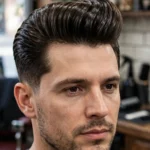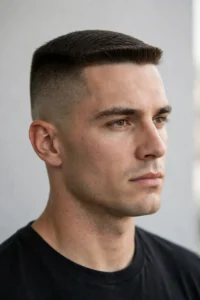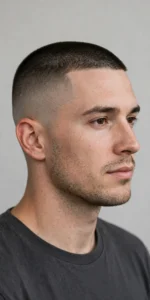


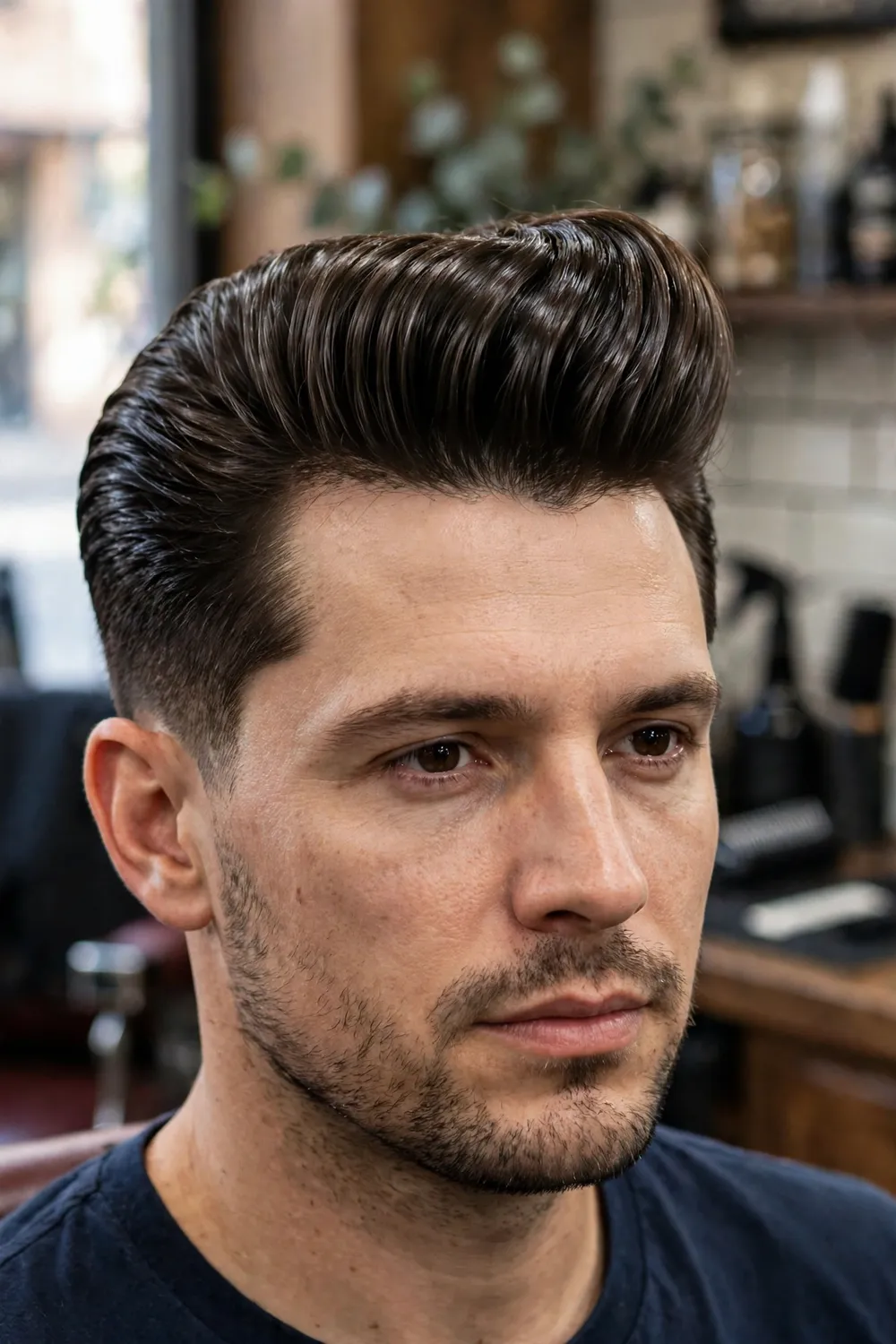
A pompadour sweeps the whole top up and back from the forehead into one tall, smooth shape — and these 39 pompadour haircuts for men cover every way to wear it, from the glossy 1950s original to faded, textured modern versions. If you’re short on time, start with the Classic Pompadour, the Modern Pompadour, or the Low Fade Pompadour — those three suit the most men and are the easiest to explain to a barber.
What Is a Pompadour Haircut?
A pompadour is a men’s haircut where the hair on top — at least 3–4 inches at the front — is swept up and back from the forehead into one high, rounded shape, held in place with product, while the sides and back are tapered or faded. The classic version runs 4–6 inches on top, combed smooth and finished with a shine; the modern version keeps the same sweep but adds texture, a matte finish and a fade. The style is named after Madame de Pompadour of 18th-century France, but the men’s version took off in the 1950s, when Elvis Presley, Johnny Cash and Chuck Berry made the tall, greased sweep a symbol of rock and roll. The look came back hard around 2011 and hasn’t really left since. For the full history, see Pompadour (hairstyle).
It gets confused with two cousins. A Quiff Haircut lifts only the front of the hair and leaves texture behind it, while a pompadour sweeps everything up and back in one continuous shape. A Slick Back Hairstyles look pushes the hair straight back and flat, with little or no height — the pompadour is its taller, bolder brother. If you want height and presence, the pompadour is the one to ask for.
The blow-dryer does most of the work. Dry the top up and back first — that sets the shape — then finish with pomade for a classic shine or matte clay for a modern look. Budget two to three weeks between trims for the sides, while the top can last five to six weeks between full cuts.
How to Ask Your Barber for a Pompadour Haircut
Walk in with this script and you’ll leave with the right cut: “I want a pompadour — about 4 to 5 inches on top at the front, slightly shorter toward the crown, swept up and back. Taper the sides and back, and leave enough length on top to blow-dry up.” That’s the classic. For a modern version, add: “Texture the top and give me a low or mid fade on the sides.” For a sharper look, ask for a skin fade or a hard part.
A few details make it land properly. Ask the barber to point-cut or thin the very front if your hair is thick, so it sits up instead of falling in a solid slab. If your hair is fine, ask him to keep the top a touch shorter — 3 to 4 inches — so it holds its height. And bring a photo. “Pompadour” means a different thing to every barber, and one picture of the exact version you want saves a whole conversation.
39 Best Pompadour Haircuts for Men
1. The Classic Pompadour
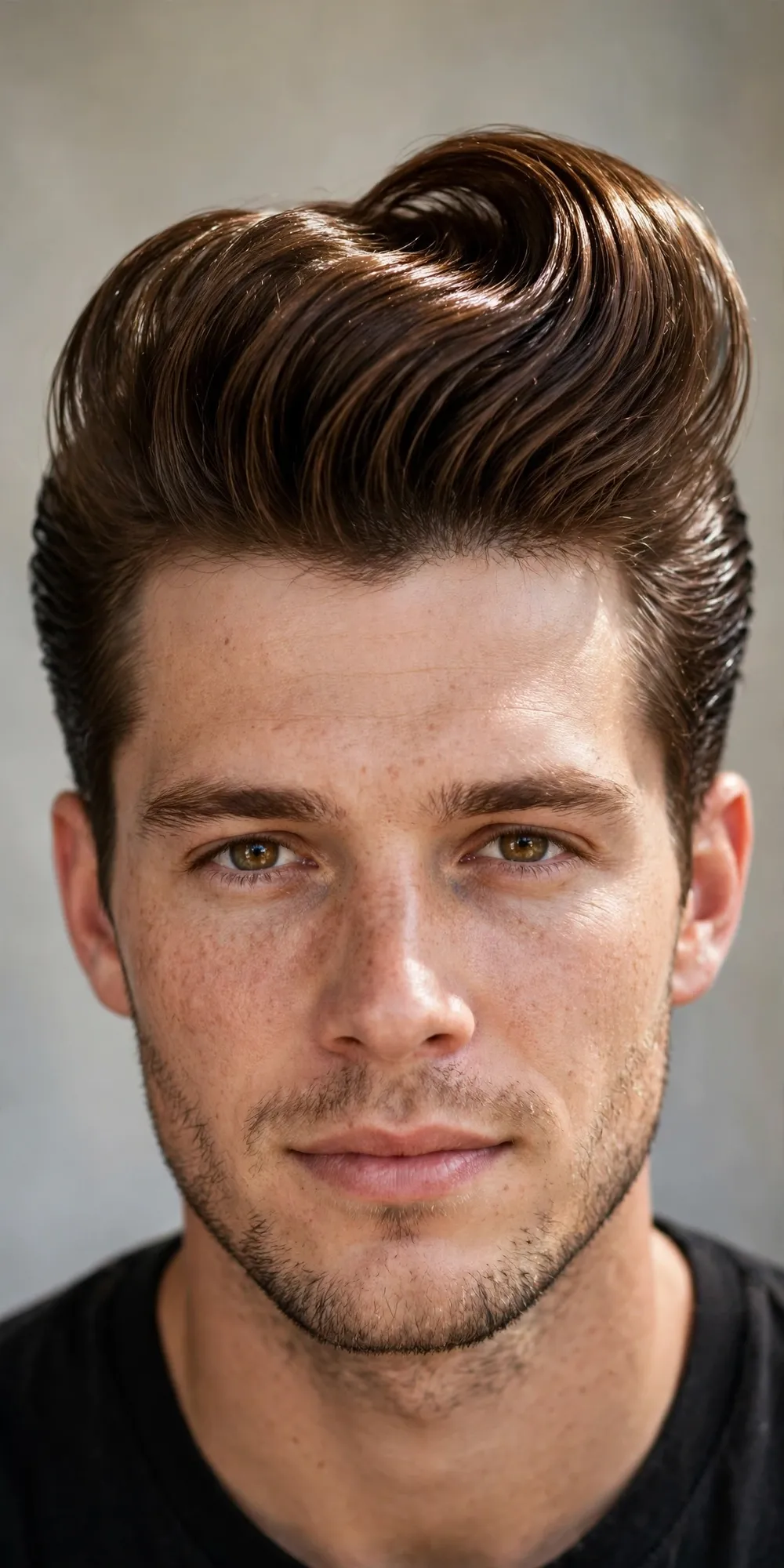
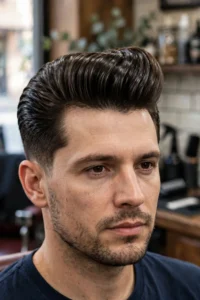
This is the one Elvis made famous: 4–6 inches on top, swept up and back in one smooth, glossy wave, with tapered sides that stay neat rather than faded. It suits oval and square faces best, since the height lengthens the face, and it works on straight or slightly wavy hair with medium thickness. Ask your barber for 4–5 inches on top, a scissor taper on the sides and back, and a clean, natural hairline. Blow-dry the front up and back with a round brush, then work a water-based pomade through from the roots and comb it smooth. Maintenance is honest but fair: five minutes every morning, and a sides tidy-up every two to three weeks. Wind and rain will drop it, so it’s a fair-weather style.
2. Classic Pompadour with Tapered Sides
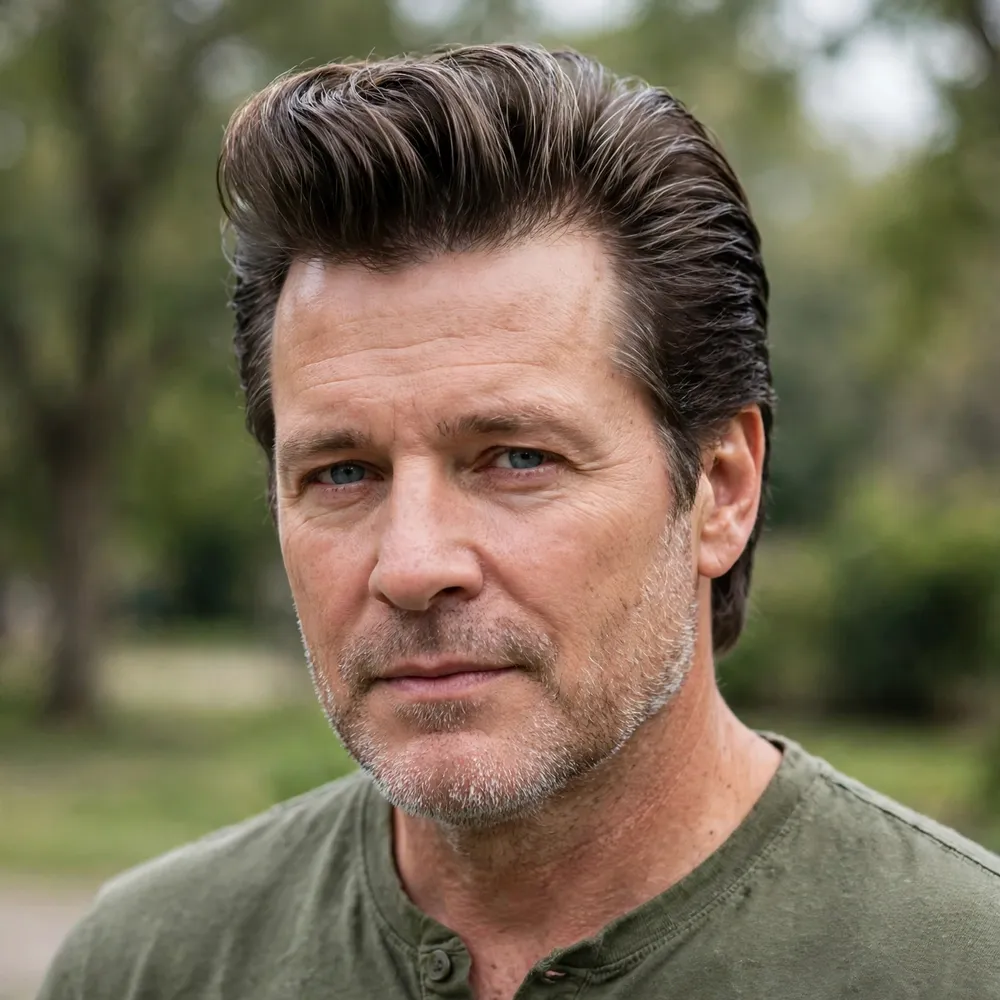
Same tall, polished top as the classic, but the sides taper down gradually instead of disappearing into a fade — which gives you a fuller, softer silhouette that looks at home in an office or at a wedding. It’s a strong pick for round faces, because the height adds length without a fade’s harsh contrast, and it works well on thick hair that would look bulky in a skin fade. Tell your barber: 4–5 inches on top swept up and back, with a classic scissor taper on the sides and back. Style it with a medium-hold pomade and a comb, finishing with a light mist of hairspray if the day is long. The taper grows out gracefully, so you can stretch a full cut to four weeks .
3. The Gentleman’s Side-Part Pompadour
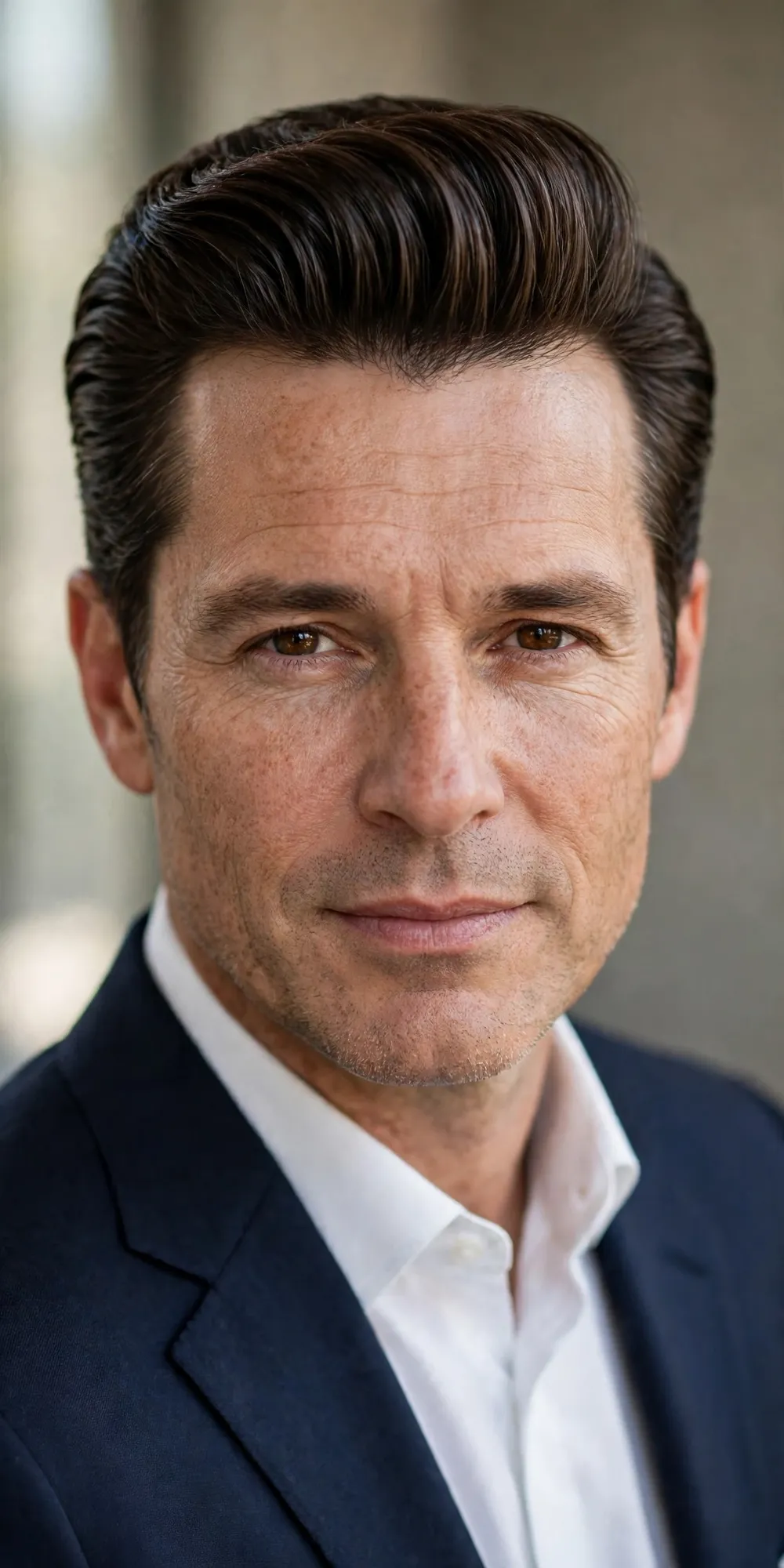
A side part meets a swept-up top in this one — polished, suit-ready, and the safest pompadour you can wear to a job interview. The top runs 3–4 inches, parted on one side and swept up and slightly across, while the sides are tapered short and clean. It flatters oval and oblong faces and looks especially good on men with straight, fine-to-medium hair, since the part gives it structure without needing much volume. Ask your barber for a defined side part, 3–4 inches on top, and a low taper — . A dab of medium-hold pomade, combed through in the direction of the part, is all the styling it needs. It holds all day, grows out cleanly, and is the version to get if the classic feels too loud.
4. The Rockabilly Pompadour
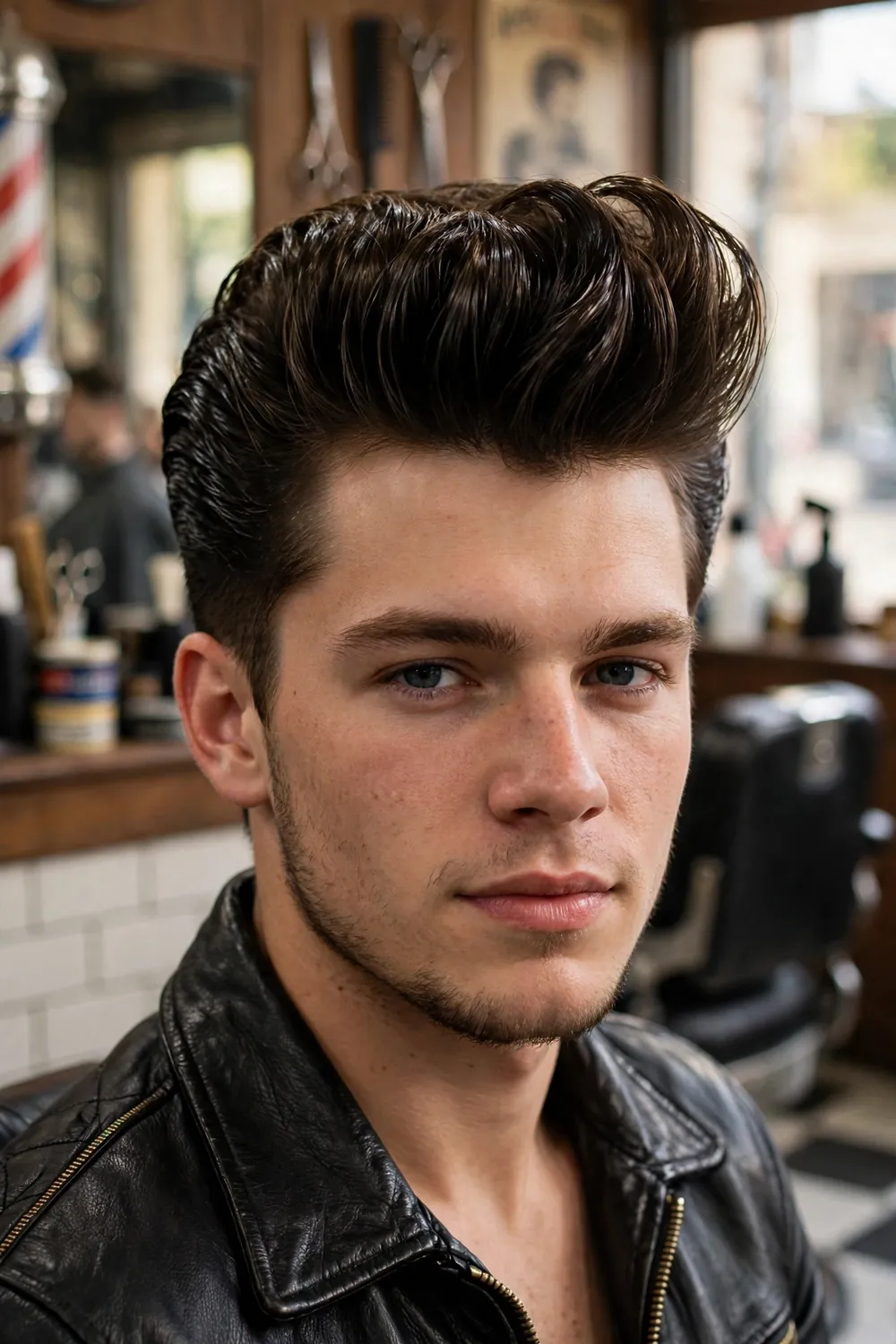
High, greased, and unapologetic — the rockabilly pompadour is the tallest, slickest version of the style, often with a ducktail at the back and a front quiff that leans forward before it sweeps up. It needs 5–6 inches on top and hair thick enough to hold a big shape, and it suits square and oval faces with strong features. Ask your barber for maximum length on top, short tapered sides, and a ducktail finish at the back if you want the full look. Styling means a strong-hold pomade — old-school oil-based if you’re committed — combed up from the front and set with a little spray. This one takes ten minutes in the morning and a real commitment to the aesthetic. Wear it with the clothes to match.
5. The Modern Pompadour
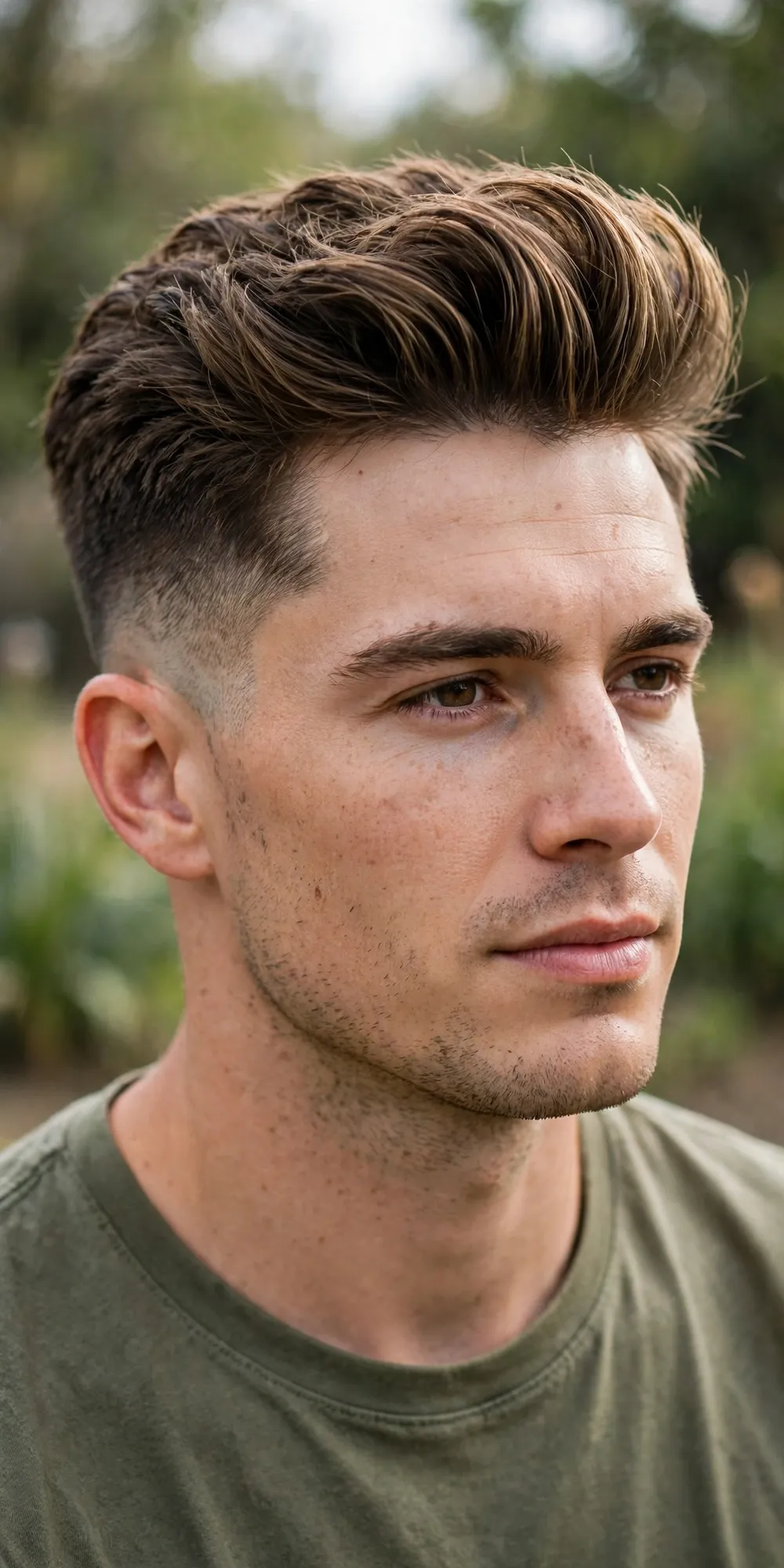
The modern pompadour keeps the tall sweep but trades the slick shine for texture and a matte finish, usually paired with a fade. The top runs 3–5 inches with point-cut texture through it, , and the faded sides keep it clean. It suits oval, square and heart-shaped faces, and works on straight, wavy or thick hair. Tell your barber: “Textured pompadour, 4 inches on top, matte finish, low or mid fade on the sides.” Style it by blow-drying up and back, then working matte clay through with your fingers rather than a comb — that keeps the piecey finish. Two to three minutes in the morning, a fade tidy-up every two weeks, and you’re done. It’s the pompadour for men who want the height without the vintage costume.
6. Textured Pompadour
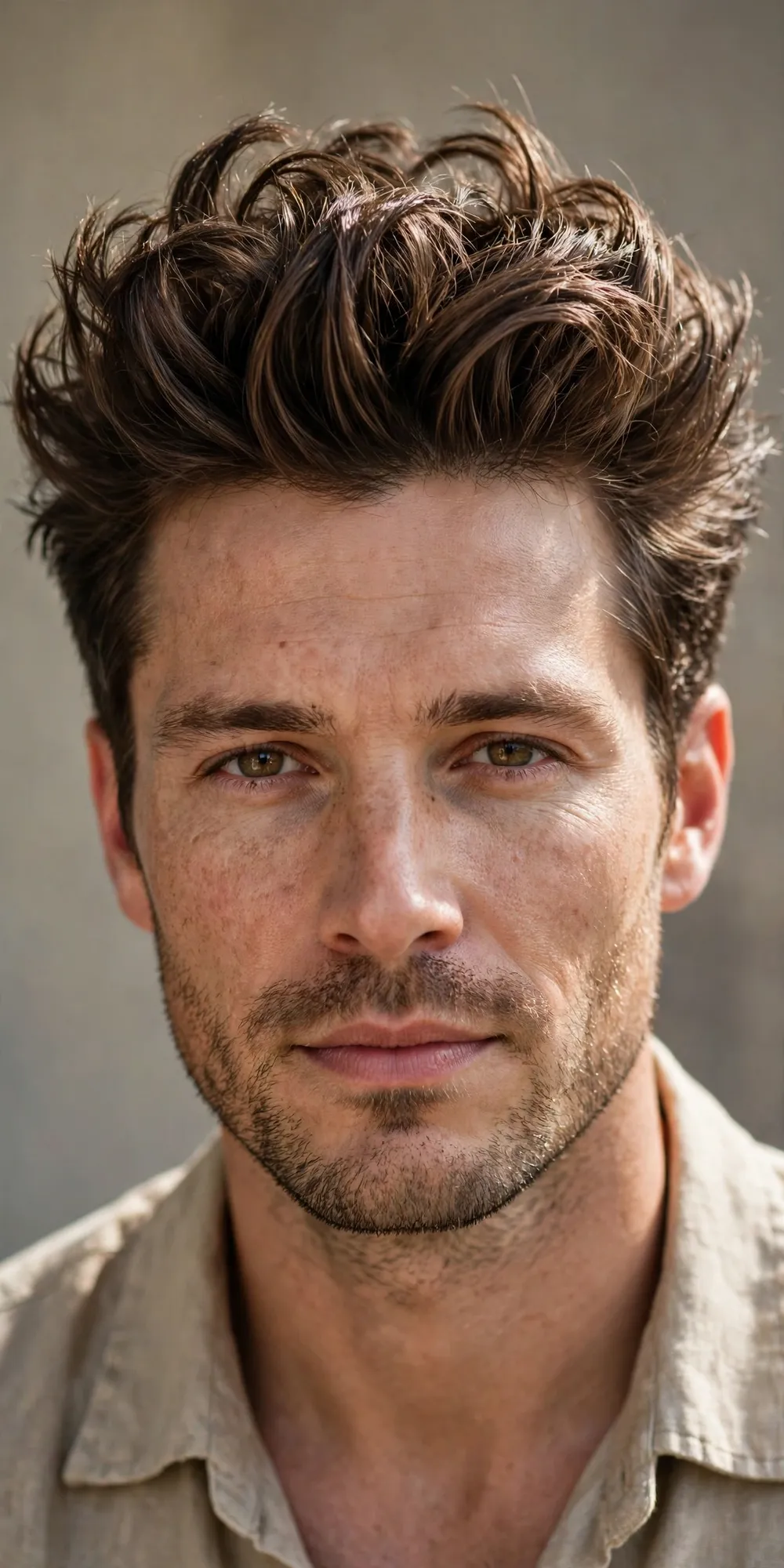
If the classic pompadour is a smooth wave, this one is a choppy, piecey lift — the same tall shape, but with the top layered so individual pieces show. It’s the best choice for men with wavy or thick hair, because the texture works with your natural movement, and it adds visual volume to finer hair too. It flatters round faces in particular. Ask your barber to point-cut or razor-texture the top, keep 3–4 inches, and pair it with a taper or low fade. Styling: blow-dry up and back, then push a pea-sized amount of matte clay or texture paste through with your fingers, pulling a few pieces forward for that lived-in edge. Three minutes, no comb needed. The fade needs a refresh every two weeks, but the textured top grows out well.
7. Matte Finish Pompadour
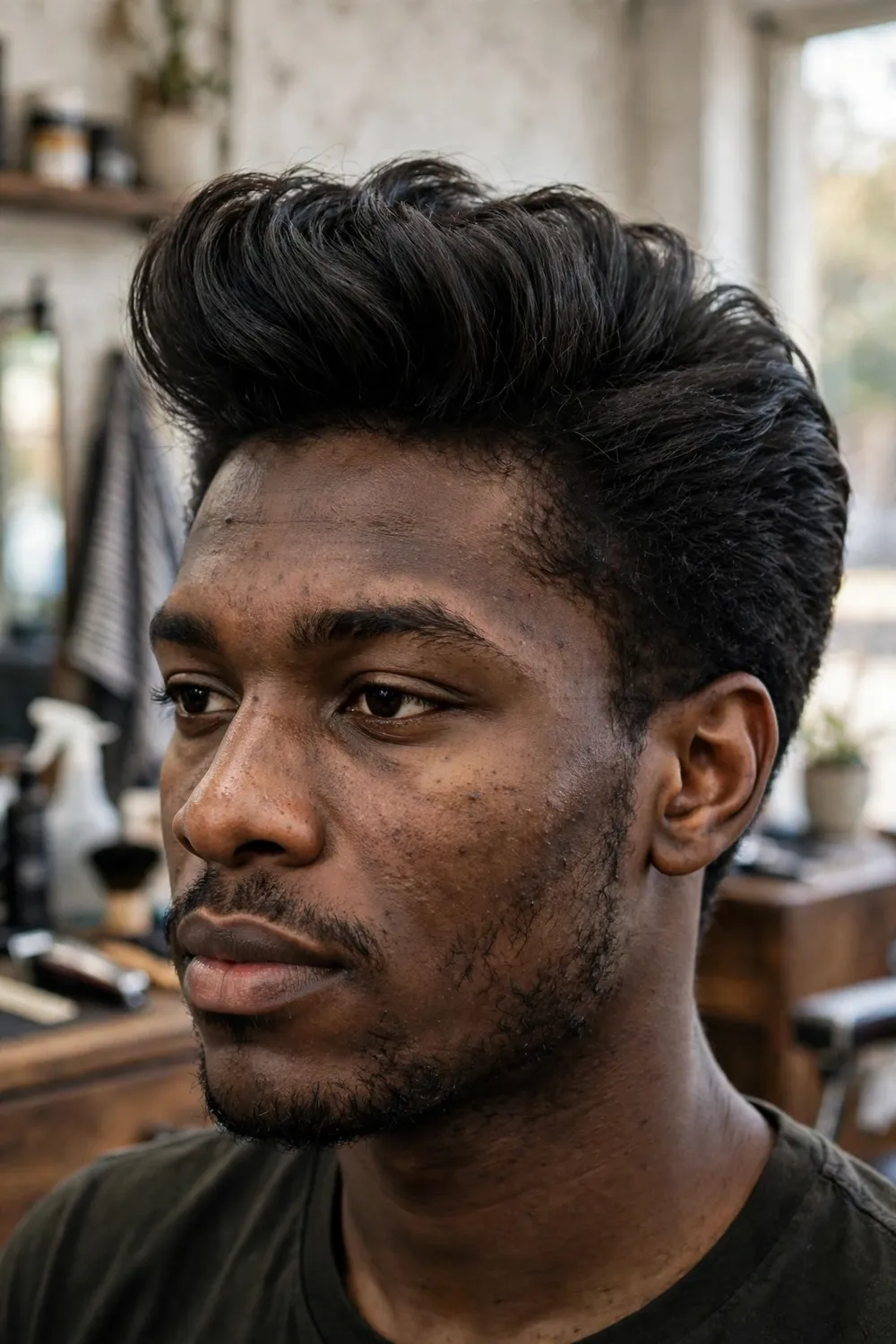
No shine, no grease, no mirror finish — the matte pompadour gives you the tall sweep with a dry, natural look that reads like your hair just does this on its own. It’s the right pick if shiny pomade feels too old-fashioned for you. The cut is the same as a modern pompadour: 3–5 inches on top with texture, faded or tapered sides. It suits most face shapes, and it’s particularly good on fine hair, where matte clay adds grip and thickness without weighing it down. Ask your barber for texture through the top and a matte finish — . Blow-dry with a little sea salt spray or volumising mousse first, then finish with matte clay. It holds all day and washes out with one shampoo.
8. Messy Pompadour

The messy pompadour keeps the height but drops the precision — loose, tousled volume swept up. It’s the laid-back version, and it suits men who want the pompadour’s presence without spending ten minutes with a comb every morning. It works best on wavy or thick hair, and it flatters oval and square faces. Ask your barber for 3–4 inches on top with lots of point-cut texture and a low fade or taper — no hard lines. To style, blow-dry roughly up and back, then work a small amount of matte paste through with your fingers and mess it up on purpose. It takes two minutes, and it genuinely looks better a bit undone. The trade-off is that it can look unfinished in formal settings, so it’s not the pick for a suit-heavy week.
9. Short Pompadour
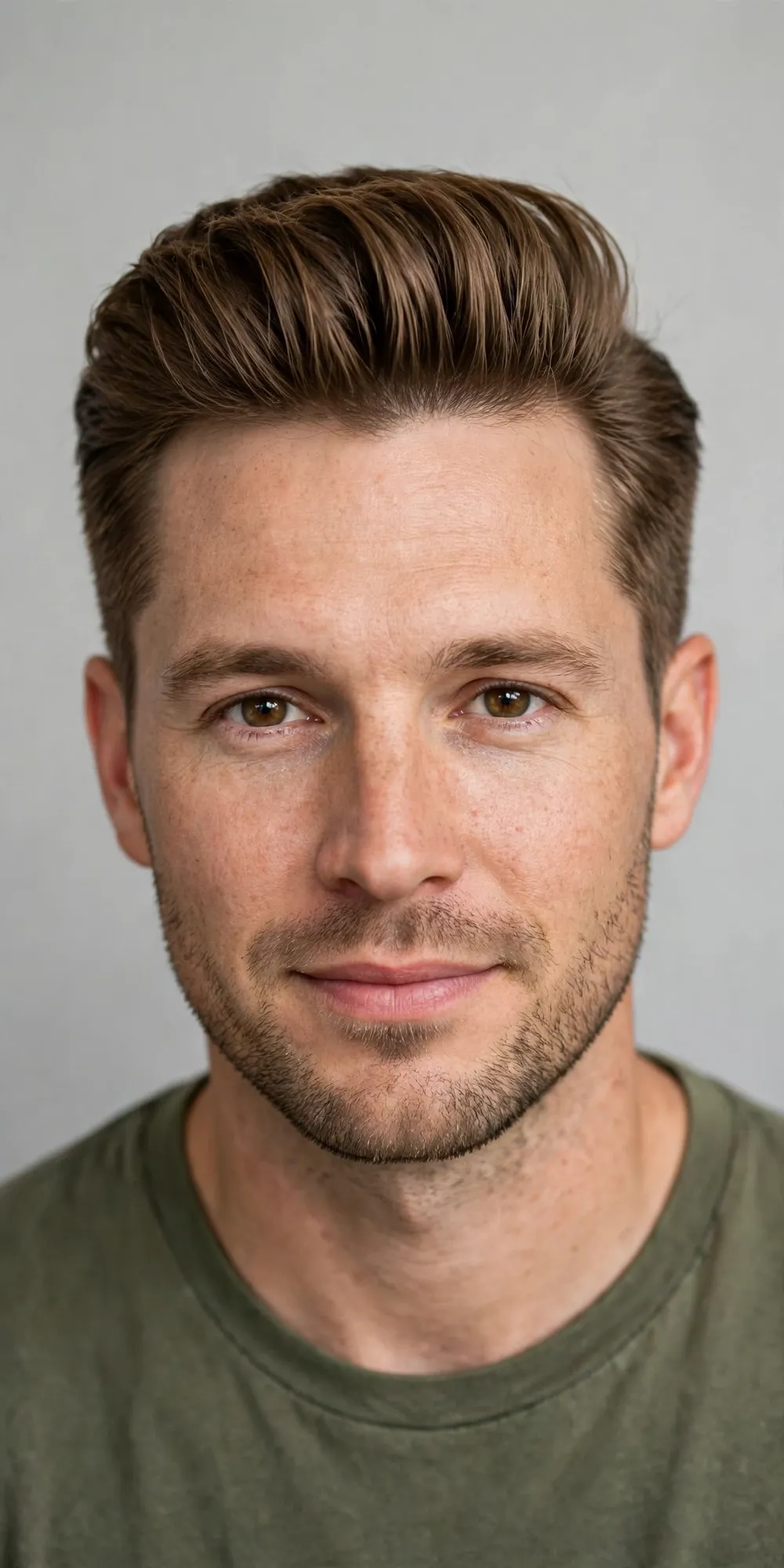
The short pompadour is the compact version: a modest lift of 2–3 inches on top, swept up and back, with short sides — all the shape, none of the drama. It’s the easiest daily version on this list and the best starting point if you’ve never had a pompadour before. It suits every face shape, works on straight, wavy or fine hair, . Ask your barber for 2–3 inches on top, a taper or low fade on the sides, and enough texture that the top doesn’t sit flat. Styling takes ninety seconds: blow-dry the front up with your fingers, add a dab of matte clay, and go. It holds all day with minimal product, grows out without looking messy, and you can stretch a cut to four weeks.
10. Long Pompadour
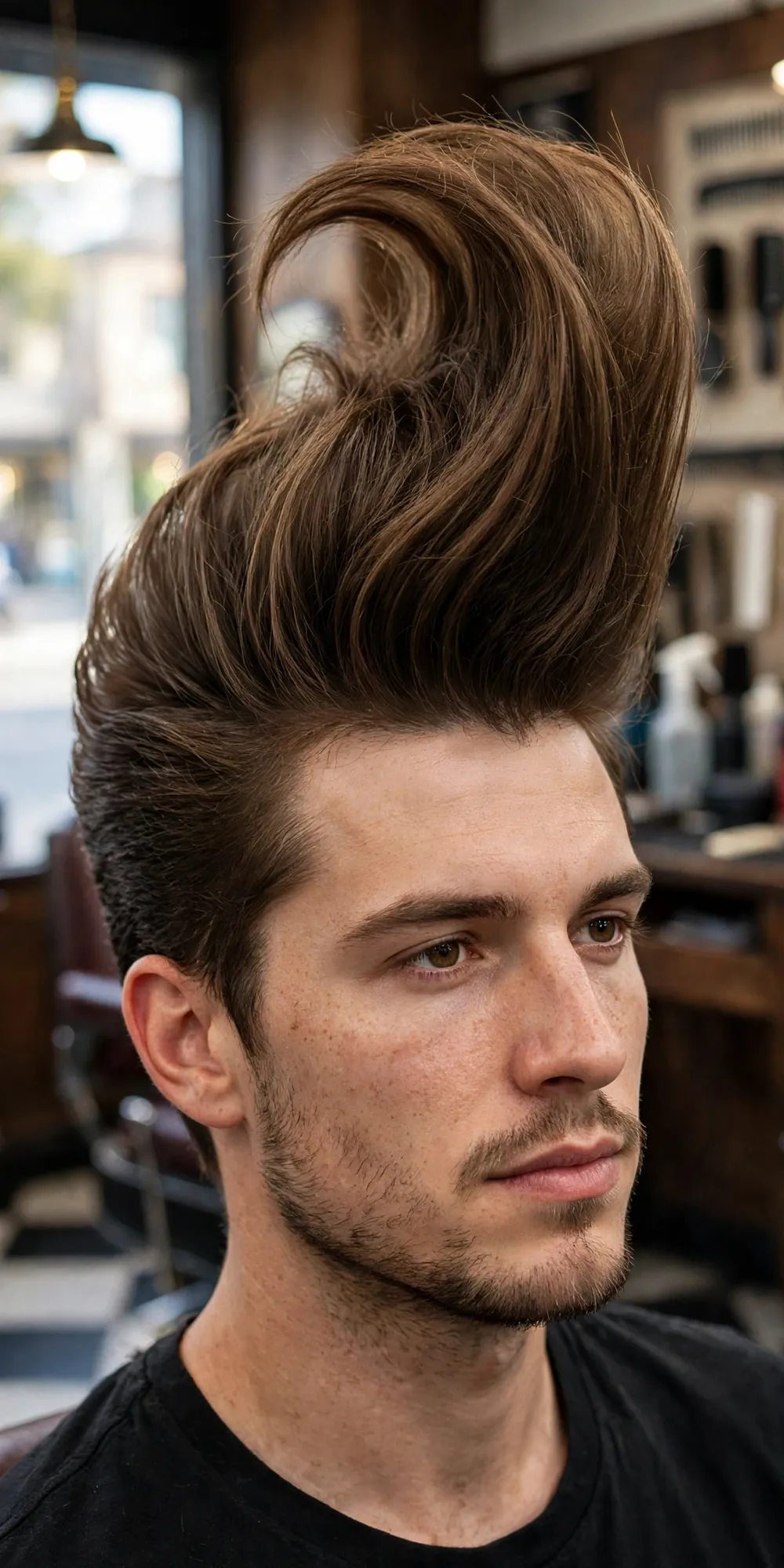
Maximum height, maximum length — the long pompadour runs 5–7 inches on top and builds the tallest sweep of any style on this list. It’s dramatic, and that’s the point: when it’s done well, it’s the first thing people notice. It needs thick, straight or slightly wavy hair with enough strength to stand up, and it suits oblong and oval faces best. Ask your barber for 5–6 inches minimum on top, shorter toward the crown, with faded or tapered sides. Styling is a real routine: blow-dry in sections with a round brush, use a volumising pre-styler, then set it with a strong-hold pomade or clay and a shot of hairspray. Give it eight to ten minutes. It needs a sides tidy-up every two weeks and a top trim every five.
11. Low Fade Pompadour
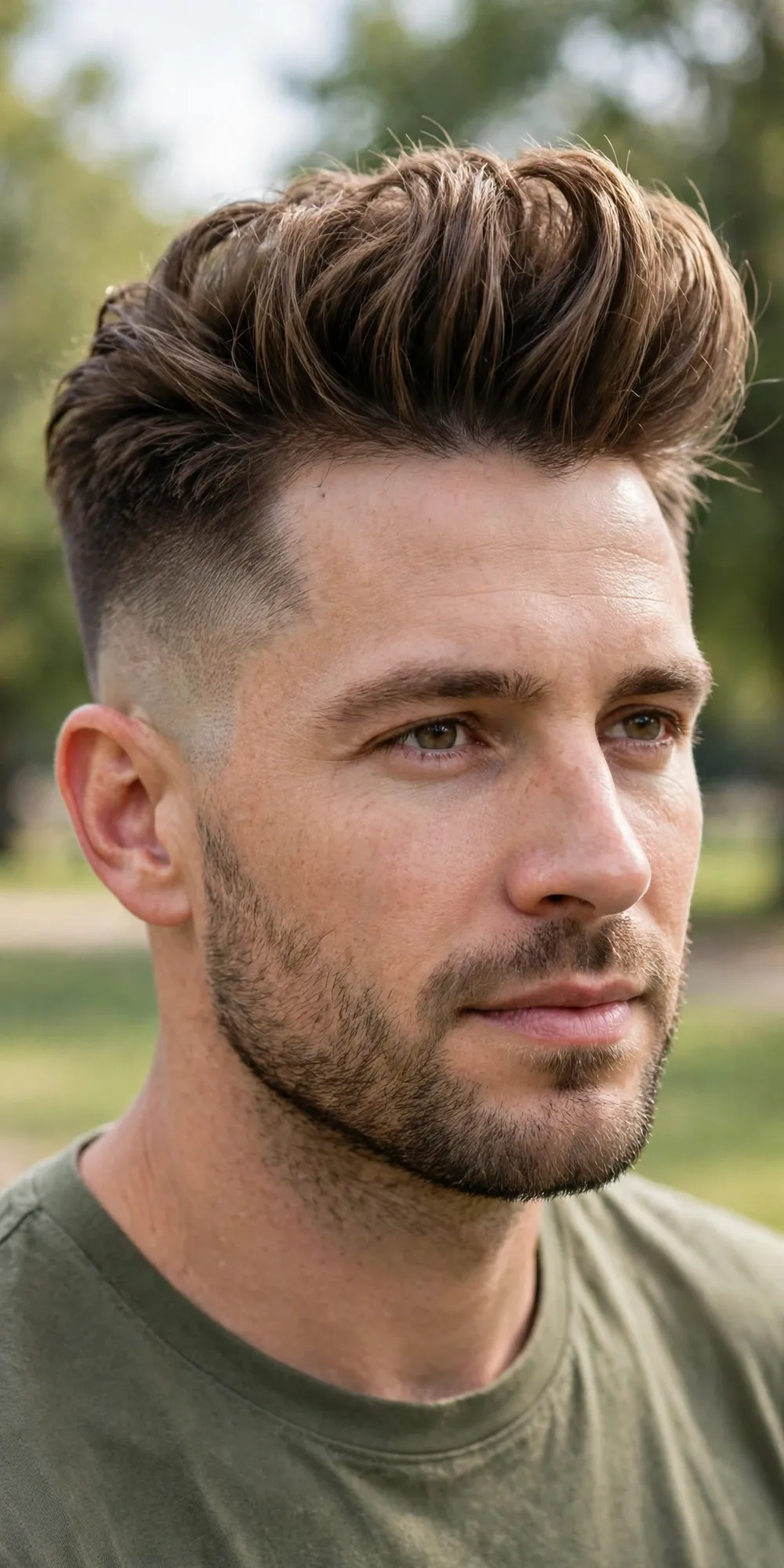
The low fade keeps the sides short just above the ears, so all the attention stays on the tall top. It suits almost every face shape, and it’s particularly good on round faces, where the height adds length without extra width. It works on straight, wavy and thick hair alike. Ask your barber for 4 inches on top swept up and back, with a low fade that starts just above the ear and blends up into the top. Blow-dry up and back, then finish with matte clay for a modern look or pomade if you want shine. It grows out gracefully, so you can push a tidy-up to three weeks.
12. Mid Fade Pompadour
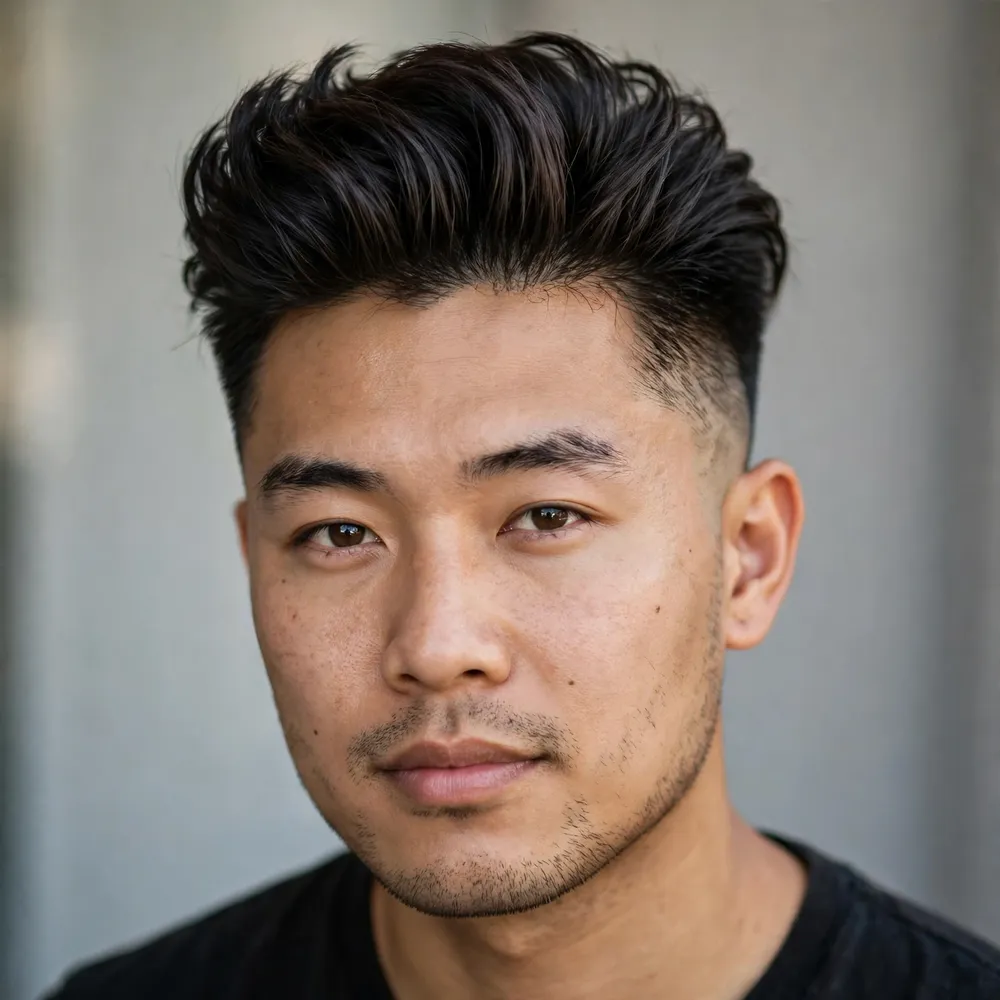
The mid fade sits halfway up the sides — higher than a low fade, lower than a high one — and that balance is exactly why it’s the most versatile pairing for a pompadour. The fade gives the tall top a clean frame without the stark contrast of a skin fade. It suits oval, square and heart-shaped faces, and it handles thick hair well. Tell your barber: “Mid fade, blended, with 4 inches on top swept up and back — keep some texture in the top.” Style it with a blow-dryer and matte clay, pushing the front up with your fingers. The fade needs a refresh every two weeks to stay crisp, but the top grows out fine between cuts.
13. High Fade Pompadour
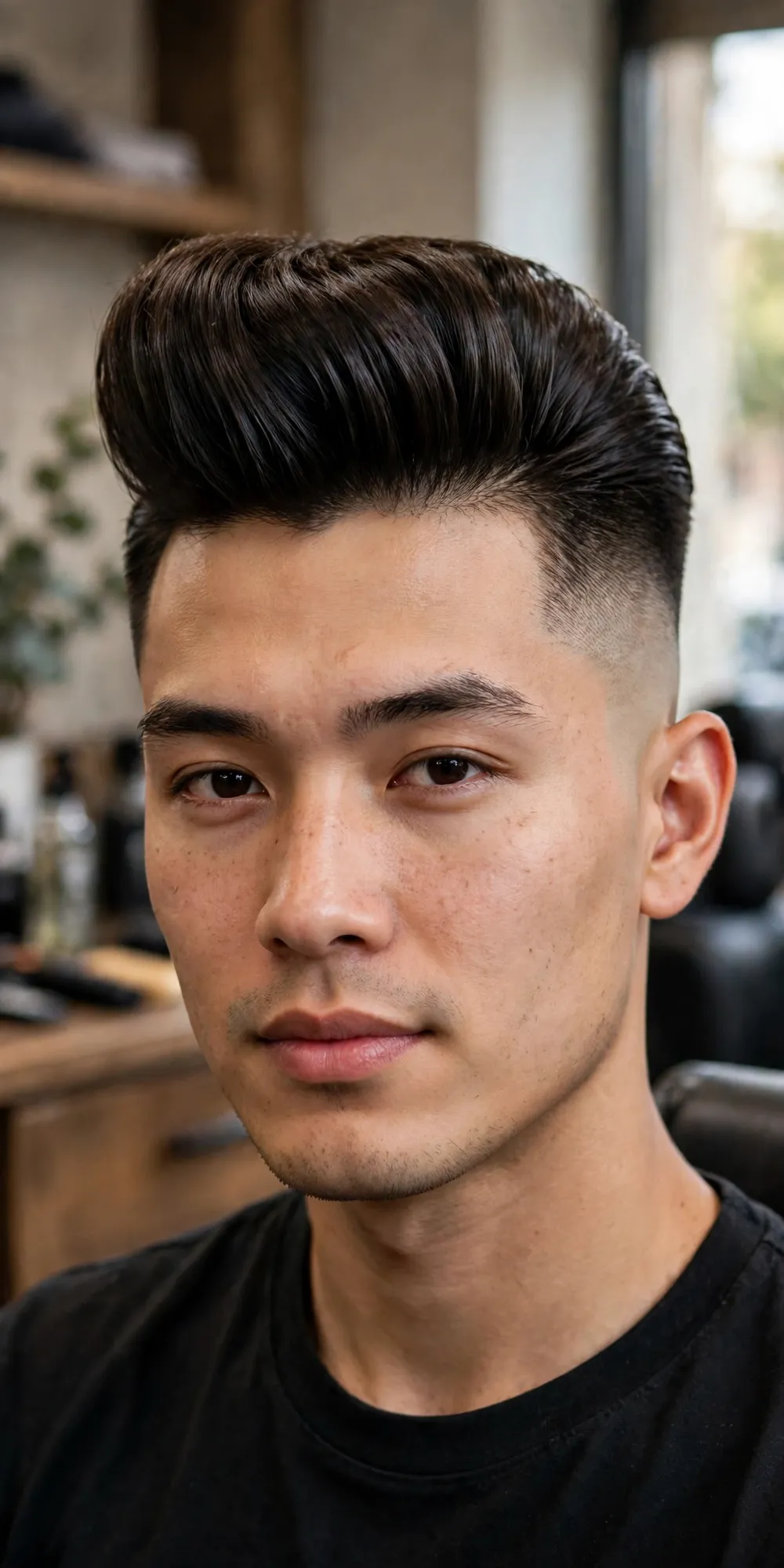
A high fade takes the sides up to near the crown, so the tall pompadour top sits on a sharp, high-contrast base — the boldest fade pairing, making the height look even taller. It suits oval and square faces best, and it’s a strong choice for men with thick hair. Ask your barber for a high fade — skin or a #0 at the bottom, blending up fast — with 4–5 inches on top, swept up and back. Styling is the usual routine: blow-dry up and back, matte clay or pomade depending on the finish you want, and a comb if you’re after a clean line. The catch is maintenance: a high fade shows growth quickly, so budget a sides tidy-up every ten days to two weeks.
14. Skin Fade Pompadour
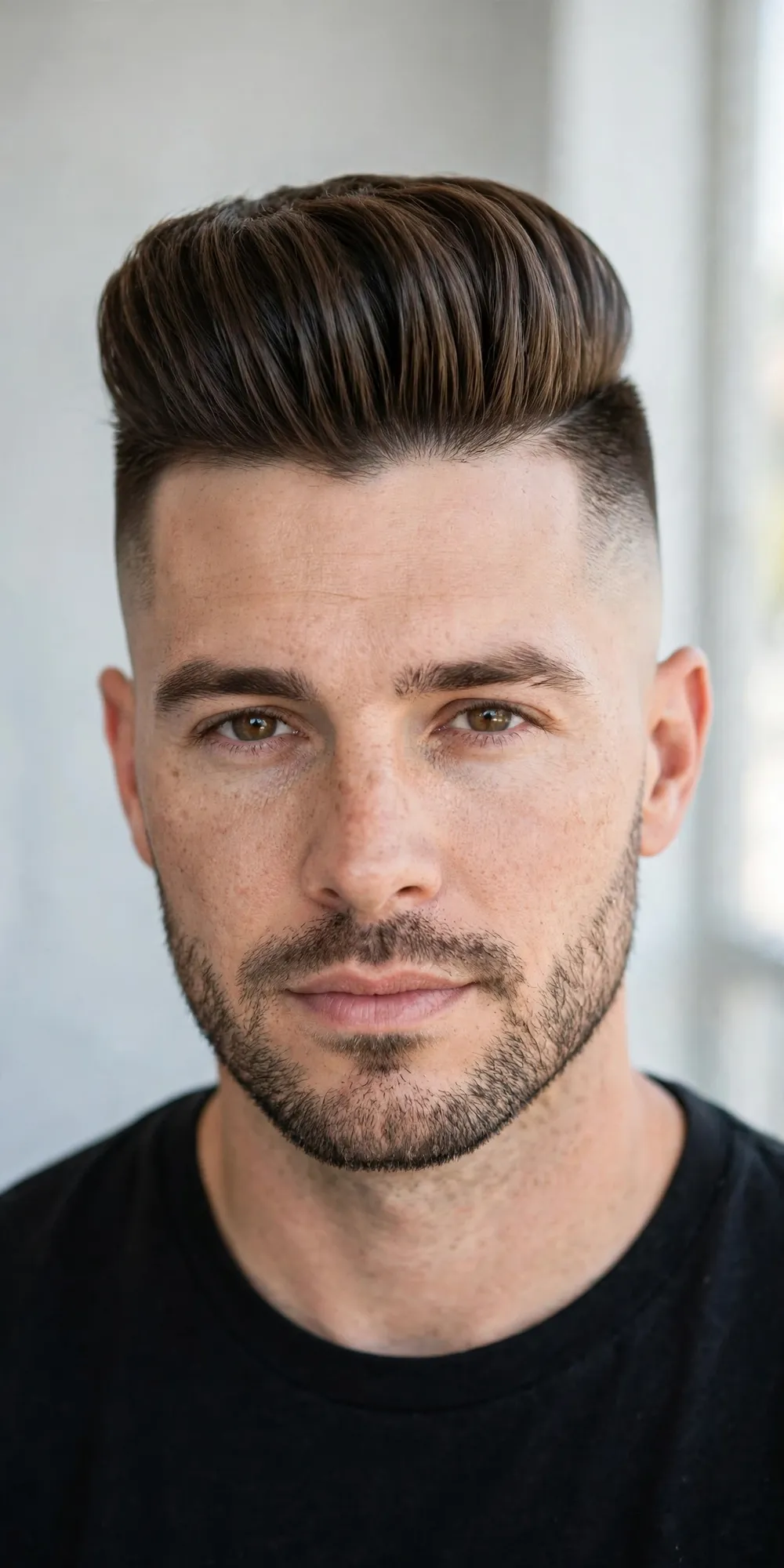
Faded to bare skin at the bottom, the skin fade pompadour is the cleanest and boldest edge you can put under a tall top. The contrast between the shaved sides and the high, voluminous sweep is dramatic, which is why it photographs so well. It suits oval and square faces with strong jawlines, and it works on straight or wavy hair with enough density on top. Ask for a skin fade with a smooth blend — no visible lines — and 4–5 inches on top, textured and swept up and back. Style with a blow-dryer and matte clay for a modern finish. Honest maintenance note: the skin fade grows out in about a week, so this is a every-10-to-14-days haircut if you want it to stay sharp.
15. Drop Fade Pompadour
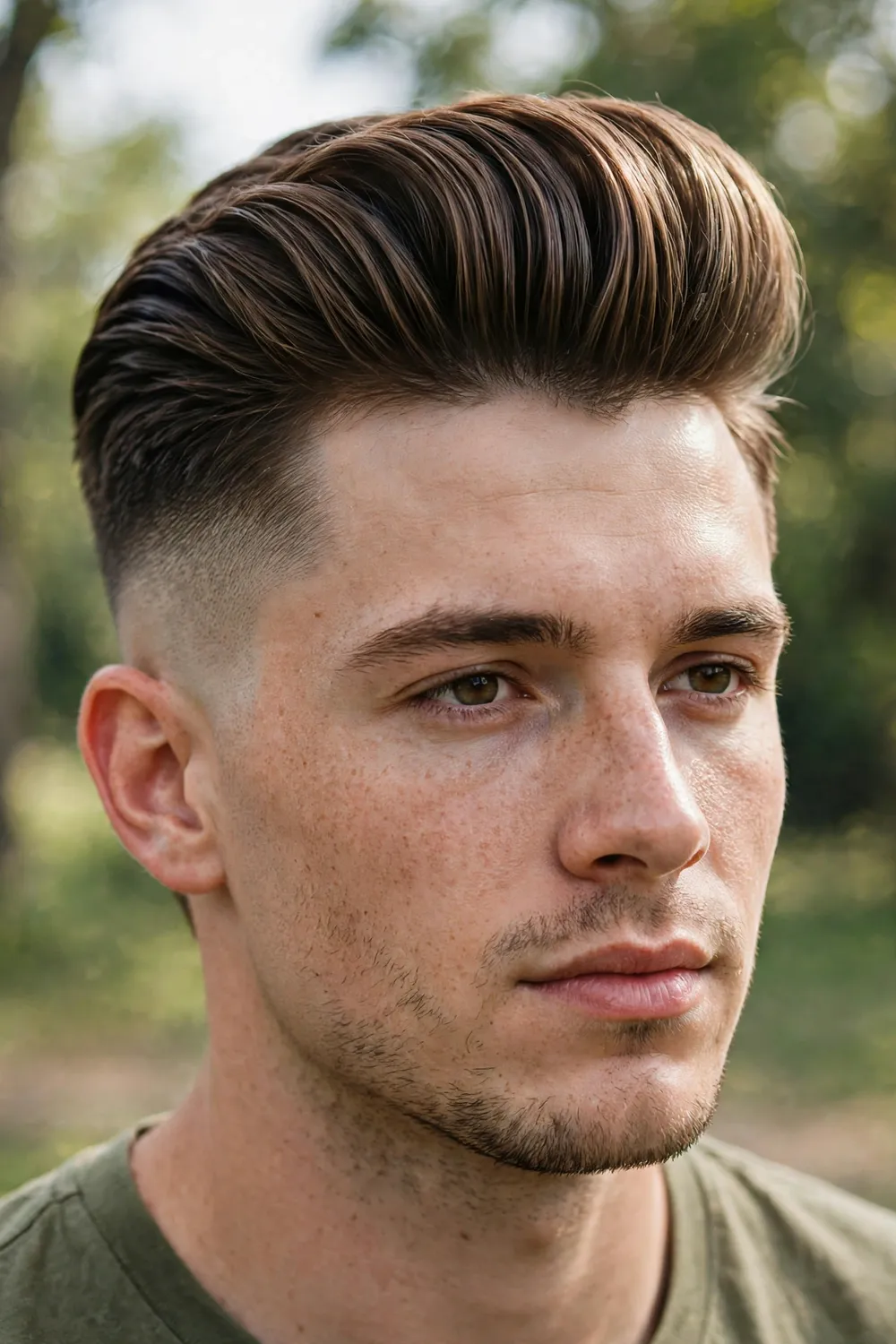
A drop fade curves down behind the ear and follows the shape of your head, which gives the pompadour a softer, more tailored frame than a standard fade. It’s a good pick for men with round or square head shapes, and it looks great on thick or wavy hair. Ask your barber for a drop fade — low at the front, dipping behind the ear — with 4 inches on top, swept up and back with some texture. Styling follows the usual pattern: blow-dry up and back, matte clay through the top, and you’re out the door in three minutes. The drop fade needs a refresh every two weeks, same as any fade, but it grows out a little more gracefully than a high fade.
16. Disconnected Pompadour
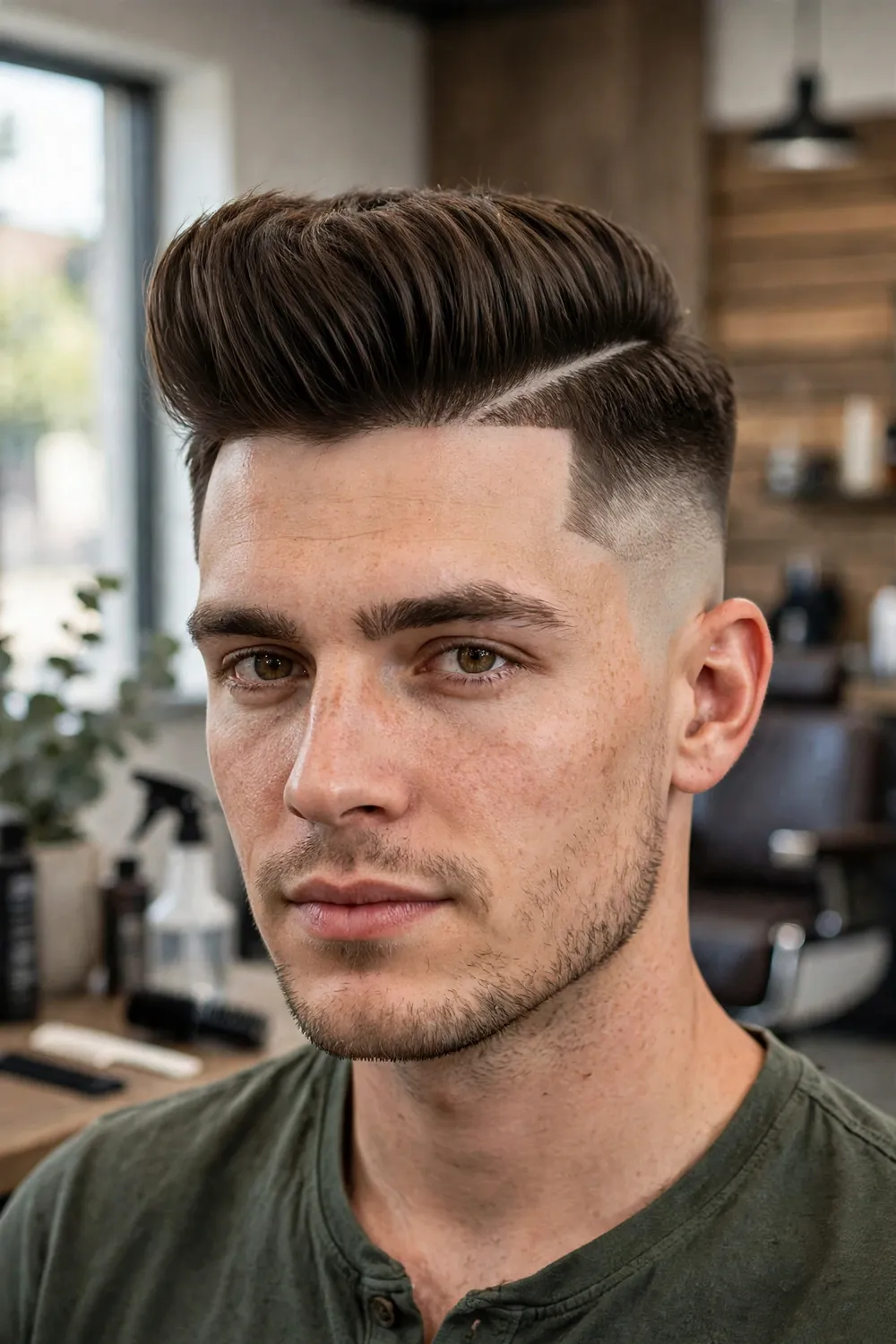
A hard line separates the long top from the short sides in a disconnected pompadour — no blending, no taper, just a sharp step where the length changes. It’s the edgiest version on this list, and it suits men with straight, thick hair and oval or square faces. Ask your barber for a disconnected cut: long on top, 4–5 inches, with the sides clipped short to a #2 or #3 and a defined line where they meet. Style the top up and back with a blow-dryer and strong-hold matte clay or pomade. Maintenance is the honest part: the line grows out in about two weeks, and once it softens the whole cut loses its point, so keep your barber visits regular.
17. Undercut Pompadour
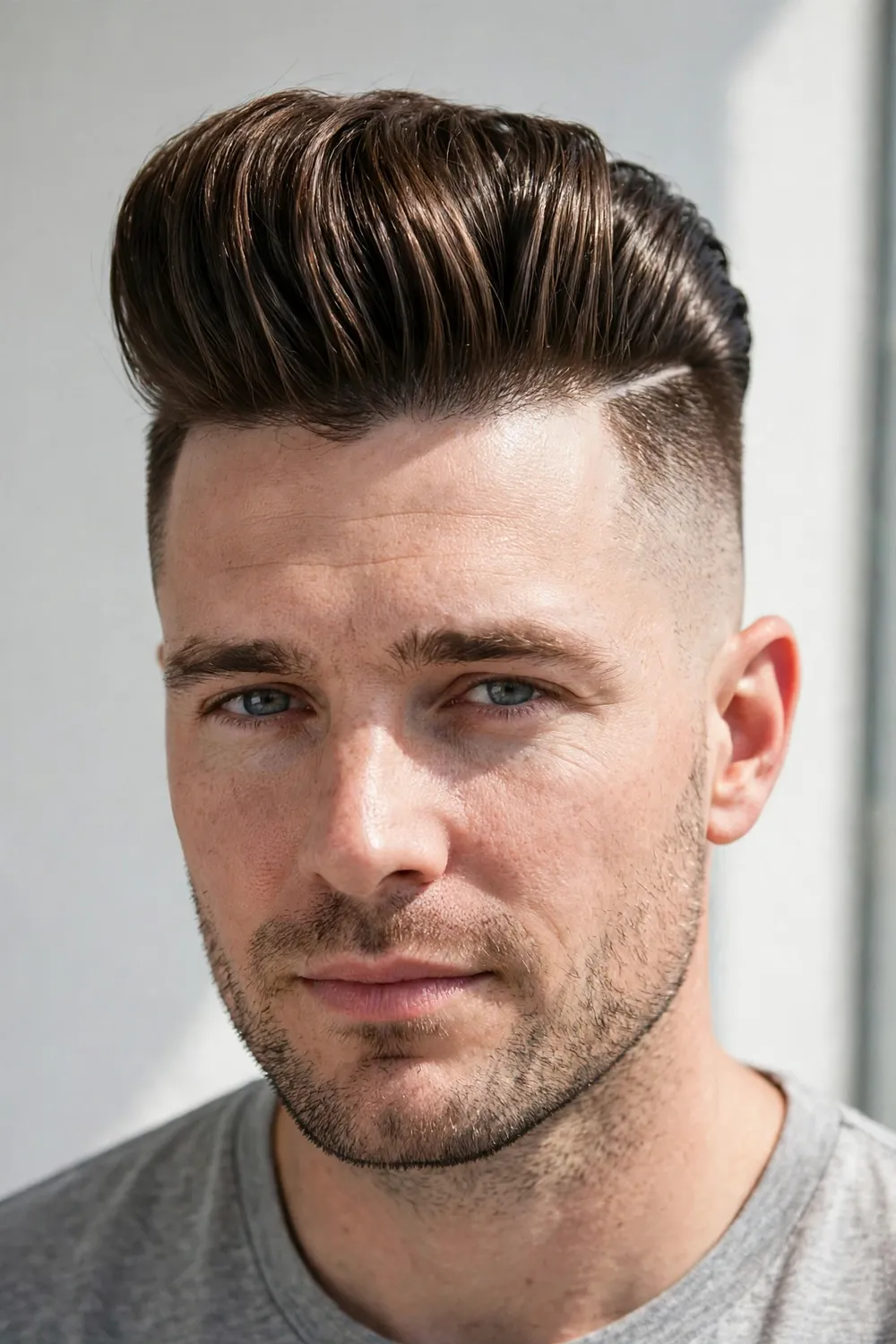
The undercut pompadour pairs a long, swept-up top with sides clipped short all the way around — one length, no fade, no taper. It suits oval, square and oblong faces, and it’s best on straight or slightly wavy hair with enough thickness to hold the height. Ask your barber for an undercut — sides and back clipped to a #2 or #3, all one length — with 4–5 inches on top, swept up and back. Blow-dry the top up and back, then use a strong-hold pomade or matte clay to set it; a comb gives the clean version, fingers the textured one. The undercut grows out more slowly than a fade, so you can stretch a cut to three or four weeks.
18. Hard Part Pompadour
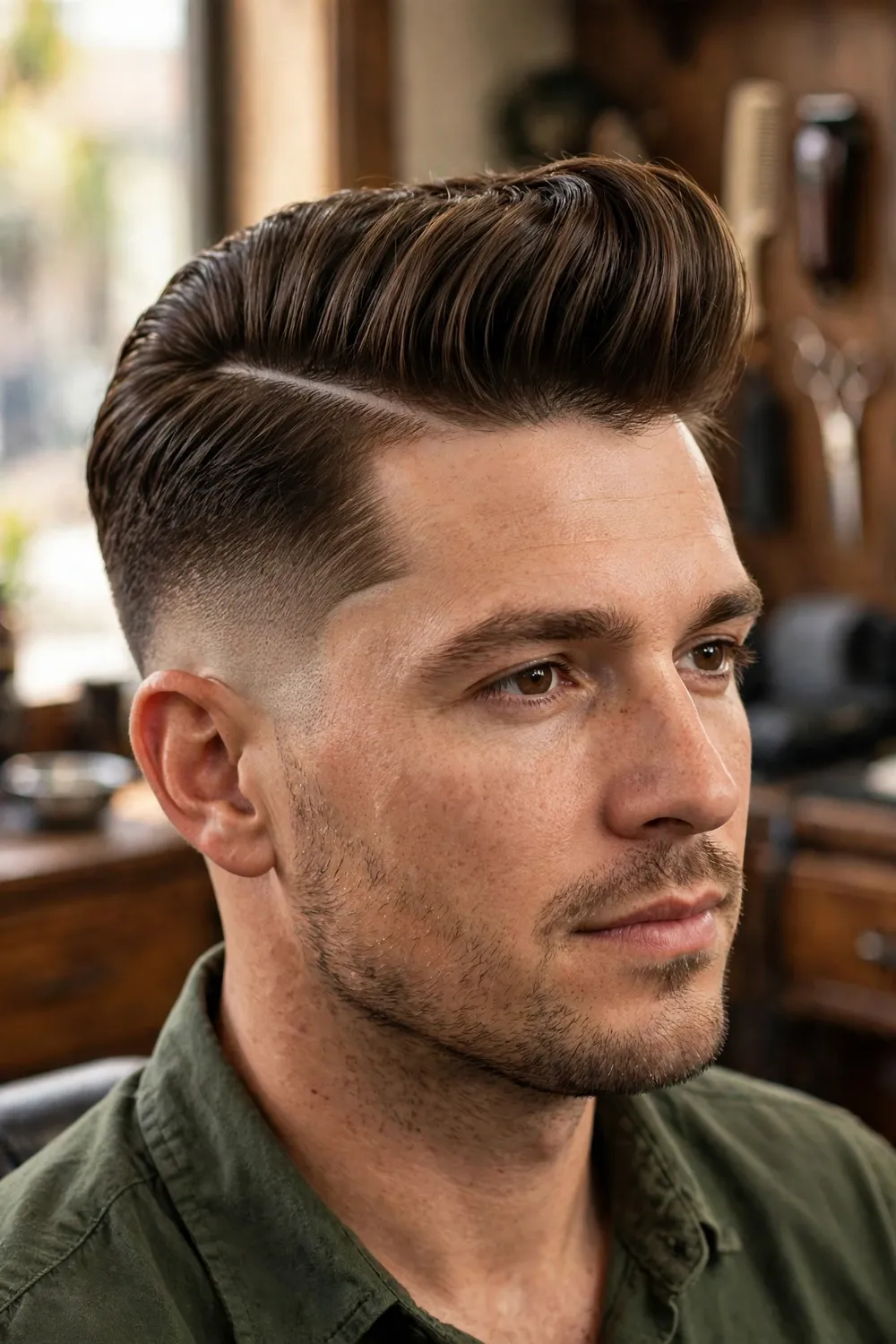
A hard part is a razor-shaved line that marks exactly where the hair parts — and combined with a pompadour it reads as extremely well-groomed. The top runs 3–4 inches, parted on one side and swept up and across, with faded or tapered sides. It suits oval and square faces and works best on straight, medium-to-thick hair. Ask your barber for a hard part on your natural part line, with a low or mid fade and the top swept up from the part. Style it with a comb and medium-hold pomade, following the part line exactly. The part line grows out in about a week to ten days, so this is a high-maintenance detail: budget a weekly line-up if you want it to stay crisp.
19. Pompadour with Shaved Design
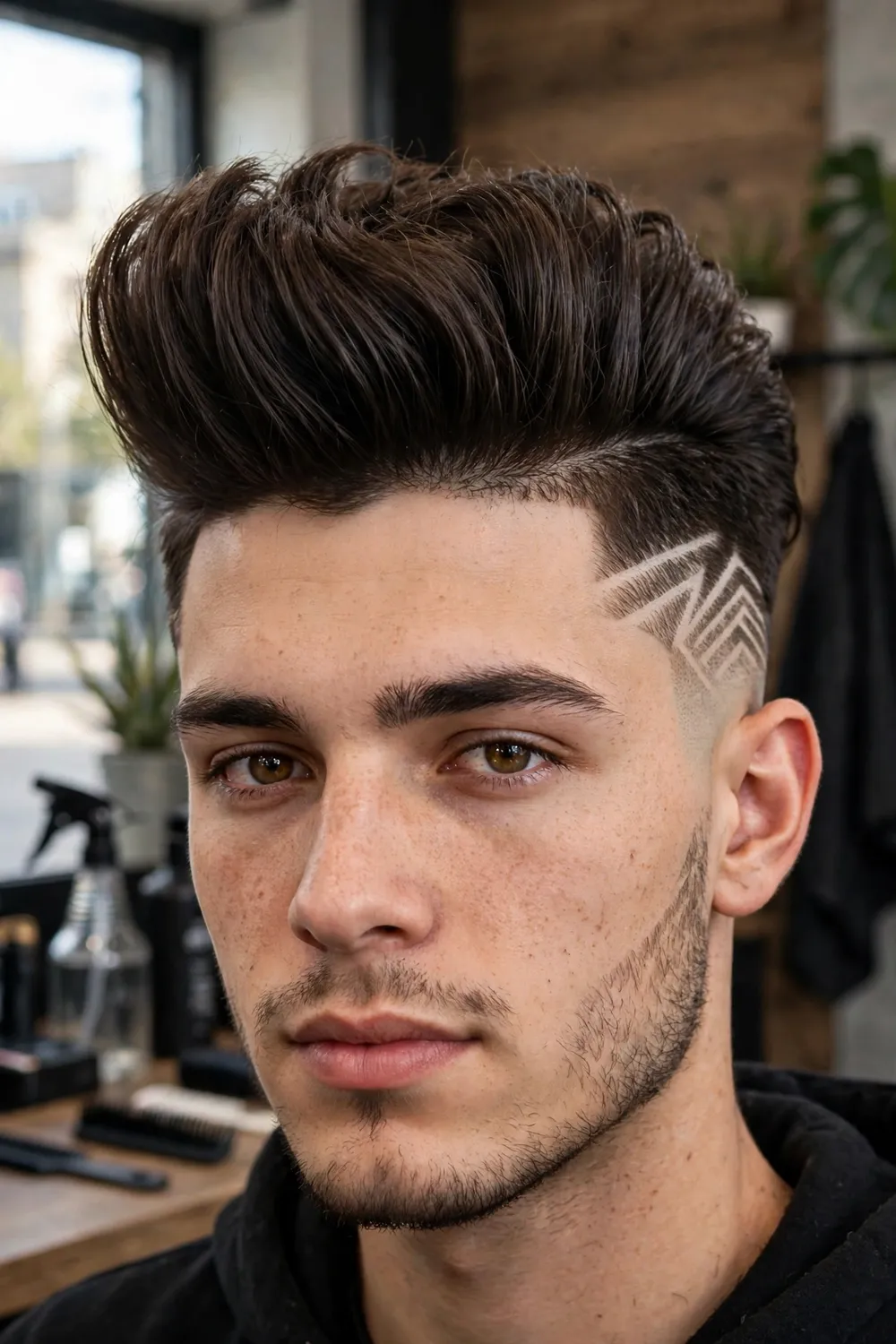
A line, pattern or geometric shape shaved into the faded sides turns a pompadour into a statement. The design usually sits in the fade on one side: a single clean line or a pair of parallel lines. The top is a standard pompadour — 4 inches, swept up and back. It suits younger men and anyone with a bold personal style, and it works on any face shape, since the design is on the sides, not the top. Ask your barber what designs he’s confident doing, and start simple — a single line grows out fast if you change your mind. Styling is the usual pompadour routine. Shaved designs grow out in five to seven days, so it’s a weekly-maintenance cut that draws attention in formal settings.
20. Curly Pompadour
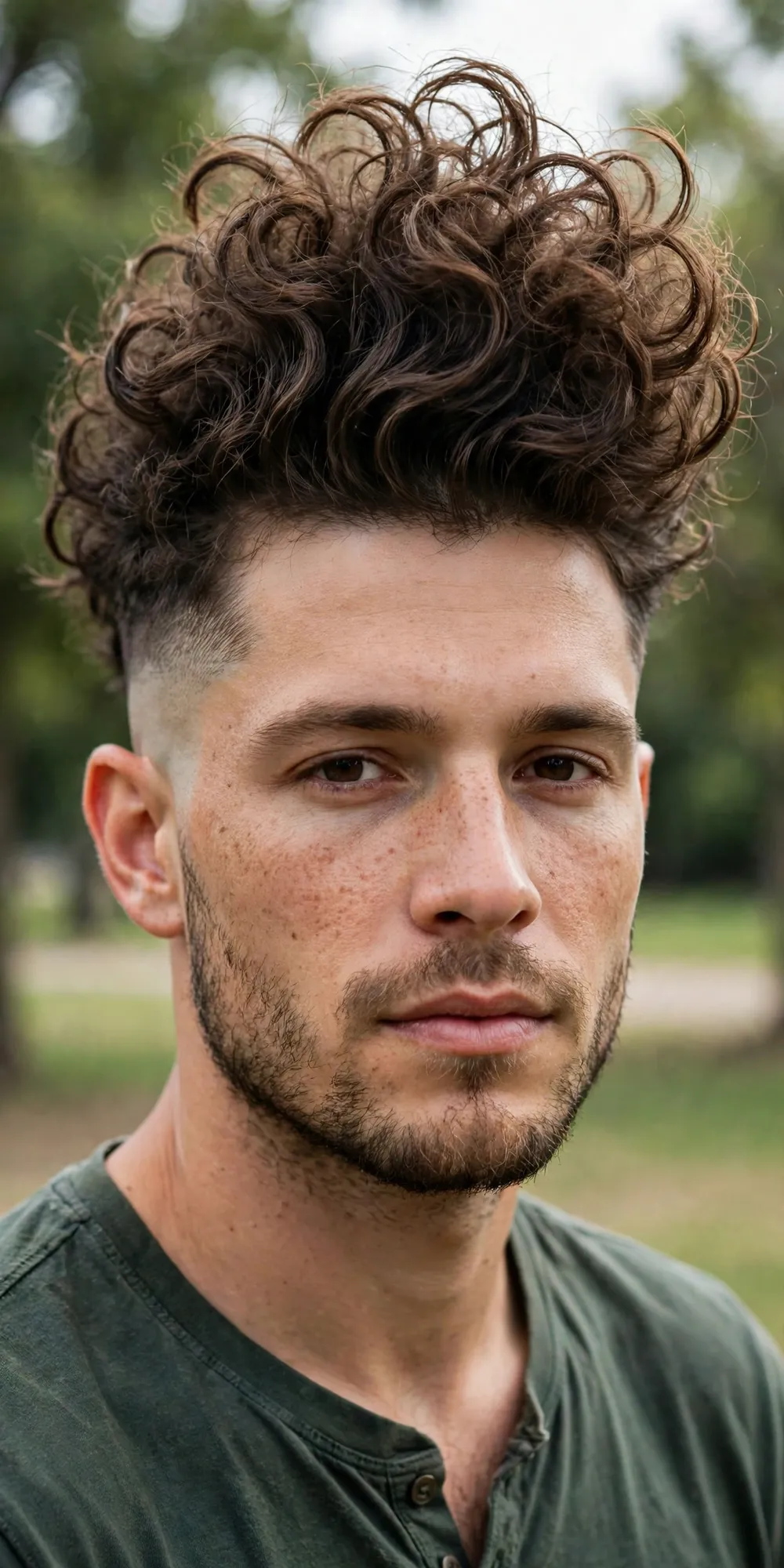
Curly hair and pompadours are a better match than most people think — the curls give you natural volume and texture. The trick is length: you need enough curl on top to lift and shape, with the sides tapered or faded short. It suits oval and square faces. Ask your barber for a curly pompadour — keep the length on top, taper the sides, and have him cut the curls dry or in their natural state so the shape is honest. Style it with a curl cream or light hold cream, scrunching the curls up and back while they’re damp. Don’t brush it — that turns curls into frizz. Maintenance is kind to you: the shape holds for weeks, and the only real job is keeping the curls moisturised.
21. Wavy Pompadour
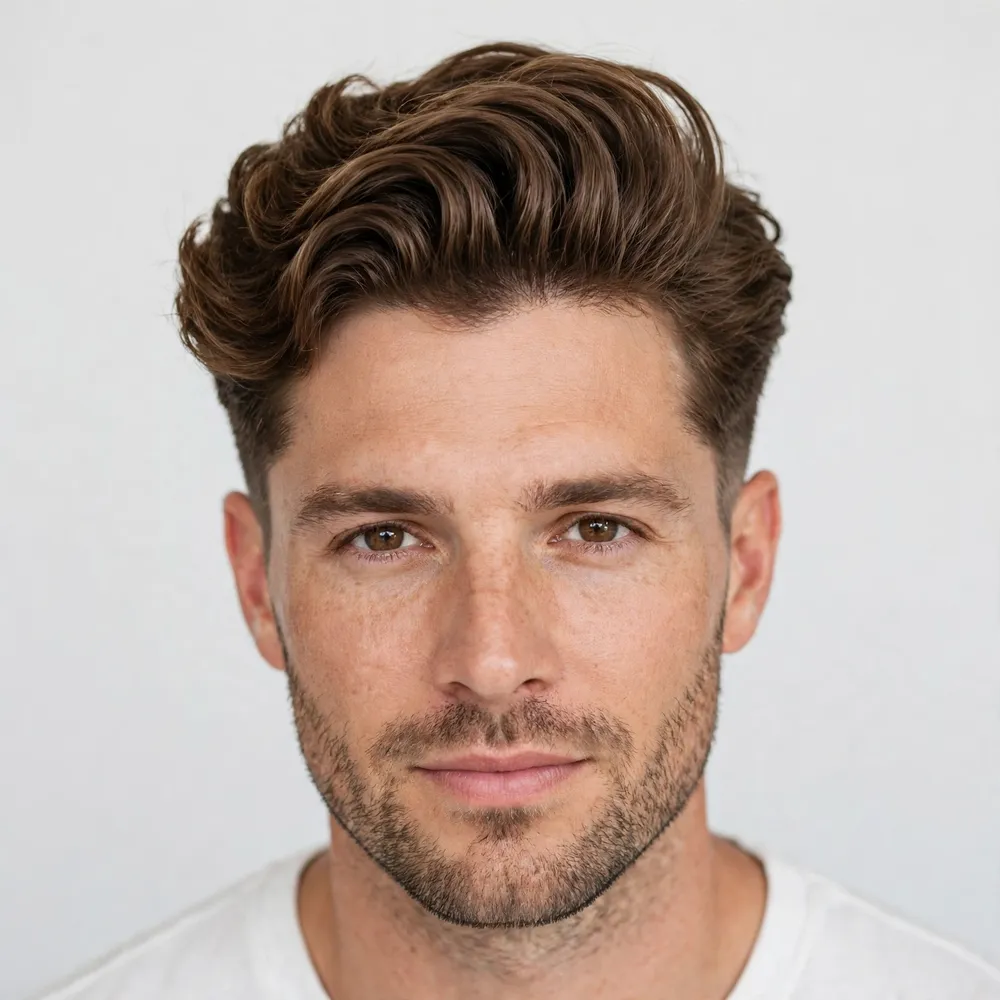
If your hair has a natural bend, a pompadour almost styles itself — the wave gives the sweep movement a comb can never fake. Let the top grow to 4–5 inches with tapered sides, and the wave does the heavy lifting once you push it up and back. It suits oval and square faces best, and men whose straight-hair friends have to fight for texture. Ask your barber for point-cut layers through the top so the wave falls in soft pieces instead of one heavy block, with a scissor taper on the sides. Style on damp hair with sea-salt spray, blow-dry upward with your fingers, then finish with matte cream. Maintenance is honest and low: a trim every four weeks keeps the shape, but skip strong pomade — it flattens the wave into a helmet.
22. Straight Hair Pompadour
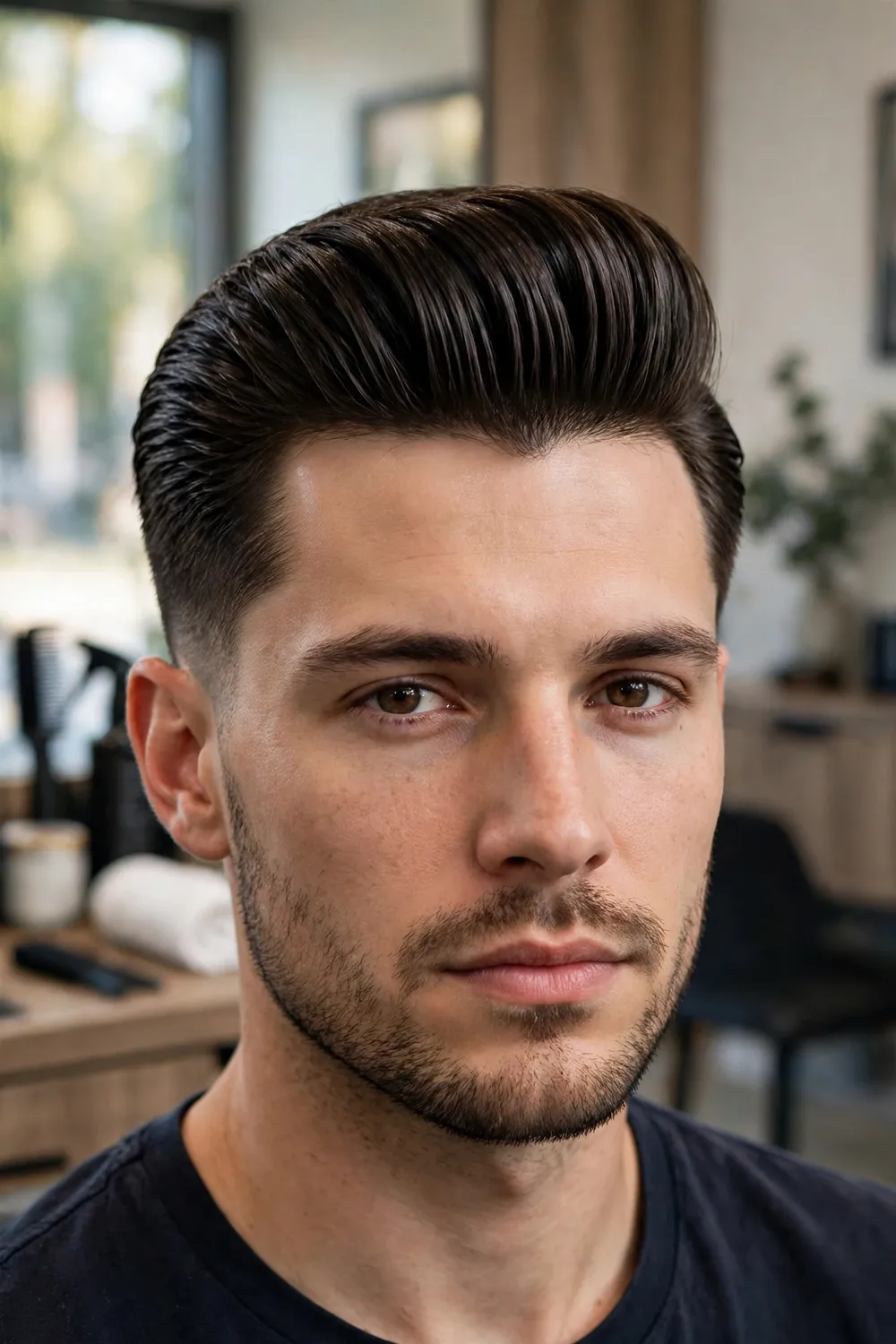
Straight hair makes the cleanest pompadour — no frizz, no fight, just one smooth sweep. The trade-off is that it shows every mistake, so the cut has to be precise and the styling has to hold. Grow the front to 4–6 inches with neatly tapered sides, and ask your barber for a slight graduation so the top lies back instead of flopping forward. It’s a strong pick for round faces — the height stretches the face — and for men who want the classic look without grease. Blow-dry up and back with a round brush, lock it with a medium-hold pomade, and finish with a drop of shine serum on the surface. Straight hair slips out of shape by evening, so carry a pocket comb. Expect a touch-up cut every three weeks to keep the edges sharp.
23. Thick Hair Pompadour
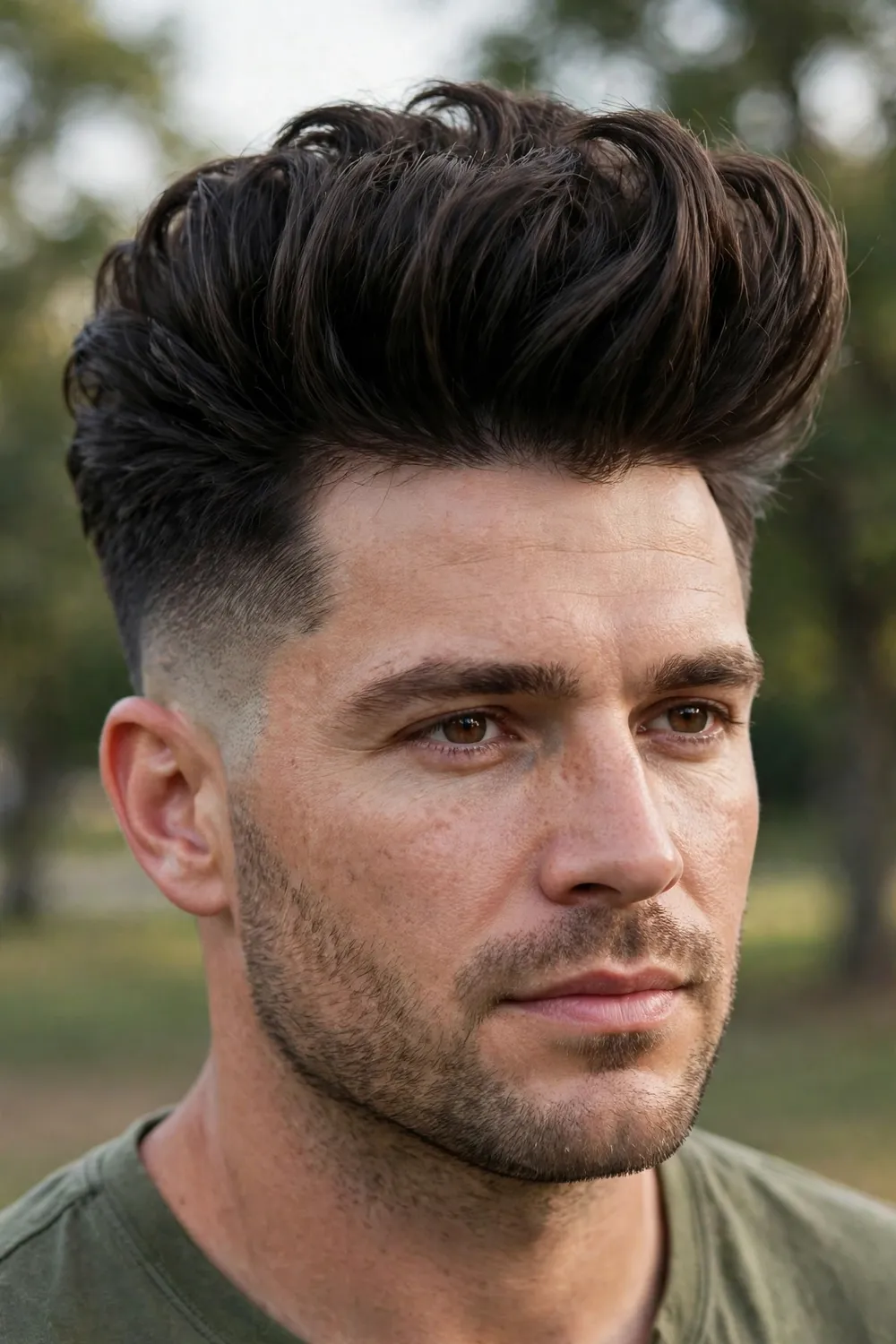
Thick hair is a pompadour’s best friend and worst enemy: the volume is effortless, but the weight can drag the shape down by midday. The fix is in the cut, not the product. Ask your barber to thin the top with thinning shears — removing bulk without shortening it — and keep the sides tight so the top looks taller. Aim for 4–5 inches on top; anything longer gets too heavy to hold. It flatters oval, square and heart faces, and it works on straight and wavy thick hair alike. Style with strong-hold matte clay, worked root to tip on nearly dry hair, then blow-dry upward in sections. The cut holds its shape well, but book a thinning pass every four weeks or the top starts sitting like a roof.
24. Fine Hair Pompadour
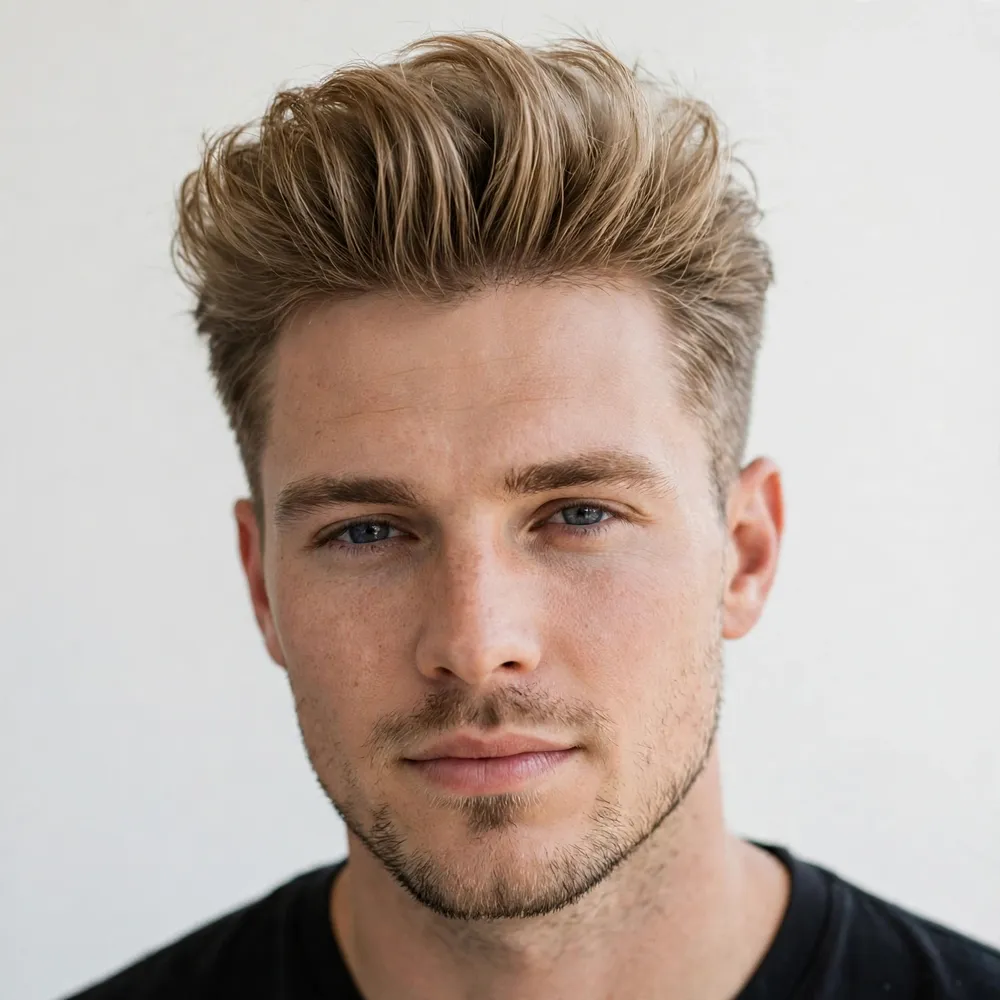
Fine hair can absolutely pull off a pompadour — it just needs a different playbook. The secret is building volume before the product ever touches your hair. Ask your barber for a shorter top, around 3–4 inches, with plenty of texture, and short sides so the top reads taller. Shorter is kinder here: long fine hair goes limp. It suits oval and oblong faces, and works best on hair that’s fine but reasonably dense. Blow-dry with a volumising pre-styler — mousse or sea-salt spray — using a round brush to lift the roots, then set with light matte paste, never heavy pomade. The honest catch: it fades by evening, so a quick re-blow or a dusting of volume powder is part of the routine. Trim every three to four weeks.
25. Asian Hair Pompadour
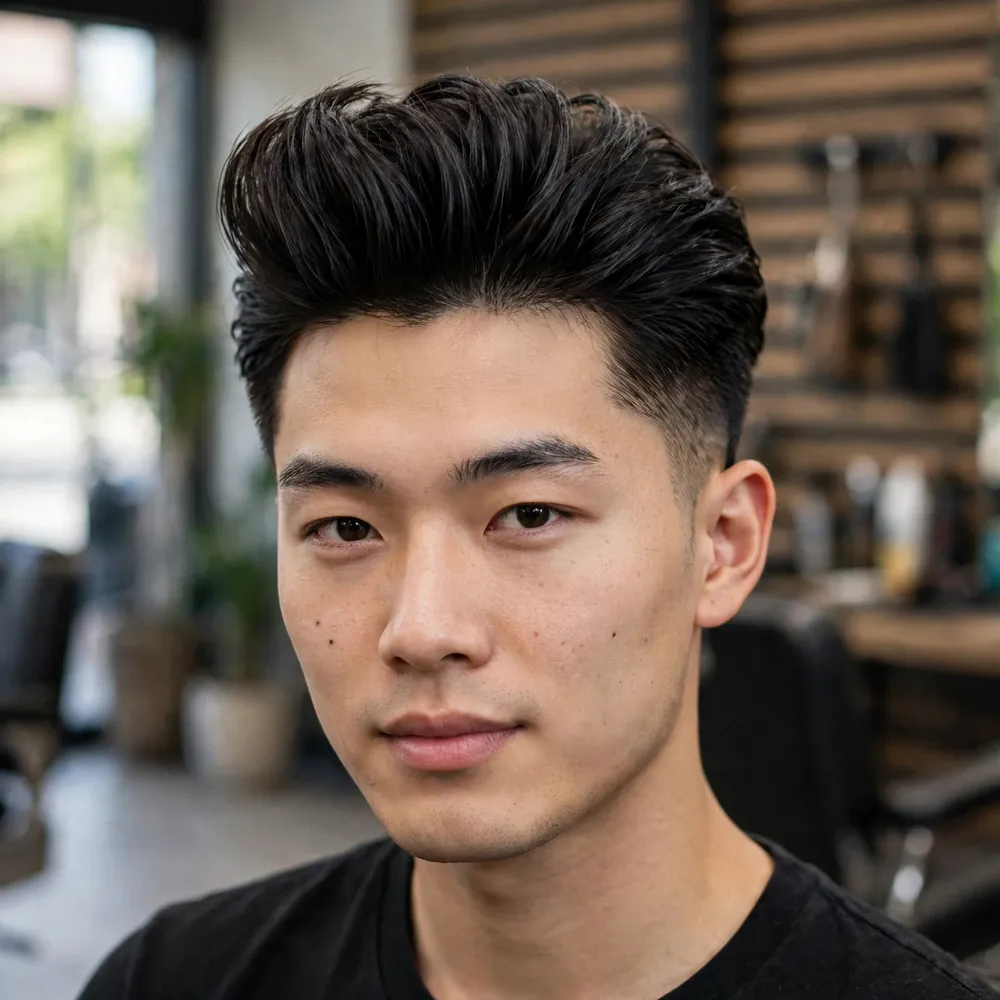
Straight, coarse Asian hair has one problem with pompadours: it sticks straight out instead of sweeping back. The version that works either textures it heavily or tames it with a down perm. Ask your barber for a textured top of 4–5 inches with the weight thinned out, or a down perm on the sides so they lie flat while the top keeps its lift. It suits oval and square faces, and thick, poker-straight hair. Style with a strong-hold matte clay on blow-dried hair; a dab of pomade on the ends adds control without shine. Once the cut is right, maintenance is straightforward — but a down perm needs redoing every six to eight weeks as it grows out. Skip this if you hate blow-drying — the dryer is non-negotiable here.
26. Pompadour with Beard
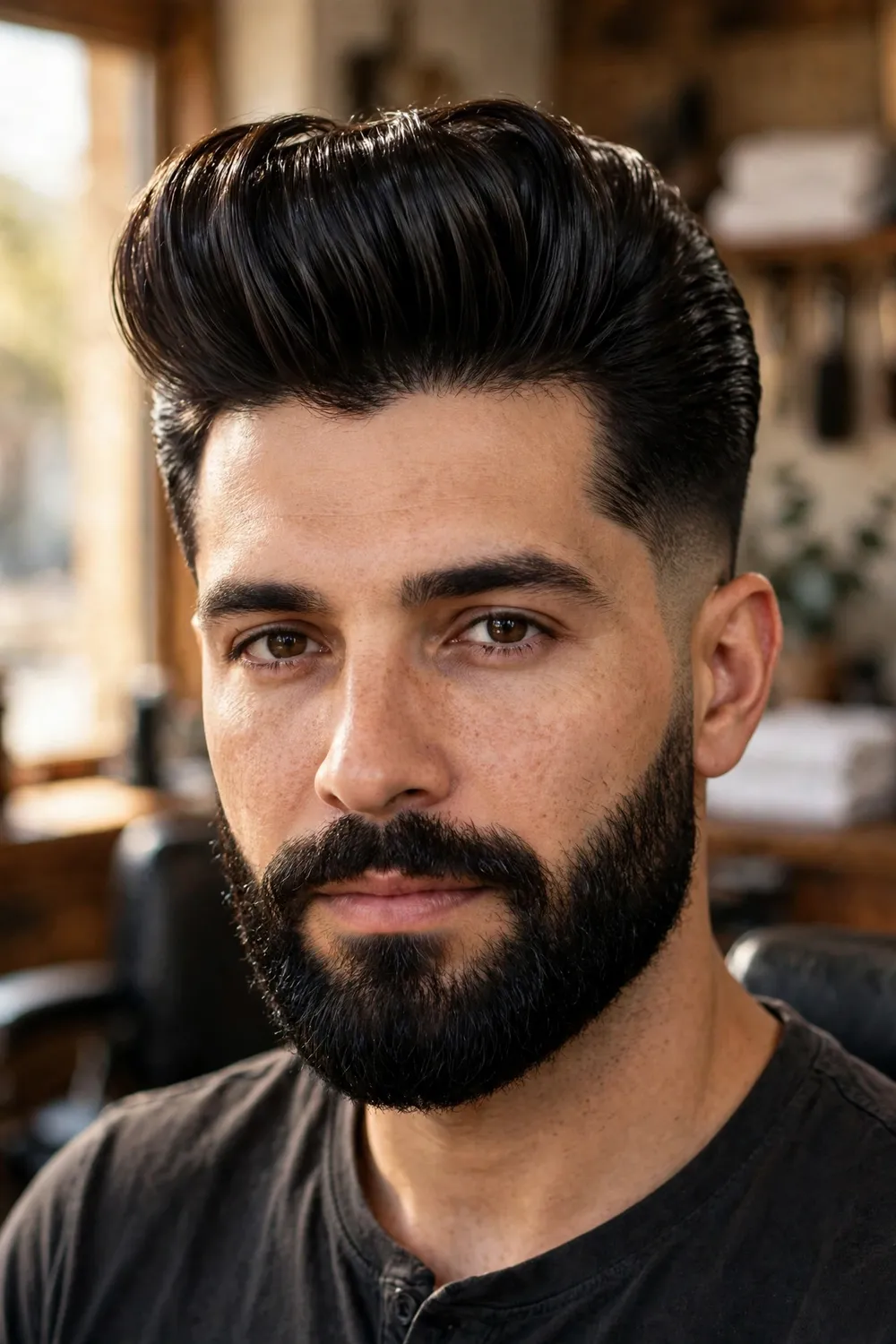
A pompadour and a beard are made for each other — height on top, weight below, balancing the face together. The trick is the connection: the fade has to blend into the beard, not stop dead at the sideburn. Ask your barber for your pompadour of choice — a low or mid fade works best — and have him taper the beard into the fade, shaping the cheek line and cleaning the neckline. It suits square and round faces best — the beard defines the jaw while the top adds length. Style the hair as usual, then oil the beard and comb it down. The honest part is maintenance: the beard needs trimming every week to keep the blend sharp, and the hair its usual two-to-three-week tidy-up. It’s the most grooming of the lot — but the payoff is a finished look.
27. Brushed Back Pompadour

Not every pompadour has to scrape the ceiling. The brushed back version keeps the same up-and-back sweep with softer height — confident and grown-up rather than a statement tower. Grow the top to 4 inches with tapered sides, and ask your barber to leave it long enough to brush straight back without a hard part. It flatters oblong and heart faces, since it adds little extra length, and suits men who want the pompadour feel without the daily blow-dry marathon. Style on towel-dried hair with light-hold cream, brush everything back with a vent brush, and let it air-dry or give it one quick pass with the dryer. It’s the lowest-maintenance pompadour here: a trim every four to five weeks, almost no product, and it still looks deliberate on a bad hair day.
28. Quiff-Pomp Hybrid
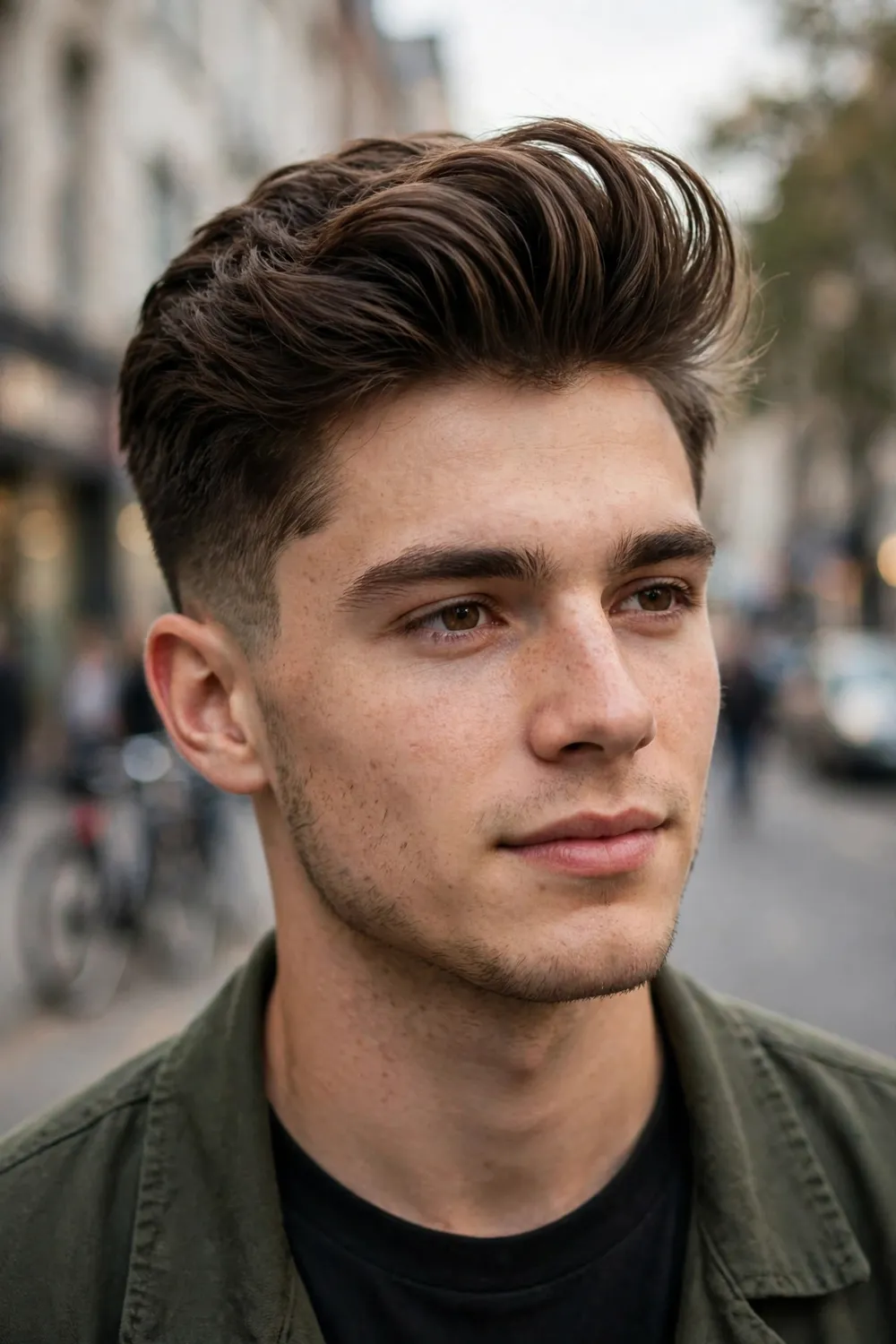
Can’t decide between a quiff and a pompadour? This hybrid takes the quiff’s lifted front and marries it to the pompadour’s full sweep back. Ask your barber for 4–5 inches on top, the front left longest, textured through the crown, and faded or tapered sides. It suits oval and square faces, and thick or wavy hair, since the texture does half the styling for you. Blow-dry the front up and slightly forward first to build the quiff lift, then sweep the rest back with a matte clay. Compared with a true pompadour, the hybrid is more forgiving on second-day hair — the front lift hides a lot. Trim every three to four weeks. If you already like textured haircuts, this one will feel familiar.
29. Slicked Pompadour
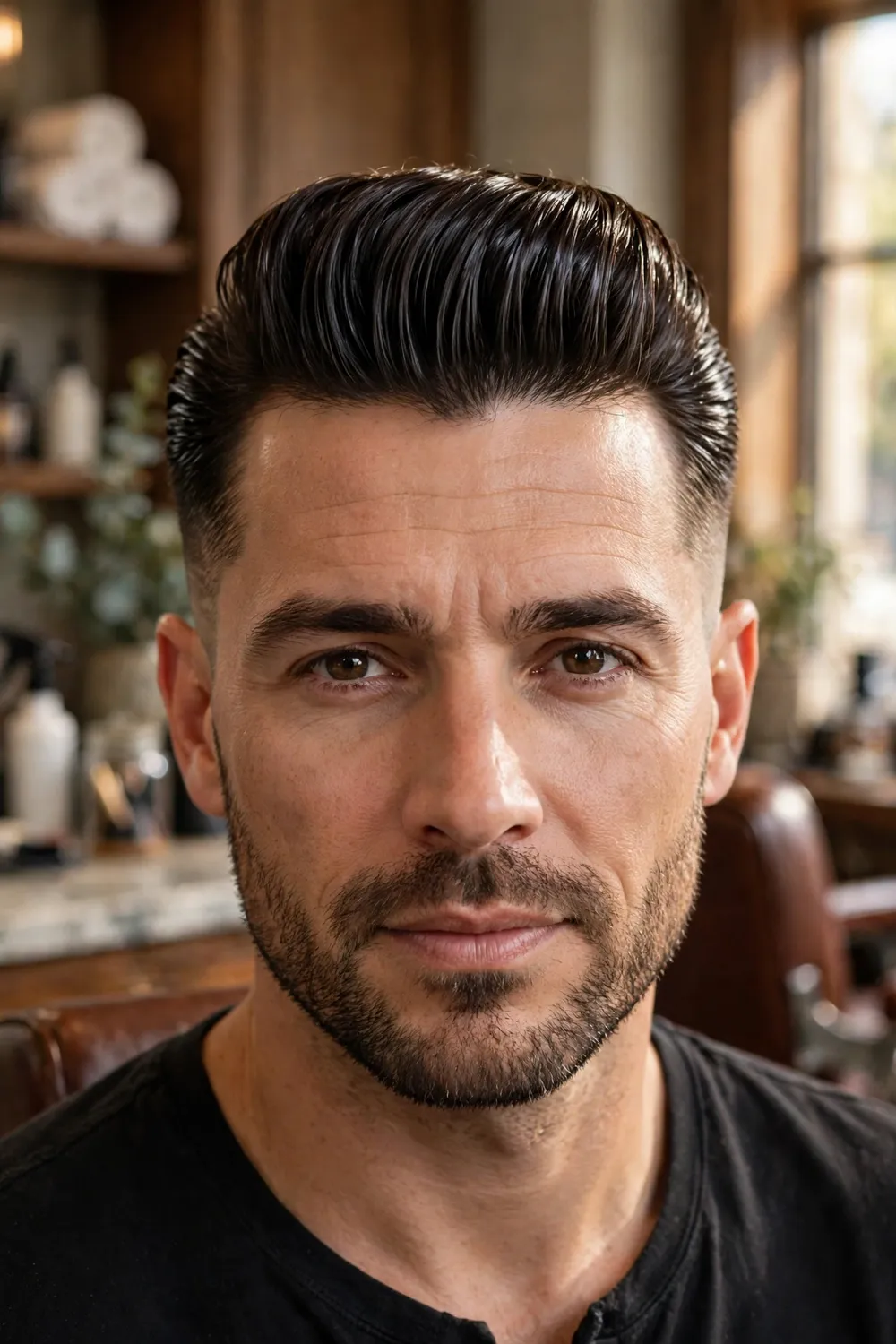
The slicked pompadour is the polished end of the spectrum — high shine, every hair in place, the kind of cut that belongs at a wedding or a board meeting. The top runs 4–6 inches, swept up and back in one smooth sheet, over tapered or faded sides. Ask your barber for a scissor cut on top with no texture, so the hair lies flat and glossy, and a sharp taper on the sides. It suits oval and square faces best and works on straight or slightly wavy hair. The product is the whole point: water-based pomade combed through damp hair, set with a fine-tooth comb and a light mist of hairspray. Honest warning: shine shows grease, so keep your hair washed and your hands off it. Trim every three weeks to keep the slick edge.
30. The Executive Pompadour

The executive pompadour is the office-safe version: moderate height, neat sides, nothing that would raise an eyebrow in a meeting — but still unmistakably a pompadour. Keep the top around 3–4 inches, swept up and back with a controlled lift, over a clean taper or low fade. Ask your barber for a tidy, graduated top, the front just long enough to sweep, and a neat taper that grows out gracefully. It flatters every face shape — which is why it’s the safest pick here — and works on straight, wavy or fine hair. Style with a medium-hold cream on damp hair, a quick blow-dry up and back, and you’re done in five minutes. It grows out well, so you can stretch cuts to four or five weeks, and it never looks messy between appointments.
31. Taper Fade Pompadour
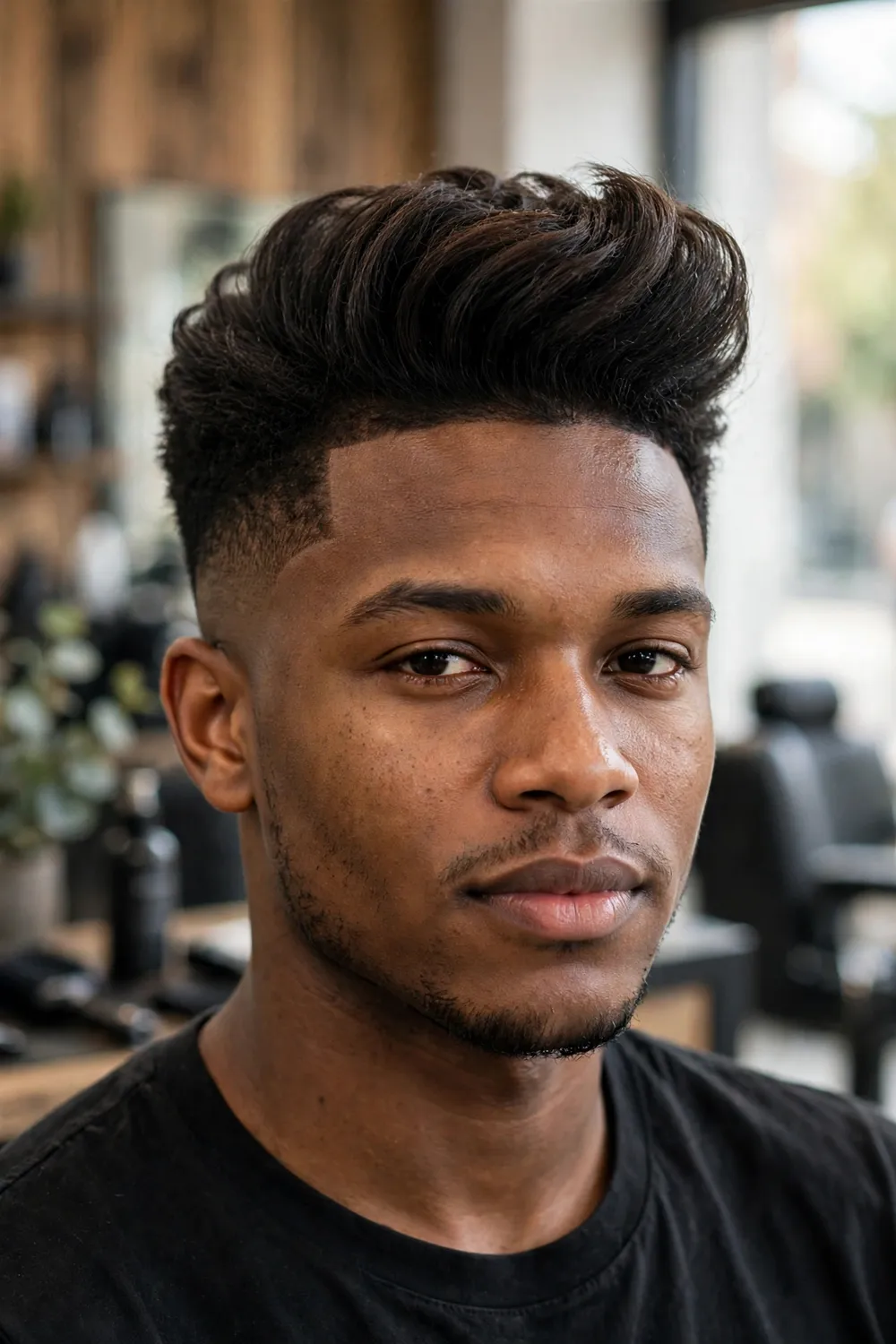
A taper fade is the quieter cousin of the skin fade — it shortens gradually at the sideburns and neckline while keeping weight on the sides. The top stays 4–5 inches, swept up and back, while the taper keeps the edges tidy without the harsh bald contrast. Ask your barber for a classic taper — no skin, just a gradual blend — and a textured or smooth top to your taste. It suits oval, square and heart faces, and it’s ideal if your workplace frowns on skin fades or you simply prefer a softer outline. Style with a medium-hold pomade or matte clay depending on the finish you want, blow-dried up and back. Best of all, a taper grows out far more gracefully than a fade — four weeks between cuts without looking scruffy.
32. Temple Fade Pompadour
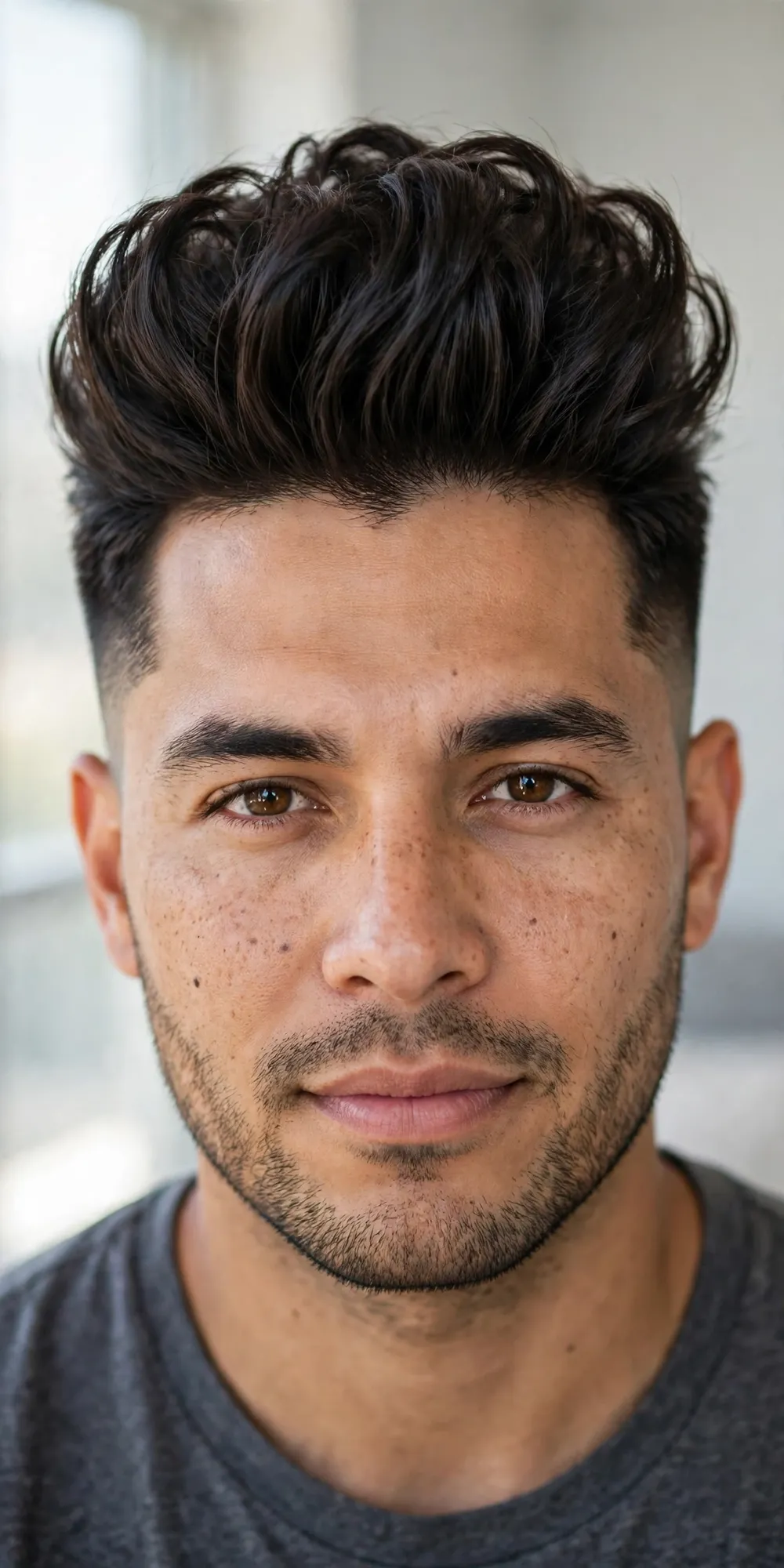
The temple fade — sometimes called a temp fade — fades only around the temples and sideburns, leaving the rest longer. With a pompadour, it frames the face with a crisp hairline while the top does the talking. Ask your barber for a low temple fade blending into a taper at the back, with 4–5 inches on top swept up and back. It suits round and square faces best — clean temples sharpen the outline — and works on straight, wavy and curly hair. Style the top with your usual pomade or clay, and keep the hairline sharp with a quick line-up between cuts. The catch is upkeep: the temple area shows growth fast, so budget for a tidy-up every two weeks to keep it crisp. For a fuller fade instead, see our guide to low fade haircuts.
33. Side-Swept Pompadour
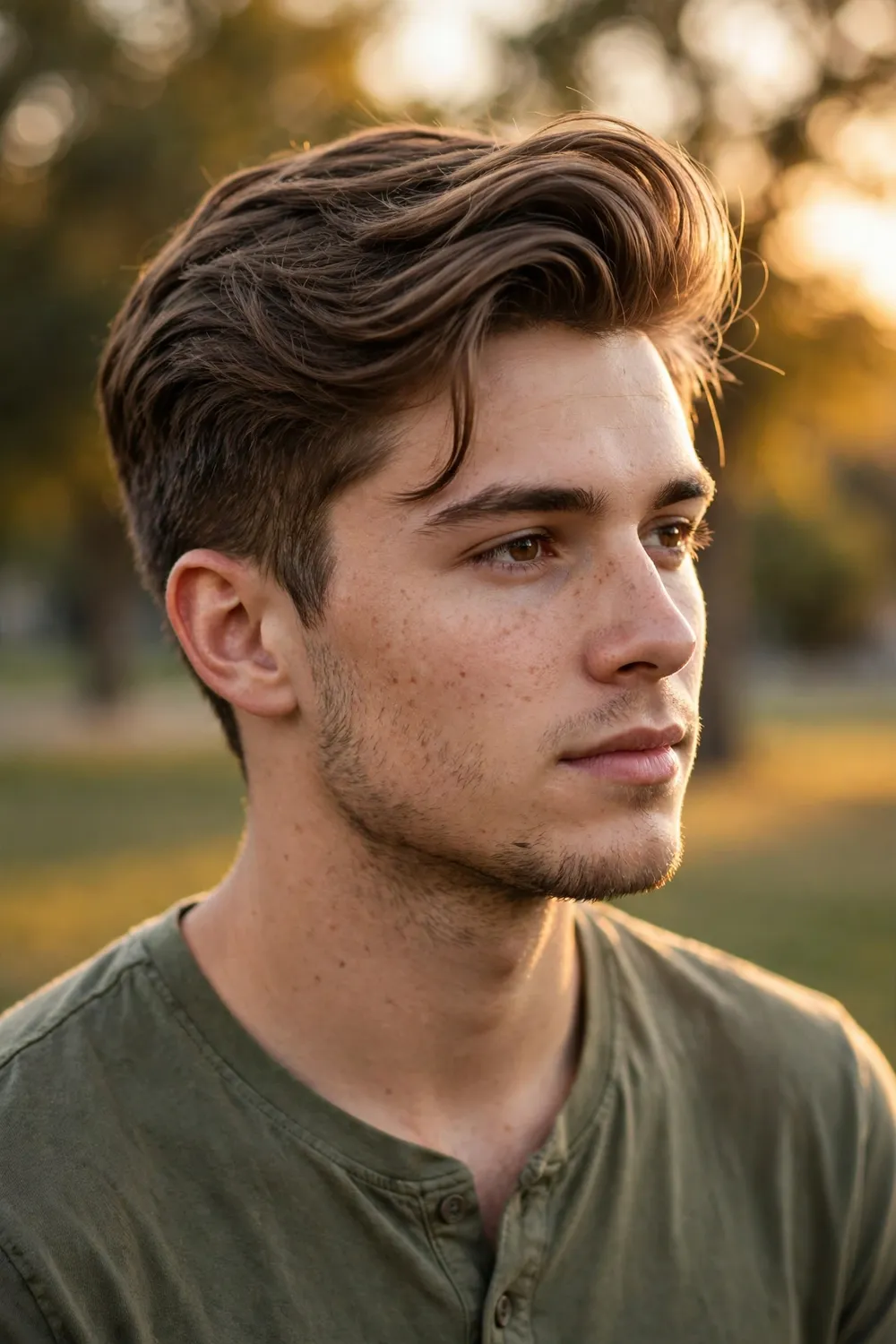
The side-swept pompadour takes the classic up-and-back shape and angles it to one side — less tower, more flow, a softer line across the forehead. It’s the easiest pompadour to wear if your hair naturally falls to one side. Ask your barber for 4 inches on top, the front slightly longer on your favoured side, tapered sides, and a soft graduation so the sweep falls naturally instead of standing straight up. It flatters round and heart faces — the diagonal breaks up the width — and suits straight and wavy hair. Style with light-hold cream on damp hair, blow-drying up and across to your part side, then combing into place. Maintenance is low — it grows out well and forgives a missed cut — but keep the front long enough to sweep, or it turns into a regular side part.
34. Spiky Textured Pompadour
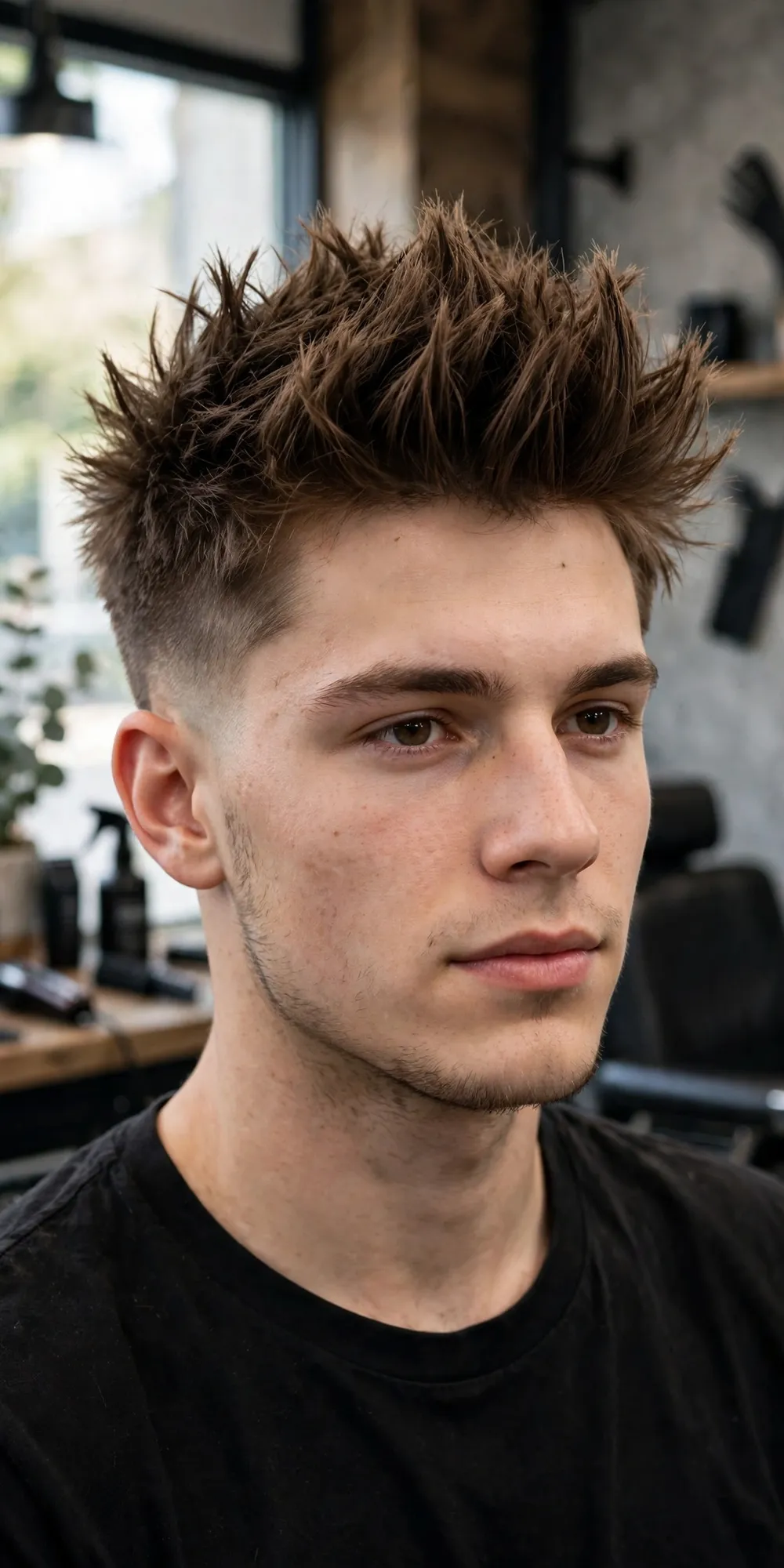
For men who find the classic pompadour too smooth, the spiky textured version breaks the top into piecey spikes that still sweep up and back. It’s the same silhouette with an edgier attitude. Ask your barber for heavy point-cutting through a 4-inch top — short, choppy layers are the point — and faded or undercut sides for contrast. It suits square and oval faces, and thick or wavy hair that holds texture on its own. Style with a matte paste or fibre: warm it between your palms, work it through dry hair in sections, and pinch the ends upward and back. Skip the comb entirely — fingers are the tool here. Day-to-day maintenance is easy, but the texture grows shaggy fast — a trim every three weeks keeps the spikes defined instead of floppy.
35. Blonde Pompadour
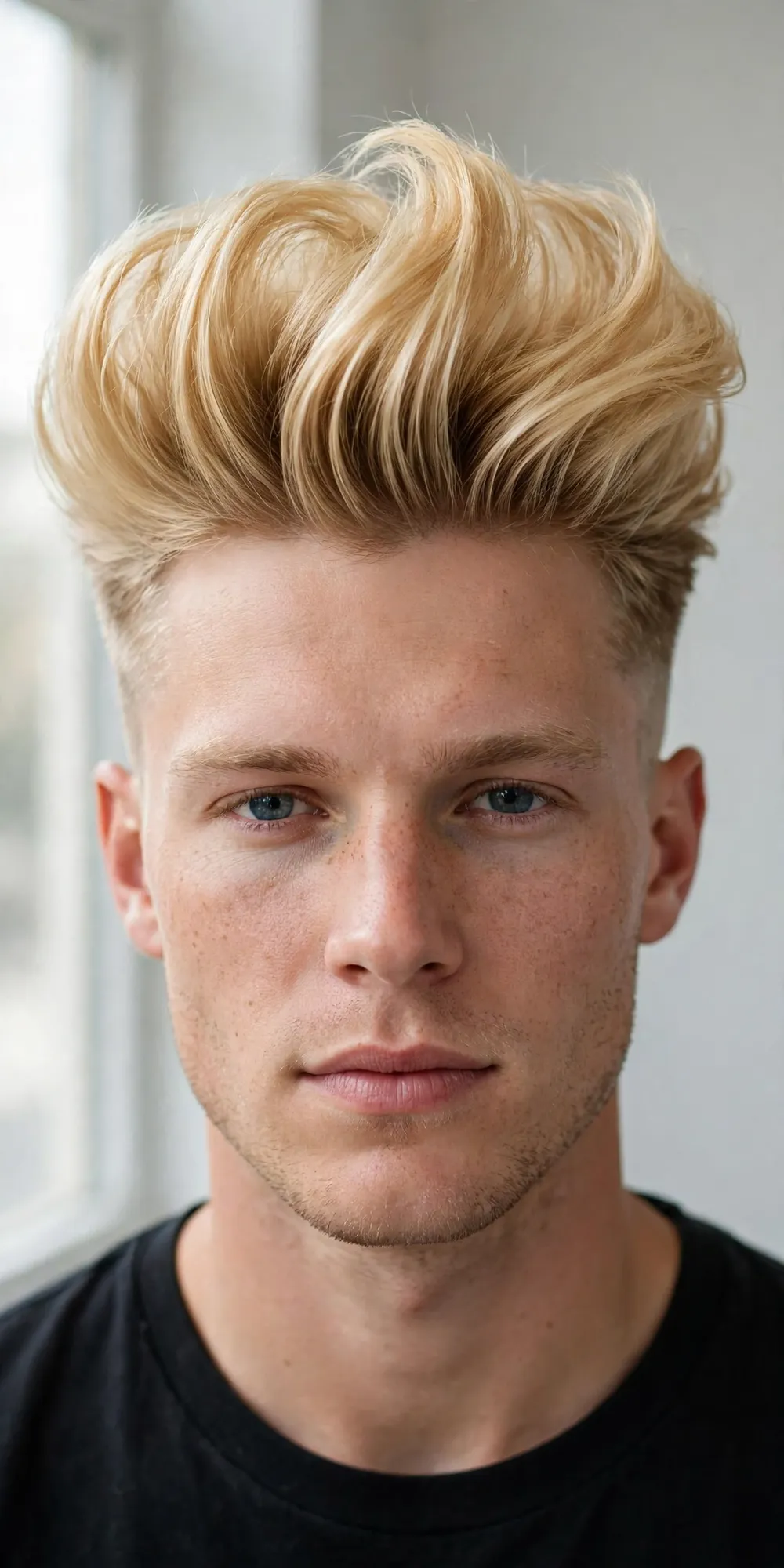
Blonde hair shows off a pompadour better than almost any other colour — every strand and layer of volume is visible, and the height reads even taller. Natural or bleached, the cut is the same: 4–5 inches on top, swept up and back, with a fade or taper of your choice. Ask your barber to keep texture through the top so the blonde catches the light in pieces, not one flat sheet. It suits oval and square faces and works on straight and wavy hair. Style with matte clay — shine products make blonde look greasy fast — and use purple shampoo weekly if you’re bleached, to keep brassiness out. The honest extra cost: bleached blonde needs toning every four to six weeks, and regular trims to stop the ends looking fried. Natural blondes skip all of that.
36. Grey Hair Pompadour
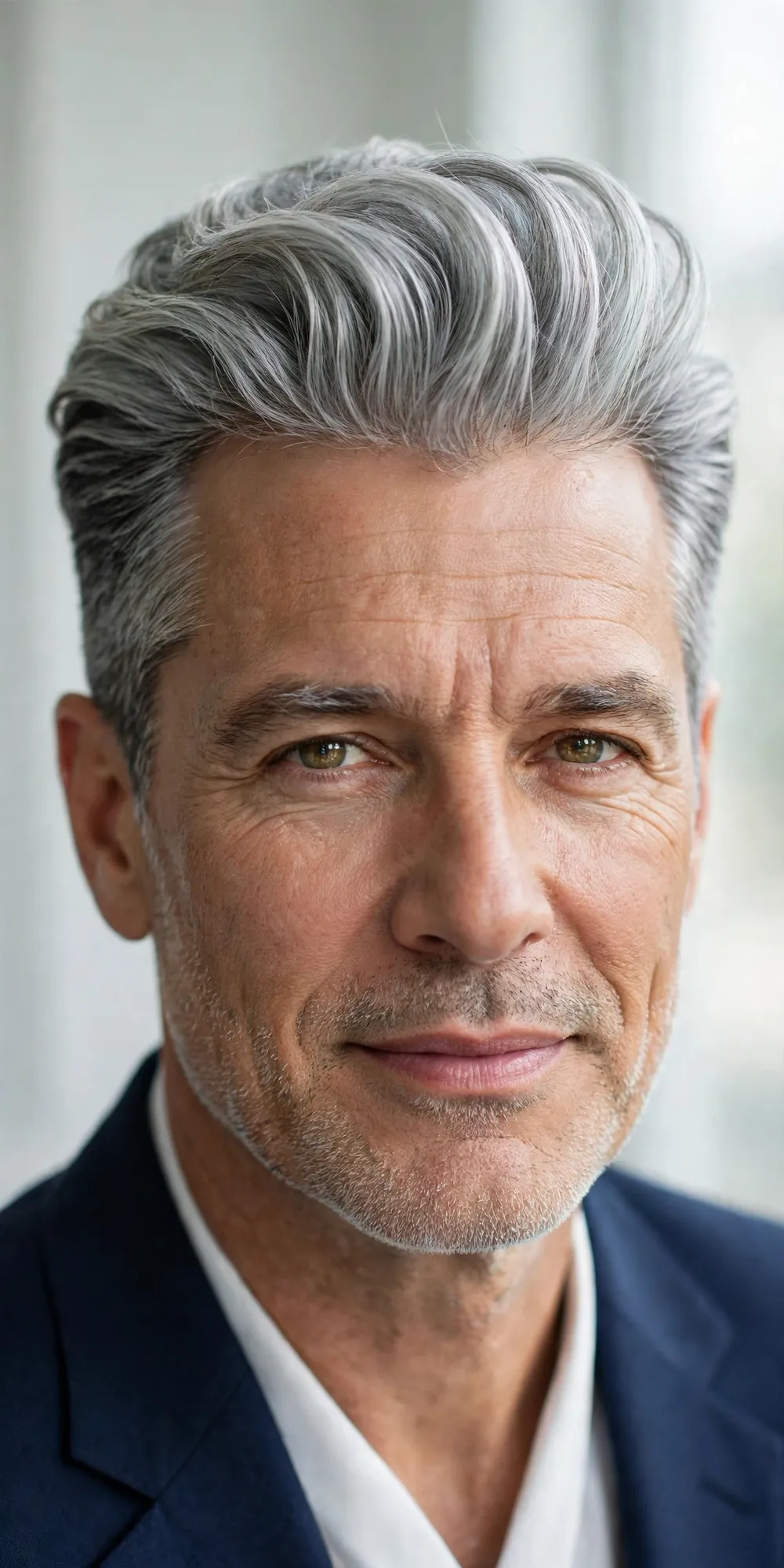
Grey hair and a pompadour are seriously underrated — the silver adds depth to the volume, and the style reads distinguished rather than try-hard. Let the top grow to 4 inches with a clean taper on the sides, and let the grey do the work: it catches light differently at every angle, so the sweep looks fuller than it is. Ask your barber for a textured top with the weight thinned slightly, and a neat taper to keep the outline sharp. It suits every face shape, and flatters men over 50 whose hair is still thick enough to hold height. Style with light matte cream — heavy pomade dulls silver — and a weekly silver shampoo keeps the tone bright instead of yellow. Trim every four weeks — grey hair shows a scruffy neckline faster than dark hair.
37. Receding Hairline Pompadour
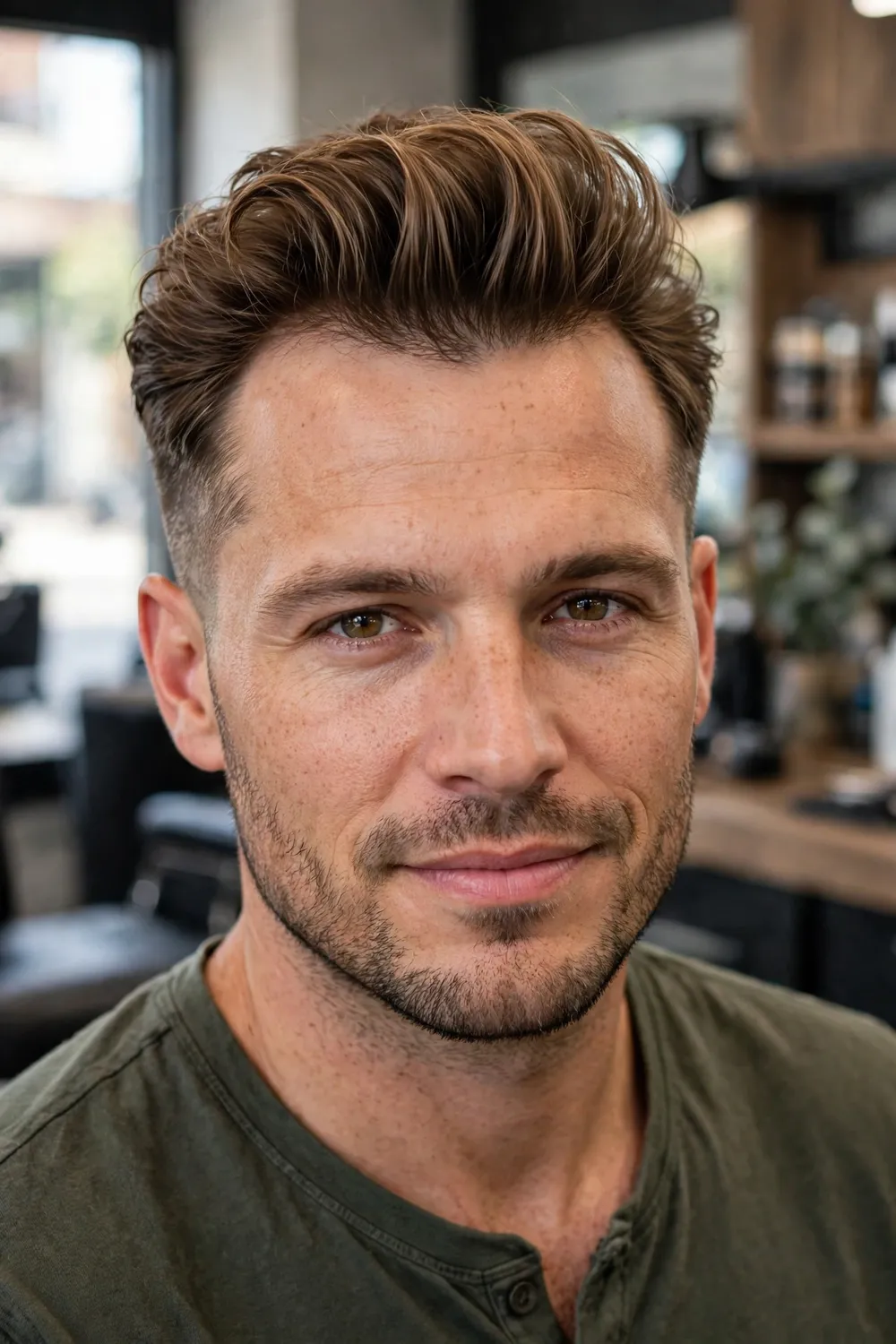
A receding hairline is no reason to give up on a pompadour — the height and forward sweep are one of the best ways to work with it. The volume draws the eye up and the sweep covers the corners. Ask your barber for a textured 3–4 inch top — shorter than the classic, since long hair shows thinning — the front swept up and slightly forward to cover the recession, and tapered sides. It suits oval and square faces best, when the hair on top is still reasonably dense. Style with a volumising pre-styler and matte paste, blow-drying forward and up rather than straight back. Be honest with yourself: if the crown is thinning too, this won’t hide it — a shorter cut may serve you better. For a receding hairline alone, though, it’s a genuine fix, not a cover-up.
38. Wet-Look Pompadour
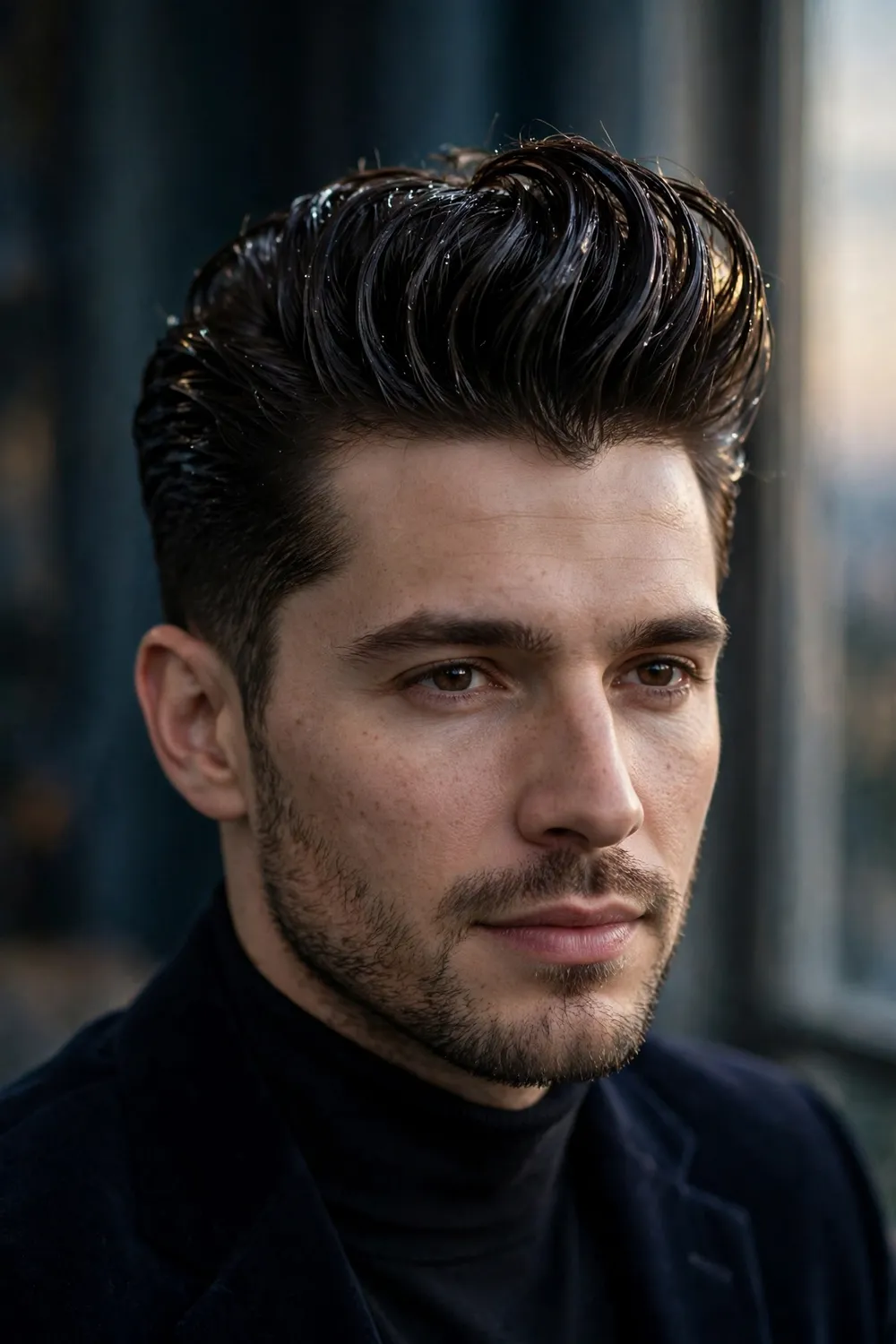
The wet-look pompadour is pure drama — glossy, sculpted, freshly-showered shine that holds all night. It’s the one to pick for evenings, weddings and photos, not for a Tuesday at the office. Ask your barber for a smooth, graduated top of 4–5 inches with no texture, and clean tapered or faded sides. It suits oval and square faces and works best on straight hair, which takes the shine evenly. Style on damp hair: work high-shine gel or wet-look pomade through from roots to ends, comb everything up and back, and finish with a shine spray. The honest trade-off: it feels heavy, transfers onto collars and pillows, and needs a proper wash to get out. Save it for occasions — as a daily style, the blowout haircut gives you the volume without the grease.
39. Pompadour Mullet
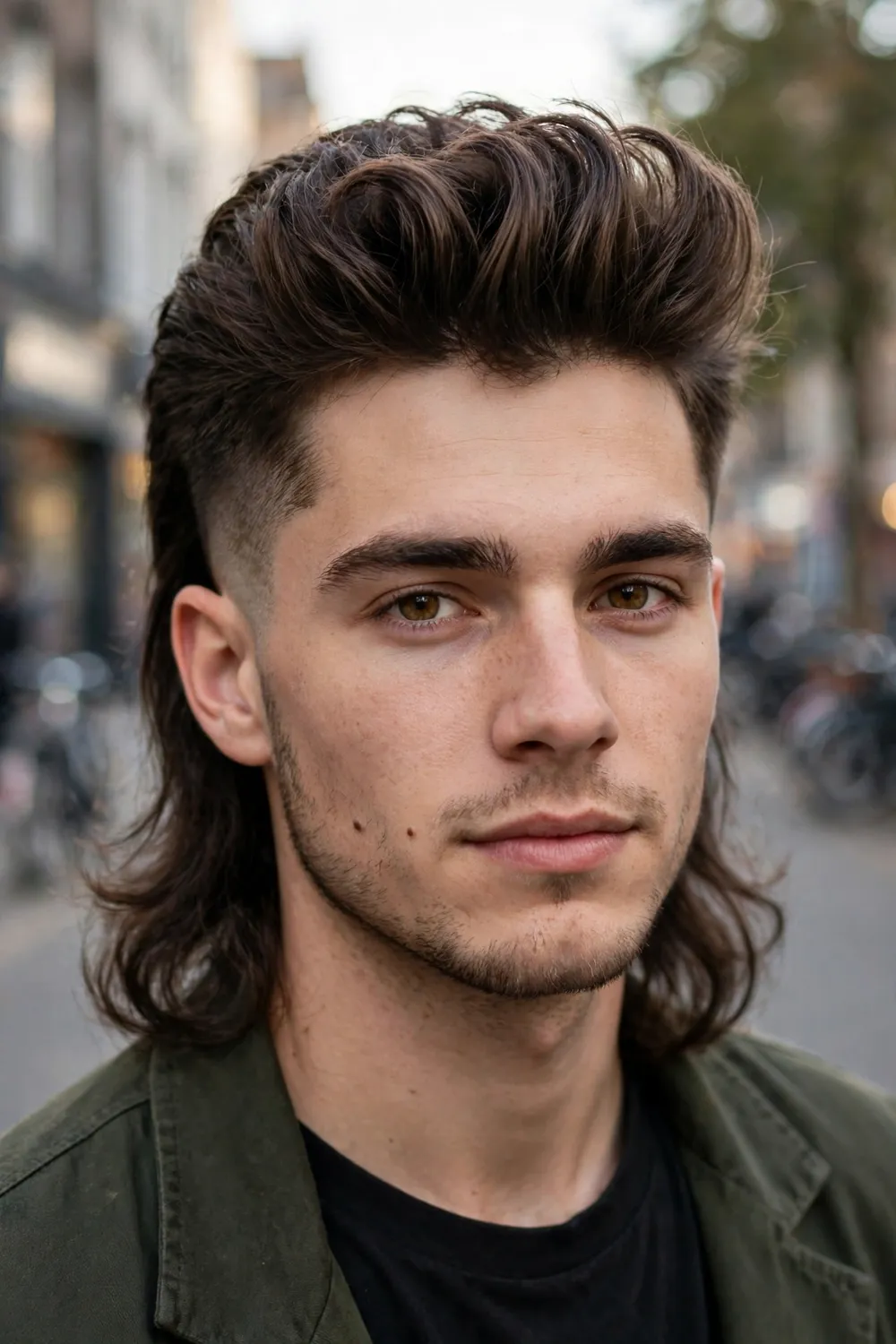
The pompadour mullet is exactly what it sounds like: full pompadour volume at the front and a longer tail at the back. It shouldn’t work, but the contrast between the sculpted front and the loose length behind it is the fun of it. Ask your barber for a classic pompadour top — 4–5 inches swept up and back — short faded sides, and the back left long, around collar length. It suits oval and oblong faces best, and needs thick or wavy hair to carry both the height and the length. Style the front as a normal pompadour with matte clay, and leave the back natural with sea-salt spray. Maintenance is two cuts in one: the front needs its usual three-week tidy-up, the back just a trim for split ends. It’s a bold, Marmite style — you’ll either love it or you won’t.
Which Pompadour Suits Your Face Shape?
| Face shape | Best pompadour picks | Why it works |
|---|---|---|
| Oval | Almost any — classic, modern, textured | Balanced proportions take height and volume easily |
| Square | Classic, modern, pompadour with beard | Height softens the strong jaw; the beard adds balance |
| Round | High fade, short pompadour, straight hair | Extra height lengthens the face; tight sides slim it |
| Oblong | Brushed back, executive, side-swept | Lower height avoids stretching the face further |
| Heart | Textured, wavy, taper fade | Volume at the sides balances a wider forehead and narrower chin |
Which Pompadour Suits Your Hair Type?
Straight hair. You get the cleanest, smoothest pompadour of anyone — but also the least forgiving one. A round brush and a medium-hold pomade are your best friends, and a graduated cut stops the top flopping forward. Keep it at 4–6 inches and don’t skip the blow-dryer; air-dried straight hair won’t hold a sweep.
Wavy hair. This is the easiest hair type for a pompadour. The natural bend adds movement and volume for free, and the style forgives a missed day of styling. Point-cut layers keep the wave from clumping, and a light matte cream is all the product you need. Go for the wavy or textured versions.
Curly hair. Curls can make a brilliant pompadour, but they need length and control. Grow the top to at least 5 inches so the curls have room to lift, ask for layers that shape rather than thin, and use a curl cream under a light-hold product to keep definition without crunch.
Thick hair. Volume is never your problem — weight is. Thinning shears are essential, and a strong-hold matte clay keeps the shape from collapsing by afternoon. Shorter sides make the top look even taller. Avoid heavy pomades that add weight on top of weight.
Fine hair. Keep the top shorter (3–4 inches), build volume with a pre-styler before any product, and use light matte paste only. The fine hair pompadour won’t last all day without a midday touch-up, so carry a small tin of paste or a volume powder — and accept that a slightly messier finish actually suits fine hair better.
5 Mistakes to Avoid with a Pompadour Haircut
- Skipping the blow-dryer. No product on earth replaces drying the hair up and back first. Air-dried pompadours collapse within an hour — five minutes with a dryer is the difference between a style and a flop.
- Using too much product. A fingertip of pomade or clay is enough. Overloading makes the hair greasy, heavy and flat, and it turns a clean sweep into a sticky helmet by midday.
- Getting the sides too long. The pompadour works because of contrast — tall top, tight sides. Let the sides grow out and the whole shape loses its point; book the two-to-three-week tidy-up.
- Choosing the wrong height for your face. A towering pompadour on an oblong face just makes it longer, and a flat one on a round face adds width. Match the height to your shape — the table above is your cheat sheet.
- Combing it the same way every day. Hair trains itself to fall in one direction. If you always sweep back, the front goes limp. Change the angle slightly, use your fingers sometimes, and let the hair keep some natural movement.
FAQs
What is a pompadour haircut?
A pompadour is a hairstyle where the hair on top is swept up and back from the forehead into one tall, smooth shape, held in place with product, over shorter tapered or faded sides. The classic version runs 4–6 inches on top with a glossy pomade finish; modern versions add texture and a matte clay finish. It takes its name from Madame de Pompadour in 18th-century France, and the men’s version became famous in the 1950s with Elvis Presley.
How is a pompadour different from a quiff?
A quiff lifts only the front of the hair and leaves texture or a natural fall behind it, while a pompadour sweeps the whole top — front and crown — up and back into one continuous shape. The pompadour is taller, smoother and more sculpted; the quiff is shorter, messier and easier to style. If you want height everywhere and a polished finish, pick the pompadour; if you want lift just at the front with a relaxed feel, the quiff wins.
How long does your hair need to be for a pompadour?
You need at least 3–4 inches on top at the front to get a proper sweep — anything shorter won’t hold the height. The classic pompadour works best at 4–6 inches. If you’re growing it out, a short pompadour or a textured version is a good halfway point, and a good barber can shape the sides while the top catches up.
How do I ask my barber for a pompadour haircut?
Say the exact style name — “classic pompadour” or “low fade pompadour”, for example — then give the numbers: how many inches on top, what you want on the sides (taper, low fade or skin fade), and the finish you want (shiny pomade or matte clay). A photo helps more than words, so save one from this guide and show it. And tell him how much time you actually spend styling each morning, so he can adjust the cut to match.
How do I style a pompadour at home?
Start with towel-dried hair and a volumising pre-styler or sea-salt spray. Blow-dry the top up and back with a round brush or your fingers — this step does most of the work. Then warm a pea-sized amount of pomade or matte clay between your palms, work it through from roots to ends, and comb or finger-style the sweep into place. Finish with a light mist of hairspray if you need it to last all day.
What face shape suits a pompadour best?
Oval faces suit every pompadour, and square faces suit it almost as well — the height balances a strong jaw. Round faces benefit most from the taller, tighter versions like the high fade pompadour, because the height lengthens the face. Oblong faces should pick lower-height versions like the brushed back or executive pompadour, and heart faces do best with textured styles that add width at the sides.
Is a pompadour high maintenance?
Honestly, yes — more than a buzz cut or a textured crop, anyway. You need a blow-dryer and product every morning, a trim every two to three weeks for the sides, and a full cut every five to six weeks for the top. The shorter and more textured versions, like the short pompadour and the brushed back pompadour, cut the effort roughly in half. If you love the look but hate the routine, start there.
Final Word
A pompadour is one of those cuts that rewards a little effort every single morning — five minutes with a dryer and the right product, and you walk out looking like you meant it. Pick the version that fits your hair and your face, show your barber the photo, and don’t be afraid to start with a shorter, easier one and grow into the full height. And if you want more ideas before your next cut, you’ll find more hairstyle guides on the blog — from fades to textured cuts, there’s something for every kind of hair.